Connect with us

Business

Retail investors drive stocks to a pre-Christmas all-time high—and Wall Street eyes a moment to sell

Published

on


S&P 500 futures ticked downward 0.22% this morning, an indicator that some traders decided overnight to lock in their gains from yesterday’s close, when the index reached a new all-time high of 6,901. The peak was entirely predictable, given that U.S. Federal Reserve chairman Jerome Powell delivered a new dose of liquidity, as expected, via Wednesday’s 0.25% interest rate cut.

Nasdaq 100 futures were down 0.51% this morning, premarket, as traders picked winners and losers in the tech sector. Oracle lost another 1% overnight. It’s down more than 9% over the last five sessions after reporting revenue below expectations and capital expenditure above expectations. Alphabet (Google) by contrast was up 0.26% in overnight trading.

The bigger picture is the fact that the S&P 500 has now risen 17.33% year to date.

The trigger for that came from Powell telegraphing 175 basis points of cuts since last year. But the markets have also been driven by retail investors—individuals, as opposed to financial institutions—buying into exchange-traded funds and individual tech stocks, according to Arun Jain and his colleagues at JPMorgan.

In the week up to December 10, retail investors ploughed $7.8 billion into stocks, above the $6.3 billion weekly average. “Retail investors continued to favor ETFs (+$6.3B) over Single Stocks (+$1.5B),” they told clients in a note seen by Fortune.

“2025 is set to be a record year for retail traders in terms of flows (tracking at ~1.9x the 5y avg), 53% above the levels seen last year and 14% above the previous peak during the retail mania of 2021,” they said.

Retail investors probably did very well in the markets this year because they tended to buy the dips—there was a 38% gain between the market’s April low and yesterday—they bought ETFs, and they bought gold (up 65% year to date), the JPM team said.

Retail trading volume has doubled since 2010, according to the Financial Times, and individual investors are now more active than mutual funds and hedge funds.

Retail investors are so enthusiastic for risk assets that some people on Wall Street are starting to worry about it. The Bank of International Settlements—a sort of bank for central banks—published a paper recently arguing that retail traders now represent the dumb money in the market.

“Retail investors continued to pour money into U.S. equity funds, even as institutional investors gradually withdrew,” the bank wrote. “Appetite for precious metals may underscore market participants seeking at least some safe asset exposure in the event that things turn sour. But part of the surge can also be traced to investors trying to take advantage of the momentum in search of price appreciation, consistent with elevated risk-taking.”

Michael Hartnett and his colleagues at Bank of America see it as as sell-signal. Their “Bull & Bear Indicator”—a gauge that measures “investor fear and greed” from technical market data such as fund flows—now stands at 7.8, just below the “extreme bullishness” level that suggests it might be a good time to cash out:

Here’s a snapshot of the markets ahead of the opening bell in New York this morning:

  • S&P 500 futures were down 0.22% this morning. The last session closed up 0.21% to hit a new record high of 6,901. 
  • STOXX Europe 600 was up 0.37% in early trading. 
  • The U.K.’s FTSE 100 was up 0.38% in early trading. 
  • Japan’s Nikkei 225 was up 1.37%. 
  • China’s CSI 300 was up 0.63%. 
  • The South Korea KOSPI was up 1.38%. 
  • India’s NIFTY 50 was up 0.51%. 
  • Bitcoin went to $92K.
Join us at the Fortune Workplace Innovation Summit May 19–20, 2026, in Atlanta. The next era of workplace innovation is here—and the old playbook is being rewritten. At this exclusive, high-energy event, the world’s most innovative leaders will convene to explore how AI, humanity, and strategy converge to redefine, again, the future of work. Register now.


Source link

Continue Reading

Business

Black Lives Matter leader in Oklahoma City indicted on claims she used funds for vacations, groceries and real estate

Published

on


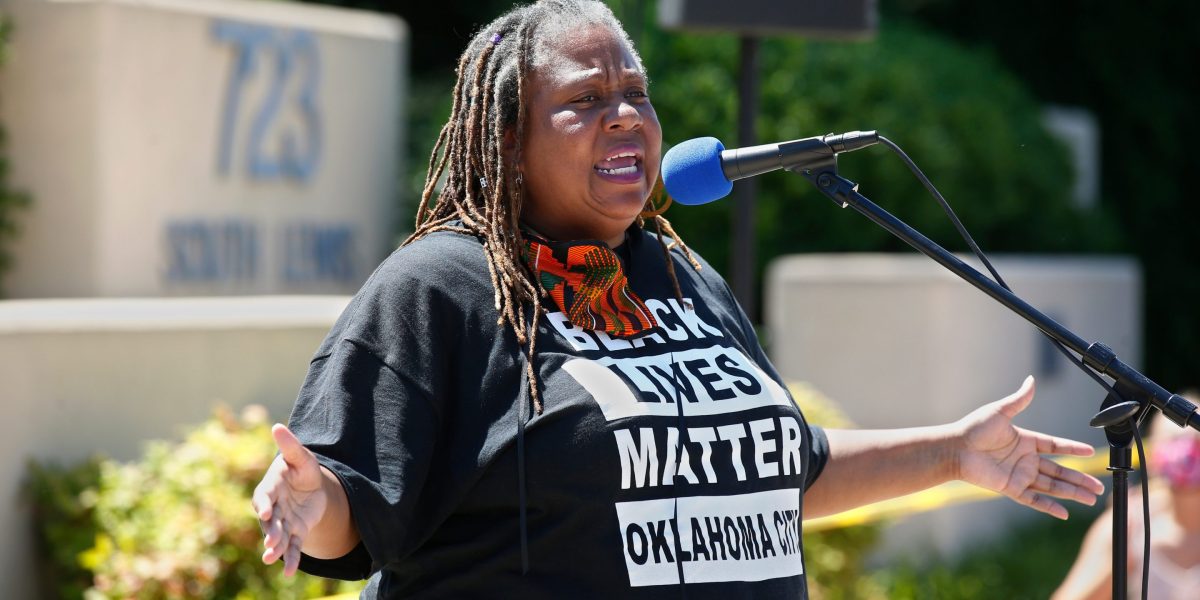
A federal grand jury indicted the leader of the Black Lives Matter movement in Oklahoma City over allegations that millions of dollars in grant funds were improperly spent on international trips, groceries and personal real estate, prosecutors announced Thursday.

Tashella Sheri Amore Dickerson, 52, was indicted earlier this month on 20 counts of wire fraud and five counts of money laundering, court records show.

Court records do not indicate the name of Dickerson’s attorney, and messages left Thursday at her mobile number and by email were not immediately returned.

According to the indictment, Dickerson served since at least 2016 as the executive director of Black Lives Matter OKC, which accepted charitable donations through its affiliation with the Arizona-based Alliance for Global Justice.

In total, BLM OKC raised more than $5.6 million dating back to 2020, largely from online donors and national bail funds that were supposed to be used to post bail for individuals arrested in connection with racial justice protests after the killing of George Floyd by a Minnesota police officer in 2020, the indictment alleges.

When those bail funds were returned to BLM OKC, the indictment alleges, Dickerson embezzled at least $3.15 million into her personal accounts and then used the money to pay for trips to Jamaica and the Dominican Republic, retail shopping, at least $50,000 in food and grocery deliveries for herself and her children, a personal vehicle, and six properties in Oklahoma City deeded to her or to a company she controlled.

The indictment also alleges she submitted false annual reports to the alliance stating that the funds were used only for tax-exempt purposes.

If convicted, Dickerson faces up to 20 years in federal prison and a fine of up to $250,000 for each count of wire fraud and 10 years in prison and fines for each count of money laundering.

In a live video posted on her Facebook page Thursday afternoon, Dickerson said she was not in custody and was “fine.”

“I cannot make an official comment about what transpired today,” she said. “I am home. I am safe. I have confidence in our team.”

“A lot of times when people come at you with these types of things … it’s evidence that you are doing the work,” she continued. “That is what I’m standing on.”

The Black Lives Matter movement first emerged in 2013 after the acquittal of George Zimmerman, the neighborhood watch volunteer who killed 17-year-old Trayvon Martin in Florida. But it was the 2014 death of Michael Brown at the hands of police in Ferguson, Missouri, that made the slogan “Black lives matter” a rallying cry for progressives and a favorite target of derision for conservatives.

The Associated Press reported in October that the Justice Department was investigating whether leaders in the Black Lives Matter movement defrauded donors who contributed tens of millions of dollars during racial justice protests in 2020. There was no immediate indication that Dickerson’s indictment is connected to that probe.


Source link

Continue Reading

Business

Hinge CEO bribed students with KitKats to get the $550 million-a-year business off the ground

Published

on


After more than a decade shaping modern romance, Justin McLeod is leaving Hinge behind to launch his next venture: Another dating app, with an AI twist, called Overtone.

Today, Hinge has more than 30 million users, with a date being set up every two seconds. But in 2011, when it launched, McLeod was just a young Harvard Business School student when he came up with the idea for the app “designed to be deleted.” And the fresh-faced, 20-something entrepreneur was so desperate for people to sign up to his app that he even bribed them with chocolate.

At the time, online dating largely took place on desktops and required real effort. The idea of swiping to find the love of your life (or a one-night stand) on your mobile phone seemed alien.

So convincing fellow students (who had no shortage of opportunities to meet people in class, dorms, and parties) to sign up to Hinge was challenging, McLeod tells Fortune.

“I remember the days of running around the college library in Washington, D.C., at this college, Georgetown, and bribing kids with KitKats to come try my app,” he laughs. “We would get dozens of users a day—maybe, if that.” 

Financing Hinge also required a lot of scrappiness, with McLeod recalling he had to “beg and borrow a lot” to get the app off the ground.

“I was out there networking and talking to as many people as I could and taking money from anyone who would give it to me. That’s just what it takes sometimes,” he says. “I was collecting—me—literally like, $5,000 checks and $10,000 checks to come and start Hinge.”

Hinge CEO’s big break came from a McKinsey job offer

These days, it’s hard enough landing an internship while studying—let alone walking straight into a full-time job right after graduating. But for McLeod, that wasn’t the case: He hadn’t even finished his second year of business school when McKinsey offered him a spot on its coveted grad scheme. 

A career in consulting would have set McLeod on a path to a six-figure salary, with Glassdoor estimating that the average consultant earns between $173,000 to $233,000 a year. McLeod’s sign-up bonus alone was $12,000.

It turned out to be the big break he needed—to finally get Hinge off the ground.

“I was able to keep putting off my offer for like a couple of years,” he recalls while adding that he “borrowed” the money to build his app.

“Once Hinge started to become successful and they saw I was the founder of it, they were like, ‘You’re probably not coming to be an analyst here are you?’ And, of course, by that time I had to pay it back.”

Why did McLeod choose the highly risky path of entrepreneurship when he could have had a comfortable career at McKinsey?

“I turned down my offer and started to work on Hinge, really because I was just so passionate about the idea. Once I started thinking about it, it was hard for me to stop. I really knew this was what I was meant to work on.”

Of course, it paid off: By 2015, Hinge had raised $26.35 million and had an estimated valuation of $75.5 million, before Match Group bought the company off McLeod for an undisclosed amount. 

The founder treated himself and his family to a nearly $13 million apartment in New York soon after. Meanwhile, Hinge brought in $396 million in 2023, last year and an estimated $550 million last year.

Advice for entrepreneurial Gen Z grads

Like McLeod, young people today aren’t dreaming of holding down a 9-to-5 gig after college or climbing the corporate ladder. Research consistently shows they want to be their own boss.

And they’re already making those dreams a reality: In fact, the second fastest-growing job title among Gen Z grads right now is “founder,” according to LinkedIn.

His advice for young entrepreneurs? “You have to be hopelessly idealistic and ruthlessly practical at the same time—that’s how you create something big and successful.”

“Some people who are like too in the hopelessly idealistic camp, dream, but never make something a reality, and people who are too in the ruthlessly practical camp do things but nothing that big or game-changing,” McLeod explains.

Instead, he says successful founders like himself constantly balance the two: Essentially dream big, but “pay attention to the very practical day-to-day realities in order to make that come to life.”

Meanwhile, to Gen Zers who don’t know what they want to do career-wise after school, his advice is to stop overthinking it—just give work a go, whether that’s starting your own business or dipping your toes in the rat race.

“I think people who get too self-involved in, like, what’s my career going to be? What am I going to do? They miss the opportunity to cultivate that passion, that interest for something out there in the world,” he says.

“I would never have figured out what I wanted if I just sat around like meditating about it. I had to work a summer in healthcare and realize that’s not it. I worked on a few other startup ideas before Hinge came to me and it was a lot of figuring out what I didn’t like or what didn’t resonate with me. But each time, I got a little bit smarter and a little bit closer.”

A version of this story originally published on Fortune.com on September 22, 2024.


Source link

Continue Reading

Business

Former ambassador: China is winning the biotech race. Patent reform is how we catch up

Published

on


The United States is at risk of losing one of the most important technology races of the 21st century: biotechnology. A 2025 report from a bipartisan, congressionally chartered commission warns that China is closing in on a win, and the United States has only a narrow window to respond.

The report, released by the National Security Commission on Emerging Biotechnology, offers dozens of recommendations, ranging from increasing federal investment and expanding domestic manufacturing to reducing reliance on Chinese suppliers and improving interagency coordination. But one issue receives too little attention. If the United States wants to compete, it must restore trust in the intellectual property rights that enable inventors to turn bold ideas into revolutionary products.

Patents make high-risk innovation financially viable. They allow startups to protect their discoveries, attract capital, and grow. Without reliable patent rights, promising research gets shelved — or picked up and advanced abroad.

This isn’t theoretical. The United States led past waves of innovation — like the explosion of biotech startups after the Bayh-Dole Act of 1980 and the 19th-century surge of invention that brought us the telephone and automobile — precisely because it backed inventors with clear, enforceable IP rights.

In biotech, the stakes are higher. The field is transforming how we treat disease, grow food, and manufacture everything from chemicals to advanced materials. And with artificial intelligence accelerating discovery, the pace is exponential. As the Commission notes, tools like AlphaFold from GoogleDeepMind can now model hundreds of millions of protein structures in days, a task that once took years.

China saw this future coming. For more than two decades, it has treated biotechnology as a national strategic priority, pouring money into research, building vast biomanufacturing capacity, and acquiring foreign IP through both legal and illicit means.

Today, Chinese firms produce many of the ingredients U.S. drugmakers rely on. According to the Commission, nearly 80% of American drugmakers depend on Chinese contractors for part of their supply chain.

In a crisis, that kind of reliance could leave Americans without access to critical medicine. The Commission outlines a scenario in which Chinese researchers develop a breakthrough cancer therapy and withhold it during a crisis over Taiwan.

Supply chains collapse. Doctors ration care. The White House faces an impossible choice: hold the line on foreign policy or secure access to lifesaving medicine.

The situation is fictional, but the threat is real.

It doesn’t stop there. The report warns that if China stays on its current path, it could soon control the biological data, manufacturing platforms, and AI tools driving the next generation of industrial and defense technologies.

When innovation stays on U.S. soil, so do the jobs, data, and supply chains that protect our citizens. If the technologies that define the future are instead developed under adversarial regimes, the United States risks dependence on foreign powers not only for products but for strategic capabilities. Falling behind wouldn’t just cost the United States market share. It would endanger national security and global influence.

The Commission is right to emphasize the need for a stronger domestic biotech sector. But efforts to achieve that goal will fall short unless we fix the foundation that enables innovation in the first place.

That foundation, our IP system, is under serious strain. Over the past decade, court decisions have blurred the boundaries of what qualifies for patent protection — what is “patent eligible” — especially in medical diagnostics, synthetic biology, and AI-enabled research.

And even when patents are granted, protecting them has become harder. A little-known administrative body called the Patent Trial and Appeal Board (PTAB) lets big corporations repeatedly try to invalidate competitors’ patents, forcing startups into expensive and drawn-out legal battles.

At the same time, a 2006 Supreme Court decision made it harder for courts to issue legal orders called injunctions — which stop infringers from continuing to use others’ inventions — even in cases of clear wrongdoing.

These trends have a chilling effect. Investors hesitate to fund science unless they can count on the underlying IP rights. In biotech, where it can cost billions of dollars and more than a decade to develop a single product, that hesitation can kill entire pipelines of innovation.

The good news is that Congress has tools to change course. Three bipartisan proposals in the House and Senate would help. One bill would restore clarity to patent eligibility standards. Another would reform PTAB procedures to curb duplicative challenges to patents. A third would make it easier for courts to block infringers by issuing injunctions.

Together, these reforms would reduce uncertainty, restore balance, and make the United States a more attractive place to innovate and invest.

We still have significant advantages: world-class research institutions, deep capital markets, and a free market that rewards bold ideas. But as the Commission warns, our lead is slipping — and time is short. To stay ahead in the race for biotech dominance, we need to fix the IP system that makes American innovation possible.

The opinions expressed in Fortune.com commentary pieces are solely the views of their authors and do not necessarily reflect the opinions and beliefs of Fortune.

Join us at the Fortune Workplace Innovation Summit May 19–20, 2026, in Atlanta. The next era of workplace innovation is here—and the old playbook is being rewritten. At this exclusive, high-energy event, the world’s most innovative leaders will convene to explore how AI, humanity, and strategy converge to redefine, again, the future of work. Register now.


Source link

Continue Reading

Trending

Copyright © Miami Select.