
Politics
Resident files state complaints against David Suarez over messages criticizing fellow Miami Beach Commissioner

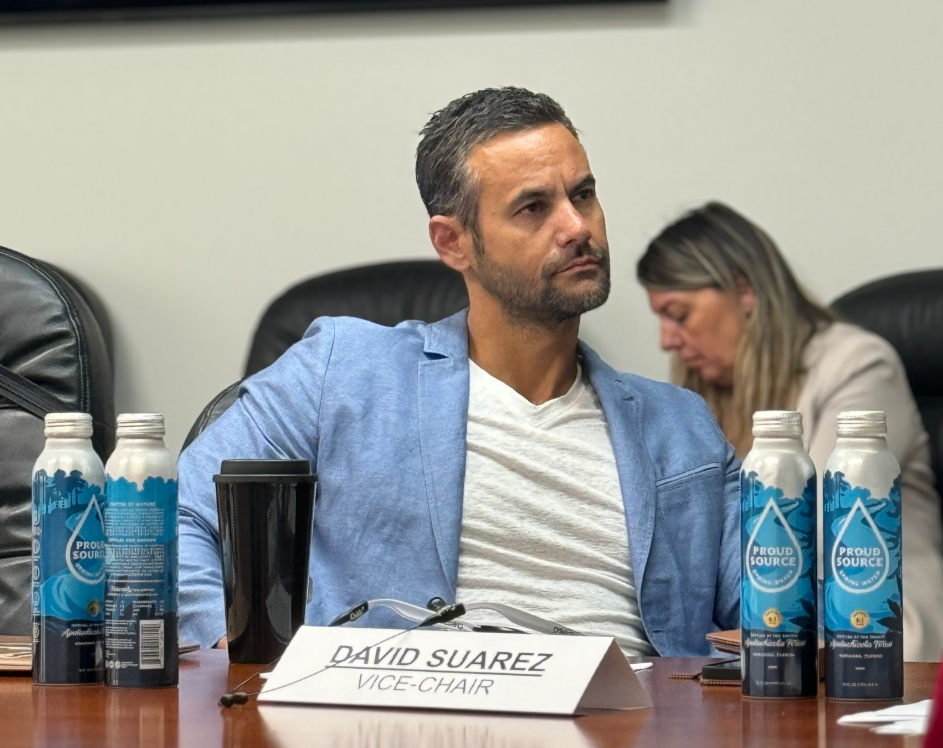
Miami Beach Commissioner David Suarez may soon come under state scrutiny after a longtime resident-activist accused him of using his public office to sway voters in an ongoing election.
If proven, it could amount to a criminal violation under Florida law.
The complaints, filed last week with both the Florida Elections Commission and Florida Commission on Ethics, cite Suarez’s public attacks on fellow Commissioner Laura Dominguez, who is seeking re-election this year.
Miami Beach resident Jo Manning, in her complaints filed Sept. 17 and 18, alleged that Suarez crossed a legal line when he used the city’s official seal and government letterhead in communications criticizing Dominguez and her City Hall conduct.
Manning’s filing points to an email Suarez sent Sept. 9 that featured the city seal and the words “Office of the Mayor and Commission.” The bottom of the email said, “Paid for by David Suarez, Miami Beach Commissioner Group 5.” Suarez posted similar content in a series of Facebook posts on Sept. 14 that linked to the email.
In his communications, Suarez laid out what he described as a pattern of “pay-for-play” activity, accusing Dominguez of accepting campaign contributions from developers around the same time she sponsored legislation favorable to them.
He named several donors who he said benefited from measures she sponsored, including the owners of The Standard hotel, board members of the Belle Island Residents Association, owners of the Deauville Beach Resort, and since-disgraced developer Rishi Kapoor.
Calling Dominguez’s record “hypocrisy at its finest,” Suarez said she broke campaign promises to guard neighborhoods from overdevelopment.
“I do not take lightly to speaking out against a colleague, but the scope of developer and lobbyist contributions to Commissioner Laura Dominguez’s re-election campaign — and legislation she has sponsored — cannot be ignored,” he wrote. “We deserve elected officials who actually put residents first, who fight for honesty, transparency, and who will not sell out their own neighborhood to the highest bidder. This election is about breaking the cycle.”
In her complaints, Manning argued that the language Suarez used “is clearly intended to influence the upcoming election,” including lines such as, “Miami Beach cannot afford four more years.” She said Suarez’s use of official city branding gave his messages “an appearance of authenticity and credibility,” leading recipients to believe it was sanctioned by Miami Beach’s government.
Manning referenced several state statutes, including one prohibiting public officials from using their office for personal benefit and two others that outline campaign spending strictures. She noted that by including a disclaimer in his post that read, “Paid for by David Suarez, Miami Beach Commissioner Group 5,” he indicated he was making a campaign expenditure and must therefore follow state laws governing such spending.
Suarez was elected in 2023, isn’t up for re-election until 2027, and isn’t actively campaigning.
The most punitive law, which Manning cited in her Elections Commission complaint, is Florida Statute 104.31. It bars public officials and employees from using their authority to influence or interfere with an election or the nomination of a public officer.
Violating that statute is a first-degree misdemeanor, punishable by up to one year in jail and up to $1,000 in fines.
Manning, a vocal presence in Miami Beach politics, said she has known Suarez for years. She told Florida Politics she first encountered him when he rented a unit in her condo building years ago. Later, she said, he misattributed a quote to her in a homeowners association letter, for which he apologized.
Their relationship soured further when Suarez, a former Republican and current Independent Party member, ran for the Commission against her friend, activist and hotel owner Mitch Novak.
“Suarez, in my opinion, is not a good person. He says things he shouldn’t. He smears other people,” she said. “He has smeared Laura Dominguez like crazy, and people have to speak out.”
Manning, a Democrat, previously took on Republican Rep. Fabián Basabe when he briefly ran for the Miami Beach Commission. Ahead of the 2021 election, she successfully sued Basabe, contending that he did not meet the city’s one-year residency requirement.
Basabe was ultimately disqualified as a candidate, leading to the re-election of then-Commissioner Mark Samuelian, Dominguez’s late partner, whom she replaced in the dais.
Manning’s lawyer in the case was former Rep. J.C. Planas, who also served as Samuelian’s campaign attorney.

Basabe recently circulated a video clip that he alleged showed Dominguez urging developers to fund political mailers ahead of the city’s election this year. He called for criminal and civil investigations.
Dominguez countered that the full recording showed her comments were misrepresented and accused Basabe of trying to tarnish her reputation. The full video, which Florida Politics published, shows that Dominguez’s remarks were part of a broader conversation about a possible ballot referendum, not a directive to manipulate voters.
The Florida Commission on Ethics and Elections Commission will separately review the complaints to determine whether they warrant a formal investigation. If probable cause is found, Suarez could face fines or prosecution.
Florida Politics contacted Suarez for comment Wednesday evening. He said he was unaware of any complaint filed against him.
“The bigger story here is that Commissioner Dominguez receives campaign contributions from developers and lobbyists, then turns around sponsoring their legislation and votes in favor, in what appears to be a simple pay-for-play scheme,” he said Thursday, after viewing the ethics complaint. “Don’t take my word for it, the public records have all the receipts.”
Dominguez faces one challenger: Fred Karlton, a 65-year-old real estate investor who is registered with the Independent Party. Another candidate, Democrat Robert Novo, dropped out of the race last week after Dominguez’s campaign successfully challenged his residency bona fides.
Novo’s last government job was as a legislative aide to Basabe.
Other races on the ballot include a two-way contest between Meiner and City Commissioner Kristen Rosen Gonzalez for Mayor, a seven-way contest for Rosen Gonzalez’s Group 1 seat and a head-to-head matchup between Group 3 Commissioner Alex Fernandez and his lone challenger, Luidgi Mary.
Meiner has no party affiliation. Gonzalez and Fernandez are Democrats. Mary is a Republican.
The city’s elections are nonpartisan.
___
Editor’s note: This report was updated to include a statement from Suarez.
Post Views: 0

Floridians know firsthand how quickly rising costs can hurt a household budget. Health care, particularly prescription drug costs, is often the most unpredictable and difficult expense to manage, so when there are important conversations in Congress about health care, most people keep a close eye on developments to ensure our policymakers do not pass legislation that would increase costs.
Fortunately, Florida has leaders who understand that affordability doesn’t come from more government mandates, but from competition, flexibility, and accountability. Sen. Rick Scott, in particular, has consistently shown he is willing to stand up for Florida families when proposals threaten to drive costs even higher.
Scott has long emphasized that Americans — not Washington bureaucrats — are best equipped to make decisions for their families. He has backed policies that keep consumers at the center of health care while resisting heavy-handed federal interference in private markets. That approach has proven especially important for employer-sponsored coverage, which millions of Floridians depend on for access to care.
Last year, Scott demonstrated that leadership in a very real way. When a massive spending package included last-minute provisions that would have inserted the federal government into the private health insurance market, including dictating how prescription benefits could be structured, he opposed it. Those provisions weren’t about lowering patients’ costs. They would have limited flexibility, increased premiums, and shifted leverage back to the pharmaceutical industry.
These issues aren’t abstract. In communities across South Florida, families are already struggling to keep up with rising prices. Seniors on fixed incomes, working parents, and small-business employees all feel the impact when health care costs rise. Too often, those rising costs are driven by prescription drug prices set by manufacturers — prices that families and employers have little ability to control. Policies that reduce choice or raise premiums only make those challenges worse.

These concerns are not just something Floridians are noticing. Voters across the country share the sentiment. Recent public opinion research confirms exactly that: a survey from the President’s pollster, John McLaughlin, of likely Midterm voters found that nearly three-quarters believe drug companies are most responsible for high prescription drug prices, not employers or patients. Even more telling, voters overwhelmingly favor keeping private health care choices available to employers rather than having the federal government impose one-size-fits-all mandates. Americans want more choice, not the government telling businesses how to design their benefits.
Large majorities also expressed deep concern that government interference in the private market would raise monthly premiums and ultimately increase Big Pharma’s profits.
Prescription drugs are a major driver of health care spending, and that disconnect between what voters want and what some policymakers are proposing is hard to ignore. Drug manufacturers alone set their prices, and those prices continue to rise year after year. Any serious effort to improve affordability should focus on increasing competition and holding drug companies accountable — not weakening the private-market tools that help keep costs in check.
Unfortunately, some of the proposals circulating in Congress would do exactly that. These ideas would bring new government mandates into the private market and eliminate options that help manage prescription drug costs. Independent analyses show these policies could raise premiums nationwide by tens of billions of dollars each year, while delivering massive new profits to drug manufacturers.
Florida families cannot afford that outcome. Neither can the American health care system as a whole. The goal of reform should be simple: lower costs, more choices, and better value for patients, not expanded government control that makes coverage more expensive.

Scott has shown that it’s possible to hold the line against policies that ultimately raise costs. As Congress continues its health care debates, Florida’s delegation should follow his lead and stay focused on real solutions that protect affordability, preserve flexibility, and put patients first.
That’s the kind of leadership Floridians expect — and the kind we need right now.
___
Barbara Casanova is the National Secretary and Florida Chair of the Republican National Hispanic Assembly. She also serves on the Miami-Dade Hispanic Affairs Advisory Board.
Politics
Parents of trans children urge compassion, not humiliation, in Florida’s schools, doctor’s offices and government halls

Juan Dominguez feared for his child Kai entering a deep depression, angry at the world, before a doctor finally provided a diagnosis of gender dysphoria. The father knew little about transgender identity at the time, but saw an immediate turnaround once Kai was treated.
But as Florida implemented new laws restricting medical professionals from providing gender-affirming care to minors, that doctor can no longer provide care, nor can any other in the state.
“The doctor that helped us identify Kai’s condition can no longer see us. We are not allowed to be open with other doctors because they won’t accept our child in their clinics,” Domingue said. “Doctors spend years studying the research. They know their patients. Medical decisions belong with families and doctors, not politicians.”
Dominguez was one of several parents to speak Wednesday at an Equality Florida press conference in Tallahassee, condemning a new round of laws aimed at LGBTQ Floridians. Parents of transgender children said their children have been humiliated in school, denied care and silenced repeatedly for any objection to what they say are draconian laws.
Equality Florida Executive Director Stratton Pollitzer said this follows a trend of attacks, ones that too often originate from Gov. Ron DeSantis’ Office.
“Let’s understand why DeSantis and this small band of his cronies are so obsessed with attacking the LGBTQ community,” Pollitzer said.
“These bills are smoke bombs meant to distract Floridians from the complete failure of Ron DeSantis and his allies to address the real crises Floridians are facing: lack of affordability, a housing emergency, and skyrocketing insurance costs.”
The press conference called out legislation, including one dubbed by critics as the “Don’t Say Gay or Trans at Work” bill threatening funding from organizations holding LGBTQ sensitivity training. Activists also took the state to task for many bills passed in prior years, most in a stretch before DeSantis’ ultimately failed run for President.
Those included bans on transgender students in women’s sports, restrictions on medical care being provided to minors and coverage to adults, and the state’s notorious “Parental Rights in Education” law barring any instruction on gender identity or sexual orientation through high school, a prohibition that includes outlawing the use of preferred pronouns or nicknames by school faculty and staff.
Luisa Montoya, President of PFLAG Broward, said she was upset she could not even register her trans son in school with his preferred name.

“Because of this, my child was repeatedly called by his birth name in front of other students. Sometimes it happened in the classroom, sometimes in the hallway. And once, it even happened over the school megaphone,” Montoya said.
“I will never forget the look on my child’s face. That moment reminded me why I fight. Because school should be a place of learning and safety — not fear or humiliation.”
Jennifer Solomon, head of Equality Florida’s Parenting with Pride program, stressed that LGBTQ families deserve representation in Tallahassee. And she said parents are one group that won’t be silenced.
“Look around. These parents are not here as strangers. They are your neighbors, your colleagues, your friends. Every one of them has a child they cherish and a story they want to be heard,” Solomon said.
“This fight is not abstract. It is deeply personal. I live it every day — in every choice I make, in every conversation I have about the future of Florida, and in every moment I stand beside families who are facing these threats with courage and love.”
Pollitzer said he was heartened in recent Legislative Sessions when, despite anti-LGBTQ legislation being filed and occasionally heard in committee, few bills have passed.
“Last year we saw a growing number of legislators refuse to waste more time on these awful bills and with people power we defeated all of them,” he said.
“We hope that with real challenges facing everyday Floridians lawmakers will again refuse to prioritize DeSantis’s agenda of more censorship, surveillance, and government control. But hope does not mean silence. And it does not mean standing down.”

A Senate committee advanced a bill to create an artificial intelligence bill of rights aiming to protect consumers and minors.
With unanimous bipartisan support, the Senate Commerce and Tourism Committee backed Sen. Tom Leek’s bill (SB 482).
“Quite simply, we get a 60-day Session once a year. If we don’t act and Congress doesn’t act, those protections won’t exist for Florida’s children and vulnerable adults,” Leek, a Port Orange Republican, told lawmakers before the 10-0 vote Wednesday. “So I believe we have to act.”
Wednesday’s vote was the bill’s first committee stop to support Gov. Ron DeSantis’ agenda as the measure heads next to the Senate Appropriations Committee.
DeSantis has increasingly been calling for more regulation to protect young people from the dangers of AI technology. But President Donald Trump has also been critical of states passing AI reforms and signed an executive order in December aimed at restricting states from overregulating the technology.
Leek argued that his bill doesn’t defy Trump’s order.
“I think the protections that we’ve got here for minors and for vulnerable adults, and for all of us really, are in line with what President Trump wants,” Leek said during Wednesday’s hearing.
Leek argued Trump was striking back against “onerous restrictions,” while his bill was specifically focused on consumer protections.
“It is purposely and deliberately targeted at those protections and not … the universe of things that could be done,” Leek said.
Under Leek’s bill, chatbot platforms would be required to post pop-up warnings that a person is talking to AI. The message would appear at the start of the conversation and reappear at least every hour.

Children would not be allowed to communicate with chatbots without parental permission. Parents would have control to see their child’s communications with the chatbot and could also limit access or delete the child’s account.
The bill would also require minors to be reminded to “take a break” at least once every hour.
Chatbot platform operators that violate the proposed new rules could face civil fines up to $50,000 per violation.
The AI bill of rights legislation comes after a 14-year-old Orlando boy killed himself in 2024 after he had been chatting with an AI bot extensively. Some of the conversations turned sexual and romantic. The family later sued in a case that got national coverage by The New York Times.
“Artificial intelligence, holding a great deal of promise, also poses novel and unique threats. Generative AI in particular can be particularly insidious in some contexts when used by children or unsuspecting or vulnerable or adults,” Leek said at Wednesday’s hearing.
“Given the incredible pace of the evolution of the technology and its adoption by business and academia, it is incumbent on us to protect Floridians for some of its problematic results.”
Several advocates and Democrats praised the bill, while also arguing there was room for improvement in Leek’s legislation.
“We would like to be a part of the conversation,” said Florida AFL-CIO lobbyist Rich Templin. “This is a great consumer protection beginning, but what about workers?”
And Turner Loesel, a technology policy analyst at the James Madison Institute, warned that the bill’s language needed to be tweaked, which Leek teased is coming. Leek said he is still working with stakeholders to tighten the bill’s definitions.
“Its definition of artificial intelligence is broad enough to capture spam filters alongside companion chatbot platforms, and we look forward to the amendments on that definition,” Loesel said.
Sen. Carlos Guillermo Smith, an Orlando Democrat, called the bill a good first step but also agreed the legislation could be beefed up.
“We need meaningful accountability in the bill. Floridians deserve more than promises. They deserve proof. That means compliance reporting and audits that show companies are actually protecting biometric data, that they’re preventing misuse, and that they’re operating transparently,” Smith said.
“I think relying solely on political actors in the Office of the Attorney General for enforcement is not enough. To stop harmful conduct, I think we need stronger civil protections, including a private cause of action for all ages to defend all of our rights that are outlined in this AI bill of rights.”


Washington interference won’t fix health care costs

Trump tones down escalating Greenland rhetoric in Davos

Kim Kardashian Praises Taylor Swift as ‘Super Talented’ Despite Infamous Beef
-

 Politics8 years ago
Congress rolls out ‘Better Deal,’ new economic agenda
-
Entertainment9 years ago
New Season 8 Walking Dead trailer flashes forward in time
-
Politics9 years ago
Poll: Virginia governor’s race in dead heat
-
Politics9 years ago
Illinois’ financial crisis could bring the state to a halt
-
Entertainment9 years ago
The final 6 ‘Game of Thrones’ episodes might feel like a full season
-
Entertainment9 years ago
Meet Superman’s grandfather in new trailer for Krypton
-
Business9 years ago
6 Stunning new co-working spaces around the globe
-
Tech9 years ago
Hulu hires Google marketing veteran Kelly Campbell as CMO