Connect with us

Politics

Republicans look to make a U-turn on federal commitment to electric vehicles for the Postal Service
Published

on


A year after being lauded for its plan to replace thousands of aging, gas-powered mail trucks with a mostly electric fleet, the U.S. Postal Service is facing congressional attempts to strip billions in federal EV funding.

In June, the Senate parliamentarian blocked a Republican proposal in a major tax-and-spending bill to sell off the agency’s new electric vehicles and infrastructure and revoke remaining federal money. But efforts to halt the fleet’s shift to clean energy continue in the name of cost savings.

Donald Maston, president of the National Rural Letter Carriers’ Association, said canceling the program now would have the opposite effect, squandering millions of dollars.

“I think it would be shortsighted for Congress to now suddenly decide they’re going to try to go backwards and take the money away for the EVs or stop that process because that’s just going to be a bunch of money on infrastructure that’s been wasted,” he said.

Beyond that, many in the scientific community fear the government could pass on an opportunity to reduce carbon emissions that contribute to global warming when urgent action is needed.

A 2022 University of Michigan study found the new electric postal vehicles could cut total greenhouse gas emissions by up to 20 million tons over the predicted, cumulative 20-year lifetime of the trucks. That’s a fraction of the more than 6,000 million metric tons emitted annually in the United States, said professor Gregory A. Keoleian, co-director of the university’s Center for Sustainable Systems. But he said the push toward electric vehicles is critical and needs to accelerate, given the intensifying impacts of climate change.

“We’re already falling short of goals for reducing emissions,” Keoleian said. “We’ve been making progress, but the actions being taken or proposed will really reverse decarbonization progress that has been made to date.”

Many GOP lawmakers share President Donald Trump’s criticism of the Biden-era green energy push and say the Postal Service should stick to delivering mail.

Sen. Joni Ernst, R-Iowa, said “it didn’t make sense for the Postal Service to invest so heavily in an all-electric force.” She said she will pursue legislation to rescind what is left of the $3 billion from the Inflation Reduction Act allocated to help cover the $10 billion cost of new postal vehicles.

Ernst has called the EV initiative a “boondoggle” and “a textbook example of waste,” citing delays, high costs and concerns over cold-weather performance.

“You always evaluate the programs, see if they are working. But the rate at which the company that’s providing those vehicles is able to produce them, they are so far behind schedule, they will never be able to fulfill that contract,” Ernst said during a recent appearance at the Iowa State Fair, referring to Wisconsin-based Oshkosh Defense.

“For now,” she added, “gas-powered vehicles — use some ethanol in them — I think is wonderful.”

Corn-based ethanol is a boon to Iowa’s farmers, but the effort to reverse course has other Republican support.

Rep. Michael Cloud, a Texas Republican, a co-sponsor of the rollback effort, has said the EV order should be canceled because the project “has delivered nothing but delays, defective trucks, and skyrocketing costs.”

The Postal Service maintains that the production delay of the Next Generation Delivery Vehicles, or NGDVs, was “very modest” and not unexpected.

“The production quantity ramp-up was planned for and intended to be very gradual in the early months to allow time for potential modest production or supplier issues to be successfully resolved,” spokesperson Kim Frum said.

The independent, self-funded federal agency, which is paid for mostly by postage and product sales, is in the middle of a $40 billion, 10-year modernization and financial stabilization plan. The EV effort had the full backing of Democratic President Joe Bidenwho pledged to move toward an all-electric federal fleet of car and trucks.

The “Deliver for America” plan calls for modernizing the ground fleet, notably the Grumman Long Life Vehicle, which dates back to 1987 and is fuel-inefficient at 9 mpg. The vehicles are well past their projected 24-year lifespan and are prone to breakdowns and even fires.

“Our mechanics are miracle workers,” said Mark Dimondstein, president of the American Postal Workers Union. “The parts are not available. They fabricate them. They do the best they can.”

The Postal Service announced in 2022 it would deploy at least 66,000 electric vehicles by 2028, including commercial off-the-shelf models, after years of deliberation and criticism it was moving too slowly to reduce emissions. By 2024, the agency was awarded a Presidential Sustainability Award for its efforts to electrify the largest fleet in the federal government.

In 2021, Oshkosh Defense was awarded a contract for up to 165,000 battery electric and internal combustion engine Next Generation vehicles over 10 years.

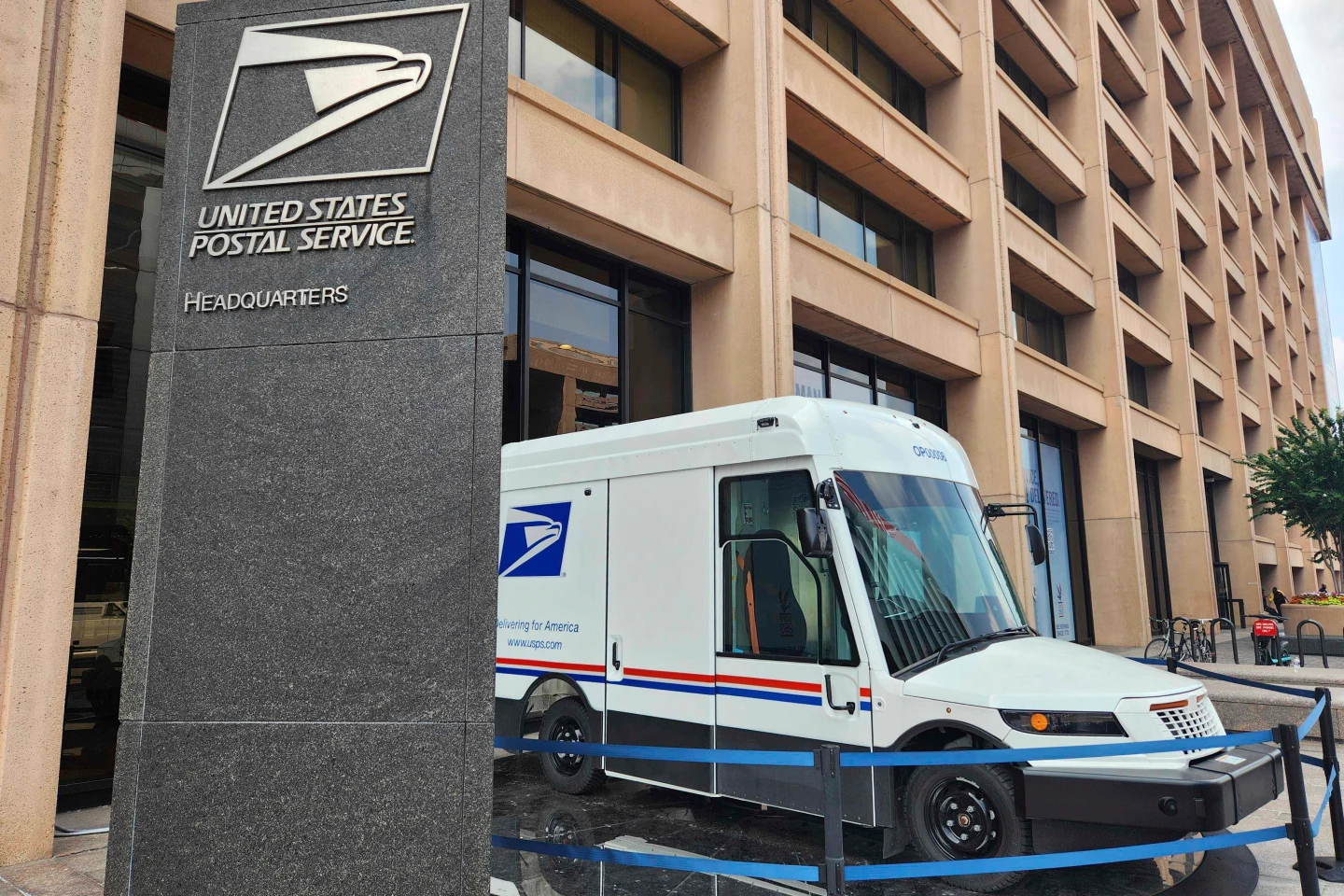
The first of the odd-looking trucks, with hoods resembling a duck’s bill, began service in Georgia last year. Designed for greater package capacity, the trucks are equipped with airbags, blind-spot monitoring, collision sensors, 360-degree cameras and antilock brakes.

There’s also a new creature comfort: air conditioning.

Douglas Lape, special assistant to the president of the National Association of Letter Carriers and a former carrier, is among numerous postal employees who have had a say in the new design. He marvels at how Oshkosh designed and built a new vehicle, transforming an old North Carolina warehouse into a factory along the way.

“I was in that building when it was nothing but shelving,” he said. “And now, being a completely functioning plant where everything is built in-house — they press the bodies in there, they do all of the assembly — it’s really amazing in my opinion.”

The agency has so far ordered 51,500 NGDVs, including 35,000 battery-powered vehicles. To date, it has received 300 battery vehicles and 1,000 gas-powered ones.

Former Postmaster General Louis DeJoy said in 2022 the agency expected to purchase chiefly zero-emissions delivery vehicles by 2026. It still needs some internal combustion engine vehicles that travel longer distances.

Frum, the Postal Service spokesperson, said the planned NGDV purchases were “carefully considered from a business perspective” and are being deployed to routes and facilities where they will save money.

The agency has also received more than 8,200 of 9,250 Ford E-Transit electric vehicles it has ordered, she said.

Ernst said it’s fine for the Postal Service to use EVs already purchased.

“But you know what? We need to be smart about the way we are providing services through the federal government,” she said. “And that was not a smart move.”

Maxwell Woody, lead author of the University of Michigan study, made the opposite case.

Postal vehicles, he said, have low average speeds and a high number of stops and starts that enable regenerative braking. Routes average under 30 miles and are known in advance, making planning easier.

“It’s the perfect application for an electric vehicle,” he said, “and it’s a particularly inefficient application for an internal combustion engine vehicle.”

___

Republished with permission of The Associated Press.


Post Views: 0


Source link

Continue Reading

Politics

First Coast manufacturing was generally flat in November, with signs of improvement

Published

on


First Coast manufacturers put the brakes on contraction for the first time in months in November, though the general industrial picture was flat.

The University of North Florida (UNF) Jacksonville Economic Monitoring Survey (JEMS) shows several sectors of the manufacturing elements expanded in November, the most upbeat turnaround on the First Coast in several months. Seven out of the 12 elements of the UNF survey showed the Purchase Managers Index (PMI) expanded last month. That’s a big change from October, when only two sectors showed expansion.

“Jacksonville’s headline PMI of 50 in November indicates that local manufacturing activity was essentially flat. This stands in contrast to the national PMI of 48.2, which shows that U.S. manufacturing continued to contract at a faster pace,” said Albert Loh, Interim Dean of the UNF Coggin College of Business who oversees the JEMS survey.

“Still, a flat PMI is relatively positive when compared with deeper national declines and highlights Jacksonville’s resilience heading toward 2026.”

UNF researchers from the JEMS project reach out to First Coast manufacturing companies each month to see where they stand on production and several other factors.

One of the key factors that showed expansion for North Florida manufacturers in October was output, which jumped from a 49 figure in October to 53 in November.

“A reading of 53 suggests a modest but meaningful pickup in business activity in the region. While not signaling a boom, it reflects resilience and indicates that local firms are navigating cost pressures, supply chain adjustments, and mixed demand with cautious optimism,” the JEMS report concluded.

New orders, another high-profile manufacturing element, also showed a substantial uptick increasing from a figure of 49 in October to 52 in November.

“New orders are a leading indicator, so this improvement points to potentially stronger production, hiring, and inventory activity ahead,” the JEMS report said.

Other factors that showed expansion in North Florida last month included output prices, average input prices, quantity of input purchased, inventory of input purchased and business activity outlook over the next year.

Key elements that are still sluggish with contraction included employment, backlogs of work, finished goods inventory and suppliers’ delivery times. New export orders were unchanged.


Source link

Continue Reading

Politics

Democrats question how court cases upholding Florida’s congressional map warrant redrawing it

Published

on


No congressional maps were presented at a second meeting of the Florida House’s redistricting committee. Now, Democrats are questioning why any would be drafted at all.

Andy Bardos, counsel for the House, told members that two key court cases contribute to a different legal landscape than when the Legislature last approved congressional lines in 2022. Most importantly, the Florida Supreme Court upheld that map, which was drawn by Gov. Ron DeSantis’ staff and broke up a seat previously held by a Black Democrat. The other case out of Louisiana awaits a Supreme Court ruling in the coming term.

Rep. Kevin Chambliss, a Homestead Democrat, questioned how the Florida Supreme Court upholding the existing map merited the reconsideration of new lines.

“That map was deemed constitutional,” Chambliss said. “If that was conclusive to an action, then that means that’s done. So then what is the reason why we’re doing it now? I’m confused, because it seems like there was a conclusion there based on the court case, and now we’re having a conversation where the second court case isn’t even finished yet.”

Bardos stressed that the only reason the Florida Supreme Court considered the congressional map was because civil rights groups sued, but the legal challenge focused only on the breakup of the North Florida seat previously represented by U.S. Rep. Al Lawson.

Justices upheld the map, but determined the prior configuration of Lawson’s seat, itself the product of a 2015 Supreme Court decision, improperly considered race as the predominant motivation in drawing a district spanning from Tallahassee to Jacksonville.

“In the process of deciding that, the court articulated legal principles that had never before been set forth by a court in that way,” Bardos said.

For example, he said that even if lawmakers want to hold to a nondiminishment requirement in the “Fair Districts” amendments in Florida’s Constitution, lawmakers “can’t make race predominant.”

Still, Bardos in presentations also explained that portions of Florida’s Fair Districts remain unchanged, including a ban on drawing maps to favor a political party.

That could likely fuel any legal challenge to maps produced by the Legislature ahead of the 2026 Midterms. President Donald Trump has pressured Republican-controlled Legislatures to draw House maps that better improve the situation for Republicans.

Minutes before the Wednesday redistricting meeting, Republican National Committee Chair Joe Gruters, a member of the Florida Senate, reposted a prediction on X that Florida could net as many as five seats in redistricting. Florida’s U.S. House delegation currently includes 20 Republicans and eight Democrats.

But notably, the House is moving forward with redistricting before DeSantis or the Florida Senate takes action. Both the Governor and Senate President Ben Albritton said they think new cartography should wait until the Supreme Court rules in another redistricting case, Louisiana v. Callais.

“Just no matter what else happens, that is going to have to be addressed,” DeSantis said last week.

Bardos said any ruling on that case will only directly impact Louisiana. However, he said the Legislature may take action at any point to adhere to legal principles set forth in that ruling, issues that will impact any court challenges to political cartography in the future.

Rep. Bruce Antone, an Orlando Democrat, suggested there’s no legally compelling reason for the Legislature to look at maps right now.

“Once a state goes through the redistricting process, what compelling reasons would there be outside of a court case requiring redistricting?” Antone said. “What compelling reasons would require us to do this exercise a second time, mid-census?”

Rep. Mike Redondo, a Miami Republican chairing the House redistricting committee, said he didn’t want lawmakers discussing “hypotheticals,” including whether lawmakers would even consider a new map. He also said lawmakers can undertake whatever process they choose, including still deciding whether to undertake field meetings around Florida.

“As a body, we’re going to make those decisions in terms of how input will be received.”

But at the meeting on Wednesday, the committee took no public comment, including from South Florida members of the public who bussed to the hearing.


Source link

Continue Reading

Politics

Boca Raton police union endorses Fran Nachlas for Mayor

Published

on


Boca Raton Deputy Mayor Fran Nachlas’ campaign to remove “Deputy” from her title just got a boost from the city’s police union.

The Fraternal Order of Police, Lodge 35, is endorsing Nachlas due to her “consistent support for public safety, dedication to community partnership, and commitment to responsible leadership.”

Boca Raton will “continue to thrive as a safe, vibrant, and forward-moving community” under Nachlas’ mayoralty, the group added in its statement announcing the support.

“Fran has been a dedicated supporter of law enforcement and a strong advocate for our community,” the organization said in a separate Instagram post.

“Your steadfast commitment to ensuring the safety and well-being of our citizens, along with your keen understanding of the unique challenges faced by our officers, exemplify exceptional leadership and dedication. We have complete confidence in your ability to lead with integrity, compassion, and unwavering commitment to the community.”

Nachlas said in a statement that she is “profoundly honored” by the nod.

“Our officers put their lives on the line every day to keep our community safe, and their trust means the world to me,” she said. “As Mayor, I will continue to prioritize public safety, strengthen community partnerships, and ensure our police have the resources and support they need.”

Nachlas was named Boca’s Deputy Mayor in March. She is a past Chair of the Boca Raton Community Redevelopment Agency and member of the Boca Raton Community Advisory Council. She now serves on the Palm Beach County Transportation Planning Agency Governing Board, Florida League of Cities Development, Code Compliance and Redevelopment Committee in addition to her City Council duties.

She is one of three candidates competing to succeed term-limited Mayor Scott Singer, along with Boca Raton Council member Andy Thomson and Mike Liebelson, an energy executive-turned-adviser.

Nachlas and Liebelson are Republicans. Thomson is a Democrat.

Boca Raton’s municipal election is on March 10, 2026.


Source link

Continue Reading

Trending

Copyright © Miami Select.