Connect with us

Politics

Republicans look to make a U-turn on federal commitment to electric vehicles for the Postal Service
Published

on


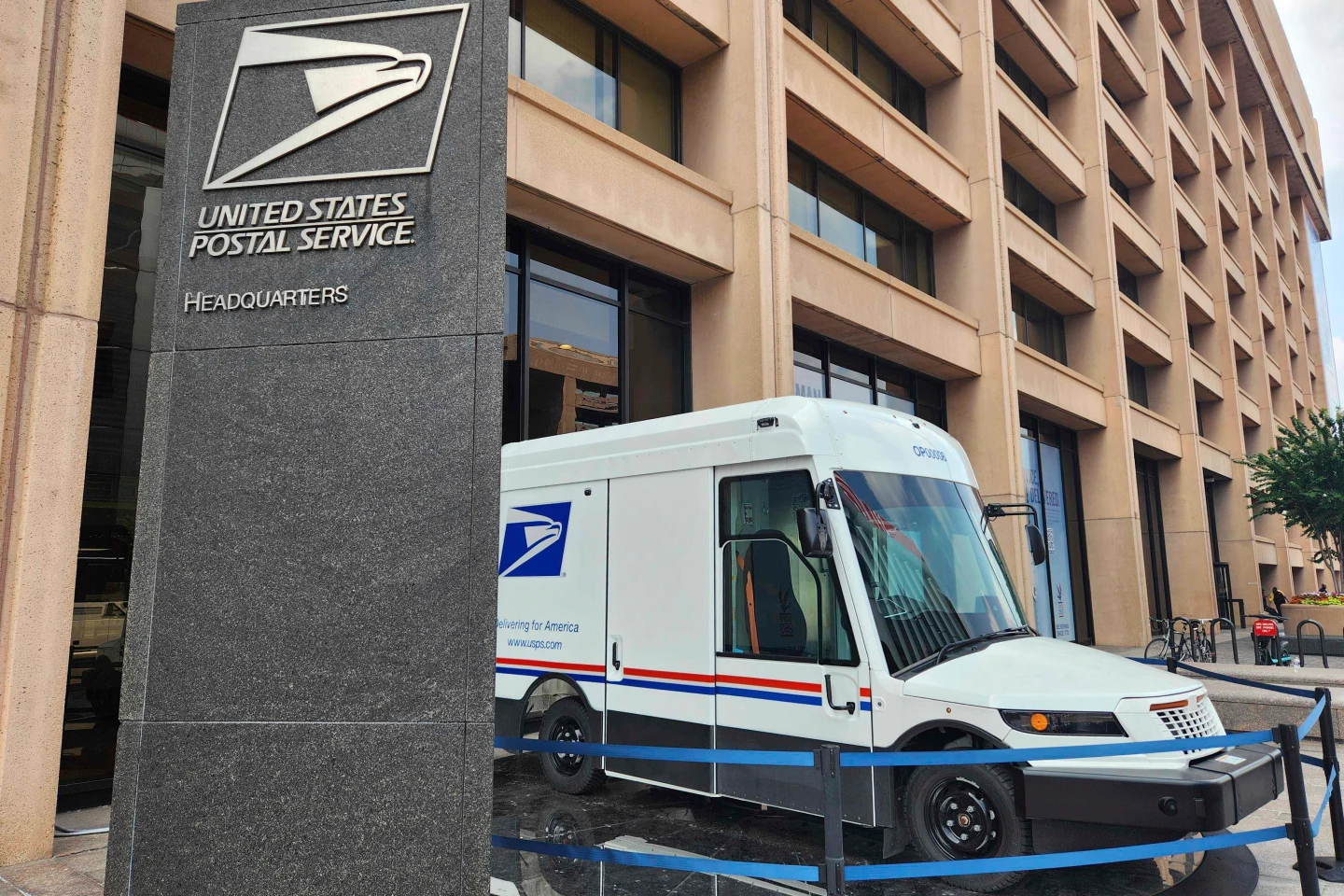
A year after being lauded for its plan to replace thousands of aging, gas-powered mail trucks with a mostly electric fleet, the U.S. Postal Service is facing congressional attempts to strip billions in federal EV funding.

In June, the Senate parliamentarian blocked a Republican proposal in a major tax-and-spending bill to sell off the agency’s new electric vehicles and infrastructure and revoke remaining federal money. But efforts to halt the fleet’s shift to clean energy continue in the name of cost savings.

Donald Maston, president of the National Rural Letter Carriers’ Association, said canceling the program now would have the opposite effect, squandering millions of dollars.

“I think it would be shortsighted for Congress to now suddenly decide they’re going to try to go backwards and take the money away for the EVs or stop that process because that’s just going to be a bunch of money on infrastructure that’s been wasted,” he said.

Beyond that, many in the scientific community fear the government could pass on an opportunity to reduce carbon emissions that contribute to global warming when urgent action is needed.

A 2022 University of Michigan study found the new electric postal vehicles could cut total greenhouse gas emissions by up to 20 million tons over the predicted, cumulative 20-year lifetime of the trucks. That’s a fraction of the more than 6,000 million metric tons emitted annually in the United States, said professor Gregory A. Keoleian, co-director of the university’s Center for Sustainable Systems. But he said the push toward electric vehicles is critical and needs to accelerate, given the intensifying impacts of climate change.

“We’re already falling short of goals for reducing emissions,” Keoleian said. “We’ve been making progress, but the actions being taken or proposed will really reverse decarbonization progress that has been made to date.”

Many GOP lawmakers share President Donald Trump’s criticism of the Biden-era green energy push and say the Postal Service should stick to delivering mail.

Sen. Joni Ernst, R-Iowa, said “it didn’t make sense for the Postal Service to invest so heavily in an all-electric force.” She said she will pursue legislation to rescind what is left of the $3 billion from the Inflation Reduction Act allocated to help cover the $10 billion cost of new postal vehicles.

Ernst has called the EV initiative a “boondoggle” and “a textbook example of waste,” citing delays, high costs and concerns over cold-weather performance.

“You always evaluate the programs, see if they are working. But the rate at which the company that’s providing those vehicles is able to produce them, they are so far behind schedule, they will never be able to fulfill that contract,” Ernst said during a recent appearance at the Iowa State Fair, referring to Wisconsin-based Oshkosh Defense.

“For now,” she added, “gas-powered vehicles — use some ethanol in them — I think is wonderful.”

Corn-based ethanol is a boon to Iowa’s farmers, but the effort to reverse course has other Republican support.

Rep. Michael Cloud, a Texas Republican, a co-sponsor of the rollback effort, has said the EV order should be canceled because the project “has delivered nothing but delays, defective trucks, and skyrocketing costs.”

The Postal Service maintains that the production delay of the Next Generation Delivery Vehicles, or NGDVs, was “very modest” and not unexpected.

“The production quantity ramp-up was planned for and intended to be very gradual in the early months to allow time for potential modest production or supplier issues to be successfully resolved,” spokesperson Kim Frum said.

The independent, self-funded federal agency, which is paid for mostly by postage and product sales, is in the middle of a $40 billion, 10-year modernization and financial stabilization plan. The EV effort had the full backing of Democratic President Joe Bidenwho pledged to move toward an all-electric federal fleet of car and trucks.

The “Deliver for America” plan calls for modernizing the ground fleet, notably the Grumman Long Life Vehicle, which dates back to 1987 and is fuel-inefficient at 9 mpg. The vehicles are well past their projected 24-year lifespan and are prone to breakdowns and even fires.

“Our mechanics are miracle workers,” said Mark Dimondstein, president of the American Postal Workers Union. “The parts are not available. They fabricate them. They do the best they can.”

The Postal Service announced in 2022 it would deploy at least 66,000 electric vehicles by 2028, including commercial off-the-shelf models, after years of deliberation and criticism it was moving too slowly to reduce emissions. By 2024, the agency was awarded a Presidential Sustainability Award for its efforts to electrify the largest fleet in the federal government.

In 2021, Oshkosh Defense was awarded a contract for up to 165,000 battery electric and internal combustion engine Next Generation vehicles over 10 years.

The first of the odd-looking trucks, with hoods resembling a duck’s bill, began service in Georgia last year. Designed for greater package capacity, the trucks are equipped with airbags, blind-spot monitoring, collision sensors, 360-degree cameras and antilock brakes.

There’s also a new creature comfort: air conditioning.

Douglas Lape, special assistant to the president of the National Association of Letter Carriers and a former carrier, is among numerous postal employees who have had a say in the new design. He marvels at how Oshkosh designed and built a new vehicle, transforming an old North Carolina warehouse into a factory along the way.

“I was in that building when it was nothing but shelving,” he said. “And now, being a completely functioning plant where everything is built in-house — they press the bodies in there, they do all of the assembly — it’s really amazing in my opinion.”

The agency has so far ordered 51,500 NGDVs, including 35,000 battery-powered vehicles. To date, it has received 300 battery vehicles and 1,000 gas-powered ones.

Former Postmaster General Louis DeJoy said in 2022 the agency expected to purchase chiefly zero-emissions delivery vehicles by 2026. It still needs some internal combustion engine vehicles that travel longer distances.

Frum, the Postal Service spokesperson, said the planned NGDV purchases were “carefully considered from a business perspective” and are being deployed to routes and facilities where they will save money.

The agency has also received more than 8,200 of 9,250 Ford E-Transit electric vehicles it has ordered, she said.

Ernst said it’s fine for the Postal Service to use EVs already purchased.

“But you know what? We need to be smart about the way we are providing services through the federal government,” she said. “And that was not a smart move.”

Maxwell Woody, lead author of the University of Michigan study, made the opposite case.

Postal vehicles, he said, have low average speeds and a high number of stops and starts that enable regenerative braking. Routes average under 30 miles and are known in advance, making planning easier.

“It’s the perfect application for an electric vehicle,” he said, “and it’s a particularly inefficient application for an internal combustion engine vehicle.”

___

Republished with permission of The Associated Press.


Post Views: 0


Source link

Continue Reading

Politics

Early voting underway for Miami Mayor’s runoff between Eileen Higgins, Emilio González

Published

on


Early voting is underway in Miami as former County Commissioner Eileen Higgins and former City Manager Emilio González enter the final stretch of a closely watched Dec. 9 mayoral runoff.

The two candidates rose from a 13-person field Nov. 4, with Higgins winning about 36% of the vote and González taking 19.5%. Because neither surpassed 50%, Miami voters must now choose between contrasting visions for a city grappling with affordability, rising seas, political dysfunction and rapid growth.

Both promise to bring more stability and accountability to City Hall. Both say Miami’s permitting process needs fixing.

Higgins, a mechanical engineer and eight-year county commissioner with a broad, international background in government service, has emphasized affordable housing — urging the city to build on public land and create a dedicated housing trust fund — and supports expanding the City Commission from five to nine members to improve neighborhood representation.

She also backs more eco-friendly and flood-preventative infrastructure, faster park construction and better transportation connectivity and efficiency.

She opposes Miami’s 287(g) agreement with U.S. Immigration and Customs Enforcement, calling recent enforcement “inhumane and cruel,” and has pledged to serve as a full-time mayor with no outside employment while replacing City Manager Art Noriega.

González, a retired Air Force colonel, former Director of U.S. Citizenship and Immigration Services and ex-CEO of Miami International Airport, argues Miami needs an experienced administrator to fix what he calls deep structural problems.

He has made permitting reform a top priority, labeling the current system as barely functioning, and says affordability must be addressed through broader tax relief rather than relying on housing development alone.

He supports limited police cooperation with ICE and wants Miami to prepare for the potential repeal of homestead property taxes. Like Higgins, he vows to replace Noriega but opposes expanding the commission.

He also vows, if elected, to establish a “Deregulation Task Force” to unburden small businesses, prioritizing capital investments that protect Miamians, increasing the city’s police force, modernizing Miami services with technology and a customer-friendly approach, and rein in government spending and growth.

Notably, Miami’s Nov. 4 election this year might not have taken place if not for González, who successfully sued in July to stop officials from delaying its election until 2026.

The runoff has drawn national attention, with major Democrats like Democratic National Committee Chair Ken Martin, Arizona U.S. Rep. Ruben Gallego and Orange County Mayor-turned-gubernatorial candidate Jerry Demings and his wife, former Congresswoman Val Demings, backing Higgins and high-profile Republicans like President Donald Trump, Gov. Ron DeSantis and U.S. Sen. Rick Scott lining up behind González.

For both parties, Miami’s outcome is seen as a bellwether heading into a volatile 2026 cycle, in a city where growth, climate challenges and governance failures remain top concerns for nearly 500,000 residents.

Higgins, a 61-year-old Democrat who was born in Ohio and grew up in New Mexico, entered the race as the longest-serving current member of the Miami-Dade Commission. She won her seat in a 2018 Special Election and coasted back into re-election unopposed last year.

She chose to vacate her seat three years early to run for Mayor.

She worked for years in the private sector, overseeing global manufacturing in Europe and Latin America, before returning stateside to lead marketing for companies such as Pfizer and Jose Cuervo.

In 2006, she took a Director job with the Peace Corps in Belize, after which she served as a foreign service officer for the U.S. State Department under President Barack Obama, working in Mexico and in economic development areas in South Africa.

Since filing in April, Higgins raised $386,500 through her campaign account. She also amassed close to $658,000 by the end of September through her county-level political committee, Ethical Leadership for Miami. Close to a third of that sum — $175,000 — came through a transfer from her state-level PC.

She also spent about $881,000.

If elected, Higgins would make history as Miami’s first woman Mayor.

González, a 68-year-old born in Cuba, brought the most robust government background to the race. A U.S. Army veteran who rose to the rank of colonel, he served as Miami City Manager from 2017 to 2020, CEO of Miami International Airport (MIA) from 2013 to 2017 and as Director of Citizenship and Immigration Services at the U.S. Department of Homeland Security under President George W. Bush.

In private life, he works as a partner at investment management firm RSMD Investco LLC. He also serves as a member of the Treasury Investment Council under the Florida Department of Financial Services.

Since filing to run for Mayor in April, he raised nearly $1.2 million and spent about $1 million.

Election Day is Tuesday.


Source link

Continue Reading

Politics

Paul Renner doubles down on Cory Mills critique, urges more Republicans to join him

Published

on


Mills was a day-one Byron Donalds backer in the gubernatorial race.

A former House Speaker and current candidate for Governor is leading the charge for Republicans as scandal swirls around a Congressman.

Saying the “evidence is mounting” against Rep. Cory MillsPaul Renner says other candidates for Governor should “stand up and be counted” and join him in the call for Mills to leave Congress.

Renner made the call earlier this week.

But on Friday, the Palm Coast Republican doubled down.

He spotlighted fresh reporting from Roger Sollenberger alleging that Mills’ company “appears to have illegally exported weapons while he serves in Congress, including to Ukraine,” that Mills failed to disclose conflicts of interest, “tried to fistfight other Republican members of Congress, and lied about his party stature to bully other GOP candidates out of primaries that an alleged romantic interest was running in,” and lied about his conversion to Islam.

The House Ethics Committee is already probing Mills, a New Smyrna Beach Republican, over allegations of profiting from federal defense contracts while in Congress. More recently, the Committee expanded its work to review allegations that he assaulted one ex-girlfriend and threatened to share intimate photos of another.

Other candidates have been more reticent in addressing the issue, including Rep. Byron Donalds.

“When any other members have been involved and stuff like this, my advice is the same,” said Donalds, a Naples Republican. “They need to actually spend a lot more time in the district and take stock of what’s going on at home, and make that decision with their voters.”

The response came less than a year after Mills, a New Smyrna Beach Republican, spoke at the launch of Donalds’ gubernatorial campaign.

___

Staff writer Jacob Ogles contributed reporting.


Source link

Continue Reading

Politics

Eileen Higgins brings out starpower as special election campaign nears close

Published

on


Prominent Democrats will be on hand at a number of stops.

Former Miami-Dade Commissioner Eileen Higgins is enlisting more big names as support at early vote stops ahead of Tuesday’s special election for Mayor, including a Senate candidate, a former Senate candidate, and a current candidate for Governor.

During her canvass kickoff at 10 a.m at Elizabeth Virrick Park, Higgins will appear with U.S. Senate Candidate Hector Mujica.

Early vote stops follow, with Higgins solo at the 11 a.m. show-up at Miami City Hall and the 11:30 at the Shenandoah Library.

From there, big names from Orlando will be with the candidate.

Orange County Mayor and candidate for Florida Governor Jerry Demings and former Congresswoman Val Demings will appear with Higgins at the Liberty Square Family & Friends Picnic (2 p.m.), Charles Hadley Park (3 p.m.), and the Carrie P. Meek Senior and Cultural Center (3:30 p.m.)

Higgins, who served on the County Commission from 2018 to 2025, is competing in a runoff for the city’s mayoralty against former City Manager Emilio González. The pair topped 11 other candidates in Miami’s Nov. 4 General Election, with Higgins, a Democrat, taking 36% of the vote and González, a Republican, capturing 19.5%.

To win outright, a candidate had to receive more than half the vote. Miami’s elections are technically nonpartisan, though party politics frequently still play into races.


Source link

Continue Reading

Trending

Copyright © Miami Select.