Connect with us

Business

Republican leaders powerless to stop a January vote on healthcare after moderates defect on ACA subsidies

Published

on


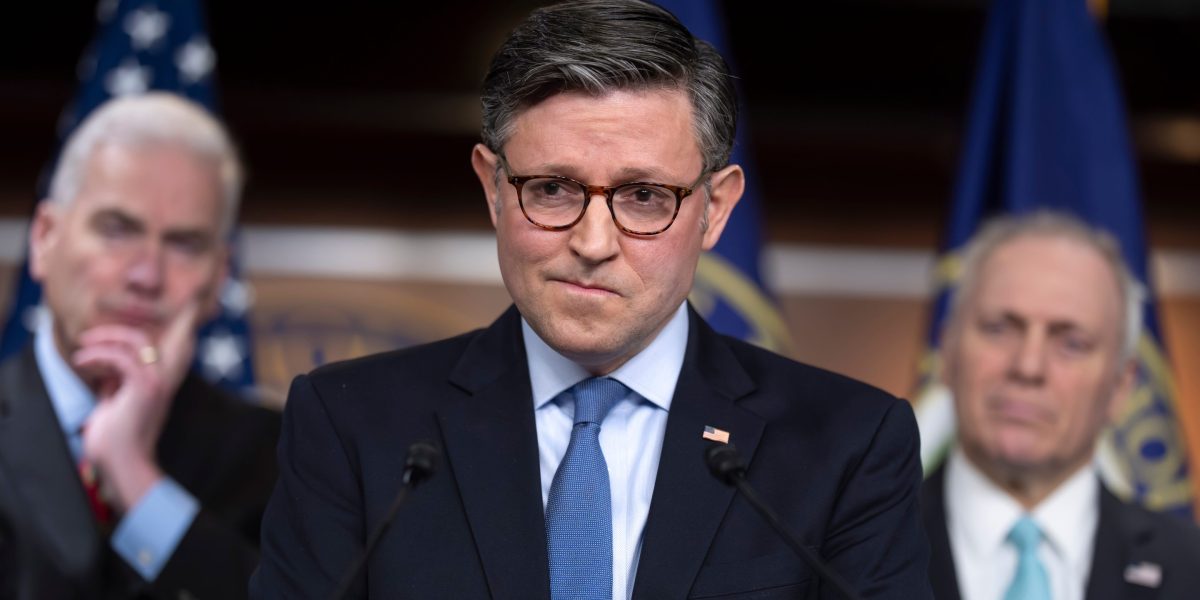
Speaker Mike Johnson had a ready-made refrain when asked why Republicans weren’t moving to extend federal health care subsidies: their party wanted to help 100% of Americans with their costs, not just the 7% of Americans enrolled in Affordable Care Act plans.

But not 100% of his conference agreed.

rare revolt from the moderate wing of the party has upended Johnson’s plans. Four Republicans this week signed onto a Democratic discharge petition that guarantees that the House will vote on extending the ACA subsidies sometime in January, with Republican leaders now powerless to stop it.

For Democrats, it was vindication of a months-long strategy, starting with the government shutdown in the fall, that pushed the expiration of the ACA support to the forefront of politics. Republicans from competitive districts most at risk of losing their seats in next year’s midterms felt the political pressure as they heard from constituents about their skyrocketing premiums.

“Nothing has changed with House Republican leadership, but something has changed within their own ranks,” said Rep. Pete Aguilar, chair of the House Democratic Caucus.

Flanked by his caucus Thursday on the Capitol steps, House Democratic Leader Hakeem Jeffries demanded that Johnson allow a vote on the three-year extension of ACA subsidies before lawmakers leave for the holidays: “Not tomorrow. Not next week. Not next year. Today.”

Johnson refused, saying it will “be on the floor that first week of January when we return.”

Lawmakers prepare to leave in limbo

The impasse left lawmakers with a cliffhanger as they headed home for the holiday break. Republican leaders now face growing pressure to appease centrist members who are threatening to side with Democrats to approve an extension of Affordable Care Act subsidies for three years.

Senate Majority Leader John Thune has to confront the issue as well. Any ACA bill clearing the House would simply push the fight to the Senate, which has already rejected a three-year extension.

A bipartisan group of senators has been meeting and discussing possible compromise bills that would extend the subsidies but put new limitations on them. But they would not consider anything until January.

Thune told reporters Thursday that a three-year extension of “a failed program that’s rife with fraud, waste and abuse is not happening.”

Yet Republican leaders in both chambers have not offered a plan that fully addresses members’ concerns about the sharp insurance cost increases many Americans are expected to face in 2026 and potentially beyond.

The White House has been engaged in discussions about the healthcare proposals but has largely allowed House Republicans to sort out their internal divisions and coalesce around a plan on their own, according to a senior administration official involved in the talks who was granted anonymity to discuss private discussions.

House Republicans on Wednesday passed a 100-plus-page health care package centered on long-standing GOP priorities, including expanding coverage options for small businesses and the self-employed. The bill would also rein in pharmacy benefit managers — middlemen that manage drug costs and process insurance claims.

Johnson touted the measure as “a bigger and better and more important thing for 100% of Americans, not just 7% of Americans.” But some Republicans who face tough reelection bids remain fixated on the looming spike in ACA costs.

The holidays provide Johnson with a brief window to try to persuade moderates to abandon the effort. The discharge petition froze once it reached the 218-signature threshold, meaning that while only four Republicans have publicly signed on, more may be willing to support the Democratic bill.

Rep. Ryan Mackenzie, one of the four Republicans who signed the Democratic petition, said it has “generated more conversations” and that “hopefully over the next three weeks, we will actually see some changes in some bipartisan efforts that actually can generate a meaningful vote that gets 218 in the House and 60 in the Senate.”

“I think allowing a vote is critically important,” Mackenzie said. “I think everybody should be able to put up their votes on the board, and they should be able to let everybody in the American public see how they voted on these individual issues.”

Leader Jeffries’ waiting game pays off

For months, Jeffries refused to support a one-year extension of ACA subsidies that a bipartisan group of lawmakers had been pursuing, dismissing it as a “non-starter” and “a laughable proposition.”

Instead, he held firm on a three-year extension with no income caps or cost offsets. That strategy paid off, as GOP moderates were forced to move in his direction when Johnson refused to allow any vote on an ACA extension.

Jeffries has faced criticism this year from progressive members of his caucus and grassroots groups who have urged him to push back more forcefully against Trump and Republicans. But on Thursday, much of the party rallied behind him on the Capitol steps, with several lawmakers praising his approach.

“As Leader Jeffries has said all along, this is the only real plan on the table,” said Aguilar.

Still, while Democrats have secured a vote, insurance costs for millions are set to rise next year, and passage of a three-year ACA subsidies extension remains a long shot even if it does pass the House. Senate Republicans have already rejected the three-year extension, but some GOP senators who are open to a deal on the subsidies said a House vote could provide momentum.

“We could have a vehicle — if we could get Republicans and Democrats behind it — then we could send it back,” said GOP Sen. Thom Tillis, adding that it “means that there’s still a chance.”

For Democrats, the fight has also allowed them to unify around a message they believe could prove potent on the campaign trail.

“The Republican health care crisis is unacceptable, unconscionable, and un-American,” Jeffries said.

A Republican House divided

The decision by four Republicans to break with party leadership and join Democrats is only the latest sign of discontent in the narrowly divided House.

Johnson has argued that the criticism directed at his leadership — and lawmakers repeatedly bypassing leadership to force votes — is inevitable given the slim GOP majority. He said he lacks the advantages of a large majority, where “the speaker had a long stick that he would administer punishment.”

“I don’t have that, because we have a small margin,” he said. Of the ACA extensions, Johnson said leadership had “talked about it at length” with GOP moderates, describing the conversations as “some intense fellowship.”

“Everybody’s in good spirits now and everybody understands what’s happening,” he added.

Some GOP members, however, don’t appear to share that assessment. There was lingering discontent as lawmakers headed home for the holidays.

“I don’t know how we did not vote on a good bipartisan extension,” said GOP Rep. Don Bacon, adding that Democrats will use the health care issue “like a sledgehammer” on the campaign trail.

House Majority Leader Steve Scalise, R-La., insisted that Republicans are finishing the year “as united as we’ve ever been.”

“We set out on a course to do big things, not little things, and that means we’re going to have some differences along the way.”

___

Associated Press reporter Mary Clare Jalonick and Kevin Freking contributed to this report.


Source link

Continue Reading

Business

Down Arrow Button Icon

Published

on


CEO burnout may be hiding in plain sight. The CEO of Calm, the world’s top sleep and meditation app, said business leaders are losing sleep, feeling drained, and contemplating quitting their jobs. But when asked how they are, they say they’re doing just fine.

Calm chief executive David Ko, speaking to an audience at the Fortune Brainstorm AI conference earlier this month, said his company did a survey of more than 250 C-suite executives, and posed a simple question to them: “How are you doing?”

“Most people said that they were doing good,” Ko said.

But when Ko broke down wellness metrics, from if leaders felt anxious or depressed to mentally present at work, the results were starkly different: 48% of respondents reported being overwhelmed, and a quarter said they were feeling anxiety or depression. Moreover, 34% said they were mentally drained, and 40% reported being unable to be mentally present on the job. Half of the survey participants said they thought of stepping down from their positions.

Ko also asked executives to compare their energy to a battery, arguing it’s a more accessible metric for individuals to assess their mental health. Only one in four executives said their batteries were “fully recharged.”

“Most leaders, like in this room, are operating at about 20%,” Ko said. “Think about what that means.”

The cost of CEO burnout

Burnout, which the majority of small-to-medium business executives report feeling, can not only result in leaders taking more sick days, higher absenteeism, and greater turnover, but can also gnaw at companies’ bottom lines. A study published by the American Journal of Preventive Medicine in April found burned-out workers can cost a workplace an average of $3,999 per hourly worker, and up to more than $20,000 per executive. The social contagion effect, in which employees pick up on the mood of their colleague or superior, can result in a “downward spiral” for the whole office, human resources experts said.

Ko said companies that have invested in mental health interventions report less burnout, higher returns in investments, and greater engagement. Nearly 85% of individuals Calm surveyed reported believing mental health directly impacts a company’s bottom line.

The CEO said mental health interventions, such as using a mindfulness app like Calm, can help employees process AI anxiety, particularly amid growing concerns of AI displacing human workers. According to a Pew Research Center report from February, more than half of employees surveyed said they’re worried about the impact of the technology in the workplace in the future. Calm, for its part, has integrated AI-guided meditations into its app, and Ko suggested his mindfulness app can not only alleviate AI anxiety through mindfulness, but also by having users engage with AI directly.

“In a world that’s currently being transformed by AI, organizations are realizing that our greatest assets aren’t just the technology,” he said. “It’s the people behind them.”


Source link

Continue Reading

Business

Down Arrow Button Icon

Published

on


Good morning. In this week’s episode of Leadership Next, Kristin Stoller and I speak with Dani Richa, chairman and group CEO of Impact BBDO International. In the annals of advertising, few agencies have had more cultural heft than BBDO. In the 1960s, it made Boomers feel part of the “Pepsi Generation” and DuPont cool with the tagline “Better Things for Better Living … through Chemistry.” Matthew Weiner even cited BBDO as the model for the fictional 1960s ad agency in his hit TV series Mad Men.  BBDO also created Snickers’ “You’re not you when you’re hungry” ad with Betty White, and many more iconic campaigns in its 134-year history. 

As a Dubai-based CEO who oversees BBDO Worldwide’s business in the Middle East, Africa and Pakistan, Richa argues that risk is a relative concept in fast-changing markets and times. He recalls thanking one CEO for taking a bold risk with a campaign, only to be told, “What? What risk? What do you mean? The biggest risk I would have taken is not doing that.”

“The starting point is choosing partners that share your values,” he said.

In an era where brands can whip up AI-generated ads—Guess’s AI-generated model in Vogue is hopefully not being a harbinger of what’s to come—Richa’s work is a reminder that technology alone will never triumph when it comes to bold ideas and creativity that’s rooted in real issues. “Big ideas that touch people, that move people, that move businesses, that never changes,” said Richa, while noting that BBDO “uses digital and social (media) like never before to amplify that messaging.”

The best ads don’t just sell products, they can change culture, politics, and the way people think. One especially memorable and award-winning campaign under his watch was “the Elections Edition” in 2022 for Lebanon’s An Nahar newspaper, which ran a blank edition, followed by an invitation for people to fill the pages with messages to politicians. It went viral, generating massive public pressure for elections and citizens’ right to vote. 

Richa compares AI to giving a camera to everyone and then realizing the best photographers produce different results. “AI is going to give you tons of stuff,” he says. “To pick the right message takes a lot of experience, a lot of creative judgment.”  

You can listen to our full conversation on Apple, Spotify or YouTube.

Contact CEO Daily via Diane Brady at diane.brady@fortune.com

Top news

OpenAI looking at $830 billion valuation

Sam Altman’s AI company is in talks for $100 billion in new investment from Softbank and others, the WSJ says. The company is also considering a possible IPO next year.

What that Trump Media-nuclear fusion deal means

The financially struggling Trump Media & Technology Group’s $6 billion merger with a nuclear fusion developer represents either a bet on more taxpayer dollars being invested in the first fusion player to go public—soon owned in part by the Trump family—or a belief that an influx of capital will speed up the launch of clean, limitless electricity that eventually will transform the global grid.

TikTok sale agreed

ByteDance, the Chinese company that owns TikTok, has reached a deal to offload 80% of its U.S. assets to Oracle, Silver Lake, and MGX, according to Reuters. The valuation is not yet known. The deal will help the company avoid being banned in the U.S.—a longstanding promise of President Trump. 

Chanel’s Claire Isnard speaks

Claire Isnard can trace her 40‑year career—including 17 years at Chanel—back to one bad exam. Had she passed, she’d likely still be in a classroom, grading essays on Italian literature. In her first-ever sit-down interview ahead of her retirement, Isnard says she’s come full circle. Despite having zero HR qualifications, she wound up as Chanel’s chief people and chief organization officer. “When you draw my story back, the first compelling and meaningful thing that would end up spread across everything I’ve done is helping people become who they didn’t think they can become,” she told Fortune.

PayPal CEO Alex Chriss on stablecoins

Since January, PayPal’s stock price has dropped more than 30% as it tries to halt competitors from encroaching on its core products of online checkout and peer-to-peer payments. In response, Chriss says the fintech is looking to get a lift from next-generation payment products like stablecoins, and working to incorporate them across its operations and products. 

North Korea is biggest crypto thief

A massive amount of crypto was robbed this year, and most of it went to North Korea. The country accounted for roughly 59% of the more than $3.4 billion in stolen crypto, according to Chainalysis’ 2026 Crypto Crime Report. 

More Epstein photos released

House Democrats released several dozen more photos Thursday from the estate of the convicted sex offender Jeffrey Epstein, showing his associations with the rich and famous, including Bill Gates and Sergey Brin, as the Department of Justice faces a deadline to release many of its case files by the end of the week.

EU agrees €90 billion loan to Ukraine

After a deal to use frozen Russian assets fell apart, the bloc agreed to fund Kyiv’s defense against the invasion by Russia with its own cash. “We committed, we delivered,” European Council president António Costa said.

Trump designates Christmas Eve, Dec. 26 as federal holidays

Government workers will get a five-day weekend, perhaps setting a tone for the private sector.

The markets

S&P 500 futures are up 0.33% this morning. The last session closed up 0.79%. STOXX Europe 600 was flat in early trading. The U.K.’s FTSE 100 was flat in early trading. Japan’s Nikkei 225 was up 1.03%. China’s CSI 300 was up 0.34%. The South Korea KOSPI was up 0.65%. India’s NIFTY 50 was up 0.59%. Bitcoin was at $88K.

Around the watercooler

Southeast Asian economies prove resilient in the face of Trump’s tariffs as supply chains expand by Angelica Ang

Walmart’s women truckers surge thanks to $115,000 starting pay and other perks bringing in nontraditional candidates Marco Quiroz-Gutierrez by Marco Quiroz-Gutierrez

Lovable hits $6.6 billion valuation as its CEO says it wants to be ‘the last piece of software’ companies ever buy by Beatrice Nolan

‘This is a wacky number’: economists cry foul as new government data assumes zero housing inflation in surprising November drop by Eva Roytburg

How Salient, an AI loan processing startup valued at $500 million, grew ARR to $25 million in two years by Lily Mae Lazarus

CEO Daily is compiled and edited by Jim Edwards and Lee Clifford.


Source link

Continue Reading

Business

The new American Dream has parents easing up on college expectations for their kids—1 in 3 are now open to trade school instead

Published

on


Many parents and kids alike are wondering whether college has the same return on investment it once did. Going to college was once seen as a one-way ticket to a successful and lucrative career. Still, there are a growing number of six-figure jobs that don’t require a degree, while entry-level job opportunities for recent graduates remain sparse

Some parents are so anxious about today’s job market that they’re exploring alternatives to the four-year degree, with one-in-three open to the idea of their kids attending a trade school instead, according to new survey results from American Student Assistance, which surveyed more than 2,200 parents of middle and high school students about their attitudes, perceptions, and decision-making about their kids’ post-high school plans. 

The fact that 35% of parents believe career and technical education is best suited for their children represents a major jump—from just 13% in 2019, according to ASA. While parents still prefer traditional college for their kids, it’s much less so than in the past. The percentage of parents preferring it dropped to 58%—a 16 percentage point drop from 2019.

And another study from ASA this summer shows it goes both ways: 70% of teens also report their parents are more supportive of forgoing a college education for something different, like trade school or an apprenticeship. 

“Parents are waking up. College doesn’t carry the same [return on investment] it once did because the cost is outrageous, and the outcome is uncertain,” Trevor Houston, a career strategist at ClearPath Wealth Strategies, previously told Fortune. “Students now face the highest amount of debt ever recorded, but job security after graduation doesn’t really exist.”

The average cost of college in the U.S. is more than $38,000 (tution and room and board) per student per year, according to the Education Data Initiative, and the average cost of college has more than doubled this century. Private schools almost always cost more than the average. Meanwhile, more than 4 million Gen Zers are jobless and blame their “worthless” college degrees. 

Why trade school is becoming more popular

One of the primary reasons trade school is becoming a more popular option for students is it can have a strong ROI, especially as college becomes more expensive and fewer traditional entry-level jobs are available. And many can land recent high school grads six-figure salaries. 

Some trade jobs that don’t require a college degree and pay six figures, according to the National Society of High School Scholars include:

  • Aircraft mechanics ($135,628)
  • Plumbers, pipe fitters, and steamfitters ($132,275)
  • Construction manager ($130,000)
  • Industrial electricians ($122,500)
  • Energy technician ($115,076)

What’s more is availability of these jobs will continue to grow, especially as older generations who work in trades start to retire, Julie Lammers, executive vice president at American Student Assistance, previously told Fortune

“An aging workforce in the trades and a surge in demand to meet infrastructure needs, ever-growing real estate demands, and changes to U.S. energy production mean that there are considerably more job openings than skilled workers to fill the need,” she said. 

Aside from trade school, students can also instead pursue apprenticeships, career-training programs, bootcamps, industry certifications, and occupation licenses. Many of thse are just pennies on the dollar compared to earning a college degree. A coding bootcamp can cost as little as $7,000—and that’s just a one-time fee as compared to nearly $40,000 for one year of college. 

These career paths made possible by trade schools, apprenticeships, bootcamps, and other training and certification programs were coined by IBM as “new-collar jobs.” In October 2017, IBM launched its apprenticeship program to train people for new-collar jobs that prioritize skills over degrees, and focuses on in-demand job functions like cybersecurity, design, data science, mobile development, cloud, artificial intelligence, and blockchain—all career paths that can also lead to six-figure salaries. 

The Trump administration also announced this week its Tech Force program, which does not require a college degree or work experience for technology professionals who are willing to serve two-year stints in federal agencies. If you’re accepted to the program, you can earn about $150,000 to $200,000, considering the demand for tech professionals in today’s rapidly evolving tech landscape.

“This is a clarion call,” Scott Kupor, director of The US Office of Personnel Management, said in a statement. “If you want to help your country lead in the age of rapid technological advancement, we need you.”

This story was originally featured on Fortune.com


Source link

Continue Reading

Trending

Copyright © Miami Select.