Connect with us

Business

Republican leaders powerless to stop a January vote on healthcare after moderates defect on ACA subsidies

Published

on


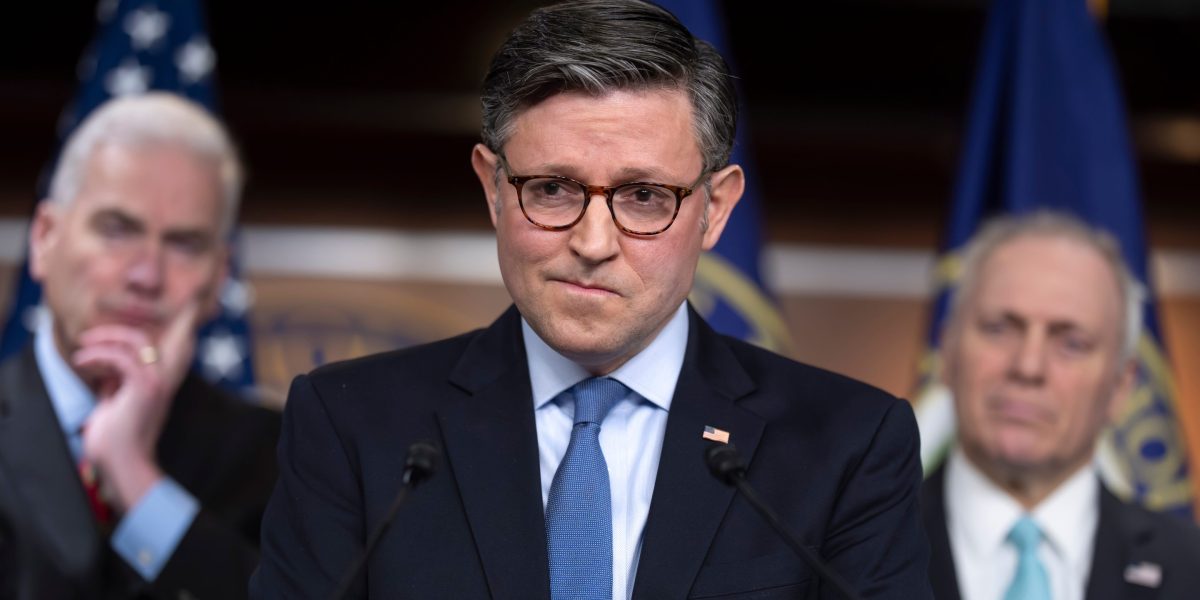
Speaker Mike Johnson had a ready-made refrain when asked why Republicans weren’t moving to extend federal health care subsidies: their party wanted to help 100% of Americans with their costs, not just the 7% of Americans enrolled in Affordable Care Act plans.

But not 100% of his conference agreed.

rare revolt from the moderate wing of the party has upended Johnson’s plans. Four Republicans this week signed onto a Democratic discharge petition that guarantees that the House will vote on extending the ACA subsidies sometime in January, with Republican leaders now powerless to stop it.

For Democrats, it was vindication of a months-long strategy, starting with the government shutdown in the fall, that pushed the expiration of the ACA support to the forefront of politics. Republicans from competitive districts most at risk of losing their seats in next year’s midterms felt the political pressure as they heard from constituents about their skyrocketing premiums.

“Nothing has changed with House Republican leadership, but something has changed within their own ranks,” said Rep. Pete Aguilar, chair of the House Democratic Caucus.

Flanked by his caucus Thursday on the Capitol steps, House Democratic Leader Hakeem Jeffries demanded that Johnson allow a vote on the three-year extension of ACA subsidies before lawmakers leave for the holidays: “Not tomorrow. Not next week. Not next year. Today.”

Johnson refused, saying it will “be on the floor that first week of January when we return.”

Lawmakers prepare to leave in limbo

The impasse left lawmakers with a cliffhanger as they headed home for the holiday break. Republican leaders now face growing pressure to appease centrist members who are threatening to side with Democrats to approve an extension of Affordable Care Act subsidies for three years.

Senate Majority Leader John Thune has to confront the issue as well. Any ACA bill clearing the House would simply push the fight to the Senate, which has already rejected a three-year extension.

A bipartisan group of senators has been meeting and discussing possible compromise bills that would extend the subsidies but put new limitations on them. But they would not consider anything until January.

Thune told reporters Thursday that a three-year extension of “a failed program that’s rife with fraud, waste and abuse is not happening.”

Yet Republican leaders in both chambers have not offered a plan that fully addresses members’ concerns about the sharp insurance cost increases many Americans are expected to face in 2026 and potentially beyond.

The White House has been engaged in discussions about the healthcare proposals but has largely allowed House Republicans to sort out their internal divisions and coalesce around a plan on their own, according to a senior administration official involved in the talks who was granted anonymity to discuss private discussions.

House Republicans on Wednesday passed a 100-plus-page health care package centered on long-standing GOP priorities, including expanding coverage options for small businesses and the self-employed. The bill would also rein in pharmacy benefit managers — middlemen that manage drug costs and process insurance claims.

Johnson touted the measure as “a bigger and better and more important thing for 100% of Americans, not just 7% of Americans.” But some Republicans who face tough reelection bids remain fixated on the looming spike in ACA costs.

The holidays provide Johnson with a brief window to try to persuade moderates to abandon the effort. The discharge petition froze once it reached the 218-signature threshold, meaning that while only four Republicans have publicly signed on, more may be willing to support the Democratic bill.

Rep. Ryan Mackenzie, one of the four Republicans who signed the Democratic petition, said it has “generated more conversations” and that “hopefully over the next three weeks, we will actually see some changes in some bipartisan efforts that actually can generate a meaningful vote that gets 218 in the House and 60 in the Senate.”

“I think allowing a vote is critically important,” Mackenzie said. “I think everybody should be able to put up their votes on the board, and they should be able to let everybody in the American public see how they voted on these individual issues.”

Leader Jeffries’ waiting game pays off

For months, Jeffries refused to support a one-year extension of ACA subsidies that a bipartisan group of lawmakers had been pursuing, dismissing it as a “non-starter” and “a laughable proposition.”

Instead, he held firm on a three-year extension with no income caps or cost offsets. That strategy paid off, as GOP moderates were forced to move in his direction when Johnson refused to allow any vote on an ACA extension.

Jeffries has faced criticism this year from progressive members of his caucus and grassroots groups who have urged him to push back more forcefully against Trump and Republicans. But on Thursday, much of the party rallied behind him on the Capitol steps, with several lawmakers praising his approach.

“As Leader Jeffries has said all along, this is the only real plan on the table,” said Aguilar.

Still, while Democrats have secured a vote, insurance costs for millions are set to rise next year, and passage of a three-year ACA subsidies extension remains a long shot even if it does pass the House. Senate Republicans have already rejected the three-year extension, but some GOP senators who are open to a deal on the subsidies said a House vote could provide momentum.

“We could have a vehicle — if we could get Republicans and Democrats behind it — then we could send it back,” said GOP Sen. Thom Tillis, adding that it “means that there’s still a chance.”

For Democrats, the fight has also allowed them to unify around a message they believe could prove potent on the campaign trail.

“The Republican health care crisis is unacceptable, unconscionable, and un-American,” Jeffries said.

A Republican House divided

The decision by four Republicans to break with party leadership and join Democrats is only the latest sign of discontent in the narrowly divided House.

Johnson has argued that the criticism directed at his leadership — and lawmakers repeatedly bypassing leadership to force votes — is inevitable given the slim GOP majority. He said he lacks the advantages of a large majority, where “the speaker had a long stick that he would administer punishment.”

“I don’t have that, because we have a small margin,” he said. Of the ACA extensions, Johnson said leadership had “talked about it at length” with GOP moderates, describing the conversations as “some intense fellowship.”

“Everybody’s in good spirits now and everybody understands what’s happening,” he added.

Some GOP members, however, don’t appear to share that assessment. There was lingering discontent as lawmakers headed home for the holidays.

“I don’t know how we did not vote on a good bipartisan extension,” said GOP Rep. Don Bacon, adding that Democrats will use the health care issue “like a sledgehammer” on the campaign trail.

House Majority Leader Steve Scalise, R-La., insisted that Republicans are finishing the year “as united as we’ve ever been.”

“We set out on a course to do big things, not little things, and that means we’re going to have some differences along the way.”

___

Associated Press reporter Mary Clare Jalonick and Kevin Freking contributed to this report.


Source link

Continue Reading

Business

House Democrats release more Epstein photos, including Bill Gates and a dinner full of wealthy philanthropists

Published

on


House Democrats released several dozen more photos Thursday from the estate of the convicted sex offender Jeffrey Epstein, showing his associations with the rich and famous, as the Department of Justice faces a deadline to release many of its case files on the late financier by the end of the week.

The photos released Thursday were among more than 95,000 that the House Oversight Committee has received after issuing a subpoena for the photos that Epstein had in his possession before he died in a New York jail cell in 2019. Congress has also passed, and President Donald Trump has signed, a law requiring the Justice Department to release its case files on Epstein, and his longtime girlfriend and confidante Ghislaine Maxwell, by Friday. Anticipation about what those files will show is running high after they have been the subject of conspiracy theories and speculation about his friendships with Trump, former President Bill Clinton, the former Prince Andrew, and others.

House Democrats have already released dozens of photos from Epstein’s estate showing Trump, Clinton and Andrew, who lost his royal title and privileges this year amid scrutiny of his relationship with the wealthy financier. The photos released Thursday showed Epstein cooking with Sultan Ahmed bin Sulayem, an Emirati businessman. The photos also include the billionaire Bill Gates and images of a 2011 dinner of notable people and wealthy philanthropists hosted by a nonprofit group. The committee made no accusations of wrongdoing by the men in the photos.

There were also images of passports, visas and identification cards from Russia, the Czech Republic, Ukraine, South Africa and Lithuania with personally identifying information redacted, as well as photos of Epstein with women or girls whose faces were blacked out. The committee has said it is redacting information from the photos that may lead to the identity of victims being revealed.

Rep. Robert Garcia, the top Democrat on the oversight panel, said in a statement that the “new images raise more questions about what exactly the Department of Justice has in its possession. We must end this White House cover-up, and the DOJ must release the Epstein files now.”

Join us at the Fortune Workplace Innovation Summit May 19–20, 2026, in Atlanta. The next era of workplace innovation is here—and the old playbook is being rewritten. At this exclusive, high-energy event, the world’s most innovative leaders will convene to explore how AI, humanity, and strategy converge to redefine, again, the future of work. Register now.


Source link

Continue Reading

Business

Down Arrow Button Icon

Published

on


A 911 call about a man resembling “the CEO shooter.” Body-camera footage of police arresting Luigi Mangione and pulling items from his backpack, including a gun that prosecutors say matches the one used to kill UnitedHealthcare CEO Brian Thompson, and a notebook they have described as a “manifesto.” Notes about a “survival kit” and “intel checkin,” and testimony about his statements behind bars.

A three-week pretrial hearing on Mangione’s fight to exclude evidence from his New York murder case revealed new details about his December 2024 arrest in Altoona, Pennsylvania, steps prosecutors say he took to elude authorities for five days, and what he may have revealed about himself after he was taken into custody.

The hearing ended Thursday. Mangione watched from the defense table as prosecutors called 17 witnesses, many of them police officers and other personnel involved in his arrest. Mangione’s lawyers called none. Judge Gregory Carro said he won’t rule until May 18, “but that could change.”

Mangione, 27, an Ivy League graduate from a wealthy Maryland family, has pleaded not guilty to state and federal murder charges. The pretrial hearing was in the state case, where he faces the possibility of life in prison, but his lawyers are trying to exclude evidence from both cases. Federal prosecutors are seeking the death penalty. He is due back in court for a hearing in that case on Jan. 9. Neither trial has been scheduled.

Here are some of the things we learned from Mangione’s pretrial hearing:

Body cameras give a close-up look at Mangione’s arrest

The public got an extensive, even exhaustive view of how police in Altoona, about 230 miles (370 kilometers) west of Manhattan, conducted Mangione’s arrest and searched his backpack after he was spotted eating breakfast at McDonald’s.

While there were quirky moments and asides — about holiday music, a hoagie and more — the point of the hearing was to help the judge assess whether Mangione voluntarily spoke to police and whether the officers were justified in searching his property before getting a warrant.

For the first time, body-worn camera video of Mangione‘s arrest was played in court and excerpts from one were made public. Previously, only still images had been released. Taken from multiple officers’ cameras, the footage put ears and eyes on the critical moments surrounding his arrest, along with an incongruously cheerful soundtrack: “Jingle Bell Rock” and other Christmas tunes on the restaurant’s sound system.

Officers on the witness stand were quizzed about what they said and did as Mangione went from noshing on a hash brown to being led away in handcuffs, as well as what they perceived, where they were standing and how they handled evidence after bringing him to a police station.

Mangione’s lawyers argue that none of the results of the search nor statements he made to police should be mentioned at his trial, which has yet to be scheduled. Prosecutors disagree. Carro didn’t hint at his conclusion. He invited both sides to submit written arguments and said he planned to study the body-camera video before issuing a written decision.

Differing views of Mangione’s statements and bag search

Mangione’s lawyers noted that one officer said “we’ll probably need a search warrant” for the backpack, but his colleagues had already rifled through it and later searched the bag again before getting a warrant.

Prosecutors emphasized an Altoona police policy, which they said is rooted in Pennsylvania law, that calls for searching the property of anyone who is being arrested. The two sides also amplified some contrasting signals, in officers’ words and actions, about their level of concern about whether the backpack contained something dangerous that could justify a warrantless search.

The officer searching the bag, Christy Wasser, testified that she was checking for a bomb. But Mangione’s lawyers pointed out that police didn’t clear the restaurant of customers — some were seen on body-camera footage walking to a bathroom a few feet away — and that she stopped her initial search almost immediately after finding a loaded gun magazine wrapped in a pair of underwear.

The find appeared to confirm officers’ suspicions that Mangione was the man wanted for Thompson’s killing.

“It’s him, dude. It’s him, 100%,” officer Stephen Fox was heard saying on body-worn camera video, punctuating the remark with expletives as Wasser held up the magazine.

Mangione gave police a fake name and a reason to arrest him

Mangione’s statements to police prior to his arrest matter mainly because, as shown on body-worn camera video, he initially gave officers a fake name — Mark Rosario — and a phony New Jersey driver’s license bearing that name. He eventually acknowledged the ruse and gave his real name after police ran the ID through a computer system and couldn’t get a match.

The fake name promptly gave Altoona police a reason to arrest him and hold him for New York City police. “If he had provided us with his actual name, he would not have committed a crime,” Fox testified. An NYPD lieutenant testified that the Rosario name matched one the suspected shooter used to purchase a bus ticket to New York and gave at a Manhattan hostel.

Mangione told police early on he didn’t want to talk, but officers engaged him for almost 20 minutes before a supervisor urged Fox to inform him of his right to remain silent. It happened after Mangione had admitted to lying about his name and said he “clearly shouldn’t have.”

An important factor in whether suspects have to be informed of their right to stay silent — known as a Miranda warning — is whether they are in police custody.

Prosecutors elicited testimony from officers suggesting Mangione could have believed he was free to leave when he gave the false name. But one of the first officers to encounter Mangione testified that he “was not free to leave until I identified who he was” — though Mangione wasn’t told that, and body camera video showed multiple officers standing between him and the restaurant door.

911 caller: Customers concerned ‘he looks like the CEO shooter’

For the first time, the public heard the 911 call that drew police to the Altoona McDonald’s, ultimately leading to Mangione’s arrest.

The restaurant’s manager told a dispatcher: “I have a customer here that some other customers were suspicious of that he looks like the CEO shooter from New York. They’re just really upset and they’re like coming to me and I was like, ‘Well, I can’t approach them, you know.’ ”

The woman, whose name was edited out of the recording played in court and omitted from the version released to the public, said she first tried calling a non-emergency number, but no one answered. Then she called 911.

“It’s not really an emergency,” she told the dispatcher at the start of the call.

The manager said Mangione was wearing a medical mask and a beanie pulled down on his forehead, leaving only his eyes and eyebrows visible. She said she searched online for a photo of the suspect for comparison.

A hoagie reward and getting ‘the ball rolling’ with the NYPD

At first, Altoona police officers were skeptical that Thompson’s killer might be in their city, a community of about 44,000 people about midway between Pittsburgh and Harrisburg.

Patrolman Joseph Detwiler, the first officer to arrive at McDonald’s, sarcastically responded “10-4” when a dispatcher asked him to check on the manager’s 911 call, a police supervisor testified.

The supervisor, Lt. Tom Hanelly Jr., testified that he texted Detwiler a reminder to take the call seriously and offered to buy the officer his favorite hoagie — a large turkey from local sandwich shop Luigetta’s — if he nabbed “the New York City shooter.”

Though, Hanelly acknowledged on the witness stand, “it seemed preposterous on its face.”

Hanelly said he read up on the shooting as he drove to McDonald’s and searched for a direct line “to get the ball rolling” with NYPD investigators. He ended up calling a New York City 911 call taker.

“We’re acting off a tip from a local business here, we might have the shooter,” Hanelly said in a recording played in court.

The call taker asked what shooter he was talking about. Hanelly then clarified, “the UHC shooter” and said he “matches the photos that your department put out.”

Hanelly said an NYPD detective called him back about 45 minutes later.

Mangione in court: Pumping his fist and scribbling notes

Mangione stayed active throughout the hearing, taking notes, reading documents, conferring with his lawyers and occasionally looking back toward his two-dozen or so supporters in the courtroom gallery.

He watched intently as prosecutors played a surveillance video of the killing and security and body-worn camera footage of his interactions with Altoona police. He pressed a finger to his lips and a thumb to his chin as he watched footage of two police officers approaching him at the McDonald’s.

He gripped a pen in his right hand, making a fist at times, as prosecutors played the 911 call.

Mangione arrived to court each morning from a federal jail in Brooklyn, where he has been held since shortly after his arrest. He was given permission to wear regular clothes — a gray or dark blue suit and various button-down shirts — instead of jail garb and had his hands uncuffed throughout the proceedings.

One day, he pumped his fist for photographers. Another day, he shooed away a photographer he felt had gotten too close to him.

A backpack full of ‘goodies,’ including to-do lists and travel plans

Along with the gun and notebook, police officers said Mangione’s backpack was stuffed with food, electronics and notes including to-do lists, a hand-drawn map and tactics for surviving on the lam — items Altoona Police Sgt. Eric Heuston described as “goodies” that might link him to the killing.

‘Keep momentum, FBI slower overnight,’ said one note. ‘Change hat, shoes, pluck eyebrows,’ said another.

One note said to check for “red eyes” from Pittsburgh to Columbus, Ohio or Cincinnati (“get off early,” it reads). The map showed lines linking those cities, and noted other possible destinations, including Detroit and St. Louis.

Other items found on Mangione or in his bag included a pocketknife, driver’s license, passport, credit cards, AirPods, protein bar, travel toothpaste and flash drives.

Mangione talked behind bars, prison officers say

Before he was moved to New York City, Mangione was held under close watch in a special housing unit at a Pennsylvania state prison, SCI Huntingdon, about 19 miles (31 kilometers) west of Altoona.

Correctional officer Matthew Henry testified that Mangione made an unprompted comment to him that he had a backpack with a 3D-printed pistol and foreign currency when he was arrested.

Correctional officer Tomas Rivers testified that Mangione asked him whether the news media was focused on him as a person or on the crime of Thompson’s killing. He said Mangione told him he wanted to make a public statement.

Rivers said Mangione was in the special housing unit in part because the facility’s superintendent had said he “did not want an Epstein-style situation,” referring to Jeffrey Epstein’s suicide at a Manhattan federal jail in 2019.


Source link

Continue Reading

Business

The Kennedy Center is now the Trump Kennedy Center, White House says

Published

on


President Donald Trump’s handpicked board voted Thursday to rename Washington’s leading performing arts center as the Trump Kennedy Center, the White House said, in a move that made Democrats fume, saying the board had overstepped its legal authority.

Congress named the center after President John F. Kennedy in 1964, after his assassination. Donald A. Ritchie, who served as Senate historian from 2009-2015, said that because Congress had first named the center it would be up to Congress to “amend the law.”

Richie said that while Trump and others can “informally” refer to the center by a different name, they couldn’t do it in a way “that would (legally) stick.”

But the board did not wait for that debate to play out, immediately changing the branding on its website to reflect the new name.

House Democratic leader Hakeem Jeffries told reporters that legislative action was needed, “and we’re going to make that clear.” The New York Democrat is an ex officio member of the board because of his position in Congress.

Trump has teased the name change for some time

Press secretary Karoline Leavitt announced the vote on social media, attributing it to the “unbelievable work President Trump has done over the last year in saving the building. Not only from the standpoint of its reconstruction, but also financially, and its reputation.”

Trump, a Republican who’s chairman of the board, said at the White House that he was “surprised” and “honored” by the vote.

“The board is a very distinguished board, most distinguished people in the country and I was surprised by it and I was honored by it,” he said.

Trump had already been referring to the center as the “Trump Kennedy Center.” Asked Dec. 7 as he walked the red carpet for the Kennedy Center Honors program whether he would rename the venue after himself, Trump said such a decision would be up to the board.

Earlier this month, Trump talked about a “big event” happening at the “Trump Kennedy Center” before saying, “excuse me, at the Kennedy Center,” as his audience laughed. He was referring to the FIFA World Cup soccer draw for 2026, in which he participated.

A name change won’t sit well with some Kennedy family members.

Maria Shriver, a niece of John F. Kennedy, referred to the legislation introduced in Congress to rebrand the Kennedy Center as the Donald J. Trump Center for the Performing Arts as “insane” in a social media post in July.

“It makes my blood boil. It’s so ridiculous, so petty, so small minded,” she wrote. “Truly, what is this about? It’s always about something. ‘Let’s get rid of the Rose Garden. Let’s rename the Kennedy Center.’ What’s next?”

Trump earlier this year turned the Kennedy-era Rose Garden at the White House into a patio by removing the lawn and laying down paving stones.

Another Kennedy family member, Robert F. Kennedy Jr., serves in Trump’s Cabinet as secretary of the Department of Health and Human Services.

Trump showed scant interest in the Kennedy Center during his first term as president, but since returning to office in January he has replaced board members appointed by Democratic presidents with some of his most ardent supporters, who then elected him as board chairman.

He also has criticized the center’s programming and its physical appearance and has vowed to overhaul both.

Trump secured more than $250 million from the Republican-controlled Congress for renovations of the building.

He attended opening night of the musical “Les Misérables,” and last week he served as host of the Kennedy Center Honors program after not attending the show during his first term as president. The awards program is scheduled to be broadcast by CBS and Paramount+ on Dec. 23.

Sales of subscription packages are said to have declined since Trump’s takeover of the center, and several touring productions, including “Hamilton,” have canceled planned runs there. Rows upon rows of empty seats have been seen in the Concert Hall during performances by the National Symphony Orchestra.

Some performers, including actor Issa Rae and musician Rhiannon Giddens, have scrapped scheduled appearances, and Kennedy Center consultants including musician Ben Folds and singer Renée Fleming have resigned.

___

AP writer Hillel Italie contributed to this story from New York.


Source link

Continue Reading

Trending

Copyright © Miami Select.