Connect with us

Politics

Rays extension will ‘probably have to happen’
Published

on


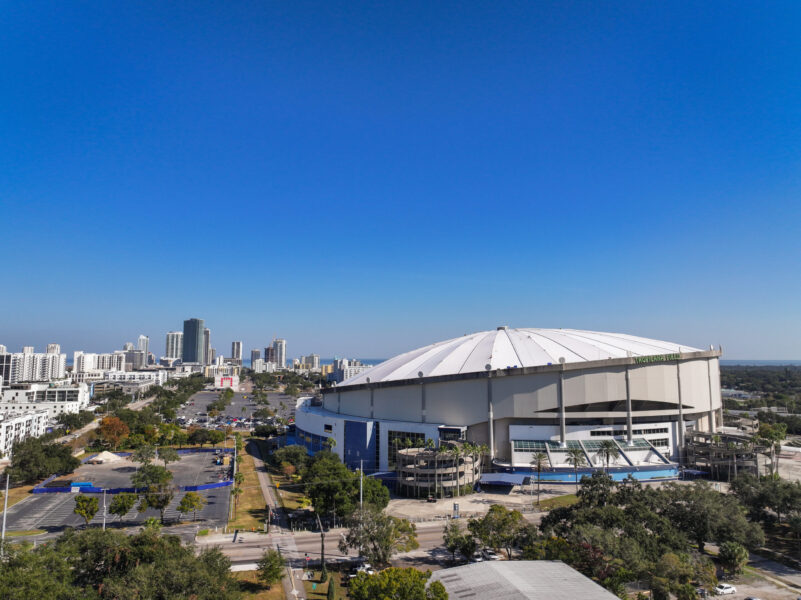
St. Petersburg Mayor Ken Welch believes the Tampa Bay Rays will need to extend their lease at Tropicana Field beyond 2028.

Patrick Zalupski, the team’s new majority owner, caused a stir in early October by announcing plans to open the 2029 season in a new stadium. He acknowledged that the timeline was “aggressive, and perhaps audacious.” Many stakeholders believe it is unfeasible. 

In a recent interview, Welch said the two parties have discussed extending the team’s lease “only in passing.” The Rays have not formally requested additional time at the Trop, which is now sporting a roof for the first time in over a year. 

“We’ve got a stadium that can be their home for five, seven years, whatever makes sense,” Welch told the Catalyst. “And then long term, it’ll have to be a different conversation.” 

Welch called a short-term lease extension practical and the “first, best option” for the Rays. “I think it will probably have to happen,” he added. 

However, any agreement must also “make sense for the city.” An extension cannot impede long-awaited plans to redevelop roughly 60 acres of prime real estate surrounding the stadium. 

The city began displacing thousands of Black residents and business owners, including the Mayor’s grandfather, from the Historic Gas Plant District in the 1980s. Welch noted that the land has featured a sea of surface parking lots for over 40 years, rather than previously promised jobs, housing and economic opportunities. 

“So, we’re going to move forward with that,” he said. The Rays, under former owner Stuart Sternberg, exited an arduously negotiated redevelopment deal in March. 

A spokesperson said the Rays would not comment on a potential lease extension “right now.” 

Zalupski previously said a new fixed-roof stadium would anchor a “best-in-class” development, likely encompassing at least 100 acres, with hotels, office space, shops, restaurants, bars and a music venue. Welch subsequently said the acreage target would seemingly eliminate the Gas Plant from contention. 

“So, there are a lot more conversations that need to happen if it came to a point where they decided this was a spot, and they wanted to resurrect the old deal,” he added. “At least for the stadium piece, it’ll have to be a whole different funding model.” 

Mayor Ken Welch at a Nov. 20 City Hall on Tour event. Image via Mark Parker/St. Pete Catalyst.

Welch no longer supports using community redevelopment area (CRA) coffers to help fund a new stadium. However, the financing mechanism could offset site infrastructure costs. 

Administrators are currently considering a $6.8 billion unsolicited redevelopment proposal. The project, led by ARK Investment Management and Ellison Development, would encompass 94.5 acres.

The proposal checks several boxes on Zalupski’s wishlist – without the Rays spending a dime. It also includes a stadium option.

Team leadership is studying several potential stadium sites throughout Tampa Bay. Rays co-owner and CEO Ken Babby has said that the team is watching the Gas Plant process unfold “like everybody else,” and “we’ll see what the future brings.” 

Babby has also noted that the “home of the Tampa Bay Rays is right here at Tropicana Field,” and credited the city for ensuring the storm-damaged ballpark is ready for the 2026 baseball season. 

Welch, in his first meeting with the new owners, emphasized the importance of a “sincere effort” to repair relationships with the community, the city, and Pinellas County after the Rays reneged on signed deals and dissolved once-substantial support for a new stadium. “They understood that,” he said. 

“Ken Babby, in particular, said, ‘We need to rebuild those relationships,’” Welch continued. “I think they’ve said and done all the right things so far to do that. And I give them credit for that.” 

For now, both sides are celebrating a significant milestone at the Trop. The city announced Nov. 21 that crews had installed the domed stadium’s final roof panel ahead of schedule. 

The Rays, in a social media post, called it a “massive step forward” for the team, city and fans. Babby, on his personal account, said he was “beyond thankful.” 

Tampa Bay Rays CEO Ken Babby (center) talks with Chris Steinocher (left), CEO of the St. Petersburg Area Chamber of Commerce, and Mark Ferguson, owner of Ferg’s Sports Bar and Grill, at a Nov. 12 event. Image via Mark Parker/St. Pete Catalyst.

St. Petersburg must provide the Rays with a suitable home for Major League Baseball under the current use agreement. City Council members have approved nearly $60 million in remediation and repair expenses, and the final cost could continue climbing. 

Babby previously pledged that the ballpark would “look better than it ever has” when fans return in April 2026. Welch subsequently said the Trop’s “bones” are in “very good shape,” according to city engineers. 

The Mayor would not support a “big new investment” in the stadium. He also realizes that “having the Trop open again is good for our economy.” 

“To me, if we did not go this route, I don’t think the Rays would ever be back in St. Pete or Tampa Bay,” Welch said of repairing the Trop. “Because I don’t think playing outdoors in the Summer is something they want to do for more than one year, in an emergency situation

“I really saw that as the only route to bring the Rays back here, and then have the potential for them staying long-term.”

Welch reiterated that the Rays know he is open to discussing a lease extension at the Trop, and that his focus remains on the surrounding land. He also noted that a termination agreement with previous ownership allows the city to redevelop two parcels – one for affordable housing and one for a new Woodson African American Museum of Florida – “almost immediately.” 

___

Mark Parker reports via St. Pete Catalyst; republished with permission.


Source link

Continue Reading

Politics

Carlos G. Smith files bill to allow medical pot patients to grow their own plants

Published

on


Home cultivation of marijuana plants could be legal under certain conditions.

Medical marijuana patients may not have to go to the dispensary for their medicine if new legislation in the Senate passes.

Sen. Carlos G. Smith’s SB 776 would permit patients aged 21 and older to grow up to six pot plants.

They could use the homegrown product, but just like the dispensary weed, they would not be able to re-sell.

Medical marijuana treatment centers would be the only acceptable sourcing for plants and seeds, a move that would protect the cannabis’ custody.

Those growing the plants would be obliged to keep them secured from “unauthorized persons.”

Chances this becomes law may be slight.

A House companion for the legislation has yet to be filed. And legislators have demonstrated little appetite for homegrow in the past.


Source link

Continue Reading

Politics

Rolando Escalona aims to deny Frank Carollo a return to the Miami Commission

Published

on


Early voting is now underway in Miami for a Dec. 9 runoff that will decide whether political newcomer Rolando Escalona can block former Commissioner Frank Carollo from reclaiming the District 3 seat long held by the Carollo family.

The contest has already been marked by unusual turbulence: both candidates faced eligibility challenges that threatened — but ultimately failed — to knock them off the ballot.

Escalona survived a dramatic residency challenge in October after a rival candidate accused him of faking his address. A Miami-Dade Judge rejected the claim following a detailed, three-hour trial that examined everything from his lease records to his Amazon orders.

After the Nov. 4 General Election — when Carollo took about 38% of the vote and Escalona took 17% to outpace six other candidates — Carollo cleared his own legal hurdle when another Judge ruled he could remain in the race despite the city’s new lifetime term limits that, according to three residents who sued, should have barred him from running again.

Those rulings leave voters with a stark choice in District 3, which spans Little Havana, East Shenandoah, West Brickell and parts of Silver Bluff and the Roads.

The runoff pits a self-described political outsider against a veteran official with deep institutional experience and marks a last chance to extend the Carollo dynasty to a twentieth straight year on the dais or block that potentiality.

Escalona, 34, insists voters are ready to move on from the chaos and litigation that have surrounded outgoing Commissioner Joe Carollo, whose tenure included a $63.5 million judgment against him for violating the First Amendment rights of local business owners and the cringe-inducing firing of a Miami Police Chief, among other controversies.

A former busboy who rose through the hospitality industry to manage high-profile Brickell restaurant Sexy Fish while also holding a real estate broker’s license, Escalona is running on a promise to bring transparency, better basic services, lower taxes for seniors and improved permitting systems to the city.

He wants to improve public safety, support economic development, enhance communities, provide more affordable housing, lower taxes and advocate for better fiscal responsibility in government.

He told the Miami Herald that if elected, he’d fight to restore public trust by addressing public corruption while re-engaging residents who feel unheard by current officials.

Carollo, 55, a CPA who served two terms on the dais from 2009 to 2017, has argued that the district needs an experienced leader. He’s pointed to his record balancing budgets and pledges a residents-first agenda focused on safer streets, cleaner neighborhoods and responsive government.

Carollo was the top fundraiser in the District 3 race this cycle, amassing about $501,000 between his campaign account and political committee, Residents First, and spending about $389,500 by the last reporting dates.

Escalona, meanwhile, reported raising close to $109,000 through his campaign account and spending all but 6,000 by Dec. 4.

The winner will secure a four-year term.


Source link

Continue Reading

Politics

Florida kicks off first black bear hunt in a decade, despite pushback

Published

on


For the first time in a decade, hunters armed with rifles and crossbows are fanning out across Florida’s swamps and flatwoods to legally hunt the Florida black bear, over the vocal opposition of critics.

The state-sanctioned hunt began Saturday, after drawing more than 160,000 applications for a far more limited number of hunting permits, including from opponents who are trying to reduce the number of bears killed in this year’s hunt, the state’s first since 2015.

The Florida Fish and Wildlife Conservation Commission awarded 172 bear hunt permits by random lottery for this year’s season, allowing hunters to kill one bear each in areas where the population is deemed large enough. At least 43 of the permits went to opponents of the hunt who never intend to use them, according to the Florida chapter of the Sierra Club, which encouraged critics to apply in the hopes of saving bears.

The Florida black bear population is considered one of the state’s conservation success stories, having grown from just several hundred bears in the 1970s to an estimated more than 4,000 today.

The 172 people who were awarded a permit through a random lottery will be able to kill one bear each during the 2025 season, which runs from Dec. 6 to Dec. 28. The permits are specific to one of the state’s four designated bear hunting zones, each of which have a hunting quota set by state officials based on the bear population in each region.

In order to participate, hunters must hold a valid hunting license and a bear harvest permit, which costs $100 for residents and $300 for nonresidents, plus fees. Applications for the permits cost $5 each.

The regulated hunt will help incentivize maintaining healthy bear populations, and help fund the work that is needed, according to Mark Barton of the Florida chapter of Backcountry Hunters and Anglers, an advocacy group that supported the hunt.

Having an annual hunt will help guarantee funding to “keep moving conservation for bears forward,” Barton said.

According to state wildlife officials, the bear population has grown enough to support a regulated hunt and warrant population management. The state agency sees hunting as an effective tool that is used to manage wildlife populations around the world, and allows the state to monetize conservation efforts through permit and application fees.

“While we have enough suitable bear habitat to support our current bear population levels, if the four largest subpopulations continue to grow at current rates, we will not have enough habitat at some point in the future,” reads a bear hunting guide published by the state wildlife commission.

___

Republished with permission of the Associated Press.


Source link

Continue Reading

Trending

Copyright © Miami Select.