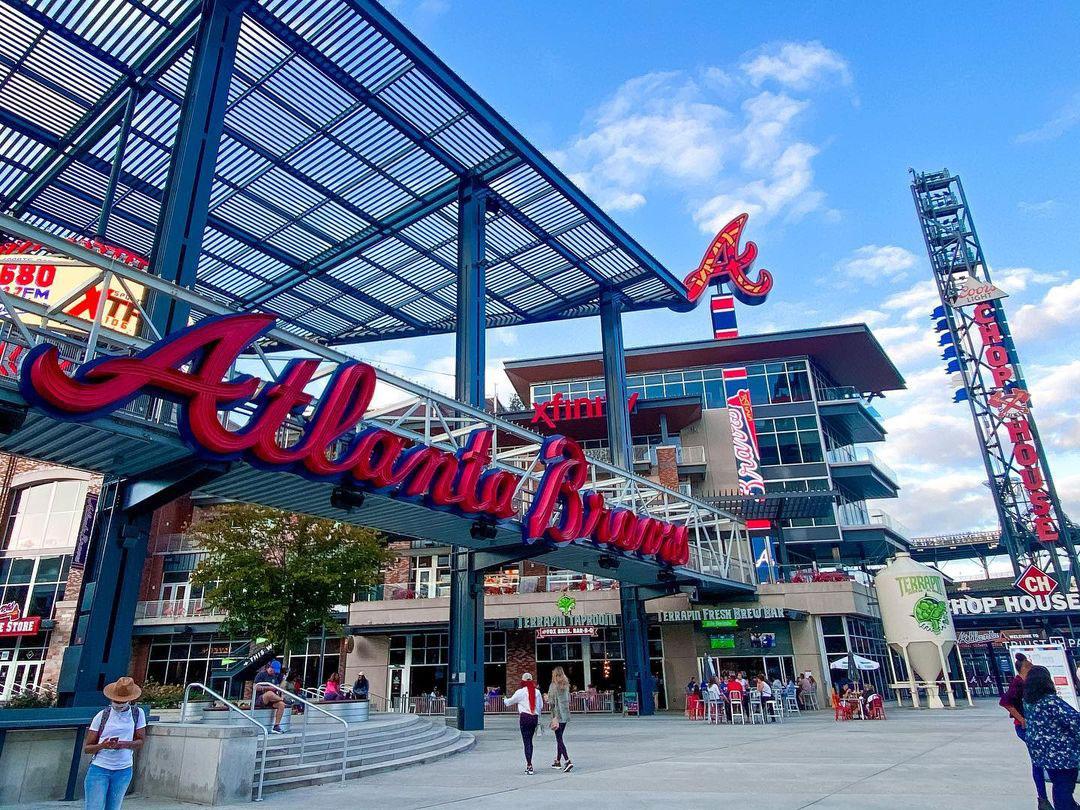
The Battery Atlanta Changed the Economics of Sports
When the Atlanta Braves opened Truist Park in 2017, the real revolution wasn’t the stadium—it was The Battery, a mixed‑use district built around it. Sports Business Journal and Front Office Sports have repeatedly highlighted The Battery as the most successful stadium‑anchored development in North America.
The model is simple:
- The stadium draws people
- The district keeps them there
- The surrounding development—not the ballpark—drives the revenue
Hotels, restaurants, apartments, office towers, and entertainment venues create a 365‑day economic engine.
Why This Model Works
The Battery succeeds because it blends:
- Walkability
- Mixed‑use density
- Year‑round programming
- Seamless integration of sports and entertainment
- A design that encourages people to stay before and after games
It is not a stadium with development around it. It is a neighborhood built around a stadium.
Tampa’s HCC Village Could Replicate—and Improve—This Model
The proposed HCC stadium village mirrors The Battery’s core principles but adds unique advantages:
- A college campus integrated into the district
- A minor league/academy stadium
- Proximity to an NFL stadium
- A central location accessible to the majority of the region’s population
Tampa’s version would be larger, more diverse, and more interconnected than Atlanta’s.
The Economic Impact Is Proven
Cobb County’s tax revenue, hotel occupancy, and business growth around The Battery have exceeded projections every year since 2017. The district has become a national case study in how sports can anchor long‑term development.
Tampa’s business community sees the same potential. The HCC village would generate:
- New tax revenue streams
- Year‑round tourism
- Job creation
- A revitalized urban corridor
A Unified Sports District With Even Greater Potential
The combination of a new Tampa Bay Rays ballpark, the existing facilities at Steinbrenner Field and Raymond James Stadium, and a fully redeveloped HCC Dale Mabry campus could create a sports and entertainment district that surpasses the scale and impact of Atlanta’s Battery. With three major venues already clustered in a high‑traffic corridor, the foundation is stronger than what Atlanta started with. Add in mixed‑use development, year‑round activation, and the ability to leverage existing infrastructure, and Tampa has the chance to build a destination that is bigger, more connected, and more economically powerful than anything the region has seen.
Source link