Connect with us

Business

Ray Dalio issues his most dire warning to America yet: The ballooning $37 trillion deficit will trigger an ‘economic heart attack’

Published

on


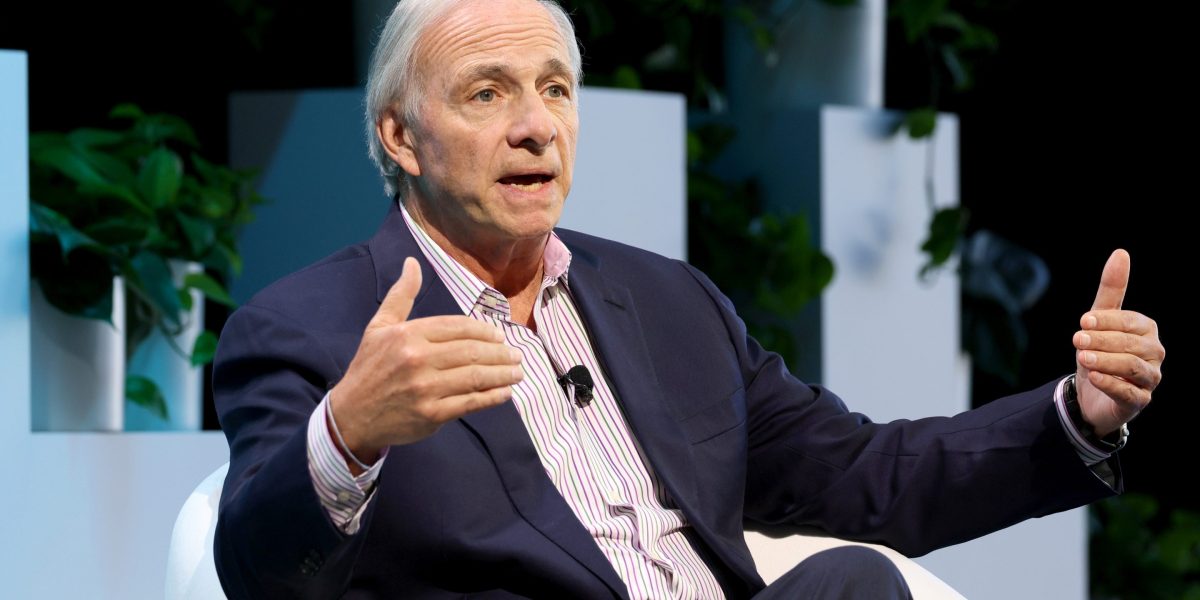
Hedge fund billionaire Ray Dalio is known for his dire warnings about the economy and the national debt, but he just issued one of his starkest warnings to date, likening the United States’ mounting debt crisis to an impending “economic heart attack” and urging policymakers to revisit the fiscal discipline that characterized the 1990s boom years. Dalio’s alarm, sounded in a series of social media posts and interviews, including with Fortune‘s Diane Brady, comes as the national debt nears $37 trillion and the federal deficit continues to swell, fueling bipartisan anxieties about the country’s financial health.

Dalio, founder of the world’s largest hedge fund, Bridgewater Associates, described America’s deficit spiral in dramatic—and visceral—terms. “We’re spending 40% more than we’re taking in and this is a chronic problem,” he said in a recent appearance on Fox Business. “What you’re seeing is the debt service payments … well into squeezing away, so it’s like plaque in the arteries squeezing away buying power.”

The analogy underscores a grim reality: debt service payments have ballooned as a share of government spending, increasingly crowding out funds for other priorities. Dalio warns the U.S. is near a tipping point where it must issue new debt merely to pay interest on existing obligations—a cycle he says could trigger not just a financial shock but a systemic breakdown reminiscent of cardiac arrest. We’ve got to go back, he argues—back to the ’90s.

A blueprint for recovery

Dalio contends that there is still a way out—as long as the country acts with unity and resolve. He points to the ’90s as a model for bipartisan problem-solving, fiscal restraint, and balanced economic growth. “If we change spending and income (tax returns) by 4% while the economy is still good,” he wrote on Twitter, “the interest rate will go down as a result and we’ll be in a much better situation.” He added that we know this kind of balance can happen because it happened before, from 1991 to 1998. Dalio wrote, referencing how both spending controls and targeted tax measures restored equilibrium in the 1990s.

Dalio suggests that by trimming the federal deficit to 3% of GDP—levels last sustained during the Clinton era—the U.S. could stabilize markets, tame interest payments, and avoid crisis. In a CNBC appearance in early July, Dalio put the odds at over 50% that a financial “trauma” will result from the debt not being dealt with properly.

Past warnings

This is far from the first dire warning to come from Dalio on the state of the U.S. economy. In the past five years, he has voiced concerns about the debt created to fight the financial effects of the pandemic, both inflation and stagflation, and even a looming recession. Although a recession has not set in since the COVID-related crash of 2020, Dalio warned that rising asset prices weren’t creating real wealth, as inflation was eroding purchasing power.

A consistent theme of Dalio’s warnings is that the disease may be worse than the cure, criticizing policymakers likely to act only when inflation became critical and the dollar’s value had materially eroded. He has voiced variations of his “heart attack” and “plaque” critique since 2024.

Despite offering a clear prescription, Dalio expresses skepticism that current political dynamics will allow for compromise or the hard choices required. “My fear is that we will probably not make these needed cuts due to political reasons,” he wrote on Twitter, warning that absolutism in Washington could doom efforts to put the country’s fiscal house in order.

The consequences, Dalio argues, would be severe and far-reaching: sustained government overspending, rising debt service burdens, and a loss of confidence among buyers of U.S. Treasuries. This scenario, he says, could escalate into what he calls a “serious supply-demand problem,” where the market refuses to fund America’s borrowing habits at sustainable rates, catalyzing a financial crisis with global shockwaves. The April fall in the 10-year Treasury bond market was a tremor of just such a refusal from foreign investors, who seemed to balk at President Donald Trump’s planned tariffs being much more aggressive than expected.

Dalio’s repeated invocations of the 1990s are more than nostalgia—they are a call to bipartisan pragmatism and shared sacrifice. He warns that failure to act now, with the economy still on stable footing, will only raise the costs (and pain) of inevitable reforms. Although Dalio did not comment on it, the debt situation has actually worsened throughout 2025, with legislation passing through Congress that is set to expand the debt for years to come. Trump’s One Big Beautiful Bill Act will add $3.4 trillion to deficits over the next decade, according to the Congressional Budget Office.

For this story, Fortune used generative AI to help with an initial draft. An editor verified the accuracy of the information before publishing. 


Source link

Continue Reading

Business

Cadillac returns as sponsor for PGA tour event at Trump National Doral

Published

on


Cadillac is returning as the title sponsor of a lucrative PGA Tour event held at Trump National Doral, which will hold one of the $20 million signature events in 2026.

The Cadillac Championship will be held the first weekend in May on the course once dubbed the “Blue Monster.” Doral first became part of the PGA Tour schedule in 1962, and it was held each year through 2016 until becoming a World Golf Championship under various names.

Brian Rolapp, the CEO of the PGA Tour, referred to Trump National Doral as a “legacy venue on our schedule.”

“We appreciate the support of Cadillac as we bring a new era of the PGA Tour to our fans in Miami,” Rolapp said in a statement.

Cadillac was the title sponsor of the WGC at Trump National Doral from 2011 through 2016. But the automaker chose not to renew its contract, the PGA Tour could not find a replacement sponsor for Doral in 2016 when President Donald Trump was the presumptive Republican nominee and the WGC event was moved to Mexico City.

Doral is among eight courses that has held a regular PGA Tour event for at least 50 years — the others are Riviera, Pebble Beach and Torrey Pines in California; Colonial (Texas), Waialae (Hawaii), Harbour Town (South Caroline) and Muirfield Village (Ohio).

It returned to the golf landscape in 2022 by hosting a LIV Golf event each of the last four years until returning to the PGA Tour schedule for 2026. The tour designated Trump National Doral a signature event before it signed Cadillac as the title sponsor.

This story was originally featured on Fortune.com


Source link

Continue Reading

Business

Rob Reiner’s 32-year-old son in jail after fatal stabbing at Los Angeles home

Published

on


Rob Reiner’s younger son, Nick Reiner, was in jail Monday after being booked for what investigators believe was the fatal stabbing of the director-actor and his wife at their Los Angeles home a day earlier, authorities said.

It was not immediately clear what charges Nick Reiner, 32, would face. A police statement said he was being held without bail and the case will be presented to the district attorney’s office on Tuesday.

Representatives for the Reiner family did not immediately respond to a request for comment, and it wasn’t immediately clear if Nick Reiner had an attorney who could speak on his behalf.

Nick Reiner has spoken publicly of his struggles with addiction. By 18, he had cycled in and out of treatment facilities with bouts of homelessness and relapses in between. Rob and Nick Reiner explored their difficult relationship and Nick Reiner’s struggles with drugs in a semi-autobiographical 2016 film, “ Being Charlie.”

Rob and Michele Singer Reiner were found dead Sunday afternoon at their home in Los Angeles, and investigators believe they were stabbed, a law enforcement official told The Associated Press. The official, who was briefed on the investigation, could not publicly discuss the details and spoke to the AP on condition of anonymity.

Nick Reiner was arrested Sunday around 9:15 p.m., police said.

Reiner was long one of the most prolific directors in Hollywood, and his work included some of the most memorable movies of the 1980s and ’90s, including “This is Spinal Tap,” “A Few Good Men,” “When Harry Met Sally” and “The Princess Bride.”

His role as Michael “Meathead” Stivic in Norman Lear’s 1970s TV classic “All in the Family” as a liberal foil to Carroll O’Connor’s Archie Bunker catapulted him to fame and won him two Emmy Awards.

The son of comedy legend Carl Reiner, Rob Reiner married photographer Michele Singer Reiner in 1989. The two met while he was directing “When Harry Met Sally.” They had three children together: Nick, Jake and Romy.

Reiner told The New York Times in 1989 that the cinematographer on “When Harry Met Sally,” Barry Sonnenfeld, predicted he would marry her. “I look over and I see this girl, and whoo! I was attracted immediately,” Reiner said.

Michele Singer Reiner was a producer for “Spinal Tap II: The End Continues,” “God & Country,” “Albert Brooks: Defending My Life” and “Shock and Awe,” according to IMDB. Earlier in her career, she photographed the cover image of President Donald Trump’s 1987 bestseller “The Art of the Deal.”

Trump on Monday blamed Rob Reiner’s outspoken opposition to the president for the actor-director’s killing, delivering the unsubstantiated claim in a social media post that seemed intent on decrying his opponents even in the face of a tragedy.

Relatives of Lear, the legendary producer who died in 2023, said the Reiners’ deaths left them bereft.

“Norman often referred to Rob as a son, and their close relationship was extraordinary, to us and the world,” a Lear family statement said. “Norman would have wanted to remind us that Rob and Michele spent every breath trying to make this country a better place, and they pursued that through their art, their activism, their philanthropy, and their love for family and friends.”

Los Angeles Mayor Karen Bass called the deaths a devastating loss for the city.

“Rob Reiner’s contributions reverberate throughout American culture and society, and he has improved countless lives through his creative work and advocacy fighting for social and economic justice,” Bass said in a statement. “An acclaimed actor, director, producer, writer, and engaged political activist, he always used his gifts in service of others.”

Reiner was previously married to actor-director Penny Marshall from 1971 to 1981. He adopted her daughter, Tracy Reiner. Carl Reiner died in 2020 at age 98 and Marshall died in 2018.

Killings are rare in the Brentwood neighborhood. The scene is about a mile from the home where O.J. Simpson’s wife Nicole Brown Simpson and her friend Ron Goldman were killed in 1994.

__

Balsamo reported from Washington. Associated Press Entertainment Writer Andrew Dalton in Los Angeles contributed.


Source link

Continue Reading

Business

AI investment pressures, supply-chain risks, and strategy misalignment are all on the line for CFOs

Published

on


The talk is over. In 2026, it’s time to execute.

When the CFO Alliance, a finance-professional peer community, released its latest report, called Project Greenlight, in late November, the organization said that finance experts expect 2026 to be “the most pivotal year the finance function has faced in a decade.” There’s a lot at stake for CFOs and their organizations, according to the report, including supply-chain risks, pressure to make big AI investments, and the perils of stakeholder misalignment on strategy.

CFO Brew recently spoke with Nick Araco, the CEO of CFO Alliance, to get a sense of why 2026 is shaping up to be a high-stakes year. He also shared what’s top of mind for the finance leaders he’s been speaking with.

This interview has been edited for length and clarity.

What makes you think that 2026 will be such a pivotal year in finance?

2026 has to be a year where we replace debate with data and execution. I call it “informed execution.” We’ve seen such a rapid acceleration, given AI and technology advancements, converge with a year of volatility and uncertainty. Imagine you’re sitting in the seat of a CFO, where you’re at the intersection of that, and you’ve had a 2025 that’s caused you and your enterprises to hit a pause button. You had months, if not a whole year of pause. 2026 has to be a year of execution.

How did the group that worked on the Project Greenlight report identify the top execution risks, and how did it lay out a roadmap for addressing each?

What we did was convene about an hour-and-a-half’s time and openly debated until we got to a point where we agreed on the most material and critical areas of risk. You can imagine we started with a laundry list, because the CFO Alliance population of almost 10,000 or more is very diverse…At the end of the day, we identified four execution risks that most often stall plans, or stall action. [According to the report, these are geopolitical and regulatory disruption, technology and AI adoption, talent and team capabilities, and stakeholder alignment and governance.]

I want to focus on one specific risk: AI adoption. What would you say are the keys to identifying where an organization should be investing its money, but also how to track the ROI?

A year ago at this time, I would tell you that nine out of 10 of our members were saying, ‘We agree, it’s time to lean in, and it’s time to have the right discussions. Let’s bring in cross-functional leaders and cross-level leaders, and let’s make sure we are demonstrating comfort, and make sure that we’re demonstrating through our own actions, an embrace.’ Let me fast forward to where we are in 2025. These discussions need to be about enterprise value and performance. They need to be about, ‘How would this impact our business?’

I’m going to be very specific as to what the discussions need to be and are, because our members are using the following framework around AI. “What’s the specific opportunity or pain point that we are attempting to address…when it comes to AI? Why does it matter now? What’s blocking our progress that we’re even having this discussion? What’s one condition, and if we solve for this, what would be different by X date, and how would we know it helped us?” Those questions they’re using in every conversation, so they can tie it back to value.

What have been the biggest recurring topics in your conversations with CFOs from the past two or three months?

There are three key areas of focus: What type of leader do I want to be in ’26? How do I best stand up the highest performing finance function? And that includes accounting, treasury, FP&A, and capital markets or strategy functions. And then, from an enterprise standpoint, am I really at the forefront of understanding how technology and AI may disrupt our position in our industry, or our industry or business as a whole?

Standing up a high-performing finance function and team [is] more complex than ever before. I’m tired of the bashing of accounting…No one can do their job in finance without a strong accounting function. We’re done complaining about it; we’re going to do something about it. We’re going to try to make accounting sexy again by embracing the AI factor and bringing critical thinking into the accounting skill set.

This report was originally published by CFO Brew.


Source link

Continue Reading

Trending

Copyright © Miami Select.