Connect with us

Business

Protect your agentic AI before you wreck your agentic AI

Published

on


Artificial intelligence? It’s no mere tool, but a capability. And just like a superhero discovering their powers for the first time, you can’t expect an employee or organization to master that newfound capability without rethinking everything—and making a bit of a mess along the way.

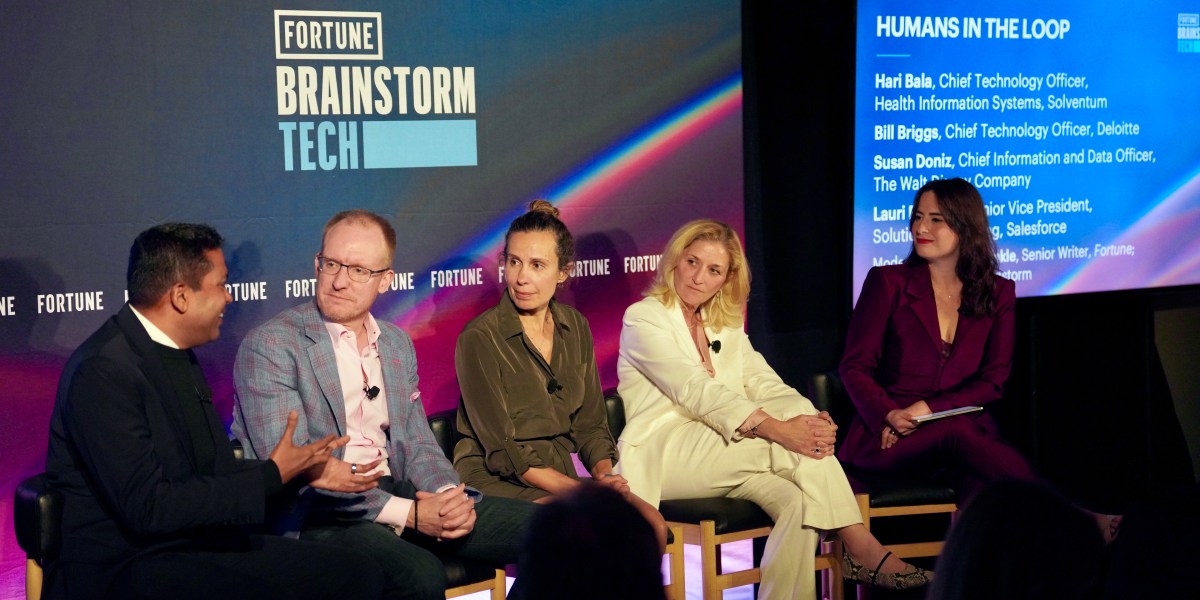
At the annual Fortune Brainstorm Tech dinner during CES in Las Vegas, a panel of senior technology executives deliberated the nuances of AI-driven change management—and in particular, where humans must remain “in the loop” as agentic AI sweeps across the corporate world.

“[With] any technology adoption, it’s tempting to … [take] the things we’ve always done and see how we can do it a little bit differently and a little bit better,” said Deloitte CTO Bill Briggs. “What we’ve found with AI is, that’s a trap.”

Sure, impact and value have been demonstrated in more “bounded” places within organizations, Briggs added. But “we can’t use how we’ve always thought about the world” to define the approach, he said. “We’ve gotta really fundamentally challenge what the outcomes are that we’re seeking and work backwards from there.”

You’ve also got to be realistic and design the system for failure, said Hari Bala, CTO of Health Information Systems at Solventum, the name of the healthcare company spun off from 3M in 2024. Dot your Is; cross your Ts.

“How do you make sure you have kill switches? How do you make sure you have audit-ability?” he asked. “How do you do it in an automated way while infusing AI through the reasoning and orchestration layer?”

And you certainly don’t want to make an even bigger mess than the one you’re trying to clean up. Several executives on the panel, which was moderated by Fortune’s Allie Garfinkle, agreed that there is a fine line to walk between embracing a revolutionary vision for future change and critically evaluating the efficiency of a present operation.

“We watched the [technology] sprawl happen in the past,” said Lauri Palmieri, SVP of solution engineering for Salesforce, citing service-oriented architecture and microservices, two software development models that promised better ways to build. “If you let it get out of control, you’re literally just putting more of a mess in place that you’re going to have to go back and clean up later.”

Disney chief information and data officer Susan Doniz concurred.

“An AI-first mindset is firstly about simplification,” she said. “If you’re just automating what you have, you might just be industrializing waste across what you’re trying to do.”

“‘Industrializing waste’ or ‘weaponizing inefficiency,’” Briggs interjected with a grin. “Both things are terrible.”

So what’s the solution?

Get a bold leadership team, for starters. “There’s something to be said to having strong leadership at the top that says, ‘Just go,’” said Palmieri of Salesforce.

Then get your data sorted. “The data is the fuel and the foundation,” Disney’s Doniz said. “If you don’t have well orchestrated, integrated, safe, secure data, you’re not going to have anything to ingest that will actually [make] your process better.”

And don’t let perfection be the enemy of the good, said Briggs of Deloitte. “My all-time favorite quote is Lorne Michaels from Saturday Night Live: ‘We don’t go on because we’re ready; we go on because it’s 11:30.’ So how do we force some urgency?”

For more from the 2026 Fortune Brainstorm Tech dinner in Las Vegas, read “From factory floors to offices: Physical AI is ‘going to be massive’” by Sheryl Estrada.

This story was originally featured on Fortune.com


Source link

Continue Reading

Business

AI is baked into health care. Now CEOs are focusing on patient and staff outcomes

Published

on


Good morning. What is the state of U.S. business? It depends on where you are and what you do. I was in San Francisco earlier this week, debating the AI dividend with a dozen CEOs of major hospital systems at a dinner sponsored by Philips. If you’re Suresh Gunasekaran of UCSF Health, which consistently ranks among the world’s best in health outcomes and medical research, AI is becoming baked into a more seamless patient experience. “Being a medical student, a pharmacy student, a nurse is no longer the same in the age of AI,” Gunasekaran said.

For Providence CEO Erik Wexler, who faces staff shortages, rising costs and reduced Medicaid payments in 51 hospitals and 1,000 clinics spread across seven states with different regulatory environments, AI is perhaps less ubiquitous but equally powerful. The reaction to ambient technology that acts on insights gleaned from doctor-patient conversations? “This is life-changing technology,” Wexler told me. “When a physician says that, you feel like you’ve discovered plutonium.”

While many Americans may fear the impact of AI on their jobs, many welcome the prospect of it lowering their average $17,000 tab for health care, which is expected to account for almost 19% of U.S. GDP this year.

Americans’ struggle with affordability and access to health care are two persistent problems U.S. Chamber of Commerce President and CEO Suzanne P. Clark cited in her 2026 State of American Business remarks yesterday in an otherwise upbeat speech. She drew comparisons between this 250th anniversary year and the last time America had a big birthday in 1976. Along with fond memories of waving a little flag in the Englewood, Ohio bicentennial parade, she recalled a dour mood shaped by 5.7% inflation, 7.7% unemployment, soaring energy costs, rising crime, stagnating productivity and a “ballooning regulatory state”—not to mention fear of nuclear annihilation amid the Cold War.

Fast forward to today, she said, and there’s been a threefold increase in GDP, a homegrown energy revolution, a 40% rise in median household income and of course several waves of transformative technologies. The lesson for Clark? “Despite all of our challenges, we live in an era of abundance and advancement,” she said. “America is very good at getting better.”

In the AI age, the question for business leaders is how to accelerate adoption and transformation while keeping costs in check. 2026 may be the year where the focus shifts to outcomes. As Jeff DiLullo, chief region leader of Philips North America, advised health systems leaders at our dinner: “AI either has to increase access to care, increase the quality and the outcomes, or reduce staff burden. And if it can’t do those things, don’t do it.”

Contact CEO Daily via Diane Brady at diane.brady@fortune.com

Top news

Questions for the next Fed chair

The DOJ’s criminal probe into Federal Reserve Chair Jay Powell has delayed the search for his successor by raising questions about the independence of the next chair and whether they’ll win Senate confirmation. Two Republican Senators have vowed to withhold any vote until the investigation is resolved. One person who will “absolutely, positively” not take the job is JPMorgan CEO Jamie Dimon, an often-rumored candidate. What about running the Treasury? “I would take the call,” he said in a new interview

Ashley St. Clair sues xAI

The conservative influencer Ashley St. Clair, who had a child with Elon Musk, has sued his xAI firm in New York, seeking a restraining order to keep the chatbot Grok from undressing images of her. xAI has not commented on the filing, but has sued St. Clair in Texas for allegedly violating its terms with her lawsuit. 

Trump targets power plants

The Trump administration is reportedly considering a plan to have tech companies bid on building new power plants in an effort to lower electricity prices for average Americans, who are starting to push back against data centers. The president has praised Microsoft for announcing that it will pay higher utility bills for its U.S. data centers. 

Gov. Newsom comes out against billionaire’s tax

California Governor Gavin Newsom has joined a list of business leaders in opposing a billionaire tax for the state that will be voted on in November. He describes it as “bad business,” creating a split in the Democratic Party between him and New York City Mayor Zohran Momdani’s “tax the rich” sentiment.

Oracle struggles to bring employees to new HQ

Oracle is struggling to bring employees to its “world headquarters” in Nashville despite investing over a billion dollars in the office and offering various amenities. Most employees are reportedly hesitant to move simply because of salary ceilings in the state.

Tesla’s self-driving subscription model draws criticism

Tesla customers are speaking out on social media after CEO Elon Musk announced that the company’s self-driving technology will only be available through a monthly subscription after Feb. 14. The technology is currently available for a flat $8,000 fee, or $99 a month. “You will own nothing and be happy,” one X user posted.

The markets

S&P 500 futures were up 0.28% this morning. The last session closed up 0.26%. STOXX Europe 600 was up 0.08% in early trading. The U.K.’s FTSE 100 was up o.02% in early trading. Japan’s Nikkei 225 was down 0.32%. China’s CSI 300 was up o.41%. The South Korea KOSPI was up 0.90%. India’s NIFTY 50 was up 0.11%. Bitcoin was at $95K.

Around the watercooler

Exclusive: Former OpenAI policy chief creates nonprofit institute, calls for independent safety audits of frontier AI models by Jeremy Kahn

‘They’re going to have to think and act a lot more like hotels’: The new rules of office space now that the ‘genie is out of the bottle on hybrid’ by Jake Angelo

Worried about AI taking your job? New Anthropic research shows it’s not that simple by Sharon Goldman

Singapore tries to give its flagging stock market a kickstart with a link to the NASDAQ, allowing firms to easily list in both places by Angelica Ang

CEO Daily is compiled and edited by Joey Abrams, Claire Zillman and Lee Clifford.


Source link

Continue Reading

Business

Singapore tries to give its flagging stock market a kickstart with a link to the NASDAQ, allowing firms to easily list in both places

Published

on


Firms will soon get the opportunity to list in both the U.S. and Singapore in a first-of-its kind partnership. The SGX-NASDAQ dual listing bridge, which will commence later this year, is part of Singapore’s drive to revitalize its stock exchange, which has persistently lagged other regional bourses like the Hong Kong Stock Exchange in attracting IPOs and other deals. 

The bridge will likely appeal to Southeast Asian companies who want to draw on the U.S.’s deep capital market, yet still tap “strong brand recognition” in Southeast Asia, says Chan Yew Kiang, the ASEAN IPO leader at accounting firm EY.

Tay Hwee Ling, capital service markets leader of Deloitte Southeast Asia, adds that U.S. firms might also take the opportunity to extend their trading hours beyond the close of U.S. markets, as well as strengthen their presence in Southeast Asia. 

The partnership also broadens investment options for Asian investors looking to diversify amid geopolitical uncertainty, says Clifford Lee, global head of banking at DBS.

“With the Global Listing Board, companies can access the best of both worlds—U.S. market depth and Asian growth in a streamlined pathway,” an SGX spokesperson said. 

A boost to Singapore?

Singapore’s stock exchange has long suffered from low liquidity. Average daily turnover on the SGX is just $1.4 billion, compared to $29 billion on the HKEX. 

“China and Hong Kong have massive populations of active retail speculators who drive high daily turnover, while Singapore’s retail base is smaller, more conservative and prefers dividends and bonds,” says Glenn Thum, a research manager at Singapore-based stockbroker Philips Securities. “The higher liquidity and volumes in HKEX attract high-frequency traders, creating a cycle that boosts valuations and attracts more IPOs.”

Hong Kong also benefits from a steady pipeline of Chinese companies hoping to tap global investors by listing in the financial center. Exchanges in mainland China “benefit from the depth and breadth of the local investor base and market size,” says Chan of EY.

Then there’s the U.S., which offers deeper pools of capital than other Asian exchanges. That’s led several Southeast Asian companies, like ride-hailing firm Grab and e-commerce company Sea, to list in the U.S. instead of their home base of Southeast Asia. More recently, Filipino food conglomerate Jollibee Foods Corporation (JFC) announced that it would list its international business in the U.S. by 2027.

Singapore’s market is improving. In 2025, the SGX’s IPO proceeds also surged to its highest level since 2019, topping Southeast Asia’s IPO market. The turnover value of securities traded on the SGX in December climbed by 29% year-on-year. 

Still, Singapore’s IPOs are still much smaller than Hong Kong’s. Singapore’s largest IPO, NTT DC REIT, raised $773 million; by comparison, CATL’s secondary listing in Hong Kong raised over $5 billion.

Not a ‘silver bullet

But Thum of Philips Securities warns that the bridge isn’t a “silver bullet,” as companies will still face a local liquidity crunch unless U.S. investors really start trading during Singapore hours.

Also, only companies with a market capitalization greater than 2 billion Singapore dollars ($1.6 billion) qualify for the dual listing bridge, meaning only a small number of Southeast Asian businesses will qualify. For example, QAF Limited, a Singaporean food conglomerate housing bakery brands like Gardenia and Bonjour, has a market capitalization of approximately $546 million, which means it would not be able to file for a dual listing on the Nasdaq.

By comparison, the HKEX’s threshold for a secondary listing is just $385 million in market capitalization. 

This story was originally featured on Fortune.com


Source link
Continue Reading

Business

Ford CEO Jim Farley: Trump administration will ‘always answer the phone’

Published

on


Ford CEO Jim Farley has the ear of President Donald Trump—and he has a lot to say about what the administration needs to do to support the U.S. auto industry.

Farley said in an interview with Bloomberg Television on Thursday the White House has been “great” to work with, but has several asks for how the administration can improve trade to bolster U.S. automakers.

“They always answer the phone,” Farley said. “But there is a long list of things we got to work through.”

Trump visited Ford’s Dearborn, Mich., facility on Tuesday, touring production of the F-150 truck factory, in an effort to show support for U.S. manufacturing amid growing concerns of a weak labor market. Even as American carmakers have poured billions of dollars into reshoring jobs and expanding U.S. production, domestic manufacturing jobs have continued to dwindle. Ford is making a $19.5 billion pivot away from some larger electric vehicle production in favor of less expensive and more hybrid models as it navigates lower EV demand and consumers’ affordability concerns. The move follows Trump’s killing an EV tax credit which went into effect at the end of September.

Addressing threats from Chinese rivals

The administration has made an effort to address some of these concerns, according to Farley. He praised Trump’s decision to rollback fuel economy standards and ease some auto tariffs, but said his automaker continues to be impacted by the levies—particularly those affecting aluminum, a common material in auto manufacturing. In February 2025, Farley said the tariffs would cost Ford billions of dollars, all the while serving as a “bonanza” for Asian auto manufacturing competitors.

Indeed, Farley has identified China as a top competitor to U.S. autos, posing an “existential threat,” not just because of the country’s technology prowess, but also in its labor infrastructure that supports manufacturing, explaining last September that American manufacturing is lagging behind Chinese rivals in the “essential economy,” or industries that manufacture physical goods. He called on American businesses and policymakers to invest in building a blue-collar workforce.

Farley said on Thursday China has been able to nab meaningful market share in Europe—as much as 10% in the EV market—as a result of lower prices, which he attributed to Chinese government subsidies.

“They pose a lot of threat to labor locally, they have huge subsidies from the government that they’re exporting,” Farley said. “As a country, we need to decide what is a fair playing field.”

Differing trade deal visions

Chief among Farley’s ongoing concerns was the continuation of the Canada-United-States-Mexico-Agreement (CUSMA), a trade deal that replaced the North American Free Trade Agreement (NAFTA) and which is subject to review this year. It will either be left to expire or be renewed for 16 years.

“We built our entire vehicle business as an industry between Canada, Mexico, and the U.S.,” Farley said. “We have to get this revised.”

While Trump imposed a 25% tariff on autos from Mexico and Canada last year, CUSMA has allowed workarounds for those countries to ease the burden of the levies. Farley said he wants to protect the deal, as so much of the auto industry in North America is interconnected and relies on the openness of cross-border supply chains, which is both efficient and cost-saving.

Trump, who signed the agreement in 2020, has undermined the deal, eschewing the need for cars manufactured in other parts of North America. The president’s most recent criticisms of the agreement came amid comments shortly following his tour of the Ford plant.

“We could have it or not. It wouldn’t matter to me,” Trump said. “I don’t really care about it.”


Source link

Continue Reading

Trending

Copyright © Miami Select.