Good morning. The U.S. economy closed out 2025 with a puzzling mix: sluggish job growth alongside accelerating productivity.
The U.S. Bureau of Labor Statistics (BLS) reported on Friday that nonfarm payrolls rose by a seasonally adjusted 50,000 in December 2025, missing the 73,000 Dow Jones estimate and slowing from November’s revised gain of 56,000. November payrolls were revised down by 8,000 jobs, while October’s loss deepened to 173,000 from 105,000. For 2025 as a whole, payrolls grew by an average of 49,000 jobs per month, down sharply from 168,000 in 2024.
Bank of America Global Research analysts wrote in a report on Friday that although payroll growth has slowed since June, the unemployment rate has risen by only about 11 basis points. The report noted, “We have been highlighting that tighter immigration restrictions are likely to play a bigger role in the slowdown in job growth this year.”
The unemployment rate is a key statistic for the Fed, and markets responded to Friday’s miss by pricing out a January rate cut, according to the analysts. Futures now imply less than half a cut priced in through April, which marks the end of Powell’s term.
The productivity factor
Despite weak job growth, forecasts still point to solid overall economic expansion. I asked Gregory Daco, EY chief economist, how the U.S. economy can continue to grow strongly while hiring softens.
“We’re seeing a clear decoupling between growth and hiring,” Daco said. Output is still expanding, but companies are generating that growth with fewer incremental workers and fewer hours.
“Productivity has rebounded meaningfully as businesses continue to streamline operations, automate processes, and extract more output from existing teams in a high-cost, high-interest-rate environment,” Daco explained. “This isn’t AI-led in a narrow sense yet—it’s the payoff from multi-year efficiency drives, tighter cost discipline, and delayed hiring.”
According to the BLS, nonfarm business sector labor productivity increased 4.9% in the third quarter of 2025, as output rose 5.4% while hours worked increased just 0.5%.
Areas of job growth
Where job growth has occurred, employment in food services and drinking places continued to trend higher in December, adding 27,000 jobs. The sector added an average of 12,000 jobs per month in 2025, roughly in line with the 11,000 average monthly gain in 2024.
Health care employment also continued its upward trend in December, rising by 21,000 jobs, including a gain of 16,000 in hospitals. Health care added an average of 34,000 jobs per month in 2025, down from an average monthly increase of 56,000 in 2024.
Monster’s newly released 2026 Job Market Outlook also reflects these pockets of strength. Based on full-year 2025 job posting and job seeker data, the report shows employer demand remaining firm in health care, essential services, infrastructure-related roles, and skill-based jobs, even as other parts of the labor market slow.
‘Hiring hasn’t stopped’
As private payroll growth weakened throughout 2025 and hiring appetites diminished, I asked Daco whether he expects that trend to continue amid ongoing geopolitical uncertainty and tariff-related risks
“Yes—barring a material improvement in policy clarity, I expect hiring restraint to persist,” he said. Private payroll growth has already slowed sharply as firms shift into cost-control mode, with geopolitical risks, tariff uncertainty, and elevated financing costs reinforcing that bias, he explained.
“Hiring hasn’t stopped, but it has become more selective and more conditional on clear demand visibility,” Daco added. “In this environment, CFOs are likely to continue favoring efficiency, automation, and capex discipline over broad-based workforce expansion.”
*Quick note: “The Data Imperative: Reinventing Finance with AI,” is the next Emerging CFO webinar which will take place Tuesday, Jan. 27 at 11 a.m. ET. Join Fortune, in partnership with Workday, for a timely discussion featuring Adobe’s CFO Dan Durn, and additional speakers to be announced, that will offer firsthand insights and practical strategies from leaders shaping AI-driven finance transformation. You can register for the event here. Email us at CFOCollaborative@Fortune.com with any questions.
Leaderboard
Young Kim was appointed CFO and chief operating officer at Bitmine Immersion Technologies, Inc. (NYSE: BMNR) effective immediately. Kim has more than 20 years of experience. From 2021 to 2025, he served as partner and senior portfolio manager at Axiom Investors, following a decade as senior portfolio manager at Columbia Threadneedle Investments from 2011 to 2021. Earlier in his career, Kim held roles across investment research, venture capital, business development, and software engineering.
Jimmi Sue Smith is retiring from her position as CFO of Koppers Holdings Inc. (NYSE: KOP) effective Jan. 5. Smith will continue to serve as treasurer, as well as in an advisory role, to assist with a transition through Feb. 28. Bradley Pearce, chief accounting officer, will serve as interim CFO and still perform his current role while an external search is conducted to identify a permanent successor.
Big Deal
The latest S&P Global Market Intelligence data shows that large U.S. corporate bankruptcies rose to one of the highest monthly totals in five years in December 2025, with filings increasing to 72 from 63 in November. This uptick extended the 15-year high for annual filings first set in November, bringing the total to 785 for the year—the highest since 2010. Rising interest rates have been a significant factor, as many companies struggled to refinance their debt, according to the report.
The data covers companies with public debt and at least $2 million in assets or liabilities, as well as private companies with at least $10 million in assets or liabilities at the time of filing.
Courtesy of S&P Global Market Intelligence
Going deeper
“Powell blasts DOJ criminal probe as attack on Fed independence. ‘Public service sometimes requires standing firm in the face of threats’” is a Fortune article by Jason Ma.
He writes: “Federal Reserve Chairman Jerome Powell said in a statement on Sunday that the Justice Department served the Fed with grand jury subpoenas, threatening a criminal indictment over his testimony before the Senate last June related to renovations on the headquarters, which has seen cost overruns. Powell, who is typically cautious in his public remarks, was clear that the probe was political in nature and had nothing to do with the Fed renovations or his testimony, dismissing them as ‘pretexts.'” Read the complete article here.
Overheard
“After more than two decades of declining well-being for most middle- and low-income households, it is clear that structural reforms are needed to bring costs back in line with wages.”
—Gene Ludwig, former U.S. Comptroller of the Currency, and chairman of the Ludwig Institute for Shared Economic Prosperity, and Shannon Meyer, a research analyst at the Ludwig Institute, write in a Fortune opinion piece titled, “Millions of Americans are grappling with years of declining economic wellbeing and affordability needs a rethink.”
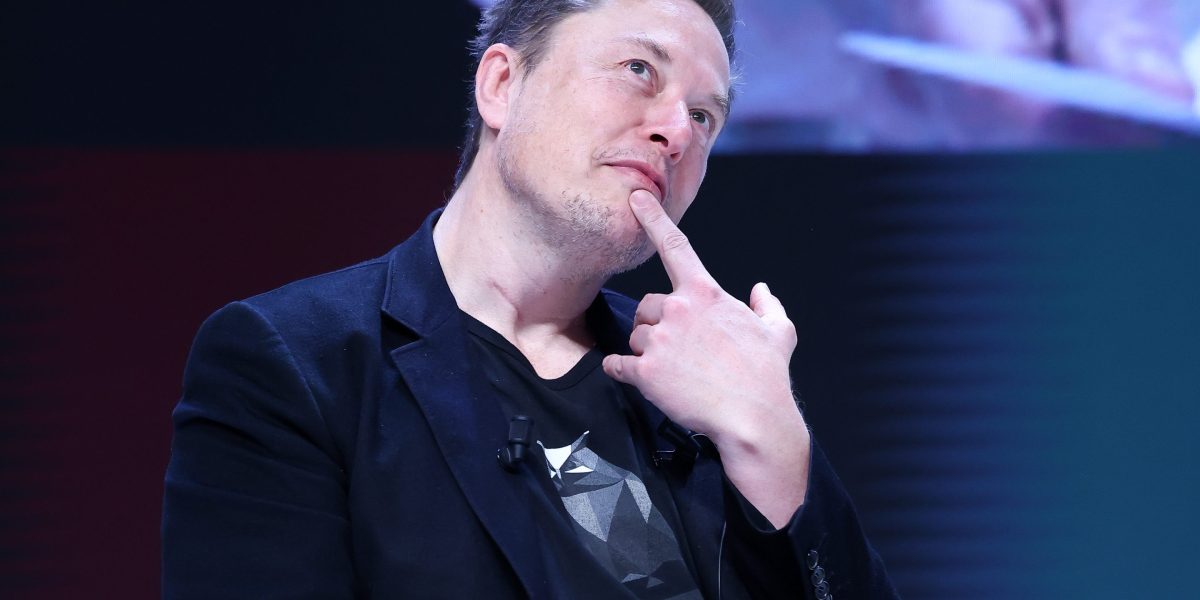
Saving for retirement is pointless thanks to the impending “supersonic tsunami” of AI and robotics, which will bring about a world of zero scarcity, according to Elon Musk.
While the Tesla and SpaceX CEO admitted he’s “more optimistic” than most, he insisted people shouldn’t stress over building a nest egg for the distant future, contrary to the staid advice of nearly all other financial professionals.
“Don’t worry about squirreling money away for retirement in 10 or 20 years,” said the world’s richest man on the Moonshots with Peter Diamandispodcast last week. “It won’t matter.”
Part of Musk’s controversial take lies in his vision of a world transformed by rapidly improving AI, robotics, and energy technology.
Musk’s hot take
By 2030, AI will surpass “the intelligence of all humans combined,” Musk predicted. He also claimed eventually there will be more humanoid robots than humans on Earth. Slowly, the traditional job will be replaced as well, with white collar positions first on the list.
“Anything short of shaping atoms, AI can do probably half or more of those jobs right now,” he said.
The advances could lead to such big productivity increases, he said, that they will surpass “what people possibly could think of as abundance.”
Rather than a universal income, everyone will enjoy a “universal ‘you can have whatever you want’ income” in the future, he claimed. In this world, the link between individual wages, savings, and living standards no longer makes sense.
Even without savings, AI will help people obtain better medical care than currently available within five years, as well as remove any limit on the availability of goods, services, or educational opportunities.
Musk’s comments build on his earlier claims that AI and humanoid robots will make work “optional” within 10 to 20 years and render money itself irrelevant. Musk previously compared the future of work to leisure activities like playing sports or video games rather than a survival necessity.
“If you want to work, [it’s] the same way you can go to the store and just buy some vegetables, or you can grow vegetables in your backyard. It’s much harder to grow vegetables in your backyard, and some people still do it because they like growing vegetables,” Musk said during the U.S.-Saudi Investment Forum in November.
Post-work’s downsides
To be sure, Musk’s predictions about the future come at a time where many Americans are struggling to save. In part due to persistent inflation and weak wage growth, only 55% of American adults said they had a “rainy day” fund of three months expenses saved up for an emergency, down from a high of 59% in 2021, according to a survey by the Federal Reserve. Fewer than half of those surveyed said they could cover an expense of $2,000 or more with their savings.
Musk is also not blind to the potential downsides of a society without the need to earn a living. A high universal income could come hand-in-hand with social unrest, as people may face a deeper crisis of meaning, he warned.
“If you actually get all the stuff you want, is that actually the future you want? Because it means that your job won’t matter,” Musk said.
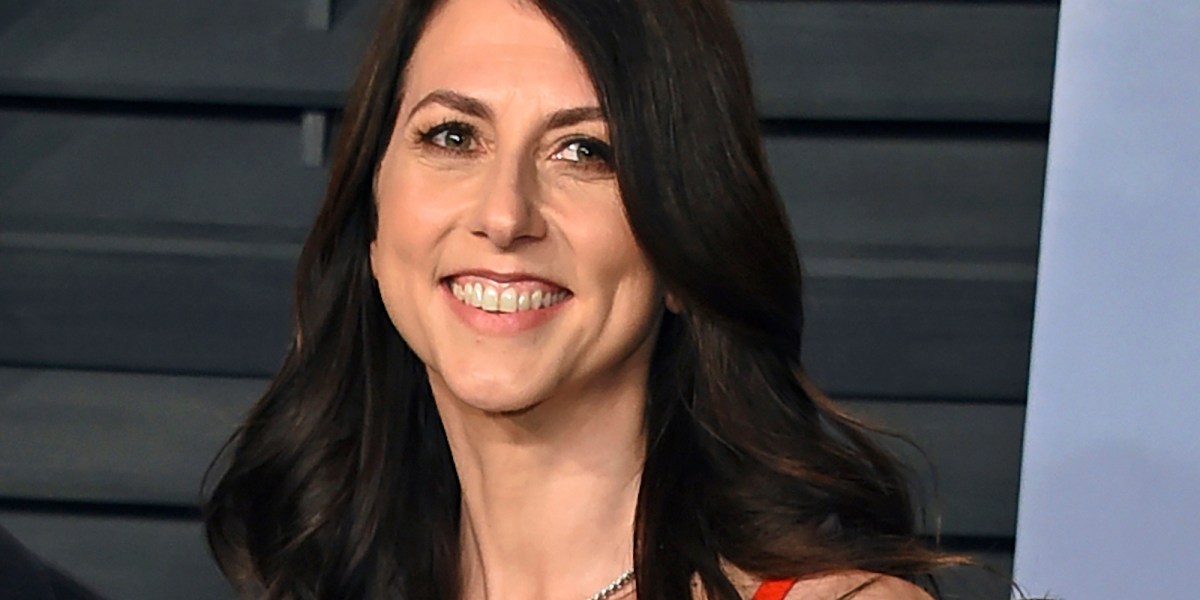
The Trevor Project, known for its hotline for LGBTQ+ youth, received $45 million from billionaire and author MacKenzie Scott at the end of 2025, the organization said Monday.
The gift is the largest in the organization’s history but also a major boon following years of management turmoil, layoffs and the loss of significant federal funding over the summer.
“I literally could not believe it and it took some time. I actually gasped,” said Jaymes Black, CEO of The Trevor Project, when they were notified of Scott’s gift.
Scott, whose fortune largely comes from her ex-husband Amazon founder Jeff Bezos, gave more than $7 billion to nonprofits in 2025, but this gift to The Trevor Project was not included among the donations she disclosed on her website in December. Scott previously gave The Trevor Project $6 million in 2020.
In July, the Trump administration stopped providing specific support for gay, trans and gender nonconforming young people who called the 988 National Suicide & Crisis Lifeline. The Trevor Project was one of the organizations staffing that option and lost $25 million in funding, the nonprofit said.
The Trevor Project continues to run an independent hotline for LGBTQ+ young people that Black said reaches about 250,000 young people annually, but they served another 250,000 callers through the 988 Press 3 option, which was tailored for LGBTQ+ young people.
U.S. Department of Health and Human Services’ Substance Abuse and Mental Health Services Administration (SAMHSA) reported more than 1.5 million contacts were routed through the service between Sept. 2022 and July 2025.
The Trevor Project has gone through years of internal turmoil after exploding in size from an organization with an annual budget around $4 million in 2016 to over $83 million in 2023, according to its public tax returns. The nonprofit’s board removed its CEO in 2022 and has gone through a series of layoffs, including in July. Black said the project’s 2026 budget was $47 million.
“We are a smaller organization than we were before,” Black said. “And we will continue to be really intentional and really mindful around growth and what growth really means for the organization.”
After it lost the 988 funding, The Trevor Project launched an emergency fundraiser that brought in $20 million to date, Black said, which they also hope Scott saw as proof that the organization was determined to stick around and make it through this period.
“MacKenzie Scott’s folks were clear, like this gift was made for long-term impact,” Black said, adding that they would take their time deciding how to use the funds.
Thad Calabrese, a professor at New York University who researches nonprofit financial management, said it’s not at all uncommon for nonprofits that grow very quickly to run into financial problems. But he also said the cuts and general instability in especially federal funding for nonprofits has upended many organizations’ business models.
“Academic research has often viewed public funding as very stable, as a signal to donors that you’ve arrived as an organization, but the reality is you are now also open to changing political fortunes,” he said.
He said research is also unclear whether diversifying an organization’s revenue streams is always a better financial strategy.
“You’re less dependent upon a few funders, but on the other hand, if you have a lot of different revenue streams, do you have the management capacity for that?” Calabrese asked, speaking generally and not commenting specifically on The Trevor Project.
Scott has distinguished herself among the biggest individual donors by giving large, unrestricted gifts to nonprofits, often with a focus on equity or social justice. With the exception of an open call in 2023, she does not ask for project proposals nor accept applications.
Despite the size of her gifts, which now often exceed the recipient organization’s annual budget, research from the Center for Effective Philanthropy has found that concerns about nonprofits misusing Scott’s funds or growing unsustainably have largely not been born out. That may be because Scott’s team, the members of which are largely unknown, conducts extensive research on organizations before making grants.
In an essay announcing her 2025 gifts, Scott said, “The potential of peaceful, non-transactional contribution has long been underestimated, often on the basis that it is not financially self-sustaining, or that some of its benefits are hard to track. But what if these imagined liabilities are actually assets? … What if the fact that some of our organizations are vulnerable can itself be a powerful engine for our generosity?”
Black called Scott’s second gift “a powerful validation,” of The Trevor Project’s mission and impact, saying, “We’re calling this our turnaround story.”
___
Associated Press coverage of philanthropy and nonprofits receives support through the AP’s collaboration with The Conversation US, with funding from Lilly Endowment Inc. The AP is solely responsible for this content. For all of AP’s philanthropy coverage, visit https://apnews.com/hub/philanthropy.
Muhammad Ali once joked that he should be a postage stamp because “that’s the only way I’ll ever get licked.”
Now, the three-time heavyweight champion’s quip is becoming reality.
Widely regarded as the most famous and influential boxer of all time, and a cultural force who fused athletic brilliance with political conviction and showmanship, Ali is being honored for the first time with a commemorative U.S. postage stamp.
“As sort of the guardian of his legacy, I’m thrilled. I’m excited. I’m ecstatic,” Lonnie Ali, the champ’s wife of nearly 30 years, told The Associated Press. “Because people, every time they look at that stamp, they will remember him. And he will be in the forefront of their consciousness. And, for me, that’s a thrill.”
A fighter in the ring and compassionate in life
Muhammad Ali died in 2016 at the age of 74 after living with Parkinson’s disease for more than three decades. During his lifetime and posthumously, the man known as The Greatest has received numerous awards, including an Olympic gold medal in 1960, the United Nations Messenger of Peace award in 1998 and the Presidential Medal of Freedom in 2005.
Having his face on a stamp, Lonnie Ali said, has a particular significance because it’s a chance to highlight his mission of spreading compassion and his ability to connect with people.
“He did it one person at a time,” she said. “And that’s such a lovely way to connect with people, to send them a letter and to use this stamp to reinforce the messaging in that life of connection.”
Stamp to be publicly unveiled
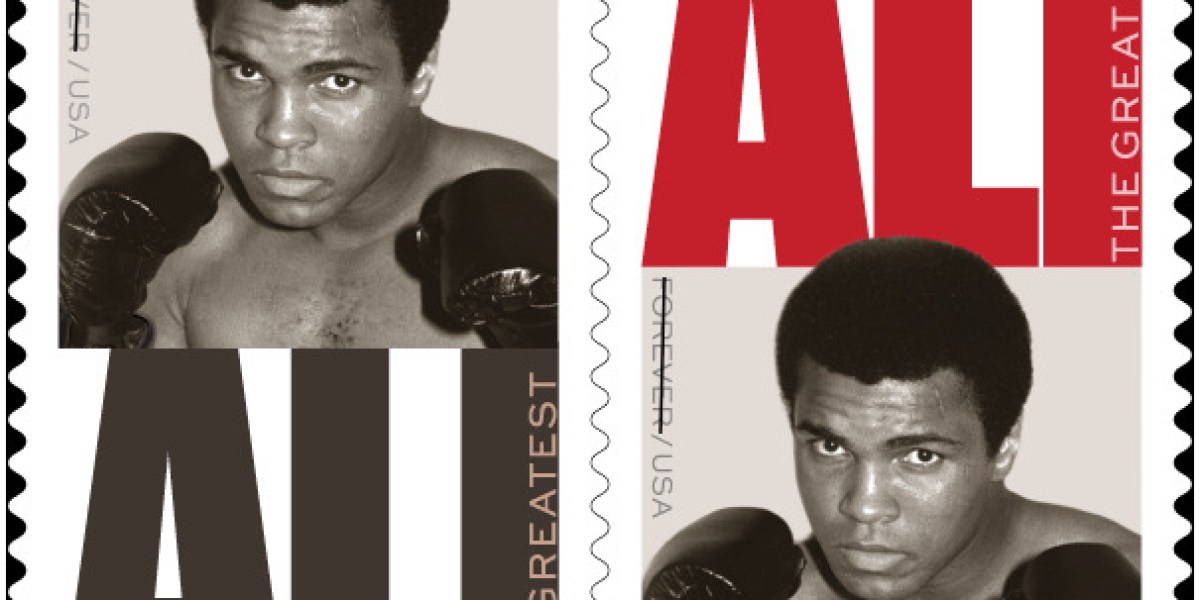
A first-day-of-issue ceremony for the Muhammad Ali Forever Stamp is planned for Thursday in Louisville, Kentucky, the birthplace of the famed boxer and home to the Muhammad Ali Center, which showcases his life and legacy. That’s when people can buy Muhammad Ali Forever Stamps featuring a black-and-white Associated Press photo from 1974 of Ali in his famous boxing pose.
Each sheet of 20 stamps also features a photo of Ali posing in a pinstripe suit, a recognition of his work as an activist and humanitarian. Twenty-two million stamps have been printed. Once they sell out, they won’t be reprinted, U.S. Postal Service officials said. The stamps are expected to generate a lot of interest from collectors and noncollectors.
Because they’re Forever Stamps, the First-Class Mail postage will always remain valid, which Lonnie Ali calls an “ultimate” tribute.
“This is going to be a Forever Stamp from the post office,” she said. “It’s just one of those things that will be part of his legacy, and it will be one of the shining stars of his legacy, getting this stamp.”
Creating a historic stamp
Lisa Bobb-Semple, the USPS director of stamp services, said the idea for a Muhammad Ali stamp first came about shortly after his death almost a decade ago. But the process of developing a stamp is a long one. The USPS requires people who appear on stamps to be dead for at least three years, with the exception of presidents.
As the USPS was working behind the scenes on a stamp, a friend of Ali helped to launch the #GetTheChampAStamp campaign, which sparked public interest in the idea.
“We are really excited that the stars were able to align that allowed us to bring the stamp to fruition,” said Bobb-Semple, who initially had to keep the planned Ali stamp secret until it was official. “It’s one that we’ve always wanted to bring to the market.”
Members of the Citizen Stamps Advisory Committee, appointed by the postmaster general, are responsible for selecting who and what appears on stamps. Each quarter, they meet with Bobb-Semple and her team to review suggestions submitted by the public. There are usually about 20 to 25 commemorative stamp issues each year.
Once a stamp idea is selected, Bobb-Semple and her team work with one of several art directors to design the postage. It then goes through a lengthy final approval process, including a rigorous review by the USPS legal staff, before it can be issued to the public.
Antonio Alcalá, art director and designer of the Muhammad Ali stamp, said hundreds of images were reviewed before the final choices were narrowed to a few. Finally, the AP image, taken by an unnamed photographer, was chosen. It shows Ali in his prime, posing with boxing gloves and looking straight into the camera.
Alcalá said there’s a story behind every USPS stamp.
“Postage stamps are miniature works of art designed to reflect the American experience, highlight heroes, history, milestones, achievements and natural wonders of America,” he said. “The Muhammad Ali stamps are a great example of that.”
A candid figure on war, civil rights and religion
Beyond the boxing ring, Ali was outspoken about his beliefs when many Black Americans were still fighting to be heard. Born Cassius Clay Jr., Ali changed his name after converting to Islam in the 1960s and spoke openly about race, religion and war. In 1967, he refused to be inducted into the U.S. Army, citing his religious beliefs and opposition to the Vietnam War.
That stance cost Ali his heavyweight championship title and barred him from boxing for more than three years. Convicted of draft evasion, he was sentenced to five years in prison but remained free while appealing the case. The conviction was overturned by the U.S. Supreme Court in 1971, further cementing his prominence as a worldwide figure.
Later in life, Ali emerged as a global humanitarian and used his fame to promote peace, religious understanding and charitable causes, even as Parkinson’s disease limited his speech and movement.
Ali’s message during a time of strife
The commemorative postage stamp comes at a time of political division in the U.S. and the world. Lonnie Ali said if her husband were alive today, he’d probably “block a lot of this out” and continue to be a compassionate person who connects with people every day.
That approach, she said, is especially important now.
“We have to mobilize Muhammad’s life and sort of engage in the same kinds of acts of kindness and compassion that he did every day,” she said.





 Politics8 years ago