Connect with us

Business

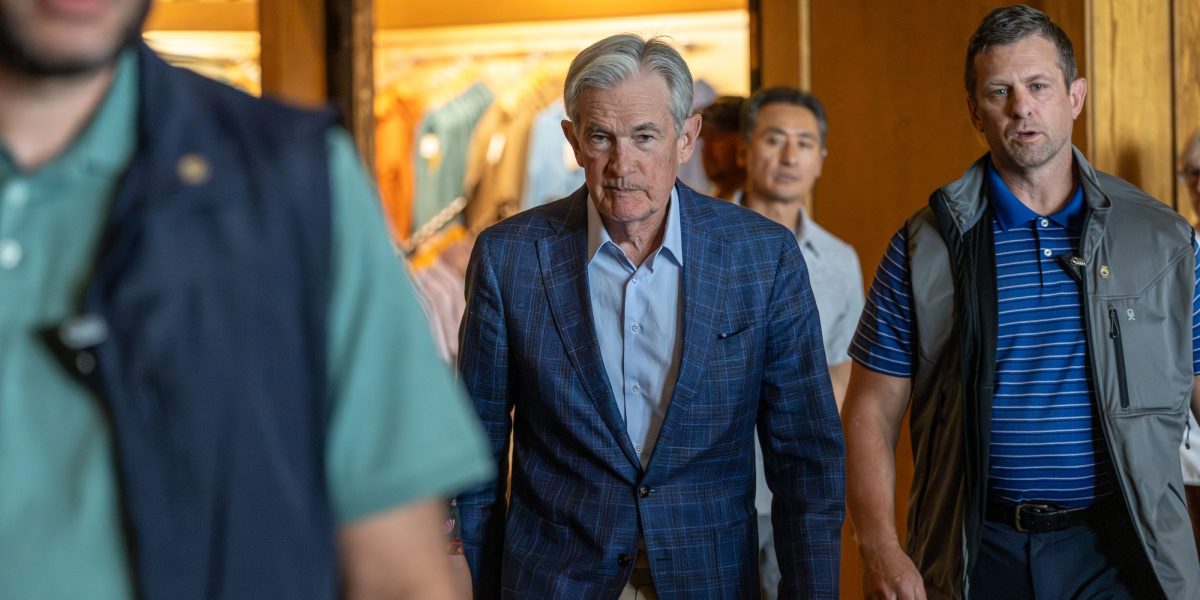
Powell’s ‘unusual’ Jackson Hole remarks reveal he’s boxed in by Trump’s tariffs and deportations, risking a 1970s-style mistake, economist Slok says

Published

on


Powell noted that while labor markets remain in balance, it is a “curious kind of balance that results from a marked slowing in both the supply of and demand for workers.”

“This unusual situation suggests that downside risks to employment are rising,” he added. “And if those risks materialize, they can do so quickly in the form of sharply higher layoffs and rising unemployment.”

Slok told Fortune in an interview immediately after the speech that this type of language was “puzzling.” 

“Including the word ‘curious’—I mean, that’s just a somewhat unusual expression,” Slok remarked.

Markets rejoiced at the slight hint Powell gave that he would cut interest rates at the next Fed meeting. However, Slok argued the speech signals that Powell sees something deeper happening in the job market: deportations and immigration crackdowns warping labor supply. And in his view, that could make inflation harder to tame.

A Fed cornered by politics

Powell’s speech threaded the needle between two forces: slowing growth and stubbornly high inflation. On one side, he acknowledged a cooling labor market and rising recession risk, but on the other, he flagged tariffs and a weakening dollar as potential new inflation drivers.

Slok added that Powell is now clearly putting more weight on the labor market slowing, but also left the door open to see what the August employment report will say.

“So it was a very two-handed speech, but still tilting towards focusing on the worries that the labor market has been slowing down,” Slok said. 

But he added Powell was blunt about what could go wrong: tariffs and trade wars. 

“It is also possible, however, that the upward pressure on prices from tariffs could spur a more lasting inflation dynamic, and that is a risk to be assessed and managed,” Powell warned in his prepared remarks.

Slok said that risk is real, and that tariffs will have a “bigger” impact on inflation than we’ve seen so far. 

“If you look at this earnings season, we’ve had a number of companies, including Tesla, saying that prices of their products are going up,” Slok said. “So I do think that it’s justified, from a Fed perspective, to worry about the upside risk to inflation.”

Deportations as an inflationary shock

Slok went further, saying Powell’s “curious kind of balance” line likely reflects the impact of mass deportations. The removal of workers, he argued, is pushing up wages in industries like agriculture, construction, and hospitality.

The administration has a goal of removing 3,000 undocumented immigrants a day, or 1 million each year, Slok noted. That would “of course” have consequences for not only labor demand, but labor supply. 

The result, he said, is inflationary pressure: “So if you lower the labor supply, it really is the same impulse to the economy as tariffs. Tariffs result in higher inflation and lower GDP. Deportations … will also result in lower employment growth and more inflation, especially wage inflation.”

Slok warned that Powell may be sleepwalking into a classic “stop-go” trap.

In the 1970s, the Fed cut interest rates too soon after an initial inflation spike, only to see prices surge again as oil shocks and wage demands rippled through the economy. That forced policymakers to slam rates back up, tipping the U.S. into repeated recessions and damaging the Fed’s credibility for years.

“The risk today is we could see that same dynamic repeat,” Slok said. If inflation starts climbing again after a rate cut, “the Fed will have to reverse course—and in the worst case, start hiking again.”

Back then, political pressure played a decisive role. President Richard Nixon heavily pressured Fed Chair Arthur Burns to ease rates ahead of the 1972 election, a move historians blame for igniting the second wave of ’70s inflation. 

Today, President Donald Trump’s push for aggressive rate cuts and his trade war have put Powell in a strikingly similar bind. Powell is forced to balance political demands for looser policy against the Fed’s dual mandate of maintaining price stability and maximum employment.

The bottom line

Slok was careful to note that Powell’s speechwriters likely aren’t drafting with Trump in mind. Still, he admitted, the political overlay is unavoidable. With tariffs and deportations feeding inflation from one side, and a weakening economy pulling the other way, Powell’s choice set is narrowing.

“Both tariffs and deportations result in the same impact on the economy, namely higher inflation and slower GDP growth. And that happens to be exactly what the consensus is expecting at the moment,” Slok said.

At Jackson Hole, Powell described that position as a “curious” balance. But for Slok, it looks more like a trap. 


Source link

Continue Reading

Business

Citadel’s shot at Andreessen Horowitz points to coming battle over DeFi and U.S. stock trading

Published

on


A quiet fight between two of the most powerful names in finance burst into the open last week. In a letter to the Securities and Exchange Commission, Citadel Securities complained that crypto interests are poised to damage the U.S. stock market and harm consumer protections with a pell-mell rush into decentralized finance (DeFi). The firm didn’t directly say who it regards as responsible for this state of affairs—but it’s enough to guess from the footnotes, which refer to the venture giant Andreessen Horowitz more than 10 times.

The source of the dispute is the fast-growing world of tokenized equities, which let users trade shares of popular companies but in a blockchain wrapper. The likes of Robinhood, Kraken, and even BlackRock are all dabbling in this technology, whose advantages include easy 24/7 trading and instant settlement. Holding stock on a blockchain also reduces middlemen, and expands opportunities to deploy equity-based collateral.

So what’s not to like? According to Citadel, the problem is DeFi platforms like Uniswap. Right now, traders use them to swap billions of dollars of crypto every day—and soon large volumes of tokenized Nvidia or Apple stock could be sloshing around these platforms, too. And if the SEC grants certain exemptions that Andreessen and its DeFi allies are seeking, Uniswap and others will get to operate as de facto brokerages—without taking on the legal responsibilities that go with that. These include displaying the price of every trade or ensuring customers get the best price. Citadel also warns of “fragmenting liquidity” as stock investing gets split between two parallel systems.

In response to the letter, the founder of Uniswap (one of Andreessen’s blue-ribbon portfolio companies) took to X to accuse Citadel of slandering DeFi in order to protect its lucrative role as the “king of shady tradfi market makers.” Other prominent names in crypto piled on as well, accusing the firm of trying to smother innovation.

At first glance, it appears both sides have a point. If tokenized stock trading breaks into the mainstream, it would threaten Citadel’s business model of paying firms like Robinhood for their orders and using that volume to make trading profits. So the company’s letter to the SEC is clearly based in self-interest. That said, Citadel’s concerns about liquidity are not unreasonable—if the pool of U.S. stocks is divided into two separate pools, doesn’t that make trading more expensive for everyone? Likewise, it’s fair to ask if the SEC would be wise to grant exemptions on investor protection rules that have historically served the public very well.

In reading the letter, it’s remarkable to read its claims that the likes of automated AMMs, block builders, validators and layer 2 blockchains are basically brokerages—less for the argument itself, than that Citadel and the SEC are discussing this stuff at all. It wasn’t long ago when only a handful of crypto diehards knew what these terms even meant. Now, they have become mainstream enough to be part of a non-crypto firm’s correspondence with the SEC, and there is no doubt they’re here to stay.

As for which side is going to prevail, it’s worth noting the fight pits two of the most powerful firms in the country against each other. On one side, there is Citadel, which is owned by Ken Griffin, one of the richest and most combative people in the country. On the other is Andreessen, an influential VC firm that doubles as a PR firm and lobbying agency with immense clout in Washington, DC. For now, it feels Griffin may be able to slow down the spread of tokenized equities but, as with any superior technology, he will be unable to stop it.

Jeff John Roberts
jeff.roberts@fortune.com
@jeffjohnroberts

DECENTRALIZED NEWS

Binance’s new look: The world’s biggest cryptocurrency exchange announced Yi He as co-CEO, confirming her status as the most powerful woman in crypto, while also establishing a de facto corporate headquarters for the first time via major licenses in Abu Dhabi. (Fortune)

Alt-coin winter: The recent downturn has battered alts with the sector shedding $200 billion since market peak. Memecoins have been hit particularly hard, due in part to the sheer number of them, but also because they are competing with a growing number of other speculative opportunities like prediction markets. (Bloomberg)

If at first you don’t succeed: Coinbase plans to relaunch in India early next year. It first opened shop in 2022, but was forced to retreat a year later in the face of hostile regulators who blocked its access to the country’s national payments network. (TechCrunch)

Mining mischief: The Malaysian government is using drones and a cross-agency task force to go after thousands of illegal Bitcoin mining operations that hop from place to place, and have stolen over $1 billion of electricity. (Bloomberg)

Saylor selling? The fraught world of DATs got dicier as Strategy said it might sell Bitcoin as a last resort. The move comes as Strategy’s share price fell below mNAV as the firm faces looming dividend obligations—but there is also a case that Saylor’s corporate strategy wizardry means the firm will be just fine. (Fortune)

MAIN CHARACTER OF THE WEEK

Changpeng Zhao, cofounder of Binance.

Samsul Said—Bloomberg/Getty Images

CZ wins the main character title this week as his debate with goldbug Peter Schiff helped drive a flood of social media attention around the Binance founder who looks very much back in the crypto game.

MEME O’ THE MOMENT

Franklin the Turtle loves UDSC and USDT.

@haonan

After the U.S. Treasury Secretary Bessent co-opted beloved children’s character Franklin the Turtle to pitch T-bills, it didn’t take long for CT to expand the meme to stablecoins. 

Fortune Brainstorm AI returns to San Francisco Dec. 8–9 to convene the smartest people we know—technologists, entrepreneurs, Fortune Global 500 executives, investors, policymakers, and the brilliant minds in between—to explore and interrogate the most pressing questions about AI at another pivotal moment. Register here.


Source link

Continue Reading

Business

If you want your employees back in the office, try feeding them, says Gensler executive

Published

on


What do both employees and employers really want in a workplace of the future? It’s a topic that came up last week in my conversations with CEOs, designers, and thought leaders at Fortune’s Brainstorm Design conference in Macau.

If you ask Ray Yuen, office managing director at the design and architecture firm Gensler, the answer is food. A recent Gensler survey asked employees to rank the office spaces that were most important to them. The top three? The office food hall, cafe, or lounge. 

“It’s really about food and wellness,” Yuen said onstage. “They didn’t even mention anything about work. Everybody just picked the stuff that we really want as human beings.”

It’s worth listening to these human desires as companies try to bring people back into the office, Yuen said. He described a project he worked on recently for a large company’s new Tokyo headquarters, where 50% of the company’s employees were working remotely and he was tasked with finding a way to bring them back. One of the biggest successes was a lo-fi vinyl listening bar, where no tech or talking was allowed, he said. 

Flexibility is also key. In the past, Yuen said he used to heavily design about 80% of a company’s headquarters with built in furniture and modules like cubicles, and leave about 20% as “flexible space.” Now, the balance is more 50/50, so companies can transform their office spaces easily when needs arise, such as an office happy hour, he says.

“We’re no longer just designing workplaces. We’re actually designing experiences. Because [employees may] think, ‘Well, if I can work anywhere, why do I want to go to work? I can do it at home,’” Yuen said. “You’ve really got to make the campus or the workplace be more than work, and that’s the fun part of it.”

Kristin Stoller
Editorial Director, Fortune Live Media
kristin.stoller@fortune.com

Around the Table

A round-up of the most important HR headlines.

Employers used to frown on social media posting during work hours, but now employees at companies including Starbucks and Delta are being asked to post on-the-job social media content. Wall Street Journal

The U.S. Equal Employment Opportunity Commission, or EEOC, is reportedly blocking or stalling claims brought by transgender workers. Bloomberg

As automated systems come under fire for potentially allowing discriminating hiring practices, many states are expanding bans on discrimination to AI. Washington Post

Watercooler

Everything you need to know from Fortune.

Meeting shakeup. Instagram’s CEO is calling employees back to the office five days a week, but is canceling all unnecessary recurring meetings —Marco Quiroz-Gutierrez

Earnings report. In the U.K., Gen Z college graduates are earning 30% less than Millennials did at the same stage of life. —Preston Fore

Trade troubles. As Gen Zers opt for trade schools and blue-collar jobs, there is one sector they are hesitant to get involved in: manufacturing. —Emma Burleigh 


Source link

Continue Reading

Business

McKinsey’s CFO: Why finance chiefs shouldn’t hit pause on AI right now

Published

on


Good morning. For CFOs, using the words “uncertainty” and “unprecedented” has become second nature this year.

“There’s a bit of fatigue from uncertainty right now,” Yuval Atsmon, CFO of McKinsey, told me when we met in Washington, D.C., to discuss how finance chiefs navigated 2025 and the impact of AI. He often hears some executives joke, “Can we just have something that has a precedent?”

Following President Donald Trump’s so-called Liberation Day, Atsmon said significant uncertainty emerged around the new administration’s economic and geopolitical agenda. “If I look at the peak of uncertainty, what I was focused on as a CFO was: What are the things that I should be doing that would be helpful in any scenario?” Atsmon said. “The worst thing is inaction,” he added. Acting on what you can control builds resilience, he said.

Key questions included: How can you improve liquidity and operational efficiency? What costs can be delayed or eliminated? Which investments are essential, and which can be stopped?

While uncertainty often drives defensive moves, Atsmon noted the importance of reviewing long-standing strategies and seizing competitive opportunities. “I wouldn’t recommend anyone stop making AI investments at this moment,” he said, adding that some actions are still driven by inertia, not strategy.

“The other thing that I think is different in 2025 than it was over the last 100 years is that so much of resource allocation now happens through the technology function of the company,” Atsmon said.

Yet there’s still uncertainty about AI’s readiness to impact the bottom line. McKinsey already uses AI to handle up to 30% of its tasks—such as faster research and better summarization—but “you can’t really do a full strategic analysis yet,” he said. Timelines vary widely by company.

Atsmon pointed to new McKinsey research estimating profound changes in how work is done by 2030. People will need to reorganize how they create value or take on different activities. For CFOs, curiosity about technology is useful, but the core responsibility is enabling the organization to respond at the right pace—neither moving so fast that it creates financial strain nor so slowly that competitiveness erodes, he said.

For most organizations, he believes AI efforts should be “80% on productivity for growth and 20% on productivity for efficiency.” The biggest opportunity, he said, lies not in reducing headcount but in unlocking better uses of time.

Ultimately, leveraging AI requires a willingness to reimagine how work gets done. It is a cross-functional C-suite effort. “More than ever,” Atsmon said, “managing uncertainty—economic, geopolitical, and technological—comes down to planning for the best, but also preparing for the worst.”

SherylEstrada
sheryl.estrada@fortune.com

Leaderboard

Jennifer DiRico was appointed EVP and CFO of PTC (Nasdaq: PTC), effective Jan. 1. DiRico succeeds Kristian Talvitie, who will continue to serve as CFO through Dec. 31. DiRico’s experience ranges from large-scale enterprise software organizations to high-growth technology companies. She currently serves as CFO of Commvault, a cyber resilience company. Before Commvault, DiRico spent several years at Toast in finance and operations leadership roles.

David Hastings was appointed CFO of Trevi Therapeutics, Inc. (Nasdaq: TRVI), a clinical-stage biopharmaceutical company, effective Jan. 6. Hastings brings over 25 years of financial leadership experience. Most recently, he was CFO at Arbutus from June 2018 until March 2025. Previously, he was SVP and CFO of Unilife from 2015 until 2017.  Prior to that, Hastings spent the majority of his career as CFO and EVP at Incyte. 

Big Deal

“Global Economic Outlook Q1 2026: AI Tailwinds Boost Otherwise Weak Growth” is an economic research report published by S&P Global Ratings. Some key takeaways from the report include that global growth is holding up better than expected into 2026, helped by AI-driven investment and exports, even as underlying demand stays relatively soft. Also, forecasts have been revised up in many countries, but policy uncertainty, labor markets, bond yields, and the risk that AI underdelivers on earnings all remain key threats to the outlook.

Going deeper

KPMG’s latest “M&A trends in financial services” report is a review of M&A in Q3 for each of the banking, capital markets, and insurance sectors, with the latest data and top deals, as well as an outlook for M&A.

“Momentum from the prior quarter, driven by regulatory rollback and private equity interest, persisted in the third quarter of 2025,” according to the report. “However, inflation, credit quality concerns, trade policy uncertainty, and geopolitical tensions posed significant challenges, requiring adept navigation.”

Overheard

“In the days after the acquisition was completed, I was asked during a media interview if good luck was a factor in bringing together these two tech industry stalwarts. Replace good luck with good timing, and the answer is a resounding, ‘Yes!'”

Amit Walia, the CEO of Informatica, a Salesforce company, writes in a Fortune opinion piecetitled, “Why the timing was right for Salesforce’s $8 billion acquisition of Informatica—and for the opportunities ahead.”


Source link

Continue Reading

Trending

Copyright © Miami Select.