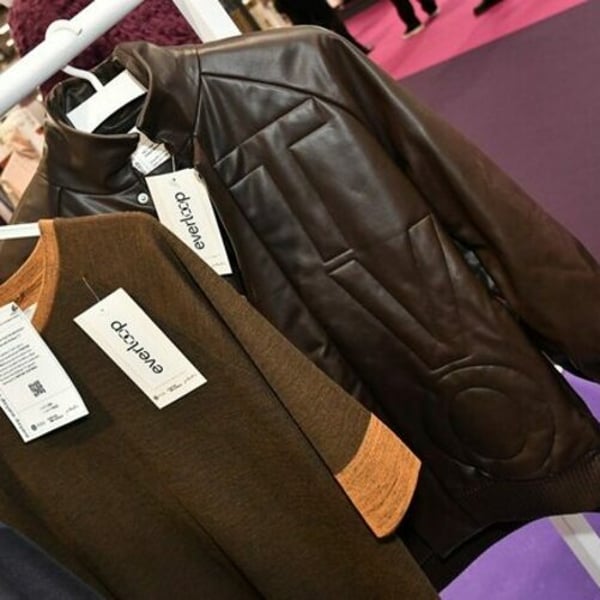
Faber VC has co-led an investment round for British biomaterials specialist Ponda, backing the launch of BioPuff, a plant-based alternative to down insulation already used by Positive Materials.
Jacket presented by Positive Materials featuring BioPuff (right)
Ponda has announced that it has raised US$2.4 million (approximately €2.2 million) to commercialise its plant-based BioPuff insulation and expand its European wetland farming network.
The round was co-led by Lisbon-based Faber VC and London-based Counteract, with participation from PDS Ventures, Evenlode Impact and the Royal College of Art. This brings the company’s total funding to US$6.5 million, comprising venture capital alongside multiple grants and awards from Innovate UK, the Terra Carta Design Lab and the H&M Foundation- Ponda was among the winners of the H&M Foundation’s 2022 innovation award.
BioPuff is a thermal insulation material made from Typha, a wetland plant grown through paludiculture- the process of rewetting and sustainably cultivating degraded peatlands. It delivers thermal performance on a par with goose down, but at lower cost and with a markedly positive environmental impact. For Rita Sousa, a partner at Faber, “by combining regenerative agriculture in coastal areas with an advanced material with strong potential in the textile sector and beyond, Ponda is well placed to unlock significant opportunities across multiple industries, while generating a real impact on biodiversity at scale.”
According to Ponda, the funding will enable it to increase production capacity, moving from the pilot phase to commercial scale, while strengthening its network of Typha growers in several European countries. Ponda also plans to launch the first commercial BioPuff lines for the autumn/winter 2026 collections. Julian Ellis-Brown, the company’s co-founder and CEO, emphasises that “each coat filled with BioPuff does not just avoid emissions; it directly funds the restoration of peatlands, one of the most powerful carbon sinks on the planet.”
The importance of this production model stems from the fact that drained peatlands release around 2 gigatonnes of emissions a year, further increasing the risk of flooding. By working with landowners to rewet these areas and cultivate Typha, Ponda is helping to convert sources of emissions into carbon sinks, potentially avoiding up to 30 tonnes of CO₂ equivalent per hectare each year, the company says.
Founded at Imperial College London and the Royal College of Art, Ponda has evolved from an academic project into a company with active industrial operations. Its Bristol facility includes fibre processing, blending, and prototyping, enabling the development and testing of BioPuff.
The company already works with brands such as Berghaus, Stella McCartney, Parley for the Oceans, and Sheep Inc., with whom it has developed prototypes to test the material’s durability and performance in real-world conditions. Positive Materials, part of the PDS group, also presented a bomberjacket in Paris last year, made with Oval faux fur and insulated with BioPuff.
Although the fashion sector is currently the main application, BioPuff is also being explored for areas such as home textiles, furniture, toys, and other uses.
This article is an automatic translation. Click here to read the original article.
Long reserved for women or military dress, brooches adorned men’s chests during Milan Fashion Week, a throwback to a bygone era but with jewellery now signalling individuality, not just status.
A brooch by Dolce & Gabbana – Aleksej Shelikhov- Facebook
From huge flowers or watch brooches at Dolce & Gabbana to pins at Armani, the bling passed from hands to jackets during the fall/winter 2026/2027 shows in the Italian city.
“I like these small details, people have to pay attention to them,” said reggaeton star Rauw Alejandro, in the front row at Prada.
Chinese buyer John Chen, 45, sported a gold brooch in the shape of a triangle, the Milanese brand’s logo, on a green sweater just below his neck. “I started wearing brooches about five years ago. I like to play with them” to personalise outfits, he told AFP.
In Armani’s refined yet relaxed collection, some men sported a tie pin on their jacket lapel, while male and female models wore matching sparkling brooches. At designer Rowen Rose, a large orange stone was used to fasten a green or yellow scarf to a matching sweater.
“It gives an extra touch. It’s a good accessory- it’s become very masculine,” said Fabio Annese, a 26-year-old Milanese interior designer sporting a heart-shaped brooch at Dolce & Gabbana.
Known for its extravagant style, D&G has been selling brooches for men since entering the jewellery world in 2015, and they are “still important in more formal collections,” a spokesperson said. Among their offerings are crosses, crowns, scarabs, and flowers in gold and embellished with diamonds, the last costing a cool 7,500 euros (around $8,800).
The trend is in many ways a return to the past. In Europe, until the 18th century, the “most important” jewellery was worn by men, explained Emanuela Scarpellini, professor of contemporary history at the University of Milan.
Wealthy and powerful men used it as a sign of their status, the glittering accessories often signalling membership of a noble family or a religious order, or military rank. It was only with the rise of the middle-classes and businessmen in the 19th century that came “the idea that men should dedicate themselves to work, with a more sober attitude,” Scarpellini said at the launch of a new Milan exhibition.
“The Gentlemen,” on show at the Palazzo Morando until September, reveals how men’s jewellery since then usually served a purpose, such as watches, cufflinks and tie pins. Nowadays “there’s a new freedom,” as with clothing, said exhibition curator Mara Cappelletti, a professor of jewellery history.
“There are fewer jewellery pieces with a function, and more with a freer choice,” she told AFP. “Many of the objects men wear today were not designed for a male audience,” she said, adding that many were vintage. “The brooch has never been so popular.”
Cappelletti noted that the trend was boosted by singers and actors wearing a lot of jewellery, noting a photograph of Italian singer Achille Lauro sporting a huge white gold and diamond sculpted piece on his chest, with matching earrings. All provided by the jeweller Damiani, which sponsors the pop star.
Global beauty business Sephora has announced a strategic, omni-channel partnership with Korean beauty and health retailer CJ Olive Young to bring a wide range of K Beauty products to its global customers.
CJ Olive Young aims to bring K Beauty to global shoppers – Olive Young
The partnership will debut this autumn with omni-channel partnerships set for the US, Canada, Hong Kong SAR, and Southeast Asia (Singapore, Malaysia, Thailand), Sephora announced in a press release on Tuesday. In 2027, the business will bring the tie-up to the Middle East, the UK, and Australia.
“Korean beauty is one of the most innovative, fastest growing, and desirable categories in beauty right now,” said Sephora’s global chief merchandising officer Priya Venkatesh in a press release. “Sephora was the first major retailer to debut K Beauty brands to North American consumers in 2010, and our portfolio has grown into a global business. We are thrilled to partner with leading Korean beauty retailer Olive Young, bringing their expertly curated assortment of Korean beauty brands to our beauty fans globally. Their differentiated assortment, coupled with Sephora’s unique point of view on the beauty shopping experience, will bring an unrivalled and inspiring offer for all beauty lovers who are keen to explore the most sought-after Korean beauty products.”
Sephora shoppers will be able to browse a dedicated zone curated by CJ Olive Young comprising popular Korean health and beauty brands. The business’ beauty advisor will also offer guidance and assistance to customers to help them find their desired products.
“We are pleased to enter this partnership with Sephora as we continue to advance our global expansion strategy,” said CJ Olive Young’s chief strategy officer Youngah Lee. “As global interest in K-beauty continues to accelerate, we see this collaboration as a meaningful opportunity to work together in expanding the reach of Korean brands in key international markets.”
Big beauty firms continue to open statement stores at key UK destinations with Superdrug now choosing to “significantly upsize” at Merry Hill.
Merryhill
It’s set to double its footprint to 16,000 sq ft at the West Midlands mall creating the brand’s biggest UK store to date.
Planned to open in Q2, Superdrug’s recommitment to Merry Hill is the latest in a series of leading brands to “significantly invest” in the centre, with operator Sovereign Centros/CBRE noting a 3% year-on-year sales boost in the beauty category.
It follows M&S’s 100,000 sq ft flagship store opening in November, which also includes a strong beauty element, while Superdrug sister value beauty brand Savers opened a 5,000 sq ft unit last year, also its largest in the UK so far.
The upsized Superdrug store will feature a more extensive range of the latest beauty products, as well as access to treatments such as ear piercing, manicures, and eyebrow threading.
Clare Jennings, property director at Superdrug, said: “This year, we will continue our programme of refurbishing stores, acquiring new sites and expanding existing stores, with Merry Hill selected as the site for one of our largest Superdrug stores in the UK.
“Choosing Merry Hill for this expansion was ideal, given its strong mix of health and beauty retailers and its position as a super-regional hub in the West Midlands. It’s the perfect location to grow our store and continue serving our loyal Merry Hill customers.”