Connect with us

Business

Plummeting bank stocks lead global selloff as fear of private credit ‘contagion’ hits across equities and the dollar

Published

on


S&P 500 futures were down more than a full percentage point this morning, after markets in Asia and Europe sold off heavily in reaction to two small regional U.S. banks that reported exposure to a potentially fraudulent loan worth only $60 million. 

The “contagion”—as ING called it in a note this morning—spread to Nasdaq 100 futures, which were down 1.4% this morning. The VIX “fear” index (which measures volatility) spiked 32% today. It has not been that high since President Trump roiled the market with his Liberation Day tariffs in April.

Until yesterday afternoon, few people outside of Utah and Arizona had ever heard of Zions Bancorporation or Western Alliance Bank. The lenders disclosed that they were exposed to $50-$60 million in bad loans that were potentially fraudulent.

What happened next was extraordinary: 74 American bank stocks lost $100 billion in market cap as the S&P 500 declined 0.63%. “The S&P Regional Banks Select Industry Index fell 6.3% on Thursday – the worst fall since Liberation Day,” Peter Schaffrik of RBC told clients in a note this morning.

Investors are spooked by the First Brands scandal, in which the car parts supplier took more than $10 billion in loans on the private credit market and then went bankrupt.

Although Goldman Sachs, JPMorgan and Citi all used their earnings calls this week to insist that their due diligence in rating the loans they give out to companies via private credit is both diversified and sound, traders this morning are running for the hills.

In Europe, the Stoxx 600 and the FTSE 100 both lost more than a full percentage point immediately after they opened. 

ING’s Francesco Pesole noted, “The contagion to other risk assets shows not only that markets are still sensitive to regional bank concerns (a legacy of SVB’s 2023 collapse), but potentially to the broader credit market, which has been operating on exceptionally tight spreads over the past few months.”

It is even hurting the dollar, which was down 0.08% this morning and has lost 0.73% of its value against foreign currencies in the last five days, as measured by the DXY index.

“Unlike in 2023, the risks appear more isolated this time, but they could feed into a narrative that the U.S. business environment and credit quality are in a poorer state than what data suggests, perhaps also due to AI distortions. Expect great scrutiny over upcoming regional bank earnings, with any further spillover into U.S. stocks set to extend the dollar sell-off,” Pesole said.

Peter Sidorov and his colleagues at Deutsche Bank told clients that the selling had moved into high-yield credit as investors switched into the safe haven of U.S. government bonds. “Other risk assets also struggled, with US HY credit spreads +10bps wider. Treasuries rallied with the 2yr yield dropping -7.3bps to a 3-year low of 3.42%,” he said.

Chatter among analysts is gloomy. “Inside credit markets for more than a year, there has been a grudging recognition that there was and is a series of credit problems that could be substantial and could be dangerous to the overall economy,” Andrew Milgram, chief investment officer of Marblegate Asset Management told the Financial Times.

Finally, banks have unexpectedly borrowed money via the U.S. Federal Reserve’s “repo” facility for a second straight day. They normally only do that at the end of the month or the quarter, the Wall Street Journal said—suggesting the supply of cash reserves at some banks is tighter than expected.

Here’s a snapshot of the markets ahead of the opening bell in New York this morning:

  • S&P 500 futures were down 1% this morning. The index closed down 0.63% in its last session.
  • STOXX Europe 600 was down 1.58% in early trading. 
  • The U.K.’s FTSE 100 was down 1.61% in early trading. 
  • Japan’s Nikkei 225 was down 1.44%.
  • China’s CSI 300 was down 2.26%. 
  • The South Korea KOSPI was flat. 
  • India’s Nifty 50 was up 0.47% before the end of the session. 
  • Bitcoin was down to $104.9K.


Source link

Continue Reading

Business

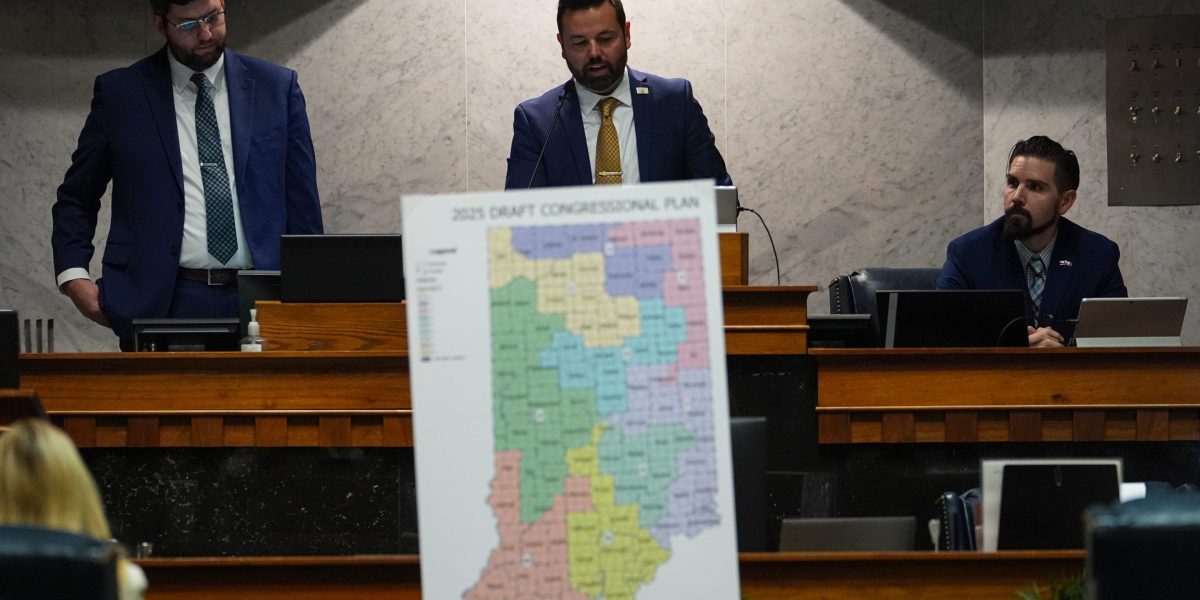
Trump couldn’t insult his way to victory in Indiana redistricting battle

Published

on


If Indiana Republican senators had any doubt about what to do with President Donald Trump’s redistricting proposal, he helped them make up their minds the night before this week’s vote.

In a social media screed, Trump accused the state’s top senator of being “a bad guy, or a very stupid one.”

“That kind of language doesn’t help,” said Sen. Travis Holdman, a banker and lawyer from near Fort Wayne who voted against the plan.

He was among 21 Republican senators who dealt Trump one of the most significant political defeats of his second term by rejecting redistricting in Indiana. The decision undermined the president’s national campaign to redraw congressional maps to boost his party’s chances in the upcoming midterm elections.

In interviews after Thursday’s vote, several Republican senators said they were leaning against the plan from the start because their constituents didn’t like it. But in a Midwest nice rebuttal to America’s increasingly coarse political discourse, some said they simply didn’t like the president’s tone, like when he called senators “suckers.”

“I mean, that’s pretty nasty,” said Sen. Jean Leising, a farm owner from Oldenburg who works at her daughter’s travel agency.

Trump didn’t seem to get the message. Asked about the vote, the president once again took aim at Indiana’s top senator, Rodric Bray.

“He’ll probably lose his next primary, whenever that is,” Trump said. “I hope he does, because he’s done a tremendous disservice.”

Sen. Sue Glick, an attorney from La Grange who also opposed redistricting, brushed off Trump’s threat to unseat lawmakers who defied him.

“I would think he would have better things to do,” she said. “It would be money better spent electing the individuals he wants to represent his agenda in Congress.”

Trump struggled to get traction in Indiana

The president tried to brush off the defeat, telling reporters he “wasn’t working on it very hard.”

But the White House had spent months engaged in what Republican Sen. Andy Zay described as “a full-court press.”

Vice President JD Vance met with senators twice in Indiana and once in Washington. White House aides frequently checked in over the phone.

Holdman said the message behind the scenes was often more soothing than Trump’s social media attacks.

“We were getting mixed messages,” he said. “Two days before the vote, they wanted to declare a truce on Sen. Bray. And the next day, there’s a post on Truth Social that didn’t sound like truce language to me.”

Some of Trump’s other comments caused backlash too. For example, he described Minnesota Gov. Tim Walz as “retarded,” which upset Sen. Mike Bohacek because his daughter has Down syndrome. Bohacek had been skeptical of redistricting and decided to vote no in response.

The White House did not respond to questions about outreach to senators, but it distanced itself from conservative allies who claimed Trump had threatened to withhold money from the state.

“President Trump loves the great state of Indiana,” said spokesman Davis Ingle, who insisted Trump “has never threatened to cut federal funding and it’s 100% fake news to claim otherwise.”

Regardless, Trump had struggled to get traction despite months of pressure.

Holdman said he turned down an invitation to the White House last month because he had a scheduling conflict.

“Plus, by then it was a little too late,” he said.

Leising said she missed a call from a White House official the day before a vote while she was in a committee meeting. She didn’t try to call back because she wasn’t going to change her mind.

Mitch Daniels, a former Indiana governor and a Republican, had a straightforward explanation for what happened.

“Folks in our state don’t react well to being bullied,” he said.

Daniels’ successor as governor, Mike Pence, fielded calls from senators during the redistricting debate, according to a person with knowledge of the situation who requested anonymity to disclose private conversations.

The person declined to describe Pence’s advice. Pence has been at odds with Trump ever since he, while serving as his vice president, refused to help Trump overturn his election defeat to Joe Biden on Jan. 6, 2021.

Senators said their voters didn’t want new districts

Some Republicans lashed out at senators for defying Trump.

“His life was threatened — and he was nearly assassinated,” Indiana Lieutenant Gov. Micah Beckwith wrote on social media. “All for what? So that Indiana politicians could grow timid.”

The message to the president, Beckwith said, was “go to hell.”

But senators who opposed redistricting said they were just listening to their constituents. Some believed the unusual push to redraw districts was the equivalent of political cheating. Others didn’t like that Washington was telling Indiana what to do.

The proposed map would have divided Indianapolis into four pieces, grafting pieces of the city onto other districts to dilute the influence of Democratic voters. But in small towns near the borders with Kentucky and Ohio, residents feared the state’s biggest metropolitan area would gain influence at their expense.

“Constituents just didn’t want it,” Holdman said.

During Thursday’s vote on the Senate floor, some Republicans seemed torn about their decision.

Sen. Greg Goode, who is from Terre Haute, said he had spoken twice to Trump on the phone while weighing the redistricting plan. He declared his “love” for the president but decried “over-the-top pressure.”

Goode said he wouldn’t vote for the proposal.

“I’m confident my vote reflects the will of my constituents,” he said.


Source link

Continue Reading

Business

Wisconsin couple’s ACA health plan soars from $2 a month to $1,600 as subsidies expire

Published

on


For one Wisconsin couple, the loss of government-sponsored health subsidies next year means choosing a lower-quality insurance plan with a higher deductible. For a Michigan family, it means going without insurance altogether.

For a single mom in Nevada, the spiking costs mean fewer Christmas gifts this year. She is stretching her budget already while she waits to see if Congress will act.

Less than three weeks remain until the expiration of COVID-era enhanced tax credits that have helped millions of Americans pay their monthly fees for Affordable Care Act coverage for the past four years.

The Senate on Thursday rejected two proposals to address the problem and an emerging health care package from House Republicans does not include an extension, all but guaranteeing that many Americans will see much higher insurance costs in 2026.

Here are a few of their stories.

From a gold plan to a bronze plan, a couple spends more on less

Chad Bruns comes from a family of savers. That came in handy when the 58-year-old military veteran had to leave his firefighting career early because of arm and back injuries he incurred on the job.

He and his wife, Kelley, 60, both retirees, cut their own firewood to reduce their electricity costs in their home in Sawyer County, Wisconsin. They rarely eat out and hardly ever buy groceries unless they are on sale.

But to the extent that they have always been frugal, they will be forced to be even more so now, Bruns said. That is because their coverage under the health law enacted under former President Barack Obama is getting more expensive -– and for worse coverage.

This year, the Brunses were paying $2 per month for a top-tier gold-level plan with less than a $4,000 deductible. Their income was low enough to help them qualify for a lot of financial assistance.

But in 2026, that same plan is rising to an unattainable $1,600 per month, forcing them to downgrade to a bronze plan with a $15,000 deductible.

Kelley Bruns said she is concerned that if something happens to their health in the next year, they could go bankrupt. While their monthly fees are low at about $25, their new out-of-pocket maximum at $21,000 amounts to nearly half their joint income.

“We have to pray that we don’t have to have surgery or don’t have to have some medical procedure done that we’re not aware of,” she said. “It would be very devastating.”

Family facing higher costs prepares to go without insurance

Dave Roof’s family of four has been on ACA insurance since the program started in 2014. Back then, the accessibility of insurance on the marketplace helped him feel comfortable taking the leap to start a small music production and performance company in his hometown of Grand Blanc, Michigan. His wife, Kristin, is also self-employed as a top seller on Etsy.

The coverage has worked for them so far, even when emergencies come up, such as an ATV accident their 21-year-old daughter had last year.

But now, with the expiration of subsidies that kept their premiums down, the 53-year-old Roof said their $500 per month insurance plan is jumping to at least $700 a month, along with spiking deductibles and out-of-pocket costs.

With their joint income of about $75,000 a year, that increase is not manageable, he said. So, they are planning to go without health insurance next year, paying cash for prescriptions, checkups and anything else that arises.

Roof said his family is already living cheaply and has not taken a vacation together since 2021. As it is, they do not save money or add it to their retirement accounts. So even though forgoing insurance is stressful, it is what they must do.

“The fear and anxiety that it’s going to put on my wife and I is really hard to measure,” Roof said. “But we can’t pay for what we can’t pay for.”

Single mom strains her January budget in hopes Congress acts soon

If you ask Katelin Provost, the American middle class has gone from experiencing a squeeze to a “full suffocation.”

The 37-year-old social worker in Henderson, Nevada, counts herself in that category. As a single mom, she already keeps a tight budget to cover housing, groceries and day care for her 4-year-old daughter.

Next year, that is going to be even tougher.

The monthly fee on her plan is going up from $85 to nearly $750. She decided she is going to pay that higher cost for January and reevaluate afterward, depending on whether lawmakers extends the subsidies, which as of now appears unlikely. She hopes they will.

If Congress does not act, she will drop herself off the health insurance and keep it only for her daughter because she cannot afford the higher fee for the two of them over the long term.

The strain of one month alone is enough to have an impact.

“I’m going to have to reprioritize the next couple of months to rebalance that budget,” Provost said. “Christmas will be much smaller.”


Source link

Continue Reading

Business

Gen Z is drinking 20% less than Millennials. Productivity is rising. Coincidence? Not quite

Published

on


For all the noise surrounding alcohol today, one fact rarely enters the conversation: societies with moderate, responsible drinking habits consistently outperform economically. Across OECD economies, decades of analysis confirm this link, showing that responsible consumption supports higher productivity and more resilient growth.

This isn’t just a lifestyle trend — it’s a shift in the fundamentals of growth. Gen Z is drinking differently, Dry January participation continues to rise, and employers are increasingly focused on performance, wellbeing, and sustainable productivity. These cultural shifts map onto a deeper economic trend: moderation is no longer just a personal choice, it’s becoming a structural feature of modern business strategy.

At the same time, global conditions are changing. Demographic shifts, rising health awareness, and evolving consumer expectations are altering the way societies engage with alcohol. The question today is not only how much people drink, but how drinking patterns influence labor markets, healthcare budgets, consumer behavior, and business innovation. In short, moderation has become more than a public health issue — it’s now a lever for economic competitiveness.

Responsible Consumption as an Economic Lever

Globally, we’ve grown accustomed to the idea that the alcohol sector is propelled by volume. But volume-led growth no longer tells the full story. Industry analysis shows that even as volumes fall and more consumers moderate, global alcohol spending continues to rise. Emerging markets now contribute over 65 percent of leading brewers’ profits, and the no-alcohol category has become a market worth tens of billions of dollars, growing at double-digit rates. These dynamics illustrate a shift from volume to value: responsible consumption patterns are not reducing economic value; they’re redirecting it, toward premium formats, adjacent categories, and new job creation.

New reporting from IWSR shows that while sales volumes have softened in some markets, underlying consumer demand remains remarkably stable. In the United States, the average number of drinks per adult per week has hovered between 10 and 12 for decades and is only modestly below its 2021 peak. Rather than a collapse in consumption, the data suggests a shift toward lower-volume, higher-value formats, a move that benefits both public health and profit margins.

Behind this shift is a more intentional consumer. People increasingly ask not only what a product is, but how it aligns with their lifestyle, values, and expectations for transparency. These factors are shaping purchasing behavior, and forcing businesses to innovate in ways that reward responsibility over excess.

A Virtuous Cycle for Growth

While precise quantification is complex, evidence shows that countries with lower rates of harmful drinking experience lower healthcare burdens and fewer workdays lost to alcohol-related issues. These gains feed what economists call a virtuous cycle: healthier societies support stronger economies, and stronger economies enable healthier choices.

Some still see moderation as a threat to the alcohol industry. In reality, it’s a catalyst for smarter, more sustainable growth. Moderation and responsible consumption are part of a broader shift toward value creation that supports societal well-being, investor interest, and business continuity.

A More Inclusive Model of Economic Growth

A more inclusive growth model depends on balance, not the false binary of abstinence versus excess, but a middle ground where informed adults can enjoy products responsibly, underage drinking continues to decline, and companies innovate in ways that reflect both consumer values and public health priorities.

Governments play a key role through evidence-based regulation. Companies contribute by leading on responsible innovation. Consumers participate by making informed choices. Together, these forces are reshaping how economic value and public good coexist.

The Opportunity Ahead

We’re at an inflection point. The economics of alcohol are changing, and so is the definition of growth. As businesses and governments revisit what sustainable prosperity looks like in the decade ahead, moderation will be central to that conversation. It’s not a moral stance or a temporary trend — it’s a data-driven strategy for long-term resilience.

For executives, the message is clear: moderation isn’t a soft signal — it’s a sharp business edge. Those who embrace it early will lead.

The opinions expressed in Fortune.com commentary pieces are solely the views of their authors and do not necessarily reflect the opinions and beliefs of Fortune.


Source link

Continue Reading

Trending

Copyright © Miami Select.