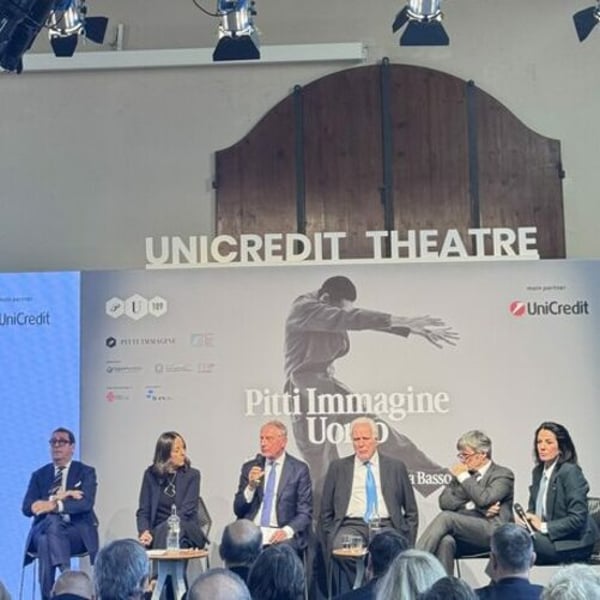
Italian fashion is ready to shift up a gear with Pitti Uomo. The fair that opens the menswear season is spearheading the sector’s recovery, as it seeks to put behind it a 2025 marked by conflict and trade wars. So says politician Adolfo Urso at the opening of the 109th edition of the Florentine trade show at the Fortezza da Basso (running from January 13 to 16). “Pitti is the event that opens the year of Made in Italy, a showcase for Italian style and manufacturing. Today, as it was 70 years ago, we must be the country of the industrial renaissance in the West,” says the minister.
The inauguration of Pitti Immagine Uomo 109
“Last year we faced a stormy sea. We resisted better than others and better than we could have imagined,” continues Urso, who, among the government’s measures, recalls work on introducing anti-ultra-fast-fashion regulations and a three-year hyper-amortisation scheme. Also in the pipeline is the SME bill, currently before the Chamber of Deputies, which contains several tools to support businesses, including the transfer of skills between generations, with the possibility of using retiring workers to train those under 35. “Beauty and the well-made must also go hand in hand with respect for sustainability and legality,” Urso stressed.
“2026 will also be the year of new markets,” continues the minister, who welcomes the EU-Mercosur agreement being finalised next week. “Other free-trade agreements are in the pipeline, with the United Arab Emirates, India, all the way to South-East Asia and Oceania. Finally, starting with Pitti and at major Italian events, we will, for the first time, open the House of Made in Italy: a Ministry office that will help companies with investment (Transition 5.0 or tax credits) and internationalisation,” Urso reveals.
“In the past two years the fashion system has lost 13-15 billion in turnover. 2025 was a complex year, but we have hit rock bottom. Now we can see clearer skies ahead and we have to push small and large companies together to recreate a new ecosystem starting from Pitti, from Tuscany,” echoes Luca Sburlati, president of Confindustria Moda.
Among the issues brought to the table by the head of the federation is the mobilisation of private savings. “It would give a boost to the listing of small businesses.” There are also high expectations for the 10-year strategic plan, “which we will present to the government in the coming weeks. The goal is to take the unique strengths of our country abroad as well. We hope to extend the agreement with Mercosur to countries such as Mexico, known for cotton sourcing,” Sburlati explains.
“Pitti is the only truly global fair for menswear and the only one that has evolved in recent years,” argues Antonio De Matteis, president of Pitti Immagine. “We must also protect the distribution chain, which is suffering today. We need to find a new generation of retailers and restore safety to the streets of our historic centres,” says De Matteis, who reveals he is studying the first overseas editions of Pitti Uomo. “We are evaluating opportunities to take the event beyond national borders and stage one-off editions to make our brands known in new, expanding markets.”
“Fashion is in crisis and is split between those who are slowing down and those who are flying. But there is also strong momentum at a national level in the interest of the industrial fabric,” says Matteo Zoppas, president of ICE. “At Pitti this year we are bringing 350 buyers, almost half of those present at the fair. They are strategically important. Pitti as a brand attracts global excellence and we are considering possible international expansion. From the government we have more and more resources and they need to be invested in this direction. There is also a spotlight on second-hand, which will reach 250 billion in turnover in the short term,” Zoppas notes.
At the end of the conference, Raffaello Napoleone, CEO of Pitti Immagine, presented the Pitti Immagine 2026 award to UniCredit, the fair’s main partner since 2020. “Giorgio Armani said that fashion is the strongest cultural expression because it tells us where we are and where we want to go. Our fashion-bank partnership started during Covid. We want to lay the foundations for a collaboration that truly adds value to Made in Italy. In Italy we have 50,000 companies linked to fashion manufacturing (in France there are 35,000). The Italian fashion system is too fragmented. It needs support to grow,” Areni concludes.
This article is an automatic translation. Click here to read the original article.
As anticipated by FashionNetwork.com, Diesel, part of the OTB Group, has confirmed the appointment of Andrea Rigogliosi as the brand’s new CEO. Rigogliosi will report directly to Ubaldo Minelli, CEO of the OTB Group.
Andrea Rigogliosi
“Diesel is a magical brand that I founded, and it has always been a unique force in the fashion landscape. Under Glenn Martens‘s creative direction, it has been transformed, rediscovering its most authentic DNA and making the brand fresher, more contemporary, and increasingly loved by younger audiences. Today, Diesel can be considered the only alternative to the luxury world, able to embody values such as inclusivity and a democratic spirit, which are particularly meaningful at a complex time for the entire fashion industry. Recently, I have closely followed the brand’s development alongside a team of managers as we navigated a challenging market phase. I am very happy about Andrea’s arrival; together with the team, I am certain he will further enhance Diesel’s potential at a crucial moment in its evolution,” said Renzo Rosso, founder of Diesel and chairman of the OTB Group.
Andrea Rigogliosi has strong international leadership experience in the luxury, fashion, and retail sectors, having held senior strategic and commercial roles across Europe.
Prior to joining Diesel, Rigogliosi was global head of retail and commercial at Miu Miu– Prada Group, leading global business growth and the expansion of its distribution network. Rigogliosi has held key positions within the LVMH Group, including president, Europe, at Fendi and general manager for France & Monaco and for Italy at Christian Dior Couture. Early in his career, he held management positions at the Poltrona Frau Group and L’Oréal Luxury Products. The executive holds a degree in International Business Administration from Bocconi University in Milan.
This article is an automatic translation. Click here to read the original article.
LVMH is doubling down on China, having opened several major flagships in the country in December. Encouraged by early indicators of a luxury sales rebound, the group is weighing further expansion to capitalise on China’s economic recovery.
The new Louis Vuitton store’s façade is treated as an elegant, sparkling, and translucent “garment” rather than a mere shell – Louis Vuitton
Following the success of its ship-shaped flagship in Shanghai opened mid-2025, the key LVMH brand has pivoted its strategic focus toward ‘hyper-physical’ immersive retail environments, deep-rooted cultural synergy, and the scaling of high-impact regional flagships. With the opening of its new emblematic building in the vibrant heart of Sanlitun, Beijing, Louis Vuitton has set another global benchmark for luxury retail and architecture.
Architecture and fashion dialogue
As Louis Vuitton’s long-standing architectural partner, Jun Aoki envisioned a space that harmoniously balances local cultural heritage with a sense of global openness. The initial inspiration for the façade was the Taihu Stone, which is central to traditional Chinese garden design.
“Beijing is a city of ‘transplanted’ nature, where the mountain’s spirit lives within the scholar’s rock,” architect Aoki Jun told FashionNetwork.com. “We envisioned this store as a stone found in such a garden, shaped by the four ancient principles of traditional Chinese scholar’s rock appreciation: the slenderness of Shòu(瘦) establishing the store’s upright and poised character; the rhythmic wrinkles of Zhòu(皱)imbuing the walls with a rugged, rock-like texture; the hollowed depth of Lòu(漏)creating intriguing pathways and framed vistas; and the luminous transparency of Tòu(透)ensuring the essential light and openness for a commercial space. It is more than a structure; it is a condensed landscape.”
The design also takes its inspiration from a Nicolas Ghesquière dress presented during a Louis Vuitton spring/ summer show in 2016, illustrating the fertile dialogue between architecture and fashion at the maison. The façade is treated as an elegant, sparkling, and translucent “garment” rather than a mere shell.
An immersive experience with gastronomy
The excellence of the building continues inside, where the retail space extends over four levels. It offers the entirety of the Louis Vuitton universe, including men’s and women’s leather goods, ready-to-wear, jewellery, shoes, perfumes, beauty, accessories, and the new Maison collection. Four private lounges are dedicated to the exclusive experience of Very Important Clients.
The LV Café embodies the maison’s desire to offer guests a complete and immersive lifestyle experience, intertwining design, culture, and gastronomy – Louis Vuitton
The interior architecture, conceived by the maison’s Architecture Studio, focused on sequencing spaces and creating superimposed voids to generate surprising vertical perspectives and total immersion in natural light. The customer’s journey is thus a constant mix of viewing the brand’s extensive product offer and contemplating the façade’s delicate lace.
Summiting the building is the very first Louis Vuitton Café in Beijing. This space, set to become a new urban meeting point and a place of openness to the city, is completed with a private dining room and a remarkable 250 square metres of outdoor spaces, including a rooftop event bar. The Café embodies the maison’s desire to offer guests a complete and immersive lifestyle experience, intertwining design, culture, and gastronomy.
Pivot to emotional retail
The era of pure acquisition has been superseded by a new focus in modern luxury, according to Bain & Company senior partner Bruno Lannes. He states that intangible experiences and deep emotional connections now hold the primary power to drive growth. As a result, physical retail requires a fundamental transformation: brands must concentrate resources on fewer, grander flagships that serve as sanctuaries for delivering powerful emotion, sensory immersion, and tailored personal engagement, rather than just being points of sale.
This philosophy is powerfully manifested in the architecture of Louis Vuitton’s new Beijing building. “Beijing represents a fascinating ‘centrality’- it accepts the world’s influences yet organises them into a logic that is purely its own,” said Aoki Jun. “As brands like Louis Vuitton move toward a holistic lifestyle offering, they must protect the ‘vibration’ of the destinations they inhabit.”
Betting on a market resurgence, Louis Vuitton is preparing for a bold new chapter in 2026. This vision was reinforced by LVMH CEO Bernard Arnault’s frequent presence in China in 2025, where he championed a strategy of cultural synergy. By scouting local craftsmanship and integrating Chinese heritage into its design DNA, the brand has transformed its flagships into emotive landscapes that offer more than just products-they offer a deep, immersive connection to the local soul.
Moving beyond its role as a traditional luxury supplier, Louis Vuitton is emerging as a pioneer of a comprehensive lifestyle offering. By weaving its heritage of travel into the realms of dining and cultural dialogue, the brand is embarking on a transformative second chapter in China.
One brand, and designer, enjoying a renaissance at Pitti Uomo is Rag & Bone, where newly installed creative director Swaim Hutson showed his debut collection for the house.
Swaim Hutson – Courtesy
After several years where the brand seemed to stand still, there was plenty of fresh momentum at its stand inside Pitti. From fabric choices and color, to proportion and attitude.
“I don’t want to obviously steer away from the DNA of what Rag & Bone has stood for over the years and what Marcus and David started. It’s about keeping the DNA – starting with workwear, denim obviously and then tailoring,” said Hutson, referring to the brand’s two UK founders and cohort, Marcus Wainright and David Neville.
So, Hutson took those three categories “and just put them in a blender and mashed them up,” for fall 2026.
“That’s the way the modern man dresses, and definitely the way guys in New York are dressing now,” underlined Hutson, pointing to a smart blazer worn with rugby jersey and track pants.
Rag & Bone fall/winter 2026 – Courtesy
Much of Rag & Bone’s suiting is made in Portugal, like an increasing number of brands. Hutson comes from a more tailoring background, but was “determined not to be stuffy,” so he mixes lots of suiting separates with sportswear.
Asked what brief did he get when you got the job, he deadpans: “What did Mr. Andrew Rosen tell me? He told me a lot. Nothing major, just more of the history of the brand and that there were no restrictions,” said Swain referring to the famed New York fashion entrepreneur and brand’s de facto CEO.
Rag & Bone began life back in 2002 with a pair of raw denim jeans, and Hutson has gone back to a rawer denim aesthetic, with R&B Raw, proprietary to the brand. A new treatment where you wash jeans 20 times without destroying the raw aesthetic, while keeping the fabric soft and supple.
“So, it doesn’t feel like wearing sandpaper. It’s raw denim, but modernized for today’s work,” said Hutson.
Rag & Bone fall/winter 2026 – Courtesy
Swaim brings nearly two decades of experience in international menswear to the role. He first won attention by founding Obedient Sons in New York- going on to become a CFDA/Vogue Fashion Fund finalist. He then held creative director roles at 3.1 Phillip Lim, Club Monaco, and Generra. Before later launching The Academy New York, a label that has established itself within the fashion, art, and music communities.
His plan for mixing suiting, denim and outerwear at Rag & Bone led to pairing a denim shirt under a suit jacket, as opposed to wearing an Oxford shirt. The subtle change of style comes as Rag & Bone is upping its efforts in Europe. Today, Rag & Bone is controlled by the WHP Global group, which also includes Vera Wang, Isaac Mizrahi, G-Star and Joseph Abboud.
Hutson was born in North Carolina, making him, as they say, a Tarheeler, but now resides in the Brooklyn Navy Yard district.
This year, the brand will open a new boutique in Dubai, following on from a fresh store in Amsterdam, adding to one in Germany, and two in London, for a chain of some 30 boutiques. The brand remains primarily a wholesale business though, with over 700 doors and annual revenues hover around $300 million.
Rag & Bone fall/winter 2026 collection – Courtesy
Rag & Bone originally began as men’s brand, but today women’s wear accounts for 60% revenues, with menswear at 40%.
The brand’s other big focus is a project called “Miramar”, a fresh denim aesthetic that is very soft, almost like terry cloth, with lots of looks ideal for travel.
“We’ve opened a couple of small Miramar stores. One is about 600 square-foot inside Moynihan Train Hall, opposite Penn Station which is beautiful. And it’s done tremendous business,” he enthuses about the new Manhattan retail hub.
In Pitti, Hutson also showed some strong new colors with bold reds and plaids. Plus, he impressed with more probable proportions – from short, plaid shirt jackets to some really cool faded blue chalk stripe looks. Seen in deconstructed jackets and a natty urban redingote, finished with neat RB logo buttons.
Next up, one suspects is a return to the catwalk for Rag & Bone after a hiatus of several years.
“We’re talking about it. It wouldn’t hurt. It’s just about the leadership being confident in what designs we put out. I would love to do a show. I think New York deserves it, and we’re a New York brand, you know,” he concludes.