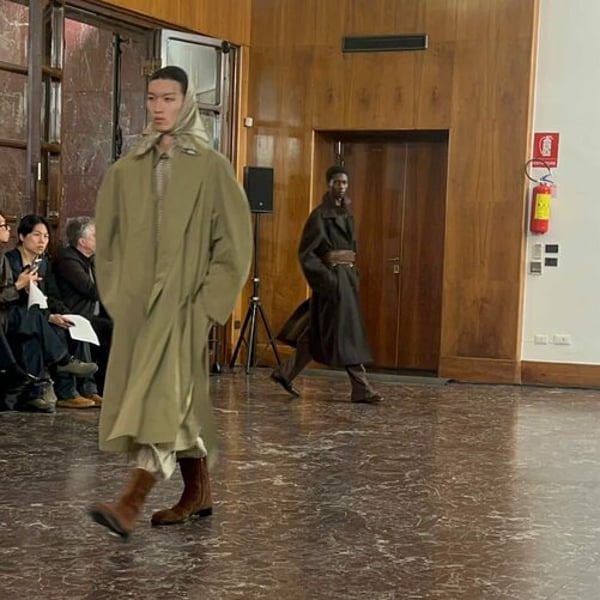
Pitti Uomo 109 staged a double bill of designer runway shows on Wednesday: Hed Mayner with some very fine conceptual and exploratory tailoring, and Shinya Kozuka, with a glove-inspired avant-garde display.
Hed Mayner: Tel Aviv tailoring
Mayner, an Israeli-born designer who for the past couple of years has divided his time between Tel Aviv and Bergamo, presented an impressive collection of enveloping clothes and twisted silhouettes that broke plenty of fresh sartorial ground.
Hed cuts clothes away from the torso and body, so they hang with a certain unexpected authority. Take his nipped-at-the-waist matinee idol coats that are finished with oversize sleeves worthy of a highwayman. Or consider his marvelous jackets, with sleeves that curve away, and shoulders that taper ahead. And you could not help admiring the cloak-meets-houndstooth topcoat combinations; or the superb flowing trench coat that Hed paired with silver sequin sweatpants and shirt.
“I wanted to create a sort of parallel universe, where the clothes work alongside the body, rather than over it,” explained Mayner, in a pre-show briefing.
With his high forehead and vertically ascending mop of hair, it would be easy to mistake Hed Mayner for a physicist. His clothes do reek of experimentation. Though he is certainly no mad scientist – as his experiments generally work, and often with great drama.
Hed showed 10 female looks and 25 looks for guys in this show, and the gals had a brainy, yet tough air about them too. Like the very snazzy pinstripe skirt suit or the brilliantly curvaceous worn. Leather biker jacket, whose shoulders ended halfway down the biceps. All told, this was a master class in bravura tailoring, that still managed to have plenty of commercial credibility.
Ever since his debut show in Paris in 2017, Mayner has been a consistently interesting designer, of considerable talent. And even if the odd look in this show was frankly absurd, like his pleated suede cone-shaped dresses, that only added to the sense of occasion.
All staged inside the Palazzina Reale di Santa Maria della Novella – a distinguished example of 1930s Rationalist architecture, finished with trompe l’oeil frescoes made to look like tapestries recounting Roman and Florentine history.
Making for a memorable fashion statement, by an Israeli designer who fully exploited the opportunity and honor of showing in Pitti, the world’s best organized fashion salon and trade fair, bar none.
Shinya Kozuka: Weird in a warehouse
The opening of Wednesday’s two shows in Pitti was by Shinya Kozuka, marking the Japanese designer’s international catwalk debut.
The invitation was a white cotton glove, and the inspiration was Japanese photographer Koji Ishii’s well-documented habit of taking photos of lost gloves found on the street.
But if the well-spring of the collection was intriguing, the clothes often felt contrived and convoluted.
In his defense, Kozuka is clearly a clever print maker. His assemblages of wild deer, moose, wild crows and campaniles seen in scarves or soft cotton shirts looked great. But a series of ragged, baggy denim shorts; lump snow-pint tops and bulky coats failed to impress.
A collection presented inside the Magazzino, meaning warehouse, of the Fortezza da Basso – the giant medieval fortress that is the nerve center of Pitti – the show-space space was decorated in a fake snowscape.
Kozuka didn’t take any bow at the finale. And the applause was the weakest we have ever heard in over 100 runways shows in Pitti.
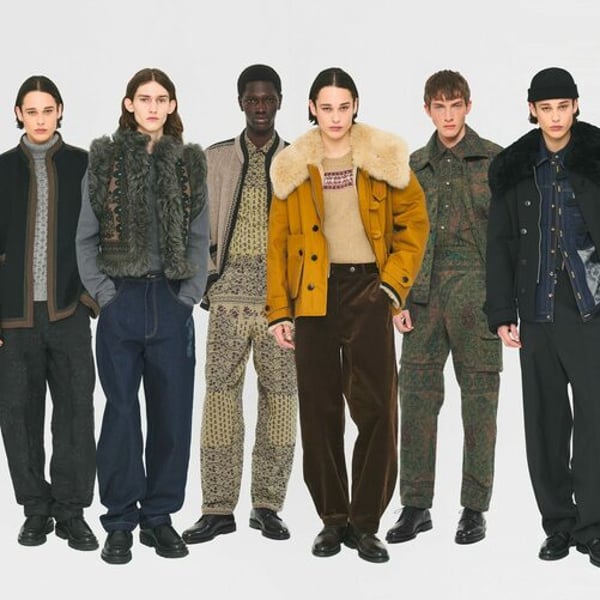
A lot of brands have had a hard time coming back from Covid, but not Antik Batik, the bohemian chic marque that returned to Pitti with real flourish this season.
Antik Batik’s menswear selection for Pitti Uomo – Antik Batik
A blend of European cool and Indian handicraft, Antik Batik could boast of a busy stand inside the Superstyling section of the three-day salon Pitti Uomo, edition 109, held in the Fortezza da Basso in Florence, Italy.
Stand out ideas included a Jimmy Hendrix worthy hippie chic embroidered waistcoat, finished with a sweatshirt interior and sheepskin collar; or a superb jacquard shirt jacket made from the matelassé cotton used for winter blankets in northern India. Made in a great, punchy gold, mauve, and bronze pattern developed by Antik Batik’s founder and creative director Gabriella Cortese.
Plus, she cut a great new range of jackets in dense cotton canvas with deep patch pockets, ending at the waist and finished with high sheepskin collars. Cortese also showed posh hippie shirts with ribbed breastplates in light yet densely woven washed Indian cotton, their labels hand done in India.
In knits, there were lots of outstanding black, deep pile kimono/cardigans, trimmed and piped with green hand embroidery, all made in the sub-continent. Seen alongside several wonderful chunkier ribbed sweaters, produced in Scotland by a great mill named McGeorge.
“It’s like what we used to wear going to school in Italy,” smiled the Turin-born Cortese. For other chilly Alpine mornings, she harnessed great traditional methods, developing natty jacquard tank tops and slim long scarves created in vicuna in Peru.
For party time, Antik Batik also had plenty of options, notably cool oversized embroidered shirts featuring an ecru and black floral design. Though her most sensational idea were inside out jeans finished in beautiful floral patterns, some made in an eye-catching patchwork. Ibiza, Deia– where Antik Batik have a pop-up and a full store– here we come.
“Pitti really is the best show anywhere for menswear. We had made menswear before but not in such a serious way, so it feels really right to be here. We’ve seen lots of great people,” explained the ever-blonde Cortese, who has still not lost the dancer’s figure she boasted when she was a young performer at Paris’ Crazy Horse back in the 1980s.
Internationally, Antik Batik sells in over 400 doors, testament to its loyal following of counterculture cool kids. Asked to define the brand’s DNA, Gabriella laughed and responded: “Chic bohemians, who enjoy reading Jack Kerouac,” referring to the Beat Generation poet whose novel One the Road inspired a generation of artists, musicians, and globetrotters.
eBay’s Circular Fashion Fund is returning for a fourth year as the digital retail giant continues to reinforce its “long-term commitment to advancing circularity in the fashion industry”.
eBay
This year, the programme is expanding its reach across the EU, Switzerland and Canada, opening applications to more businesses and start-ups “developing innovative solutions that extend the life of clothing and reduce textile waste”.
The annual programme, first launched in 2022 supporting entrepreneurs tackling the fashion and textile industry’s environmental footprint, from production to end-of-life, now want to select eight businesses with each receiving $50,000 (£37,000) in funding, alongside mentoring to help develop and scale their ideas.
One standout business will also be named the Global Winner of the Circular Fashion Fund, with the opportunity to receive an additional $300,000 investment from eBay Ventures.
With this expansion, eBay’s total global funding through the programme is set to reach $1.9 million by the end of 2026.
Alexis Hoopes, vice-president and global head of fashion at eBay, said: “Over the past three years, we’ve seen scalable solutions emerge in areas like textile recycling, resale and repair — but these businesses need capital and support to grow. With this expansion, we’re helping more founders build the infrastructure to make circular fashion an integral part of the fashion industry.”
Applications for the 2026 Circular Fashion Fund are now open and will close on 8 March.
It may not feel like tennis weather in the Northern hemisphere but with Australia’s summer in full flow, the Australian Open is making global headlines and also showing the material tech that will have a big impact in Europe and the Americas later this year.
Boss
This month, at the year’s first major international tennis tournament, Boss is debuting NovaPoly yarn: a recycled alternative to virgin polyester “with the potential to inspire industry progress in textile innovation and advanced performance”.
Developed in collaboration with Jiaren Chemical Recycling and NBC LLC, it’s claimed to be “more than just a yarn” and is “an example of Boss’s commitment to shaping the future of fashion”.
It features a special additive that speeds up degradability in comparison to conventional polyester fibres, making it biodegradable in an anaerobic active microbial environment.
The Boss brand’s ambassadors will showcase the yarn in its tennis styles during play in Melbourne this month with Taylor Fritz and Matteo Berrettini set to wear key yarn pieces on the court, including jerseys, shorts, and caps.
Hugo Boss said “this marks an important moment” in the brand’s journey as it “reinforces its position as a forward-thinking brand, complementing the company’s ongoing efforts to develop alternatives to conventional polyester and polyamide fibres and aligning with its commitment to driving progress through innovation and advanced materials”.
The fibre is made from recycled textile waste sourced from both pre- and post-consumer phases and modified with an additive.
Boss will “highlight the craftsmanship and forward-thinking approach of NovaPoly yarn through authentic storytelling, athlete endorsements, and dynamic visuals in the collection’s campaign”.
Designs using the fibre will also be available online, in its stores, and through select wholesale retail partners globally from this month.