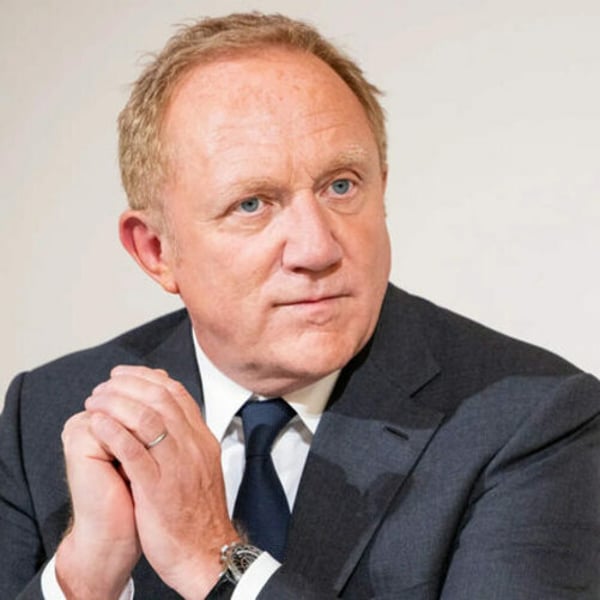
The Pinault family’s investment firm, Artemis, is entering a new phase marked by strategic restraint and leadership transition. After years of high-profile acquisitions and aggressive expansion across the luxury and entertainment sectors, the family office is now scaling back deal-making and reducing debt—moves driven by disappointing returns from portfolio companies and rising financing costs.
François-Henri Pinault – Photographer: Benjamin Girette/Bloomberg
This recalibration follows a broader shift in the family’s leadership structure. François-Henri Pinault, who co-manages Artemis with his father, Kering founder François Pinault, stepped down this month as CEO of Kering after serving in the role for two decades, signaling a renewed focus on Artemis. He remains chairman of Kering but is relocating from London to Paris to oversee the family’s investment strategy more closely.
Artemis has seen its debt rise approximately 40% above historical levels, reaching around €7.1 billion ($8.3 billion), according to a source familiar with the matter. Despite the increase, financing costs remain manageable thanks to ongoing dividends from its various holdings.
Founded in 1992, Artemis manages a wide-ranging portfolio spanning luxury, art, sports, media, and real estate. Its stakes include major shares in Kering—parent to Gucci, Balenciaga, and Bottega Veneta—as well as Christie’s auction house, vineyards, a French cruise line, and talent powerhouse Creative Artists Agency (CAA). Other recent investments include fragrance brand Creed, prime real estate assets, and a 30% stake in Italian fashion house Valentino.
Still, mounting setbacks—particularly at Gucci—have impacted the family’s net worth, which has reportedly dropped more than 50% over the past four years, according to Bloomberg. Earnings from Artemis’ portfolio payouts are expected to fall by around 40% this year to approximately €520 million.
The firm is now steering away from large-scale acquisitions, like its $3.5 billion stake in CAA in 2023, which has since increased to 54.2%. The family is favoring capital preservation over leverage, mirroring trends noted in Citigroup’s 2025 Global Family Office Report, which found that only 8% of global family offices use leverage above 30%.
Kering itself is under pressure. Standard & Poor’s issued a negative outlook in August, noting that Kering’s net debt, including leases, will hit €14.5 billion during the 2025–2026 period. While Artemis’ debt levels don’t pose a direct credit risk to Kering, the two companies’ parallel financial tightening reflects a more conservative fiscal era for the Pinault empire.
CAA has also taken on more debt, partially due to “debt-funded” dividends, according to Fitch Ratings. While Fitch maintained its rating, it warned of risks related to Artemis’ shareholder control. CAA remains dominant in talent management—especially in music and sports—and plans to open a London office in 2025, backed by new financing.
Elsewhere, Puma—where Artemis holds a 29% stake—is undergoing a strategic overhaul under new CEO Arthur Hoeld. Gucci remains under pressure, and Kering has appointed Luca de Meo to lead a turnaround of the brand.
Despite these challenges, Artemis maintains a solid equity foundation. Its assets are valued at €28 billion—roughly four times its current debt. In 2024, Artemis paid a €250.2 million dividend to its parent company, Financière Pinault, more than doubling the previous year’s payout.
As the Pinaults realign their strategy, Artemis is not just restructuring its finances—it is reinforcing its family legacy. Two siblings and three third-generation members now sit on the board, maintaining multigenerational continuity at one of France’s most influential luxury dynasties.
Not a label, not a lobby, not even a legal entity. That is how Arielle Lévy, president of the Une Autre Mode Est Possible (UAMEP) collective, characterises this nascent union. Animer, an acronym for “Acteurs Nationaux Indépendants Mode Engagée Régénérative,” aims to shine a light on all the initiatives undertaken by fashion stakeholders, from producers to brands, who are advancing responsible, regenerative fashion in France.
The union was founded by eight collectives involved in regenerative fashion – UAMEP
The union was officially launched on Monday January 19, following the petition initiated by Arielle Lévy against Shein in response to the watering down of the anti–fast fashion law. Titled “Paris deserves better than Shein,” the petition drew nearly 140,000 signatures. “I wanted us to unite because I realised how strong the civic voice was,” explains Arielle Lévy. “These collectives are doing superb work and, at a certain point, there is a desire to close ranks, to make society together,” she says.
“Breaking the isolation of initiatives across the regions”
In addition to UAMEP, a number of other collectives are behind Animer, including Fashion Revolution France, L’Âme du Fil (Angers), Collectif Baga (Marseille), Café Flax (Clermont-Ferrand), Le Comptoir de la mode responsable (Poitiers), Le Conservatoire de la Mode Vintage (Isère), and La Grande Collecte/Textile Lab (La Rochelle). “It’s a union of independent collectives, committed to their local areas and sharing the same societal project,” Arielle Lévy emphasises.
The union hopes to represent all French territories – Collectif Baga
The union plans to focus its efforts on the ground, working across supply chains, regions, practices and even our shared imagination. With “hundreds” of stakeholders already on board via the various founding collectives, Animer is built on ten key ideas: dignity, value-sharing, traceability as a common language, less and better, circular design, smart re-localisation, carbon sobriety, inclusion and plurality, cooperation rather than “sterile competition”, and proof through action.
Animer’s founders plan to bring together all the initiatives active in regenerative fashion across the country. The union hopes to become a preferred interlocutor in defending a societal project focused on respect for the earth, and for men and women. With the help of Fashion Revolution, it aims to act in the national interest by engaging the general public and the country’s institutions.
This article is an automatic translation. Click here to read the original article.
French cosmetics giant L’Oreal said on Wednesday it will set up a beauty tech hub in the south Indian city of Hyderabad with an initial investment of over 35 billion rupees ($383.4 million).
L’Oréal
The hub aims to be a global base for AI-driven beauty innovation, create 2,000 tech jobs through 2030, and speed up the rollout of advanced AI beauty solutions, the company said in a statement.
Nicolas Hieronimus, L’Oreal’s CEO, and the state government of Telangana formalized the partnership at the World Economic Forum, Davos.
Telangana has rapidly emerged as a key investment and technology hub in southern India.
Bilateral trade between India and France stood at $15 billion in 2024, and Indian Prime Minister Narendra Modi and French President Emmanuel Macron have been forging warmer ties.
The two sides have also been working to recast their tax treaty since 2024 to modernize it by adapting global standards on tax transparency, Reuters reported in December.
Swarovski on Tuesday announced the appointment of Sindhu Culas to the role of president, general manager, North America at the Austrian jewelry maker.
Sindhu Culas – Courtesy
Based in the luxury firm’s New York City office, Culas will be responsible for “maximizing the Swarovski physical and digital presence and overall brand affinity in the U.S.,” according to a press release.
“We are thrilled to welcome Sindhu to Swarovski. Her vast leadership experience and passion for the brand make her an exceptional addition to our team,” said Kolja Kiofsky, chief commercial officer, Swarovski.
“With Sindhu guiding our next chapter in North America, we are looking ahead to an exciting future filled with creativity, operational excellence, and meaningful growth under our LuxIgnite strategy.”
A retail veteran with over 25 years of experience across omni‑channel retail and institutional investment management, Culas joins the crystal jewelry maker from G-Star, where she served as CEO of North America at the British denim and apparel brand.
She began her career as a buyer and planner at Macy’s, Talbots, and Lord & Taylor before being promoted to strategy and brand management at Macy’s. Later on, the executive served as senior vendor manager at Amazon and as senior vice president of e‑commerce and strategy for Calvin Klein.
“Watching Swarovski’s brand repositioning and momentum in recent years has been inspiring,” said Culas, in response to her new appointment.
“I’m excited to join this exceptional team, collaborate across the business, and help strengthen our position while accelerating growth throughout North America. It’s a remarkable moment for the brand, and I’m thrilled to contribute to the journey ahead.”