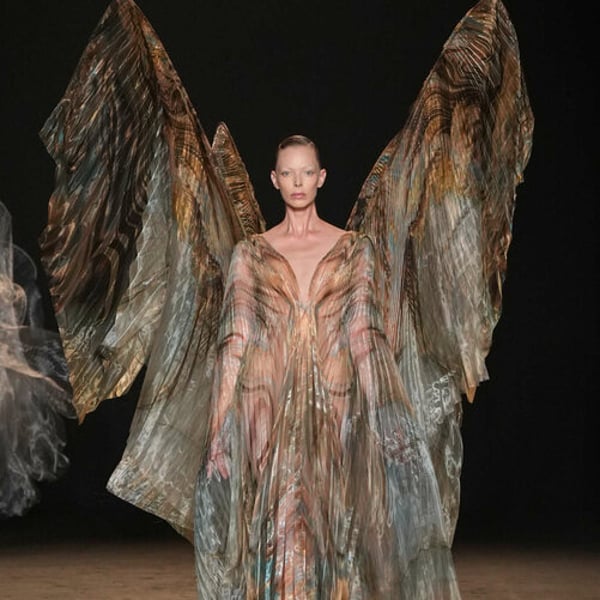
Two great couture originals staged subtly dramatic shows on Monday in Paris; Iris van Herpen with her latest techno Sturm und chic, and Rahul Mishra with 21st-century Sufism style.
Iris van Herpen: Urban ornithology
Iris van Herpen is an artist who used clothes to make unexpected and often very beautiful visual statements. Wearability is not a word that exists in her lexicon. Though words like wonderful, wicked and wow-factor certainly do.
Add breathtaking and phantasmagorical this season, where in the show in the funky Elysée Montmartre theatre she conjured up a full aviary of van Herpen creatures.
Beginning the action with a performance – a dancer in gigantic synthetic tulle wings, gyrating on a column, as a back-lit pyramidal lazar column flickered on the faux feathers.
The first proper model then appeared in a pale blue woollen lattice cocktail dress, finished with Aegean blue veil. Like most looks, anchored by remarkable pumps, built at a 35-degree angle, the better to fit into a Masai-worthy metal wire frame.
Giant crinolines or cocoon dresses followed made in honeycomb tech-y nylons, sheer fantasy garments, where the models did so much wear the clothes, as inhabit them. Before the look went into full abstraction, John Chamberlin-car-crash-style, with huge scrunched-up clouds of tulle.
Leading to Iris’ grandiose finale and intensely applauded bow, most enthusiastically in the front row by Jean-Paul Gaultier.
The latest rarefied statement of fine art made of fabrics, and the latest reminder of why Iris van Herpen had her very own retrospective in the Louvre. Not bad going for a 41-year-old.
Rahul Mishra: Seven stages of love
India’s greatest couturier Rahul Mishra entitled his latest collection “Becoming Love”, and the clothes became artful visual expression of seven stages of love in an outstanding show.
Beginning with the first moment of attraction, symbolized by golden veined metallic gold cloud dresses that opening the show. Before becoming infatuation, seen in some superb columns and cocktails, done with puckered and embroidered exotic flowers and petals. Altogether a powerful reminder that Rahul remains a creator very much in control of his atelier.
And including devotion, an entirely apt feeling, considering the show location. It was staged amid the honey-stoned 13th-century medieval Collège des Bernardins, whose founder St. Benedict of Nursia postulated a doctrine of balance, moderation and reasonableness.
Instead, in Rahul’s hands, devotion was expressed in a beautiful sculptural white cocktail, bedecked with pearl epaulettes or in a degradé sequinned dress that morphed into tulle embroidered in carnations and lotuses.
Though, his boldest looks were a quintet of Gustav Klimt-style patchwork golden gowns and suits. They represented obsession.
All told a powerful statement, even if a little editing of a quartet of outfits from which protruded nine-inch-wide fabrics at the end of metal prods would not have gone amiss. One of these even made into the show’s final section, the final stage in Sufism’s concept of love as a seven-stage adventure that inevitably ends in death.
Interpreted by Mishra as in part “a quiet culmination.” Death-inspired swirling black jacquard gowns embroidered with the face of one’s true love, to a last look in the shape of a black heart. A somber denouement to a courageous show.
Another creative director departure at a major brand is shaking up the fashion industry. It is now the turn of Austrian designer Norbert Stumpfl to leave Brioni. The label has just confirmed the end of its collaboration with the designer in a statement. Stumpfl had designed Brioni’s collections for the past seven years.
The fashion house founded in 1945, which in 1952 became the first menswear brand to stage a fashion show (in Florence’s legendary Sala Bianca), has expressed its “deep gratitude for the contribution he has made over the years. During his tenure at Brioni, Norbert interpreted with precision the concepts of lightness and discretion, contributing to the evolution of the men’s wardrobe with a modern approach that pays homage to tradition,” Brioni said.
Federico Arrigoni, CEO of Brioni, said, “Our journey continues, and the Maison will continue to consolidate its tradition- perfection of craftsmanship, exceptional materials, and innovation in tailoring techniques- to create true masterpieces, from formalwear to leisurewear and accessories. Brioni pursues its mission of defining the contemporary codes of Italian elegance, while elevating its mastery of high tailoring and bespoke craftsmanship for those who lead and accept nothing but the exceptional.”
Since 2011, Brioni has been part of the Paris-based French luxury group Kering. From 2018 until his departure, the brand’s collections were designed by Norbert Stumpfl, the acclaimed Austrian menswear couturier, celebrated for his blend of impeccable tailoring and cutting-edge fabrics- among his creations were dinner jackets woven with 24-carat gold threads and enzyme-treated silk-linen blends with a soft, distinctive handle. During his tenure, Brioni also expanded masterfully into womenswear, expressing discreet luxury with rare aplomb.
A pinnacle of Roman sartorial luxury, the Italian label marked its 80th anniversary in late November with an exhibition of its superb tailoring and a gala dinner at the Chiostro del Bramante in Rome.
This article is an automatic translation. Click here to read the original article.
An Hermes handbag that once belonged to Jane Birkin was sold for $2.86 million (2.45 million euros) at auction in Abu Dhabi on Friday, just months after the record-breaking sale of her first bag from the French brand, Sotheby’s said.
Jane Birkin with one of her signature Hermes bags – Sotheby’s
Hermes first created the design for the British singer and actress in 1984 and it has gone on to become a modern and highly prized classic, sought by fashionistas the world over. The first prototype was sold for 8.58 million euros ($10 million) at a Sotheby’s auction in Paris in July, smashing previous price records for a handbag.
The one sold on Friday was a ‘Birkin Voyageur,’ which was gifted to the former wife of French singing legend Serge Gainsbourg in 2003. The final sale price was around six times times higher than the estimated price range of $230,000-$430,000 given before the sale.
“Jane Birkin’s handbag legacy continues to captivate collectors,” Sotheby’s said in a statement sent to AFP, adding that bidding took place over 11 minutes between six collectors. The new owner was a phone buyer and has not been identified.
The handbag was one of four owned by the late celebrity, who used to sell them to raise money for charitable causes. It has a handwritten inscription in French inside from Birkin that reads: “My Birkin bag, my globetrotting companion.”
A third Hermes bag owned by Birkin is set to go under the hammer on December 15 at the Hotel Drouot auction house in Paris. It was entrusted by the late star to her friend and biographer Gabrielle Crawford, who is selling it to help fund the future Jane Birkin Foundation, Drouot said in a statement.
Produced in very limited numbers, the modern Birkin bag manufactured by Hermes has maintained an aura of exclusivity and is beloved by celebrities such as the Kardashians, Jennifer Lopez, and Victoria Beckham. The most expensive fashion item ever sold at auction was a pair of ruby red slippers worn by actor Judy Garland from The Wizard of Oz in 1939, which sold for $32.5 million in 2024 in Dallas, Texas, according to Sotheby’s.
Artificial intelligence (AI) continues its march to transform businesses’/consumers’ lives with customer advocacy platform Mention Me launching ‘AI Discovery IQ’, a free-to-use tool that “helps brands reach target consumers in the new age of generative AI search”.
Kirill KUDRYAVTSEV / AFP/Archives
It claims to allow brands to “instantly audit how discoverable they are within popular AI systems” such as ChatGPT, Claude, Gemini and Perplexity.
According to Mention Me, 62% of UK consumers now turn to generative AI tools for product recommendations, brand discovery and comparisons, “bypassing traditional search engines entirely [so] businesses are under pressure to respond to this behaviour change,” said the platform’s CEO Wojtek Kokoszka whose platform works with firms including Charlotte Tilbury, Huel and Puma, “helping marketing teams to boost consumer awareness and sales”.
With AI, it says the modern customer journey, powered by natural language prompts instead of outdated keyword strings, means consumers are 4.4 times more likely to convert if they find a brand through a large language model (LLM).
“The rise of ‘agent-mode’ assistants and AI-driven voice search has pushed brands into a new world of digital visibility. Despite this, most brands have little to no insight into how they appear in AI-generated answers”, said Kokoszka.
AI Discoverability IQ claims to give brands an overall LLM discoverability score, specific details on areas such as technical website elements, content and structured data, and actionable recommendations to improve their AI discoverability.
Its tool generates “measurable, trackable outputs” like AI Visibility Score, brands’ prompt-based results, and a side-by-side comparisons with their competitive set. This means brands “can react quickly to improve their discoverability scores” with Mention Me’s wider suite of products and unique first-party data.
It’s also “innovating and evolving” its platform to include more capabilities, such as the ability to benchmark against competitors, to drive further improvements for marketing leaders in the age of AI.
Mention Me CMO Neha Mantri said: “AI Discoverability is not yet a named practice within most marketing teams; the same way SEO wasn’t in the early 2000s. But when up to 31% of consumers say they’re more likely to trust responses from generative AI than traditional search results, this needs to change. Mention Me is naming the problem and providing a solution at just the right time.”