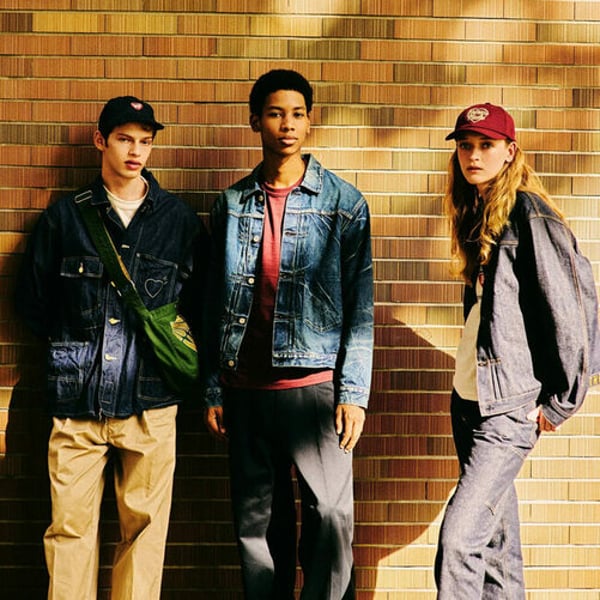
By midmorning, Human Made Inc.’s Harajuku flagship is humming with a quiet churn of tourists speaking Mandarin, English and Korean over an upbeat ‘80s pop soundtrack. Inside, white walls and exposed pipes frame racks of duck-print sweatshirts above storage crates stamped with Human Made’s retro graphics. Staff in sweatshirts and Converse sneakers keep the flow brisk, keeping with the rhythm of a brand whose shares are about to start trading after a blockbuster Tokyo debut.
Human Made
The man behind it all once said he “couldn’t do business.” Now, Tomoaki “Nigo” Nagao, who made camouflage hoodies a global status symbol, is at the helm of a streetwear IPO so hot it’s 60 times oversubscribed, according to people familiar with the deal, and a valuation that places him in fashion’s new moneyed elite.
Human Made began trading on the Tokyo Stock Exchange on Thursday, after pricing last week in a debut that valued it at $460 million. The listing marks a rare moment when streetwear, once a subcultural rebellion against luxury, has matured into one of its most valuable commodities. Nigo’s stake amounted to nearly $285 million, marking his ascent from underground fashion icon to publicly listed mogul. He has already cashed in about $56 million worth of stock.
”This is a symbolic moment when a creative business rooted in Japanese street culture is being recognized as a valuable entity in the capital market,” said Kaori Nakano, visiting professor at Aoyama Gakuin University and a fashion historian. “I expect this to boost expectations of more investments into Japanese brands.”
Institutional investors sought more than 35 times the number of shares available to them, while demand from Japanese retail buyers was about 80 times, according to the people who declined to be named because the details aren’t public. At its IPO price, the stock trades at a valuation multiple far higher than Japan’s listed fashion peers. Human Made’s latest earnings show expansion, projecting about 20% growth in both revenue and profit for the current fiscal year.
“Its high multiple won’t be justified unless revenue and profit expansion look realistic,” said Ikuo Mitsui, a fund manager at Aizawa Securities Co. “But if the market comes to see Human Made as a growth stock, it wouldn’t be surprising for it to trade at around 50 times earnings going forward.”
The stock debut vaults Nigo into a new class of fashion wealth that’s distinct from old guard billionaires like Ralph Lauren, Miuccia Prada and Donatella Versace, who have dominated fashion for decades.
“In recent years, younger consumers have started to find that old idea of luxury offputting,” said Nakano. “They want something that feels fairer, where owning a product connects you to a community, not a hierarchy.”
Appetite for the listing has been intense. Among the biggest beneficiaries is Pharrell Williams — musician, producer and longtime collaborator who now serves as Louis Vuitton’s menswear creative director — with a 25.7% stake worth about $117 million. He sold about $33 million of that upon listing. Institutional investors included Sumitomo Mitsui DS Asset Management, MY.Alpha Management HK Advisors Ltd. and Asset Management One Co..
“What investors liked most is its growth,” said Takamasa Ikeda, a senior portfolio manager at GCI Asset Management who bid for shares in the IPO but didn’t receive any due to outsize demand. “It’s an outstanding pace for a company of this size.”
Human Made’s revenue and profit have risen more than fivefold since 2020, but sustaining that momentum will be a challenge, he added. “The company needs to broaden its offerings to maintain 20% revenue growth,” Ikeda said of the brand that has partnered with Nike Inc., Levi Strauss & Co. and Pokémon. “Expanding product lineups and collaborating with more global brands could be one solution. Investors are now watching to see whether Human Made can strike new tie-ups.”
Behind the business stands a seasoned executive team: CEO Rei Matsunuma, who spent 16 years at Fast Retailing’s Uniqlo, and Rehito Hatoyama, a former executive at Sanrio Co., the $9 billion company behind Hello Kitty, where he led the brand’s global expansion strategy.
Born in December 1970 in Maebashi, Japan, Nigo grew up in a modest household: his mother a nurse, his father a metalworker. His fascination with Western style was sparked by the men’s magazine Popeye, which introduced postwar Japanese youth to the Ivy League look of 1950s America. That curiosity led him to Bunka Fashion College, where he studied fashion editing, and where his distinct mix of design, branding and storytelling began to take shape.
For a generation that came of age in the 1990s, Nigo was already a bit of a legend. His brand A Bathing Ape (BAPE) defined Tokyo’s Harajuku scene, blending hip-hop, skate and Japanese pop-culture influences long before “streetwear” became a global currency. His clothes appeared on stars like The Notorious B.I.G., Pharrell and Kanye West, who helped transform the label from a local secret into an international symbol of exclusivity.
In 1993, the same year that Japanese-French designer Kenzo Takada moved to LVMH with his eponymous brand, bringing Japanese prints to the world, Nigo launched A Bathing Ape — fusing Tokyo youth culture with a global sensibility. Nearly two decades later in 2011, the fashion designer walked away from the loss-making label that had made him famous, selling it to a Hong Kong conglomerate.
But even after BAPE’s fall, Nigo remained an enduring influence. In 2003, he co-founded luxury streetwear label Billionaire Boys Club and Ice Cream with Pharrell. In 2021, he was appointed artistic director of LVMH’s Maison Kenzo — the first Japanese person in the role since Takada himself. Virgil Abloh, the late American designer, once called him “the Yves Saint Laurent or Balenciaga of streetwear.”
Founded in 2010, Human Made reflects the same mix of nostalgia, craftsmanship and pop-culture savvy that defined Nigo’s earlier work — but with a more mature approach. While BAPE captured the chaotic energy of 1990s Tokyo street culture, Human Made channels a quieter reverence for American heritage style, blending vintage workwear with preppy aesthetics.
With Human Made’s blockbuster IPO, the industry is watching whether Nigo’s next move could be to reclaim the brand that made him famous. In 2021, BAPE’s parent company, I.T Group, was taken private in a deal led by CVC Capital Partners leaving open the possibility that the designer who once walked away from his creation may one day buy it back.
Human Made, which sells through aggregator stores in China, South Korea and Hong Kong, is now pushing to expand overseas. In China, the company has built a following among younger consumers drawn to its retro designs and ties to global pop culture. But Japan’s fashion brands have historically struggled to scale in its fast-moving market, where trends shift quickly and local labels dominate e-commerce platforms. Japanese brands like Beams and United Arrows have name recognition but remain niche.
In its IPO prospectus, Human Made describes China as its “main battlefield,” prioritizing staffing and investment there and calling it “the biggest untapped market.” It also plans to expand in the US to balance its exposure to China, and grow across Southeast Asia and Europe through partnerships and placements in high-end department stores. This happens to come at a time of political and economic strains between China and Japan, which could add uncertainty to cross-border retail growth.
The IPO is just one piece of a broader empire. Beyond fashion, Nigo has become a prolific investor and collector. He serves as a creative advisor and investor in NOT A HOTEL, a Japanese hospitality startup that has drawn attention for turning luxury vacation homes into shareable assets. The company has more than 1,000 property owners. Among its flagship properties is the NIGO House, a concrete retreat built into a cliff overlooking Tokyo Bay with panoramic views of Mount Fuji.
In his 2014 Sotheby’s auction “NIGO Only Lives Twice,” he sold 250 lots of art, toys and furniture, including KAWS sculptures and bespoke Louis Vuitton blankets, fetching $4.5 million, about twice the presale estimate. A decade later, that ability to turn cultural influence into financial value is being tested again with Human Made’s market debut.
“Human Made embodies the energy and freedom of Tokyo’s backstreets, the blend of craftsmanship and playfulness, and a kind of Otaku culture layered in there too,” said Nakano, referring to a detail-obsessed pop-culture fandom.
”It’s less about a street fashion brand going public, and more about this market value being attached to Japanese-born culture,” she said. “It’s a groundbreaking event.”
China sold more goods to the world than ever in 2025, but export saleswoman Aimee Chen says it was the hardest of her roughly two-decade career. After US President Donald Trump‘s tariff hikes led to US orders plunging by a third, Chen’s pet products company moved to diversify geographies, chasing new and often lower-income markets like South America. The response mirrored China’s official trade policy, which led to a record $1.2 trillion surplus for 2025 despite new trade barriers.
Chinese flags flutter near containers stacked at the Yangshan Deep Water Port in Shanghai, China January 13, 2022. Picture taken January 13, 2022 – REUTERS/Aly Song/File Photo
Reuters interviews with 14 salespeople working on the frontlines of China’s export diversification push, however, reveal the costs and caveats behind the rosy headline trade figures. Four of the salespeople said that orders from the new markets were often smaller in volume and less lucrative than US sales, resulting in lower commissions and pay. Government data show profits at China’s industrial firms fell 13.1% year-on-year in November, the fastest pace in over a year.
Many of the employees also described longer working hours as well as greater intensity and uncertainty amid the export boom. “I’m very anxious,” said Chen, adding that she had recently experienced stress symptoms like hair loss and insomnia.
Mingwei Liu, director at the Center for Global Work and Employment at Rutgers University, said that China’s export strategy in alternative markets depended on firms chasing high volumes of cheap orders. Companies that succeed often give clients longer payment cycles and bear higher default risks, he said.
“This market reorientation increases the labour intensity, the emotional burden and income uncertainty faced by workers in export sales,” Liu said. China’s commerce ministry and human resources ministry, as well as the office which manages the cabinet’s media queries, did not respond to requests for comment.
China and the US have grown increasingly interconnected since Beijing’s 2001 accession to the World Trade Organization. Their relationship has also become more imbalanced, with their respective economic policies favouring production in the former country and consumption in the latter.
Some American retailers and Chinese producers have said they developed relationships that were so close that they could anticipate each other’s needs and red lines, making deals feel almost automatic. Chen, for instance, described her past interactions with US retailers in largely glowing terms. Clients in the world’s largest economy were often “easy-going” and signed deals quickly, she said.
By contrast, customers in new markets like to haggle on price, she said. Chinese shipments to the US fell 20% in 2025, though it remains a top export destination. Shipments rose 25.8% to Africa, 7.4% to Latin America, 13.4% to Southeast Asia, and 8.4% to the European Union last year.
While Washington and Beijing have had previous trade disputes, tensions escalated after Trump took office at the start of 2025. He raised tariffs to over 100% in April, before partially reversing and settling for a fragile detente. His re-election sent China’s export-oriented industrial complex into a rat race for foreign demand across the world.
Monica Chen, who has been selling auto parts for more than a decade in the eastern Zhejiang province, had long relied on email to keep business going. But with US tariffs in place, she’s had to fight harder to win business. That means ramping up business travel to as much as three times a month and cold-calling prospects.
“It’s very hard to develop new markets, they are basically saturated,” said Monica, who isn’t related to Aimee Chen. Her company ultimately responded by cutting prices to undercut other Chinese firms that are also looking for buyers abroad. The firm’s orders were down a third in value from 2024, Monica said.
With profits falling, companies have placed pressure on their sales agents. Cici Lv, 24, who has sold electric bicycle batteries since 2022 from the southern city of Shenzhen, earns about 5,000 yuan ($717) per month- not much more than workers in the factories that produce such units.
But while workers’ shifts come to an end, Lv said she is constantly on the clock talking to foreign clients. One of her peers, Rowan Wang, a sales rep for an exporter of agricultural equipment in eastern China, summed up the demands as “if we’re alive, we have to reply.”
Five of the salespeople also described struggles to manage less-affluent clients in markets with which they have little familiarity. Lv said she traded messages with one client for months, discussing everything from news events to lunch choices and religion. He eventually ordered just one battery, earning Lv a commission of less than $2.
A review of the top 100 most liked export-related posts on social media platform RedNote in the six months to mid-January found 37 that raised complaints about heightened job stress. Another six complained about unprofessional client interactions.
“Sometimes it messes with your mind,” said Lv, who said she’s fielded relationship proposals. The hardship described by the sales staff may be an early warning that China’s trade diversification success in 2025 could be hard to replicate in the years ahead, said Chen Bo, senior research fellow at the National University of Singapore’s East Asian Institute.
Economists have long argued that China has to develop local markets if it wants to end its deflationary cycle. Weak consumption pushes Chinese producers to compete overseas, often against each other, which brings revenue into the economy but erodes profits, Chen said. China “can’t maintain sustainable economic growth by relying on foreign markets,” the academic said.
Spanish designer David Catalán, whose eponymous label is registered in Porto, and Portuguese designer Miguel Vieira once again took to the runway at Milan Fashion Week, supported by Portugal Fashion. According to the organisers of the Portuguese project, the initiative was included in the official show calendar of Italy’s fashion capital, one of the most important stages in the global industry. Their autumn/winter 2026/2027 collections were presented at Fondazione Sozzani on the morning of Monday, January 19, one following the other.
Foto: Filippo Fior
While the “ASSEMBLED” collection marks David Catalán’s new approach to construction and functionality, the ‘A Tea in the Desert’ line “brings Miguel Vieira’s vision inspired by Bernardo Bertolucci’s The Sheltering Sky,” Portugal Fashion said in a statement.
“ASSEMBLED is the title of David Catalán’s collection for autumn/winter 26/27. The concept draws on the logic of traditional patchwork blankets, looking to their principles of construction, reinforcement, and layering as practical responses to cold, wear, and continued use,” the note explains. “Those principles are translated into menswear through panelled cuts, contrasting materials, and structured silhouettes, creating a winter wardrobe designed to be combined, adapted and worn in day-to-day life.”
“The pieces function as layered systems, with each element playing a specific role within the whole, combining structural rigour with a contemporary approach to menswear, and focusing on functionality, durability, and versatility.”
Foto: Filippo Fior
On his social media channels, David Catalán writes: “Inside the studio and in factories, where streetwear meets the precision of tailoring and youthful instinct intersects with craftsmanship, @davidcatalanbrand shapes a contemporary, fluid, and deeply personal voice.”
“Born in Spain, Catalán chose Porto as his base on arriving to study fashion- a city that has become integral to the growth of his brand and creative identity. Today, his work reflects an intercultural journey, combining relaxed tailoring, utilitarian elements, and a modern approach to menswear, rooted in quality and experimentation,” the post further explains, announcing that in Milan, “David Catalán takes to the runway at @milanfashionweek, representing Portugal via the Portugal Fashion platform. The ‘Assembled’ collection unfolds as a reflection on construction, layering and the dialogue between function and form- a collection that captures the energy of a new generation of menswear.”
Foto: Filippo Fior
“A statement shaped by versatility, movement and the freedom to build one’s identity through clothes,” the brand adds, underscoring: “Assembled. Versatility in every layer. Freedom in every step”.
Miguel Vieira then presented the ‘A Tea in the Desert’ collection, inspired by Bernardo Bertolucci’s film The Sheltering Sky, developed “from the arid landscapes of North Africa and the emotional intensity of the protagonists, translating these references into a tailoring proposal marked by contrasting textures, volumes and atmospheres.”
Foto: Isidore Montag
“The silhouette oscillates between structured shapes and more fluid lines, creating a constant tension between restraint and freedom,” it continues. “The colour palette includes ecru, beige, camel, brown, pink, and black, rendered in materials such as flannel, silk, alpaca, cashmere, fur, wool, and sequins. Details include prints developed in the atelier and hand-braided flannel, with accessories such as scarves, ties, and bags completing the collection.”
On its social media channels, the eponymous Miguel Vieira brand highlights “A Tea in the Desert. Rigor in every cut. Sensitivity in every detail”, reads a post on @miguelvieiraofficial, shared with @portugalfashion.
Foto: Isidore Montag
“Inside the atelier, where precision defines each line and tailoring becomes language, @miguelvieiraofficial continues a career shaped by mastery, discipline, and vision,” another publication explains. “With decades of close collaboration with the textile industry, the designer refines silhouettes that have long defined contemporary menswear. Each piece reflects a commitment to structure, detail, and the discreet confidence of impeccable tailoring”.
It further previews, in Milan, ‘A Tea in the Desert’, which reveals itself as “a new chapter in a work dedicated to men’s fashion, where rigour meets sensitivity and experience is transformed into expression.” In short: “A collection rooted in tailoring, elevated by time and guided by an enduring dialogue between fabric and form.”
Foto: Isidore Montag
After Milan, Portugal Fashion moves on to Paris and, subsequently, Copenhagen, continuing the autumn/winter 2026/2027 season with a series of actions aimed at buyers, the media, and industry professionals. This reinforces the presence of creations developed in Portugal across Europe’s main fashion centres, the organisation behind the Portuguese passerelle notes, as it invests beyond borders to take Portuguese talent and fashion labels further afield.
Portugal Fashion is a project run by ANJE- National Association of Young Entrepreneurs- with the support of its strategic partners and co-financed by SIAC- Support for Collective Actions- Internationalisation of Portugal 2030, within the scope of Compete 2030- Innovation and Digital Transition Programme- with funds from the European Union, through the European Regional Development Fund.
This article is an automatic translation. Click here to read the original article.
Paon-Paon is still little-known but is already making its presence felt. The fledgling French artisanal maison is setting up a snug nest at 11 rue du Dragon in Paris, where it will open on January 30. The store is the brainchild of CEO Emmanuel Gavache, who co-founded Paon-Paon with Aurélie Introzzi, the maison’s creative director.
Paon-Paon’s first collection is big on cowhide leather – Paon-Paon
Paon-Paon was founded in December 2025, entering the market with a range of women’s footwear featuring sandals, mules, pumps and booties, some of them characterised by curved shapes, others more sharply defined. The models come in a wide variety of colours and materials, from pink or white cowhide to black or gold metal-effect leather, black or blue cashmere uppers, and more. Paon-Paon’s shoes are priced between €500 and €700, hoping to attract Parisian women with an eye for detail and luxury.
A touch of extravagance and “groundbreaking” sourcing
Introzzi, the creative mind behind the brand, said that “I design shoes because I’m profoundly convinced that footwear can do much more than change a look. Shoes influence posture, and posture can transform one’s attitude and confidence, the way one enters a room and inhabits the world.” Introzzi’s aim is to add a touch of extravagance to luxury.
Barely three months old, Paon-Paon will open its first store in Paris at the end of January – Paon-Paon
Paon-Paon shoes are made in Milan by a single manufacturer, following the “groundbreaking” sourcing strategy devised by Gavache, who is well aware of future requirements for manufacturing transparency. For example, the shoes’ leather comes from calves raised close to the tanneries that treat the material. Gavache is keen to showcase Paon-Paon’s traceable sourcing practices, and said he can organise visits to the brand’s manufacturing partners.
“Self-styled” luxury is meaningless
While Paon-Paon’s artisanal products are currently all made in Italy, Gavache is hoping to eventually produce in France, though he laments the harsh climate making it difficult to set up in business in the country. Paon-Paon is looking to expand its range, and is planning to gradually introduce leather goods and ready-to-wear within the next two years. However, Gavache prefers to describe Paon-Paon as an “artisanal maison” rather than a luxury label. “Before being deservedly labelled as ‘luxury’, [a brand] needs to be truly well-established to be identified as such. I don’t think one can self-style one’s brand as a luxury one,” he said.
Paon-Paon shoes are all made in Italy, near Milan – Paon-Paon
The same quest for the meaning of the word ‘luxury’ is mirrored in Introzzi’s words. “Having spent 12 years creating and perfecting comfortable footwear – an obsession that’s always stayed with me – working alongside top-notch artisans in Italy, I developed a desire to go a step further, travelling the extra mile and returning to what truly drives me: human nature, the environment, materials, colours, the lived experience,” she said.
Pivotal first year for Paon-Paon
The third name in Paon-Paon’s executive triumvirate is Catherine Teurquetil, who started her career in fashion and advertising before founding a children’s stationery and home decoration brand, and later taking charge of the family’s wine estate. Her business experience now enables her to actively shape “[Paon-Paon’s] vision and main strategies,” she said. According to Teurquetil, the maison’s challenge in its first year is to develop a powerful image and the vision of an established brand.
Paon-Paon is keen to become a recognised player in the French luxury sector – Paon-Paon
Teurquetil also cast light on what drove her to take part in the Paon-Paon venture: “I was immediately attracted by its creative freedom and artistic vision, as both chime perfectly with my sense for luxury and fashion.” She added that “the team’s quality, my clear desire to link up again with a demanding creative environment, and the very strong prospect of future success, made it a no-brainer.”
“Tightly controlled” distribution
After a year of preparation and barely out of the trap, Paon-Paon is already available at Printemps in New York. A “symbolically strong” presence according to Gavache, who is working on a “tightly controlled” distribution footprint. In parallel, Paon-Paon launched online and at Parisian accessories store 58M, and is hoping to work with Le Bon Marché in the capital, and with Galeries Lafayette in other French cities.
Paon-Paon shoes are equipped with removable soles, which can be replaced in Italy – Paon-Paon
For now, Paon-Paon’s priority project is its Parisian store. It extends over 70 square metres, 40 of which are devoted to the retail area and 30 to a space for product alterations and personalisation. The latter service is set to be provided by French artisans. Paon-Paon shoes, with the goal of extending their useful life, are equipped with removable soles that can be replaced in the producer’s workshop in Italy.
A “groundbreaking” sourcing approach, longer-lasting products and luxury designs don’t seem to be enough for Gavache. He has a history of investing in new technology, and is planning to bring his experience in the sector to bear. For example, he is keen to use a LiDAR scanner with volunteer customers to adapt Paon-Paon shoes to their actual foot shapes. Because, while the maison is taking flight, it might as well spread its wings in avant-garde fashion.