Connect with us

Business

Pfizer strikes $70B deal with Trump to cut Medicaid drug prices, expand U.S. manufacturing under tariff threat

Published

on


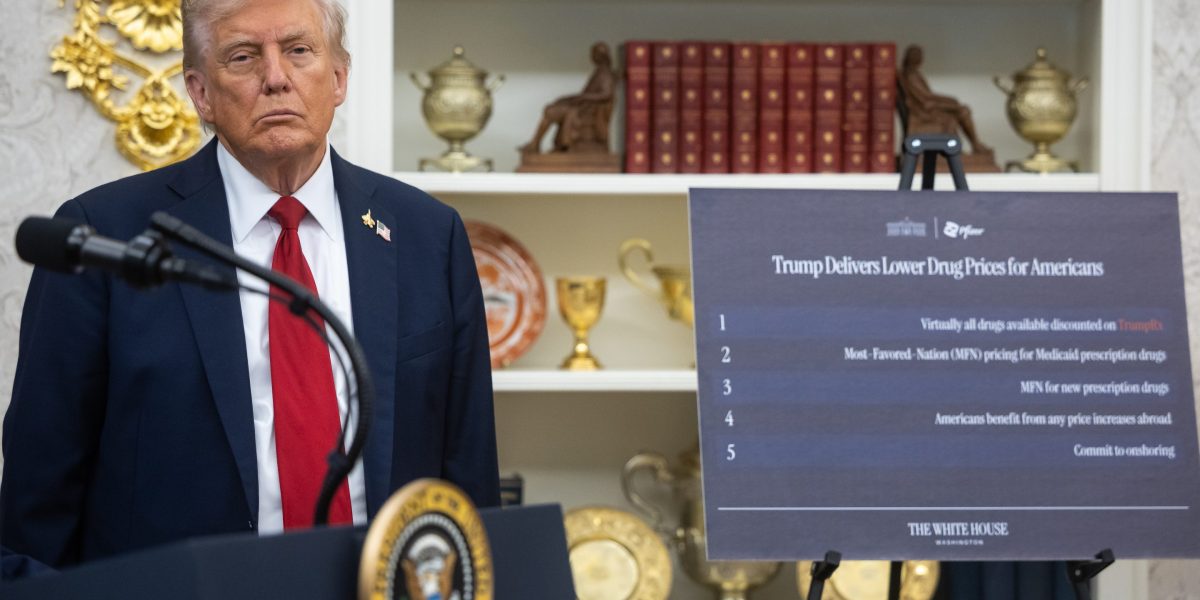
Pfizer has agreed to lower the cost of prescription drugs for Medicaid under a deal struck with the Trump administration, President Donald Trump said Tuesday as he promised similar deals with other drugmakers under the threat of tariffs.

Trump made the announcement at the White House alongside Pfizer CEO Albert Bourla just hours ahead of a possible government shutdown in a partisan standoff over health care and spending.

Pfizer Inc., one of the largest U.S. drugmakers, produces the COVID-19 vaccine Comirnaty and the treatment Paxlovid. Its products also include several cancer drugs, the blood thinner Eliquis and the pneumonia vaccine Prevnar.

Under the deal, New York-based Pfizer will charge most-favored-nation pricing to Medicaid and guarantee that pricing on newly launched drugs, Trump said. That involves matching the lowest price offered in other developed nations.

The agreement by Pfizfer builds on an executive order Trump signed in May setting a deadline for drugmakers to electively lower prices or face new limits on what the government will pay. Trump said deals with other drug companies would be coming over the next week.

“I can’t tell you how big this is,” the president said Tuesday.

“We are turning the tide and we are reversing an unfair situation,” Bourla said.

Consumers are not expected to start seeing lower prices under the Pfizer deal until 2026, according to senior administration officials who were not authorized to speak publicly and spoke on condition of anonymity.

Patients in Medicaid, the state and federally funded program for people with low incomes, often pay a nominal co-payment of a few dollars to fill their prescriptions, but lower prices could help state budgets that fund the programs.

Lower drug prices also will help patients who have no insurance coverage and little leverage to negotiate better deals on what they pay. But even steep discounts of 50% or more could still leave patients paying hundreds of dollars a month toward their prescriptions, depending on the drug.

Besides committing to lowering costs, Trump said, Pfizer agreed to spend $70 billion in domestic manufacturing facilities, becoming the latest in a string of major drugmakers to announce plans to build production in the United States.

The White House did not immediately release details about the investment, but Pfizer said in a statement that the outlay would be dedicated to U.S. research, development and capital projects in the next few years.

Pfizer also agreed to participate in a new website the administration said it plans to start up next year called TrumpRX that would allow people to buy drugs directly from manufacturers. Pfizer said most of its treatments will be offered at discounts that average 50% through the platform.

Trump has been talking for months about the need to lower drug prices and to boost U.S. drug manufacturing. To persuade companies to strike deals, Trump said he threatened to impose tariffs — a favorite tool of his to use as leverage across all areas of government — but that move could raise drug prices.

Trump said the tariff threat put the government in “a pretty good negotiating position,” and said, “This is something that most people said was not doable.”

One thing that is not doable, however, was Trump’s repeated claim that it would cut drug prices by more than 100%, “14, 15, 1,600% reductions in some cases,” he said.

A 100% reduction would make the drugs free. Cuts greater than that would essentially mean people are paid to take the drugs.

Trump sent letters in late July to executives at 17 pharmaceutical companies about changes he would like to see. Copies of the letters posted on social media note that U.S. prices for brand-name drugs can be up to three times higher than averages elsewhere.

The letters called for drugmakers to commit by Monday to offering what Pfizer agreed to: most-favored-nation pricing to Medicaid and new medications.

Trump also asked drugmakers to offer the lower pricing levels for drugs sold directly to consumers and businesses.

Trump has claimed that the U.S., with its higher drug prices, subsidizes care in other countries.

Drugmakers in the past couple of years have started launching websites to connect customers directly with some products like Lilly’s obesity treatment Zepbound or the blood thinner Eliquis from Pfizer and Bristol-Myers Squibb. That comes as patients have grown more comfortable with receiving care virtually after the practice exploded in popularity during the coronavirus pandemic.

Drug prices for patients in the U.S. can depend on a number of factors, including the competition a treatment faces and insurance coverage. Most people have coverage through work, the individual insurance market or government programs like Medicaid and Medicare, which shield them from much of the cost.

While Trump was focusing on drug costs on Tuesday, Democrats were focused on reversing Medicaid cuts in the sweeping law he signed this summer.

They were pushing for that reversal to be included in a measure to fund the government in the short term, along with an extension of tax cuts that make health insurance premiums more affordable for people who purchase coverage through Affordable Care Act marketplaces.

Republicans have said they won’t negotiate.

___

Murphy reported from Indianapolis.

Fortune Global Forum returns Oct. 26–27, 2025 in Riyadh. CEOs and global leaders will gather for a dynamic, invitation-only event shaping the future of business. Apply for an invitation.


Source link

Continue Reading

Business

Stocks: Facing a vast wave of incoming liquidity, the S&P 500 prepares to surf to a new record high

Published

on


The S&P 500 index ticked up 0.3% yesterday, its eighth straight upward trading session. It is now less than half a percentage point away from its record high, and futures were pointing marginally up again this morning. Nasdaq 100 futures were even more optimistic, up 0.39% before the open in New York. The VIX “fear” index (which measures volatility) has sunk 12.6% this month, indicating that investors seem to have settled in for a calm, quiet, risk-on holiday season.

They have reason to be happy. Washington is preparing a wave of incoming liquidity that is likely to generate fresh demand for equities.

For instance, the CME FedWatch index shows an 87% chance that the U.S. Federal Reserve will deliver an interest rate cut next week, delivering a new round of cheaper money. Further cuts are expected in 2026.

Furthermore, Wall Street largely expects President Trump to announce that Kevin Hassett will replace Fed chairman Jerome Powell in May—and Hassett is widely regarded as a dove who will lean in favor of further rate cuts.

Elsewhere, the Fed has begun a series of “reserve management purchases,” a program in which the central bank will buy short-term T-bills—a move that will add more liquidity to markets generally.

Banks, brokers and trading platforms are also lining up to handle ‘Trump Accounts,’ into which the U.S. government will deposit $1,000 for every child. The trust fund can be invested in low-cost stock index trackers—a new source of investment demand coming online in the back half of 2026.

So it’s no surprise that nine major investment banks polled by the Financial Times expect stocks to rise in 2026; the average of their estimates is by 10%.

The Congressional Budget Office also estimates that the One Big Beautiful Bill Act will add 0.9% to U.S. GDP next year largely because it allows companies to immediately deduct capital expenditures from their taxes—spurring a huge round of corporate spending. 

With all that fresh money on the horizon, it’s clear why markets have shrugged off their worries about AI and Bitcoin. The only shock will be if the S&P fails to hit a new all-time high by the end of the year.

Here’s a snapshot of the markets ahead of the opening bell in New York this morning:

  • S&P 500 futures were up 0.2% this morning. The last session closed up 0.3%. 
  • STOXX Europe 600 was up 0.3% in early trading. 
  • The U.K.’s FTSE 100 was up 0.14% in early trading. 
  • Japan’s Nikkei 225 was up 2.33%. 
  • China’s CSI 300 was up 0.34%. 
  • The South Korea KOSPI was down 0.19%. 
  • India’s NIFTY 50 is up 0.18%. 
  • Bitcoin was flat at $93K.


Source link

Continue Reading

Business

Gen Z fears AI will upend careers. Can leaders change the narrative?

Published

on


Good morning. Are you communicating the purpose of AI with your younger employees? According to new data from Harvard, most fear AI is going to take their jobs.

The Institute of Politics at Harvard Kennedy School released the fall 2025 Harvard Youth Poll on Thursday, which finds a generation under profound strain. The nationwide survey of 2,040 Americans between 18 and 29 years old was conducted from Nov. 3–7. For these respondents, instability—financial, political, and interpersonal—has become a defining feature of daily life. 

Young Americans see AI as more likely to take something away than to create something new. A majority (59%) see AI as a threat to their job prospects, more than immigration (31%) or outsourcing of jobs to other countries (48%).

Nearly 45% say AI will reduce opportunities, while only 14% expect gains. Another 17% foresee no change and 23% are unsure—and this holds across education levels and gender. 

In addition, young people fear AI will undermine the meaning of work. About 41% say AI will make work less meaningful, compared to 14% who say it will make work more meaningful and 19% who think it will make no difference; a quarter (25%) say they are unsure.

In my conversations this year with CFOs and industry experts, many have said that the goal of using AI is to remove the mundane and manual aspects of work in order to create more meaningful, thought‑provoking opportunities. However, that message does not yet seem to be resonating with younger employees.

There is a lot of public discussion and widespread fear that AI will mostly take away jobs, but research by McKinsey Global Institute released last week offers a different perspective. According to the report, AI could, in theory, automate about 57% of U.S. work hours, but that figure measures the technical potential in tasks, not the inevitable loss of jobs, as Fortune reported.

Instead of mass replacement, McKinsey researchers argue the future of work will be defined by partnerships among people, agents, and robots—all powered by AI, but dependent on human guidance and organizational redesign. The primary reason AI will not result in half the workforce being immediately sidelined is the enduring relevance of human skills. 

The Harvard poll also found young people have greater trust in AI for school and work tasks (52% overall, 63% among college students) and for learning or tutoring (48% overall, 63% among college students). But trust drops sharply for personal matters. 

Young employees are considered AI natives. However, it is important to recognize that they have not experienced as many major technology shifts as more seasoned employees—like the dawn of the internet. It’s not to say that AI won’t change the workforce, but there’s still room and need for humans. It’s up to leaders to clearly communicate how AI will change roles, which tasks it will automate, and also provide ongoing training and guidance on how employees can still grow their careers in an AI-powered workplace.

Have a good weekend. See you on Monday.

SherylEstrada
sheryl.estrada@fortune.com

Leaderboard

Fortune 500 Power Moves

Amanda Brimmer was appointed CFO of leasing advisory and head of corporatedevelopment at JLL (No. 188), a global commercial real estate and investment management company. Reporting to JLL CFO Kelly Howe, Brimmer will partner with business leaders globally to drive financial growth and performance. Brimmer brings more than two decades of experience from Boston Consulting Group, where she most recently served as managing director and senior partner.

Galagher Jeff was appointed EVP and CFO of ARKO Corp. (No. 488), one of the largest convenience store operators and fuel wholesalers in the U.S., effective Dec. 1. Jeff most recently served as EVP and CFO for Murphy USA, Inc. Before that, he spent nearly 15 years in senior and executive finance roles with retailers, including Dollar Tree Stores, Inc., Advance Auto Parts, Inc. and Walmart Stores, Inc., in addition to a decade-long career in finance and strategy consulting at organizations including KPMG and Ernst & Young. 

Every Friday morning, the weekly Fortune 500 Power Moves column tracks Fortune 500 company C-suite shifts—see the most recent edition

More notable moves this week:

Barbara Larson, CFO of SentinelOne, a cybersecurity company, will transition from her role to pursue an opportunity outside of the cybersecurity industry. Larson will continue to serve in her role through mid-January 2026. Upon her departure, Barry Padgett, chief growth officer, will serve as interim CFO. Barry has more than 25 years of experience in operational leadership at enterprise software companies, including SAP and Stripe. SentinelOne has initiated a search for its next CFO.
Jessica Ross was appointed CFO of GitLab Inc. (Nasdaq: GTLB), a DevSecOps platform, effective Jan. 15. Ross joins the company from Frontdoor, where she served as CFO. She has more than 25 years of experience in finance, accounting, and operational leadership at companies like Salesforce and Stitch Fix, and spent 12 years in public accounting at Arthur Andersen and Deloitte.

Michele Allen was appointed CFO of Jersey Mike’s Subs, a franchisor of fast-casual sandwich shops, effective Dec. 1. Allen succeeds Walter Tombs, who is retiring from Jersey Mike’s in January after 26 years with the company. Allen brings more than 25 years of financial leadership experience. Most recently, she served as CFO and head of strategy at Wyndham Hotels & Resorts. Allen began her career with Deloitte as an auditor. 

Nick Tressler was appointed CFO of Vistagen (Nasdaq: VTGN), a late clinical-stage biopharmaceutical company, effective Dec. 1. Tressler brings over 20 years of financial leadership experience. Most recently, he served as CFO of DYNEX Technologies, and before that, he was the CFO at American Gene Technologies, International, and Senseonics Holdings, Inc. Tressler has also held senior finance roles at several biopharmaceutical companies.

Mike Lenihan was appointed CFO of Texas Roadhouse, Inc. (NasdaqGS: TXRH), a restaurant company, effective Dec. 3. Keith Humpich, who served as interim CFO, was appointed chief accounting and financial services officer of the company. Lenihan has nearly 30 years of finance experience, including the past 22 years in the restaurant industry. Most recently, he served as the CFO at CKE Restaurants, Inc.

Big Deal

The ADP National Employment Report, released on Dec. 3, indicated that private-sector employment declined by 32,000 jobs in November. ADP found that job creation has been flat during the second half of 2025, while pay growth has continued its downward trend. In November, hiring was particularly weak in manufacturing, professional and business services, information, and construction.

“Hiring has been choppy of late as employers weather cautious consumers and an uncertain macroeconomic environment,” said Nela Richardson, chief economist at ADP, in a statement. “And while November’s slowdown was broad-based, it was led by a pullback among small businesses.”

ADP’s report is an independent measure of labor market conditions based on anonymized weekly payroll data from more than 26 million private-sector employees in the U.S. The next major U.S. Jobs Report (Employment Situation) for November is scheduled for release on Dec. 16 by the Bureau of Labor Statistics.

Going deeper

Here are four Fortune weekend reads:

Overheard

“The Fed no more ‘determines’ interest rates than a meteorologist determines the weather.”

—Alexander William Salter states in a Fortune opinion piece. Salter is a senior fellow with the Independent Institute and an economics professor in the Rawls College of Business at Texas Tech University. He writes: “The Fed doesn’t set interest rates. As powerful as America’s central bank is, it’s still just one player in a globe-spanning ocean of financial markets. Instead, the Fed sets targets for short-term interest rates. Those target rates indicate the Fed’s general monetary policy stance, but they are not the substance of monetary policy.”


Source link

Continue Reading

Business

Four key questions about OpenAI vs Google—the high-stakes tech matchup of 2026

Published

on


Hello, Tech Editor Alexei Oreskovic, pitching in for Allie. We’ve been enjoying some crisp blue-sky days here in San Francisco in true December fashion. For the folks at OpenAI however, the days have been red — Code Red. 

In case you haven’t been following, OpenAI CEO Sam Altman on Monday declared a “Code Red” alert in a memo to employees, according to the Information and the Wall Street Journal. The alert, the highest level on OpenAI’s three-point scale, is essentially an all-hands-on-deck call to mobilize and defend against an imminent threat. That threat is Google and its latest version of the Gemini AI model, which competes with OpenAI’s GPT family of models, particularly its flagship ChatGPT product.

It’s a remarkable turn of events, almost exactly three years to the day that OpenAI released ChatGPT and put Google and the rest of the tech industry on the back foot. Now Google is on the ascent, hoping to turn OpenAI into MySpace. Of course, with its $500 billion valuation, OpenAI and its investors are not about to surrender. 

So, as the two AI superpowers roll up their sleeves for what’s sure to be a 2026 slugfest, we thought it would be interesting to tap into the wisdom of Term Sheet readers and ask for your perspectives on some of the key questions of this critical moment in tech history. Send your thoughts directly to me or to Allie G.

How can a company like OpenAI turn a first-mover advantage into a sustainable and long-lasting business that doesn’t get bulldozed by giants with more resources and capital? 

Is there a lesson—good or bad—from a first mover of the past (e.g. Netscape vs Microsoft; Blackberry vs iPhone) that OpenAI should heed?

What is the Google Achilles heel that OpenAI should exploit? 

What is the single most important thing that OpenAI needs to execute on right now – and what is the best metric to measure its success?

And of course, what other important parts of this story should we be thinking about?

Fire away!

Alexei Oreskovic
X:
@lexnfx
Email:alexei.oreskovic@fortune.com
Submit a deal for the Term Sheet newsletter here.

Joey Abrams curated the deals section of today’s newsletter.Subscribe here.

Venture Deals

7AI, a Boston-based agentic cybersecurity platform, raised $130 million in Series A funding. Index Ventures led the round and was joined by Blackstone Innovations Investments, as well as existing seed investors Greylock, CRV, and Spark

Fact Base, a Tokyo-based manufacturing SaaS startup and maker of drawing management system ZUMEN, raised $28.5 million in Series C funding from Insight Partners.

imper.ai, a New York City-based startup that prevents AI and cyber impersonation, emerged from stealth after raising $28 million in funding. Redpoint Ventures and Battery Ventures led the investment round and were joined by Maple VC, Vessy VC, and Cerca Partners.

pH7 Technologies, a Vancouver, British Columbia-based metal extraction company, raised $25.6 million in initial Series B funding. Fine Structure Ventures led the round with strategic investment from BHP Ventures and was joined Energy & Environment Investment, Siteground, Gaingels Fund, and Calm Ventures, along with existing investors including TDK Ventures, Pangaea Ventures, Rhapsody Venture Partners, and BASF Venture Capital.

Pine AI, a Palo Alto, Calif.-based startup that specializes in agentic AI for customer service applications, raised $25 million in Series A funding. Investors included Fortwest Capital

Lumia, an agentic AI security and governance platform, raised $18 million in seed funding. Team8 led the round and was joined by New Era.

Multifactor, a San Francisco-based agentic AI security platform, raised $15 million in seed funding. Nexus Venture Partners led the round and was joined by Y Combinator, Taurus Ventures, Honeystone Ventures, Flex Capital, Pioneer Fund, Ritual Capital, and Liquid2 Ventures.

Laigo Bio, a Utrecht, Netherlands-based biotech company specializing in novel membrane protein degradation, raised €11.5 million ($13.4 million) in seed funding. Kurma Partners and Curie Capital co-led the round and were joined by Argobio Studio, Angelini Ventures, Eurazeo, the Oncode Bridge Fund, ROM Utrecht Region, and Cancer Research Horizons.

Helmet Security, a Washington, D.C.-based agentic AI communication security startup, emerged from stealth after raising $9 million from SYN Ventures and WhiteRabbit Ventures.

Addis Energy, a Somerville, Mass.-based ammonia production technology developer, raised $8.3 million in seed funding. At One Ventures led the round and was joined by existing investors Engine Ventures and Pillar VC.  

Alinia AI, a Barcelona, Spain- and New York City-based startup that builds compliance tools for AI systems, raised $7.5 million in seed funding. Mouro Capital led the round and was joined by Speedinvest, Raise Ventures, and Precursor.

BuiltAI, a London, U.K.-based financial modeling platform for commercial real estate investment, raised $6 million in seed funding. Work-Bench led the round and was joined by Lerer Hippeau, Timber Grove Ventures, Emerald Pine, and angel investors.

Curvestone AI, a London, U.K.-based platform that reduces compound errors in automated workflows, raised $4 million seed funding. MTech Capital led the round and was joined by Boost Capital Partners, D2 Fund, and Portfolio Ventures.

Govstream.ai, a Seattle-based startup building AI-native permitting tools for local governments, raised $3.6 million in seed funding. 47th Street Partners led the round and was joined by Nellore Capital, Ascend, Kevin Merritt, and Andreas Huber.

Private Equity

Ares Management Corporation recapitalized MGT, a Tampa-based national technology and advisory solutions company serving state and local education institutions and governments, with a $350 million investment that values MGT at $1.25 billion. Existing investors include the Vistria Group, JPMorgan, and WhiteHorse Capital.

TRP Infrastructure Services, an Arlington Capital Partners portfolio company, completed its acquisition of Corpus Christi, Texas-based Highway Barricades & Services, a provider of pavement marking and traffic control services. Financial terms were not disclosed.

The Care Team, a Revelstoke Capital Partners portfolio company, acquired select hospice and palliative care operations from Traditions Health, a Tennessee-based hospice, palliative, and home health provider with operations in 16 states. Financial terms were not disclosed.

Inovara Group, an Ambienta portfolio company, acquired Guildford, U.K.-based IBL Lighting Limited, an LED engine design and architectural lighting provider. Financial terms were not disclosed.

People

Hunter Point Capital, a New York City-based investment firm, hired Jonathan Coslet as a senior partner. Previously, he was at TPG


Source link

Continue Reading

Trending

Copyright © Miami Select.