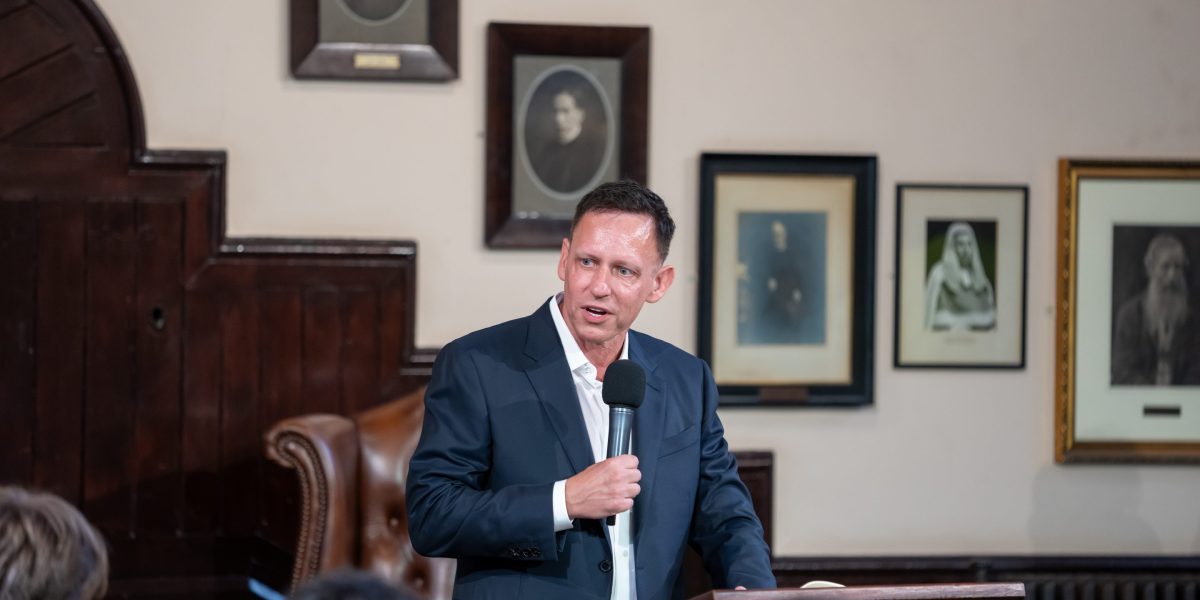
In a series of recent talks and interviews, most recently behind closed doors in Paris, as reported by Le Monde and Politico, the billionaire investor and close ally of President Donald Trump has sketched a worldview in which environmentalism, technology regulation, and global governance are not just political disagreements, but spiritual markers of an end-times struggle over the future of the West.
In lectures on Christianity delivered to select audiences, Thiel has argued the Antichrist in the 21st century will not resemble the stereotypical mad scientist, but rather a self-described protector who promises peace, safety, and an end to technological risk. Drawing on apocalyptic passages from the Bible, he portrays an approaching choice between a “one‑world state” aligned with the Antichrist and an Armageddon‑style collapse if that project fails, framing both scenarios as live possibilities for contemporary politics and technology.
Some of Thiel’s most extensive public remarks came in a June 2025 appearance on a New York Times podcast, when interviewer Ross Douthat asked Thiel what the Antichrist means to him. Thiel responded: “How much time do we have?”
Thiel links these religious themes to what he calls the exhaustion of the Enlightenment story of progress and the crisis of modern liberal democracy, arguing modernity’s faith in reason, institutions, and global cooperation is breaking down under the weight of geopolitical conflict and technological upheaval. He has suggested the stagnation of transformative innovation, rising bureaucracy, and a growing reliance on supranational bodies are signals that the modern era is ending and that a new, more openly theological politics is emerging in its place.
Greta Thunberg as symbolic antagonist
Within this framework, Thiel has repeatedly singled out Swedish climate activist Greta Thunberg as emblematic of what he calls “legionnaires of the Antichrist”—figures who seek to halt or tightly control scientific and technological development in the name of safety or planetary survival. In leaked recordings of a four‑part “Antichrist” lecture series, he described the modern Antichrist not as a reckless technologist, but as a “Luddite who wants to stop all science,” adding, “It’s someone like Greta,” and pairing her with AI safety advocate Eliezer Yudkowsky.
Thiel has argued climate activism and AI skepticism, when tied to calls for far‑reaching regulation and empowered global institutions, foreshadow the rise of a one‑world government that could suppress dissent and freeze innovation. Commentators note that by casting Thunberg and other critics of big tech as quasi‑religious enemies, he turns policy debates over emissions, data, and algorithms into a cosmic showdown between salvation through innovation and a deceptive, authoritarian environmentalism.
While it appears that Thunberg has never called out Thiel by name, she has been typically ferocious in her criticism of the wealthy in general. Generally, she often frames “the rich,” including private-jet users and fossil-fuel investors, as sacrificing people and the planet “to maintain their extreme lifestyles,” and has criticized private jets and airport expansions as symbols of this. Perhaps most famously, at the World Economic Forum in Davos in 2023, she accused the political and business elite of putting “corporate greed” and “short-term profits” above the planet and people, saying they are “at the very core of the climate crisis.”
Thunberg declined to comment, while Thiel did not immediately respond to a request for comment.
Politics, power, and the post‑liberal turn
The apocalyptic framing has far‑reaching political implications, particularly given Thiel’s role as a deep-pocketed backer of political causes. Just this past January, Thiel made one of his biggest political donations in years to help defeat California’s billionaire tax ballot proposal. Some critics counter that Thiel’s fixation on apocalyptic scenarios reveals less about looming biblical prophecy than about the anxiety of a tech elite resisting limits on capital and code at a moment when public pressure for accountability is rapidly growing.
Historically, “Antichrist” has been a fluid, contested symbol within Christian traditions, not a fixed label for contemporary activists or regulators. Thiel’s claim climate policy and global cooperation are precursors to a one‑world dictatorship ignores how such policies actually work. International climate agreements like the Paris accord set targets but are implemented through national legislatures, courts and elections, where governments remain accountable to their citizens and can be voted out.
Thiel’s talk of an “end of modernity” has relevance in a world where democratic institutions are strained, trust in elites is low, and technology has outpaced existing rules. But where he reads this as proof that Enlightenment ideals of equality, rational debate and shared institutions have failed, critics argue the crisis reflects the opposite—a failure to live up to those ideals in the face of massive inequality and corporate concentration. In other words, who is the real Antichrist?
For this story, Fortune journalists used generative AI as a research tool. An editor verified the accuracy of the information before publishing.