Connect with us

Business

Peter Thiel is hosting 4 private sold-out lectures about the Antichrist at a club in San Francisco

Published

on


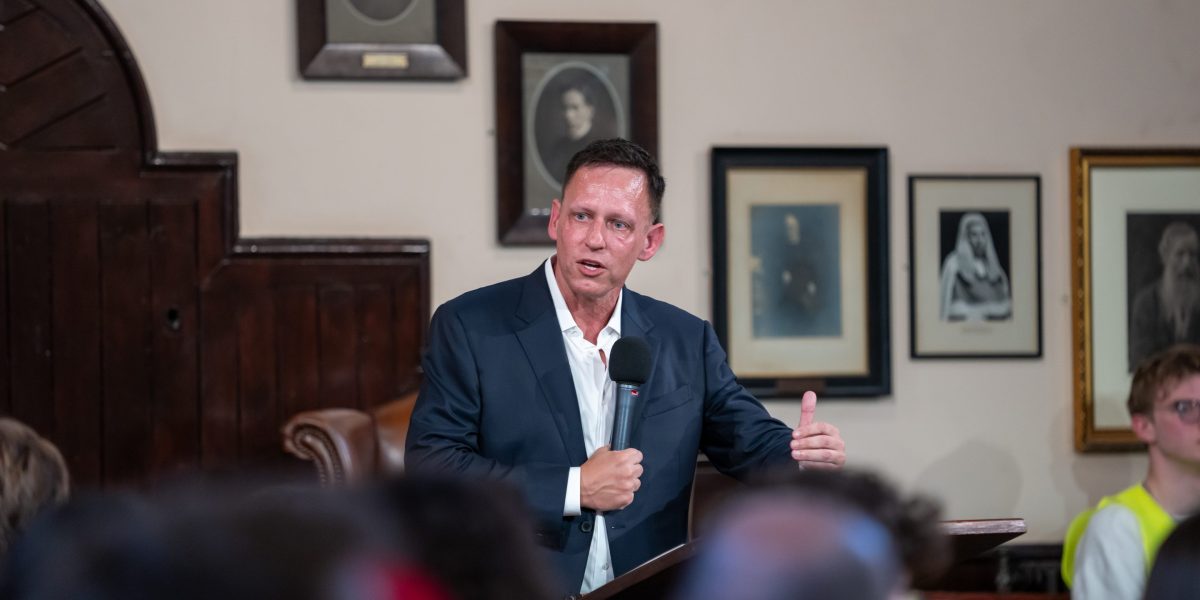
PayPal and Palantir co-founder Peter Thiel is embarking on an unusual intellectual journey this fall—delivering a sold-out four-part lecture series on the biblical figure of the Antichrist. The private lectures, hosted by The Commonwealth Club in San Francisco, represent the latest evolution in Thiel’s increasingly public theological interests, which intertwine his Christian faith with his concerns about technology’s potential to enable authoritarian control.

The series, organized by the nonprofit Acts 17 Collective, will explore “the theological and technological dimensions of the Antichrist” in four sessions across September and October. The lectures remain off-the-record, with no transcripts or recordings made public, but they draw upon the work of René Girard, the French philosopher who profoundly influenced Thiel during his Stanford undergraduate years, along with thinkers like Francis Bacon and Carl Schmitt.

Thiel’s theological preoccupations might seem incongruous with his business empire, but they reflect a consistent worldview shaped by Girard’s “mimetic theory“—the idea that human desires are learned through imitation, often leading to conflict and violence. This philosophical framework reportedly influenced Thiel’s $500,000 angel investment in Facebook in 2004, which he credits to recognizing the mimetic nature of social media.

The 57-year-old billionaire, worth an estimated $20.8 billion according to Forbes, built his fortune through a series of contrarian investments that challenged conventional Silicon Valley wisdom. His investment philosophy centers on identifying monopoly-like businesses and backing transformative technologies before they gain mainstream recognition. This approach led to early successes with PayPal, which sold to eBay for $1.5 billion in 2002, and later investments in companies like Palantir Technologies, the data-analytics firm he co-founded in 2003.

Palantir has emerged as perhaps Thiel’s most controversial venture, providing surveillance and data analysis tools to government agencies including Immigration and Customs Enforcement, the Department of Defense, and intelligence services. The company’s “Gotham” platform enables law enforcement to connect vast datasets, creating detailed profiles of individuals by combining everything from DMV records to social media activity. Recent Trump administration contracts have expanded Palantir’s reach across federal agencies, raising concerns about potential misuse for political targeting.

A theory of technological apocalypse

Thiel’s fascination with the Antichrist concept stems from his belief that such a figure would rise to power not through overt evil, but by exploiting technological fears to impose global control. In a recent New York Times interview, Thiel said his “speculative thesis” about how the Antichrist might emerge: “The way the Antichrist would take over the world is you talk about Armageddon nonstop. You talk about existential risk nonstop.”

This theory positions the Antichrist as someone who would offer “peace and safety” while using fear of catastrophic technological risks—artificial intelligence dangers, nuclear war, climate change—to justify unprecedented surveillance and control measures. The irony, as some critics note, is that Thiel himself frequently discusses apocalyptic scenarios while building the very surveillance technologies that could enable such control.

Thiel has previously suggested that modern technology provides the “mechanism” that fictional depictions of the Antichrist lacked: the ability to achieve global dominance through data integration and surveillance rather than traditional conquest. Thiel’s company Palantir exemplifies this capability, with its platforms designed to synthesize disparate information sources into comprehensive intelligence systems.

Thiel’s theological interests have grown more public in recent years, coinciding with his increased political influence. He was an early Trump supporter and delegate at the 2016 Republican National Convention, where he made history as the first openly gay speaker to declare his sexuality from the stage. His support for political figures like J.D. Vance, whom he helped launch into politics, reflects his belief that technological stagnation requires disruptive political change.

The Acts 17 Collective—which organized Thiel’s Antichrist lecture series and takes its name from Acts 17, where the apostle Paul preached to cultural elites in Athens and other intellectual centers—targets wealthy tech leaders by recognizing that traditional evangelical approaches often fail to resonate in secular tech culture. For Thiel, who grew up Lutheran but describes himself as having complicated religious views, his interpretation draws heavily on Girard’s work on sacrifice, violence, and social order, seeing Christianity as uniquely equipped to diagnose the dangers of society that technology can amplify.

The big picture

The timing of Thiel’s Antichrist lectures coincides with growing scrutiny of Palantir’s expanding role in government surveillance. Under the Trump administration, the company has secured over $113 million in federal contracts, with its technology now deployed across at least four major agencies. The company’s ability to integrate data from multiple sources has raised concerns among civil liberties advocates and even some Republicans about the potential for abuse.

Critics argue that Thiel’s warnings about the Antichrist ring hollow given his role in building the very surveillance infrastructure that could enable authoritarian control. Thirteen former Palantir employees recently signed a letter urging the company to cease its work with the Trump administration, citing concerns about how the technology might be misused for political targeting.

These tensions reflect broader questions about the role of technology companies in democratic governance. As Palantir’s tools become increasingly sophisticated, the line between legitimate security applications and potential authoritarian abuse becomes harder to define. Thiel’s theological framework offers one lens for understanding these risks, but whether his Antichrist lectures represent genuine concern about technological overreach or an attempt to deflect criticism of his own companies remains an open question.

Palantir did not immediately respond to Fortune‘s request for comment.

For this story, Fortune used generative AI to help with an initial draft. An editor verified the accuracy of the information before publishing.


Source link

Continue Reading

Business

The 9 most disruptive deals of Trump’s first year back in the White House

Published

on


President Trump lives on deals: “That’s what I do—I do deals,” he once told Bob Woodward. On the one-year anniversary of his second presidency, he’s pushing hard to make his biggest, most disruptive deal ever, one that would bring Greenland under the control of the U.S.—and the global business community is still scrambling to adapt to his approach. Here are nine of Trump’s most unorthodox deals from the past year.

Nine deals that shook the business world

April 2, 2025: Reciprocal tariffs

Trump imposes “reciprocal tariffs” on 57 countries, with each tariff understood as an opening bid in a negotiation. Several countries have since made deals. The one-on-one negotiations, unlike the multilateral system of the past 80 years, can be chaotic for companies and economies

June 13: U.S. Steel “Golden Share”

In return for allowing Nippon Steel to buy U.S. Steel, Trump requires that the U.S. receive several powers over the company, including total power over all the board’s independent directors and vetoes over locations of offices and factories. 

July 10: MP Materials

The U.S. pays $400 million for a large equity share in MP and signs a contract to buy all of MP’s rare earth magnets for 10 years. The reason for the equity stake was not disclosed.

July 14: Nvidia, Part 1

JADE GAO—AFP/Getty Images

Trump reverses the U.S. ban on selling Nvidia H20 chips to China in exchange for Nvidia paying the U.S. 15% of the revenue.

July 23: Columbia University

LYA CATTEL/Getty Images

The Trump administration restores $400 million of canceled federal research funding for the university under an unprecedented multipoint deal. For example, Columbia must supply data to the federal government for all applicants, broken down by race, “color,” GPA, and standardized test performance. A few other schools later make similar deals.

August 6: Apple

Bonnie Cash—UPI/Bloomberg/Getty Images

At a public appearance with Trump, CEO Tim Cook announces Apple will invest an additional $100 billion in the U.S. over four years; Trump announces Apple will be exempt from a planned tariff on imported chips that would have doubled the price of iPhones in the U.S.

August 22: Intel

Justin Sullivan—Getty Images

Intel trades the U.S. government a 9.9% equity stake in exchange for $8.9 billion that might already be owed to Intel under the CHIPS and Science Act. The deal is unusual because the company was not in immediate danger or significantly affecting the economy.

December 8: Nvidia, Part 2:

Trump reverses the U.S. ban on selling powerful Nvidia H200 chips in exchange for Nvidia paying the U.S. 25% of the revenue. Both Nvidia deals are unusual because the payments to the U.S., based on exports, appear to be forbidden by the Constitution. 

December 19: Pharma

Alex Wong—Getty Images

Nine pharmaceutical companies make deals with Trump that are intended to lower drug prices. This is unusual because Trump negotiated separate deals with each company, and the terms have not been released.

All eyes this week will be watching President Trump at the World Economic Forum in Davos, where the president has hinted he’ll announce some high-stakes agreements. Expect the unexpected.

A version of this piece appears in the February/March 2026 issue of Fortune.


Source link

Continue Reading

Business

Microsoft CEO Satya Nadella’s biggest AI bubble warning yet is a challenge to the Fortune 500

Published

on


Microsoft CEO Satya Nadella has been leading the charge on artificial intelligence (AI) for years, owing to his long alliance with OpenAI’s Sam Altman and the groundbreaking work from his own AI CEO, Mustafa Suleyman, particularly with the Copilot tool. But Nadella has not spoken often about the fears that rattled Wall Street for much of the back half of 2025: whether AI is a bubble. 

At the World Economic Forum annual meeting in Davos, Switzerland, Nadella sat for a conversation with the Forum’s interim co-chair, BlackRock CEO Larry Fink, explaining that if AI growth spawns solely from investment, then that could be signs of a bubble. “A telltale sign of if it’s a bubble would be if all we are talking about are the tech firms,” Nadella said. “If all we talk about is what’s happening to the technology side then it’s just purely supply side.”

However, Nadella offers a fix to that productivity dilemma, calling on business leaders to adopt a new approach to knowledge work by shifting workflows to match the structural design of AI. “The mindset we as leaders should have is, we need to think about changing the work—the workflow—with the technology.”

Growing pains

This change is not wholly unprecedented, as Nadella pointed out, comparing the current moment to that of the 1980s, when computing revolutionized the workplace and opened up new opportunities for growth and productivity and created a new class of workers. “We invented this entire class of thing called knowledge work, where people started really using computers to amplify what we were trying to achieve using software,” he said. “I think in the context of AI, that same thing is going to happen.”

Nadella argues that AI creates a “complete inversion” of how information moves through a business, replacing slow, hierarchical processes with a view that forces leaders to rethink their organizational structures. “We have an organization, we have departments, we have these specializations, and the information trickles up,” Nadella said. “No, no, it’s actually it flattens the entire information flow. So once you start having that, you have to redesign structurally.”

That shift may be harder for some Fortune 500 companies as structural changes could be accompanied by uncomfortable growing pains. Nadella says that leaner companies will be able to more easily adopt AI because their organizational structures are fresher and more malleable. On the other hand, large companies could take time to adopt new workflows.

Despite widespread adoption of AI, the 29th edition of PwC’s global CEO survey found that only 10% to 12% of companies reported seeing benefits of the technology on the revenue or cost side, while 56% reported getting nothing out of it. It follows up on an even more pessimistic finding about AI returns from August 2025: that 95% of generative AI pilots were failing.

PwC Global Chairman Mohamed Kande spoke to Fortune’s Diane Brady in Davos about the finding that many CEOs are cautious and lack confidence at this stage of the AI adoption cycle. “Somehow AI moves so fast … that people forgot that the adoption of technology, you have to go to the basics,” he explained, with the survey finding that the companies seeing benefits from AI are “putting the foundations in place.” It’s about execution more than it is about technology, he argued, and good management and leadership are really going to matter going forward.

“For large organizations,” Nadella told Fink, “there’s a fundamental challenge: Unless and until your rate of change keeps up with what is possible, you’re going to get schooled by someone small being able to achieve scale because of these tools.”

New entrants have the advantage of “starting fresh” and constructing workflows around AI capabilities, while larger firms will have to contend with the flattening effect AI has on entire departments and specializations. 

To be sure, Nadella says that large organizations have kept an upper hand, especially when it comes to relationships, data, and know-how. However, he maintains that firms must understand how to use those resources to their advantage to change management style, then that could pose a major roadblock.

“The bottom line is, if you don’t translate that with a new production function, then you really will be stuck,” he said.


Source link

Continue Reading

Business

BlackRock’s billionaire CEO warns AI could be capitalism’s next big failure after 30 years of unsustainable inequality after the Cold War

Published

on


BlackRock CEO Larry Fink opened the World Economic Forum in Davos, Switzerland, with a stark message to the global elite: AI’s unfettered growth risks pummelling the world’s working and professional classes. Beyond that, he warned that it could be capitalism’s next big failure after a 30-year reign after the Cold War that has failed to deliver for the average human being in society.

In his opening remarks on Tuesday at the gathering of thousands of executives and global leaders, the billionaire boss of the world’s largest asset manager—often called one of Wall Street’s “Masters of the Universe”—said that as those in power discuss the future of AI, they risk leaving behind the vast majority of the world, just as they have for much of the last generation.

“Since the fall of the Berlin Wall, more wealth has been created than in any time prior in human history, but in advanced economies, that wealth has accrued to a far narrower share of people than any healthy society can ultimately sustain,” Fink said.

Fink, who has used his annual BlackRock letters and annual appearances at Davos to set the agenda for a more progressive kind of capitalism, even one that is arguably “woke,” making him at times the face of ESG and of stakeholder capitalism, warned that the gains of the tremendous wealth creation since the 1990s have not been equitably shared. And the capitalist ideology driving AI development and implementation forward could come at the expense of the wage-earning majority, he added. 

“Early gains are flowing to the owners of models, owners of data and owners of infrastructure,” Fink said. “The open question: What happens to everyone else if AI does to white-collar workers what globalization did to blue-collar workers? We need to confront that today directly. It is not about the future. The future is now.” 

Fink’s past critiques of capitalism

Fink, who was appointed interim co-chair of the World Economic Forum in August 2025, replacing founder Klaus Schwab, has long espoused the reshaping of capitalism, seeing it as a responsibility of large asset managers like himself. Fink was formerly vociferous about the importance of environmental, social, and corporate governance (ESG) investing, and has argued that climate change is reshaping finance, creating an imperative for executives to reallocate their capital to address the crisis accordingly. In a 2022 letter to investors, published the day before the Davos summit, Fink emphasized a model of “stakeholder capitalism” of a business’s mandate to serve not just shareholders, but employees, consumers, and the public.  

Fink’s new primacy in Davos is the first without Schwab, following allegations that he had expensed more than $1 million, billed to the World Economic Forum, on questionable travel spending, as well as claims of workplace misconduct and research report manipulation. The BlackRock chief emphasized the need for the gathering to demonstrate its legitimacy in part by showing that it’s concerned with more than just swelling growth of companies and countries, but also the economic welfare of its employees and citizens.

“Many of the people most affected by what we talk about here will never come to this conference,” Fink said. “That’s a central tension of this forum. Davos is an elite gathering trying to shape a world that belongs to everyone.”

Though BlackRock announced in early 2025 it would roll back many of the diversity, equity, and inclusion goals it created a few years before, Fink has once again used his spotlight to call on leaders to transform their capitalist sensibilities, this time in how they imagine the AI future.

The cost of the AI boom

Last year capped an explosion of growth in the AI sector, with Morningstar analysts finding a group of 34 AI stocks, including Amazon, Alphabet, and Microsoft, shot up 50.8% in 2025. AI firms and investors have seen their wealth skyrocket in the past year, with Per the Bloomberg Billionaires Index, the median increase in net worth last year was nearly $10 billion among the 50 wealthiest Americans. Google co-founder Larry Page and Sergey Brin, for example, got $101 billion and $92 billion richer, respectively, in 2025.

The BlackRock CEO noted these gains, however, have been reserved for the richest few, alluding to a K-shaped economy of the rich getting richer, while the poor continue to struggle: The bottom half of Americans, in short, are not cashing in on the AI race. Although Fink didn’t get into the politics of utilities setting electricity prices, it seems the poor are actually paying higher bills to support the data centers powering the AI boom. According to Federal Reserve data, the poorer demographic owns about 1% of stock market wealth, translating to about 165 million people owning $628 billion in stock. Conversely, the top 1% of wealthiest households own nearly 50% of corporate equity.

Fink’s framing of the post-Cold War era as one of exploding inequality represents a mainstreaming of a once niche view that has become increasingly mainstream in the 21st century. While the triumph of the west over communism was seen as the ultimate victory for capitalism, as epitomized by Francis Fukuyama’s The End of History and the Last Man, history has in fact continued. The unprecedented rise of China as an economic superpower, through its fusion of socialism and capitalism “with Chinese characteristics,” has complicated the narrative, as has the inequality alluded to by Fink. 

An internal critic of the post-Cold War world order is Andrew Bacevich, a military veteran and historian who likened the collapse  of the Soviet Union in 1989 as “akin to removing the speed limiter from an internal combustion engine.” Bacevich’s 2020 book The Age of Illusions: How America Squandered Its Cold War Victory, was an early articulation of the once niche viewpoint that Fink lent support to on Tuesday.

What AI’s growth means for workers

Similarly, the risks of the AI boom on workers extends beyond who has a stake in the technology industry’s growth. Nobel laureate and “godfather of AI” Geoffrey Hinton has previously warned this explosion of wealth for the few will come at the expense of white-collar workers, who will be displaced by the technology.

“What’s actually going to happen is rich people are going to use AI to replace workers,” Hinton said in September. “It’s going to create massive unemployment and a huge rise in profits. It will make a few people much richer and most people poorer. That’s not AI’s fault, that is the capitalist system.”

Some companies have already leaned into culling headcount to grow profits, including enterprise-software firm IgniteTech. CEO Eric Vaughan laid off nearly 80% of his staff in early 2023, according to figures reviewed by Fortune. Vaughan said the reductions happened during an inflection point in the tech industry, where failure to efficiently adopt AI could be fatal for a company. He’s since rehired for all of those roles, and he would make the same choice again today, he told Fortune.

According to Fink, sustaining a white-collar workforce will depend on the world’s most powerful people creating an actionable plan that will defy the critiques of capitalism that has, so far, stood to predominantly benefit them.

“Now with abstractions about the jobs of tomorrow, but with a credible plan for broad participation in these gains, this is going to be the test,” Fink said. “Capitalism can evolve to turn more people into owners of growth, instead of spectators watching it happen.”

This story was originally featured on Fortune.com


Source link

Continue Reading

Trending

Copyright © Miami Select.