Connect with us

Sports

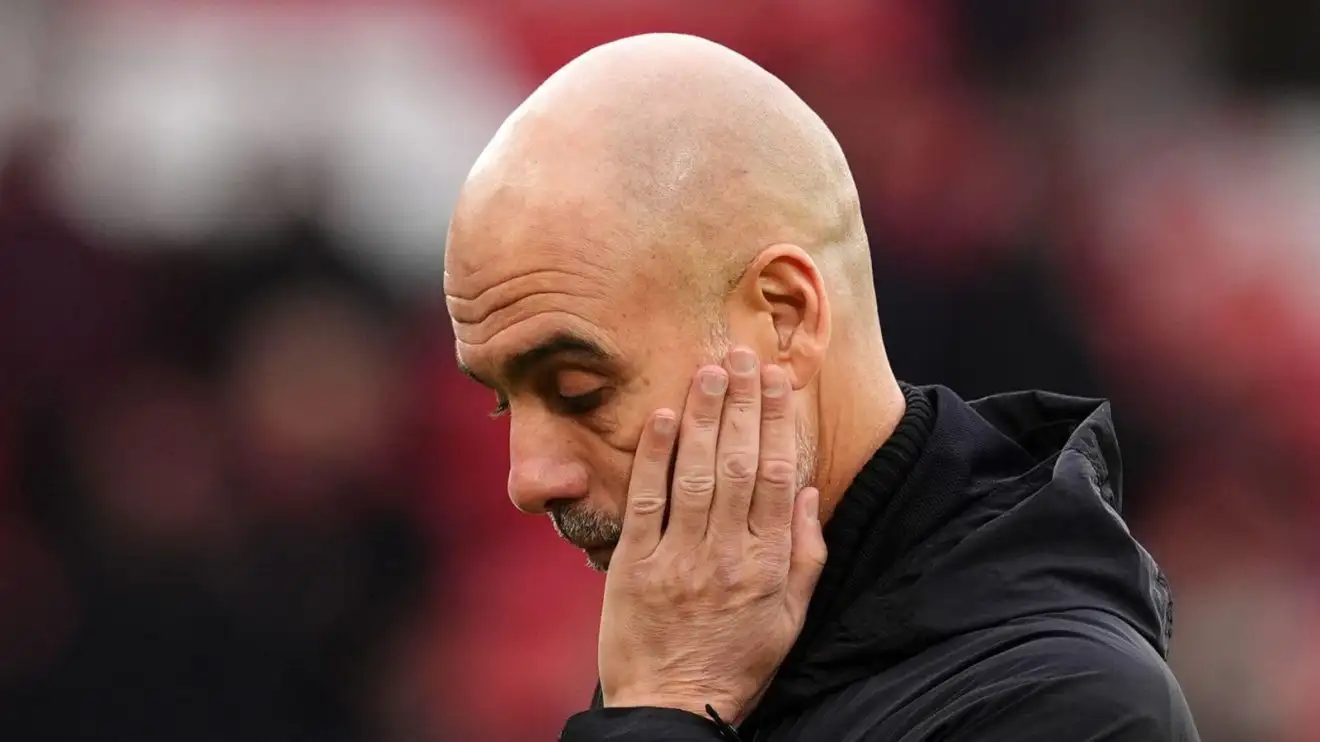
Pep Guardiola whips out the checkbook, passes €2 BILLION
Published

on


Pep Guardiola continues to spend

Guardiola, who has taken charge of Barcelona, Bayern Munich, and Manchester City, continues to spend huge

The 2025/26 European season has barely reached its halfway point, yet the transfer market is already in full swing. The latest headline moves saw Pep Guardiola and Manchester City sign Antoine Semenyo from Bournemouth for €72 million and then Marc Guehi for more than €23 million, examples of how much money top clubs are prepared to invest in new players.

On the back of that move, SportingPedia set out to identify which managers have commanded the largest transfer outlay over their careers, focusing on total spending on new signings rather than individual record deals. The resulting ranking brings together current club managers, national team coaches, sporting directors and even one retired legend, and shows just how much financial backing the game’s leading figures have attracted.

The data reveals that Pep Guardiola stands alone at the top with €2.58 billion spent on new players. The Spaniard is the only football manager to have crossed the €2 billion mark, but he soon will be joined by no other than Jose Mourinho, who is currently on €1.99 billion, needing just one deal to cross the barrier. Brazil’s head coach Carlo Ancelotti comes in 3rd position with €1.84 billion spent on players. A total of 17 managers have spent over €1 billion on transfers, with Everton’s David Moyes just shy of becoming the 18th such football manager, currently sitting at €0.99 billion spent. The list includes six figures currently away from traditional club dugouts: Ancelotti with Brazil’s national team, Thomas Tuchel with England, Mauricio Pochettino with the USA, Jurgen Klopp as a director at Red Bull, Erik ten Hag as a director at Ajax, and Arsene Wenger in retirement.

Key Takeaways:

  • Pep Guardiola is the highest spending manager in football history and the only one who has crossed the €2 billion mark on new players
  • Seventeen managers have spent over €1 billion on players acquisitions
  • Benfica’s next signing will make Jose Mourinho the 2nd manager in history to have spent more than €2 billion on transfers
  • Everton boss David Moyes will surpass €1 billion spent on new players with his next signing, currently standing at €0.99 billion
  • Roma head coach Gian Piero Gasperini also needs one modest deal to cross the €1 billion mark
  • Spanish and Italian managers dominate the highest-spending list with each country boasting 4 names, followed by Portugal (3), and Germany (2)
  • The Premier League remains a major driver of transfer spending, with current managers from Manchester City, Arsenal, Newcastle, Aston Villa, West Ham, and Everton all featuring in the top 20
  • Arsene Wenger closes the ranking on €0.96 billion, meaning every manager in the top 20 has seen roughly €1 billion euro or more invested in squads under their leadership

The Football Managers who have Spent the Most on Transfers (Billions)
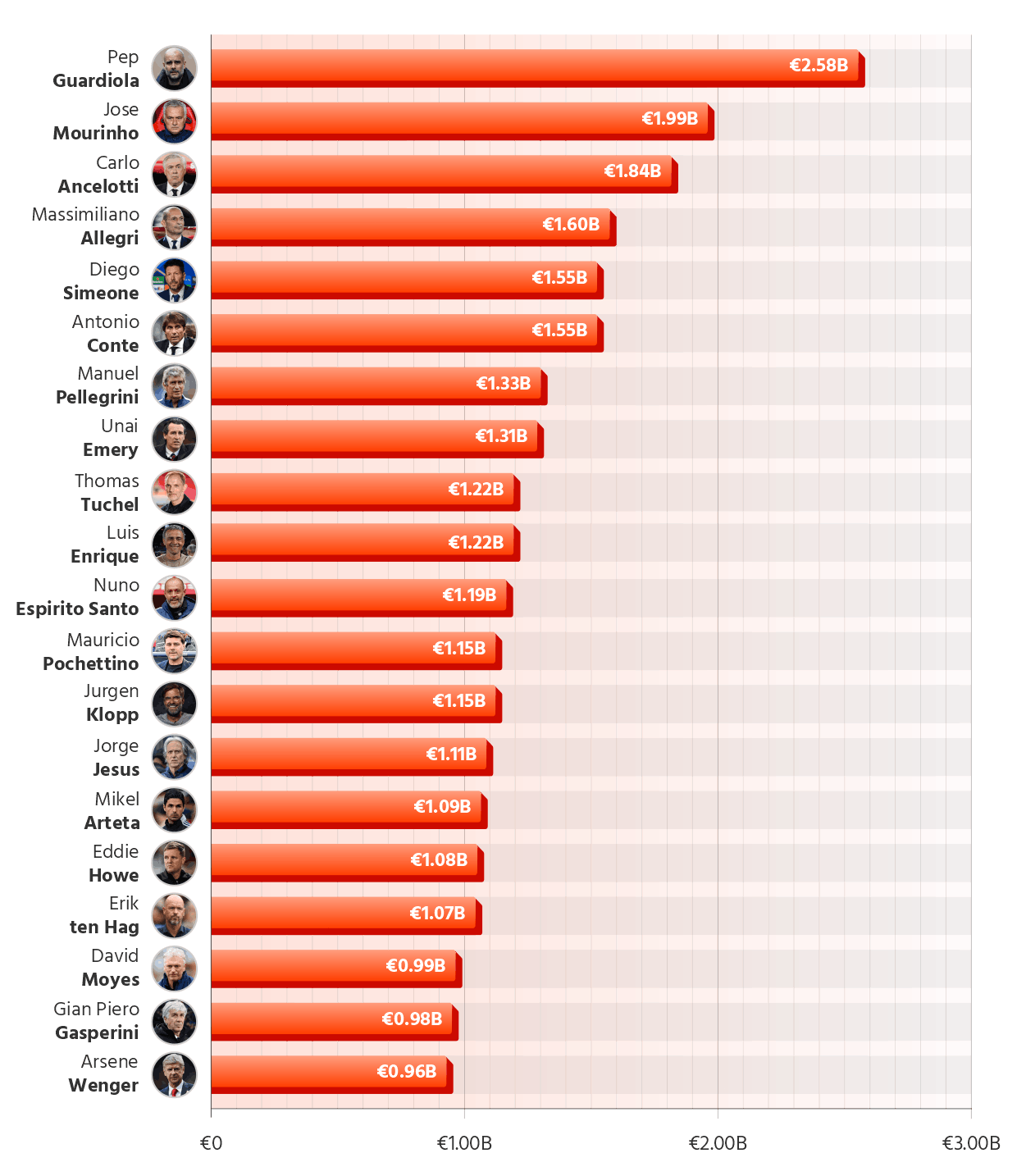
The Football Managers who have Spent the Most on Transfers (Billions)

Data Source: Transfermarkt

Pep Guardiola – Manchester City – €2.58 billion

Pep Guardiola sits clear at the top of the ranking with an estimated €2.58 billion spent on new players. Before taking over at Manchester City, where most of this spending has been concentrated, he managed =Barcelona and Bayern Munich, attracting major transfer backing at each step of his career.

Jose Mourinho – Benfica – €1.99 billion

Jose Mourinho is second on the list with €1.99 billion in transfer spending, just shy of the 2 billion threshold. Now at Benfica, he built that total across a long career that has included União de Leiria, Porto, Chelsea (two spells), Inter, Real Madrid, Manchester United, Tottenham, Roma and Fenerbahce, working almost exclusively at clubs prepared to invest heavily in their squads.

Carlo Ancelotti – Brazil national team – €1.84 billion

Carlo Ancelotti ranks third with a total of €1.84 billion. Currently coaching Brazil’s national team, he accumulated that figure during club spells at Reggiana, Parma, Juventus, Milan, Chelsea, PSG, Real Madrid (in two periods), Bayern Munich, Napoli and Everton, making him one of the most consistently backed managers in modern football.

Massimiliano Allegri – Milan – €1.60 billion

Massimiliano Allegri has overseen €1.60 billion in transfer spending, placing him fourth. Now back at Milan, he previously worked at smaller Italian clubs such as Aglianese, SPAL, Grosseto and Sassuolo before moving to Cagliari, Milan and Juventus (twice), picking up substantial transfer budgets once he reached Serie A’s elite benches.

Diego Simeone – Atletico Madrid – €1.55 billion

Diego Simeone sits fifth with €1.55 billion invested in new players. Still at Atletico Madrid, he began his coaching career in Argentina with Racing Club, Estudiantes, River Plate and San Lorenzo, plus a brief spell at Catania in Italy, before taking over Atletico in 2011 and gradually building a squad that has required sustained investment over more than a decade.

Antonio Conte – Napoli – €1.55 billion

Antonio Conte matches Simeone’s total of €1.55 billion spent on players. Now at Napoli, he previously managed Arezzo, Bari, Atalanta, Siena, Juventus, Italy’s national team, Chelsea, Inter and Tottenham, with several of those clubs giving him major budgets to reshape squads quickly in pursuit of trophies.

Manuel Pellegrini – Betis – €1.33 billion

Manuel Pellegrini has seen €1.33 billion spent on new players under his management. Currently at Betis, he built that total across a long career that has taken in Universidad de Chile, LDU Quito, San Lorenzo, River Plate, Villarreal, Real Madrid, Malaga, Manchester City, Hebei China Fortune and West Ham, combining spells at super-clubs with ambitious projects in Spain, England and beyond.

Unai Emery – Aston Villa – €1.31 billion

Unai Emery occupies eighth place with €1.31 billion in transfer spending. Now leading Aston Villa, he previously managed Lorca Deportiva, Almeria, Valencia, Spartak Moscow, Sevilla, PSG, Arsenal and Villarreal, with heavy investment at clubs like PSG and Arsenal pushing his career outlay beyond the €1.3 billion mark.

Thomas Tuchel – England national team – €1.22 billion

Thomas Tuchel is ninth with €1.22 billion in transfer outlay. Currently in charge of England’s national team, he accumulated that figure through club roles at Mainz, Borussia Dortmund, PSG, Chelsea, and Bayern Munich, where boards repeatedly backed him with substantial budgets to tailor squads to his tactical demands.

Luis Enrique – PSG – €1.22 billion

Luis Enrique shares the same total as Tuchel on €1.22 billion and rounds out the top ten. Now at PSG, his previous managerial posts include Roma, Celta Vigo, Barcelona and Spain’s national team, with the Barcelona and PSG squads in particular contributing heavily to his overall transfer spending.

Nuno Espirito Santo – West Ham – €1.19 billion

Nuno Espirito Santo has accumulated €1.19 billion in transfer spending, placing him just outside the top ten. Currently at West Ham, he previously worked at Rio Ave, Valencia, Porto, Wolverhampton, Tottenham and Al Ittihad, with Premier League and Saudi Pro League budgets helping to push his total well above the €1 billion mark.

Mauricio Pochettino – USA national team – €1.15 billion

Mauricio Pochettino stands on €1.15 billion in new player expenditure. Now coaching the USA national team, he reached that figure through club spells at Espanyol, Southampton, Tottenham, PSG and Chelsea, where long-term rebuilding projects and regular European qualification went hand in hand with sizable investment in the transfer market.

Jurgen Klopp – Director at Red Bull – €1.15 billion

Jurgen Klopp also has a total of €1.15 billion. Currently serving as head of global football for the Red Bull group, he previously managed Mainz 05, Borussia Dortmund and Liverpool, with his time at Dortmund and especially Liverpool accounting for most of the transfer spending attributed to his career.

Jorge Jesus – Al Nassr – €1.11 billion

Jorge Jesus appears next with €1.11 billion in transfer spending. Now at Al Nassr, he has held high-profile posts at Braga, Benfica (multiple spells), Sporting, Flamengo and Fenerbahce among others, building a reputation as a coach whose teams are regularly reinforced with expensive, ready-made signings.

Mikel Arteta – Arsenal – €1.09 billion

Mikel Arteta has already reached €1.09 billion in transfer expenditure, placing him fifteenth. Unlike most names on this list, his senior managerial career so far has been spent entirely at Arsenal, where a single, continuous project of rebuilding and strengthening the squad has been backed with close to €1.1 billion in new signings.

Eddie Howe – Newcastle – €1.08 billion

Eddie Howe follows closely with €1.08 billion in spending. Currently at Newcastle, he previously managed Bournemouth, Burnley and then Bournemouth again, but it is the recent phase at Newcastle, under ambitious ownership and with Premier League-level budgets, that has accelerated his rise into the €1 billion spending bracket.

Erik ten Hag – Director at Twente – €1.07 billion

Erik ten Hag sits seventeenth with €1.07 billion invested in players under his watch. Now a director at Twente, he built that total while managing Go Ahead Eagles, Bayern Munich II, Utrecht, Ajax and Manchester United, with his spells at Ajax and United contributing most of the transfer outlay associated with his career.

David Moyes – Everton – €0.99 billion

David Moyes has overseen €0.99 billion in transfer spending, narrowly missing the €1 billion mark but still ranking among the top 20. Back at Everton, he previously managed Preston North End, Manchester United, Real Sociedad, Sunderland and West Ham, with long Premier League service ensuring a steady accumulation of transfer investment over time.

Gian Piero Gasperini – Roma – €0.98 billion

Gian Piero Gasperini has seen €0.98 billion invested during his time as a manager. Now at Roma, he previously worked at Crotone, Genoa (two spells), Inter, Palermo and, most notably, Atalanta, where successive squad refreshes at Champions League level helped move his career spending close to the €1 billion threshold.

Arsene Wenger – FIFA Chief of global football development – €0.96 billion

Arsene Wenger closes the ranking with €0.96 billion in transfer outlay. Although retiring from the manager’s position in 2018, he remains one of the most heavily backed managers in history, having previously coached Nancy, Monaco, Nagoya Grampus and, above all, Arsenal, where more than two decades in charge at the highest level generated the bulk of his transfer spending total.


Source link

Continue Reading

Sports

Bills playoff woes continue, rest really does help

Published

on


The Bills run of “bad luck” continued

CGB Spender curse continues for Bills

Every NFL fan base, for the most part, has had its share of misery.

Jets fans have gone 15 years without a playoff appearance, but if they’re old enough they remember Broadway Joe and the Super Bowl III guarantee.

Eagles fans had to watch 51 Super Bowls before their team won one. And now they have doubled that.

Packers fans have so many heartbreaking postseason experiences that would have just added to their four Super Bowls and league-best 13 NFL titles.

The list could go on and on. And then there’s the Buffalo Bills.

Screenshot

Bills Misery Continues

If memories of the four straight Super Bowl losses during the 90s had begun to fade there is the new misery of not even getting back to a Super Bowl despite chance after chance after chance.

This year looked to be the best opportunity for the Bills. Their personal boogeyman Kansas City’s Patrick Mahomes wasn’t around. Neither was Baltimore’s Lamar Jackson or Cincinnati’s Joe Burrow. It was going to be Josh Allen against a bunch of kids (Buffalo was not going to face Aaron Rodgers and Pittsburgh).

Allen wasn’t just the AFC’s most experienced playoff QB; he was the best. Sure, as a wild-card team the Bills had to go on the road. But they were facing newcomers. Jacksonville had a first-year coach and a still unproven playoff QB in Trevor Lawrence. Denver had second-year Bo Nix under center. And Houston and this New England team were new to the dance as well.

This was Buffalo’s year.

Finally.

Until it wasn’t.

Heartbreak in Overtime

Saturday afternoon the Bills’ party ended the way it has every year with Allen and head coach Sean McDermott, a heartbreaking loss. This one to Denver in overtime, 33-30. The most shocking stat to come out of that game was that Allen is now 0-7 in overtime games. That’s a little hard to believe.

What wasn’t so shocking was the Bills decision to fire McDermott Monday morning.

Did some calls go against the Bills in the OT? Maybe. Since nobody knows what a catch is in the NFL anymore I’m not sure if Brandin Cooks caught that Allen pass or if it was intercepted.

All I do know is the Bills lost. Again. This time in OT. And there isn’t another fan base who has had more misery in its lifetime.

A Good Comparison

There are all kinds of comparisons being made for new Denver starting quarterback Jarrett Stidham, who has to take over Bo Nix (broken ankle) in the AFC Championship Game.

There is really only one.

Stidham, 29, in his sixth year out of Auburn. He has started four games in his NFL career, two for the Raiders in 2022 and two for the Broncos in 2023. He has not thrown a pass since 2023.

Jeff Hostetler was also 29 and in his fifth year out of West Virginia when he took over for an injured Phil Sims with two games left in the regular season for the Giants in 1990. Hostetler at that time had made just two prior starts one in 1988 and one in 1989.

Hostetler won the final two regular season games over the Cardinals and Patriots and swept through the playoffs with wins over the Bears, 49ers and the Bills in the Super Bowl.

Rest is Best

In three of the four games this past weekend one team had extra rest than its opponent all three rested teams won.

Denver and Seattle, both coming off byes, ousted Buffalo and San Francisco, while the Patriots beat the Texans, who had to travel off a short week.

Coaching Updates

Atlanta — Kevin Stefanski is the choice and it’s a good one. If QB Michael Pennix can get healthy he’ll have the right coach to develop him.

Arizona — Robert Saleh tops the Cards wish list, but the 49ers DC and former Jets head coach may have reservations after his experience with the Jets. Buffalo OC Joe Brady and Denver DC Vance Joseph are near the top of the wish list as well.

Baltimore — Chargers DC Jesse Minter is still the favorite.

Buffalo — This is going to be interesting. If the Bills want to stay the course and keep Josh Allen happy they could promote OC Joe Brady. If they go outside they may have their choice of candidates who would love to coach Allen.

Cleveland — The Browns are likely to go with an offensive minded coach and convince him to keep DC Jim Schwartz. Mike McDaniel, the former Miami coach, and Todd Monken, the former Baltimore OC, are possibilities.

Las Vegas — Tom Brady is very involved in the search and the hiring. Brian Flores was a long-time Patriots assistant and could be a good fit for the Raiders.

Miami — It looks like new GM Jon Eric-Sullivan might bring Packers DC Jeff Hafley from Green Bay with him.

New York Giants — It took some doing, but the Giants got their man in John Harbaugh.

Pittsburgh — If the Steelers can convince Flores to turn down Brady and the Raiders, he could land here. Saleh is another good possibility. McDermott followed Mike Tomlin as a safety in college at William and Mary, could he follow him as head coach here? Stay tuned.

Tennessee — Titans need a QB whisperer for No. 1 pick Cam Ward. Former Packers and Cowboys coach Mike McCarthy makes a lot of sense. Former Bears coach Matt Nagy is also in conversations.

without a playoff appearance, but if they’re old enough they remember Broadway Joe and the Super Bowl III guarantee.Eagles fans had to


Source link

Continue Reading

Sports

Miami and Indiana in the “Cuban Super Bowl.”

Published

on


CUBA

Tonight’s College Football Championship is being played at Hard Rock Stadium in Miami, and it is being called the Cuban Super Bowl, a nickname that has spread across Miami with unmistakable pride. Indiana quarterback and Heisman Trophy winner Fernando Mendoza is Cuban American and Miami‑raised, a hometown product now leading the Hoosiers onto the sport’s biggest stage. Miami head coach Mario Cristobal shares that same cultural and geographic lineage, and the two are connected by more than heritage.

GAME TIME 7:30 p.m. ABC/ESPN TV and Streaming

RADIO – SPORTS TALK FLORIDA AM 820

Cristobal and Mendoza both trace their roots to Christopher Columbus High School, the all‑boys Catholic powerhouse in the Westchester neighborhood. Cristobal graduated in 1988 before becoming a standout offensive lineman at the University of Miami. Decades later, Mendoza emerged from the same hallways and practice fields as one of Columbus’ premier quarterbacks, eventually rising to national prominence at Indiana.

The connection runs even deeper. Cristobal was once teammates with Fernando Mendoza Sr., the quarterback’s father, during their own Columbus playing days. That generational overlap adds a remarkable twist to this year’s championship storyline: the head coach of one finalist once lined up alongside the father of the opposing quarterback.

It’s a uniquely Miami narrative — family, football, culture, and legacy converging on one of the sport’s biggest nights.

More than one million Cuban Americans call Miami home. Their presence shapes culture, food, and sports passion. This championship feels deeply personal for many families.

A Community United by Culture, Pride, and Football

This game transcends typical college football stakes. It blends heritage, history, and hometown pride. It brings generations together across Miami’s neighborhoods.

The Cuban community feels seen and celebrated. The city rallies behind its coaches and its star. The “Cuban Super Bowl” becomes a cultural milestone.


Source link

Continue Reading

Sports

Managers leaving across Europe at record rates

Published

on


Manchester United have sacked Ruben Amorim

Since the start of 2026, sports media headlines have revolved around the strained Chelsea–Maresca relationship, Manchester United’s damaged connection with Ruben Amorim, and, most recently, Celtic’s woes, as the club moved on from Wilfried Nancy just 32 days after he succeeded Brendan Rodgers. Together, these rapid-fire changes on some of Europe’s biggest benches have turned the spotlight firmly onto managers and how little time they are given to turn things around.

All these proceedings prompted Sportingpedia to take a wider look at the coaching carousel across the continent, analysing managerial changes since the start of the 2025/26 season in 18 of Europe’s top 20 leagues, excluding Sweden and Norway, whose domestic seasons run on a different calendar and identifying where sackings have been most common, which competitions now lead the way for dismissals, and which clubs have already gone through multiple head coaches in a single campaign.

Some of the most curious findings are that since the start of the 2025/26 campaign there have already been 110 managerial changes across these leagues. Turkiye’s Super Lig stands out as the most volatile league with 17 changes, while among the traditional top five competitions the Premier League now leads the way with six dismissals, ahead of the Bundesliga, La Liga, Serie A and Ligue 1. What is most alarming, however, is that eleven clubs across eight different leagues have already made multiple managerial changes this season, meaning those teams are already on their third manager of the campaign while many of their rivals have yet to change even once.

Methodology

The study covers 18 of Europe’s top 20 leagues in the 2025/26 season, excluding Sweden and Norway because their competitions follow a different calendar. For each league, every managerial change since the start of the current campaign was counted. A “managerial change” is any instance of a head coach leaving his position, regardless of whether the departure was formally described as a sacking, resignation or mutual agreement.

Key Takeaways:

  • A total of 110 managerial changes have occurred in Europe’s top leagues since the start of the 2025/25 season
  • Among Europe’s traditional top five leagues, the Premier League leads with 6 managerial changes, ahead of the Bundesliga with 5, while La Liga, Serie A and Ligue 1 have each recorded 4
  • Turkiye’s Super Lig is the most volatile league overall, with 17 managerial changes since the start of the 2025/26 season
  • Greece’s Super League 1 and the Cyprus League follow with 10 changes each, while Belgium’s Jupiler Pro League has witnessed 9
  • Eleven clubs across Europe’s top leagues have already made multiple managerial changes in 2025/26, with two head coaches leaving at each team
  • These eleven clubs come from eight different competitions: Super Lig, Liga Portugal, the Scottish Premiership, Ekstraklasa, Greece’s Super League 1, the Cyprus League, Austria’s Bundesliga and the Premier League
  • Israel’s Liga ha’Al is the most stable league in the sample with only 2 head coach departures, while the Eredivisie and Denmark’s Superliga have seen 3 changes each

Number of managerial changes in Europe’s top leagues since the start of the 2025/26 season

Number of managerial changes in Europe's top leagues since the start of the 2025/26 season

Data Source: Transfermarkt

At league level, Turkiye’s Super Lig clearly stands at the top of the instability table. With 17 managerial changes already recorded in 2025/26, clubs there have been quicker to replace head coaches than in any other competition included in the study.

Greece’s Super League 1 and the Cyprus League share second place with 10 changes each, underlining how rapidly clubs in those championships move when results or performances fall below expectations. Belgium’s Jupiler Pro League sits just behind them with 9 changes, confirming that coaching turnover has also been high in one of Europe’s most competitive smaller leagues.

Poland’s Ekstraklasa and Austria’s Bundesliga have each registered 7 changes so far, placing them firmly in the high-turnover bracket. Liga Portugal and the Premier League follow with 6 changes apiece. In England, that figure has been pushed up by the recent dismissals at Chelsea and Manchester United, ensuring that the Premier League now has more sackings than any of the other traditional top five leagues.

Germany’s Bundesliga and the Scottish Premiership have each seen 5 managerial changes, while La Liga, Serie A, Ligue 1, the Czech League and Switzerland’s Super League form a middle group with 4 departures each. These competitions sit between the most turbulent and the most stable environments: changes are regular, but not at the levels seen in Turkey, Greece or Cyprus.

At the calmer end of the scale, the Eredivisie and Denmark’s Superliga have each recorded 3 managerial departures since the start of the season. Israel’s Liga ha’Al has seen only 2 changes, making it the most stable league in the sample.

Clubs already on their third manager

Alongside the league-wide numbers, a small group of clubs shows just how extreme instability has become. In total, 11 teams across the 18 leagues have already worked with more than two head coach this season. In every case, two managers have left their roles in 2025/26, meaning a third coach has taken over by this stage of the campaign.

Nottingham Forest is the only Premier League club in this group. Nuno Espirito Santo’s spell at Forest ended after 629 days, and his successor, Ange Postecoglou, left the job after 39 days, leaving the team already on a third head coach for 2025/26.

Celtic are the most high-profile case in Scotland’s Premiership. Brendan Rodgers’ long tenure ended after 849 days, and his replacement, Wilfried Nancy, then remained in charge for only 32 days before also departing.

In Liga Portugal, Avs Futebol have already dismissed two managers. Jose Mota was in charge for 139 days earlier in the season before leaving his position. He was followed by Joao Pedro Sousa, whose time on the bench lasted 88 days before his departure.

Poland’s Ekstraklasa is represented by Widzew Lodz. Zeljko Sopic’s tenure as head coach ended after 161 days, and the next manager, Patryk Czubak, left the role after a 50-day spell.

Greece’s Super League 1 contributes two clubs. Panathinaikos first parted ways with Rui Vitoria after 319 days in charge, then later saw Christos Kontis depart after 36 days. AE Larisa followed a similar pattern, with Georgios Petrakis leaving after 96 days and Stelios Malezas after 61 days.

In the Cyprus League, Ethnikos Achnas have also seen two coaches come and go. Hugo Martins remained in charge for 89 days before his exit, and Igor Angelovski’s spell ended after 73 days.

Austria’s Bundesliga is represented by Wolfsberger AC. Mitja Morec was head coach for 148 days before leaving, and his successor, Andreas Gahleitner, lasted 31 days before his departure.

Turkey’s Super Lig adds three more names to the list of repeat changers. Antalyaspor dismissed Emre Belozoglu after 264 days and later moved on from Erol Bulut after a 65-day spell. Genclerbirligi parted company with Huseyin Eroglu after 307 days and then with Volkan Demirel after 37 days. Eyupspor first saw Selcuk Sahin leave after 96 days in charge, followed by Orhan Ak, whose tenure lasted 83 days before his departure.

Set against the broader picture of 111 managerial changes across 18 leagues, the fact that 11 clubs have already gone through multiple dismissals in a single season highlights how quickly pressure can escalate on the touchline and how fragile job security has become for coaches at all levels of European football.


Source link

Continue Reading

Trending

Copyright © Miami Select.