Robotaxis are starting to become a reality after years of hype and promises. Self-driving cars are now on the road in cities like San Francisco, Shenzhen and Wuhan, and robotaxi firms are foraying into new markets like Singapore and the United Arab Emirates. And on Thursday, Tesla CEO Elon Musk suggested that half the U.S. population will get access to a robotaxi by 2026.
At this point, those working in the autonomous vehicle space think the problem isn’t technology, but rather people, and regulators in particular.
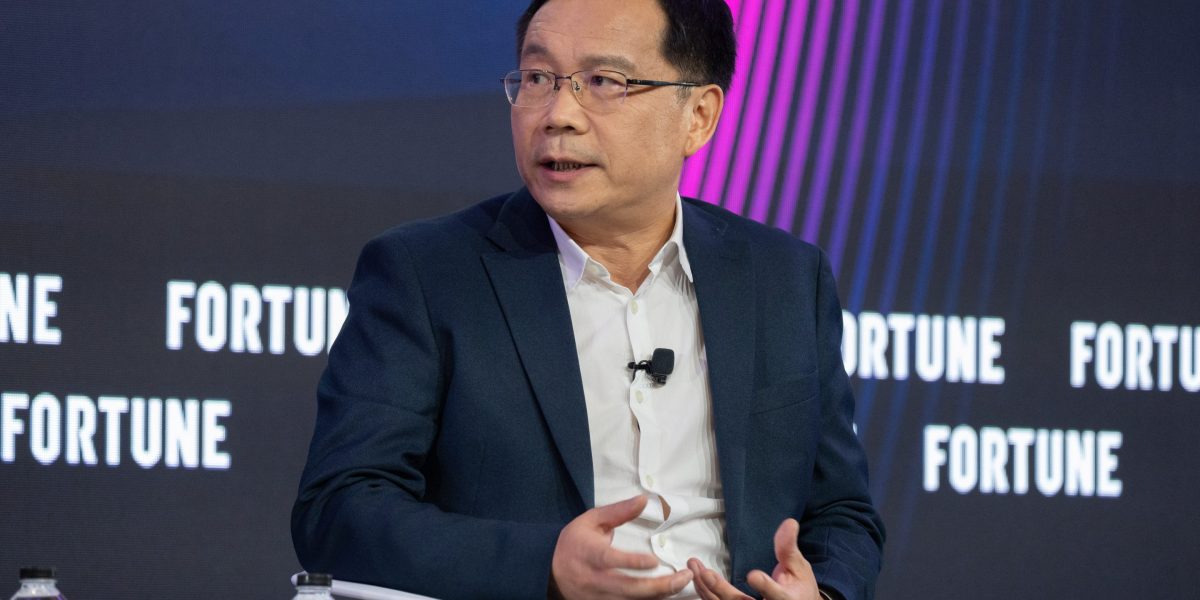
“It’s clearly mature enough to scale, but we have to work with the government on the regulation part,” said Kerry Xu, WeRide’s general manager for Singapore, at the Fortune Brainstorm AI Singapore conference on Wednesday. “Public acceptance, data, transparency…I think it takes time for the community to completely accept AVs as part of their normal life.”
Earlier this year, WeRide hosted Singapore Acting Transport Minister Jeffrey Siow at its Guangzhou headquarters, where the minister announced ambitious plans to debut AVs in the city’s public housing estates by the end of the year. The Chinese startup also debuted Singapore’s first fully driverless bus system earlier in July.
ST Liew, president of Qualcomm’s Taiwan and Southeast Asia business, agreed that the private sector needed to help build an ecosystem of trust. “We always advocate that we should have cross-industry benchmark transparency in the training data and make sure that we are compliant,” he said.
“Take care of the safety, make sure that it is transparent, and then you can enjoy yourself while you’re in the car,” he continued.
Liew credited Qualcomm’s work on autonomous vehicles to the company’s four decades of experience working on semiconductors. He noted that the power of new chips allow for “AI at the edge” to make the process of learning, deduction, and decision-making more automated. This enables driverless cars to be deployed across different geographies and weather patterns, such as Southeast Asia.
Cars built in Asia, and particularly China, are now becoming more sophisticated, offering a wide array of customer-friendly assisted driving and software features, turning cars into smartphones on wheels.
Liew pointed out that the car industry is now shifting to the “software-defined car,” which allows drivers to do much more inside the vehicle.
“If I can go into the car, then I can conduct my meetings, I can use AI to ask where I am, book my restaurants, and all that,” Liew said, “just like it’s an extension of my office or my home.”
Good morning. CEOs and CFOs are clearly focused on AI—it is the most-used term in S&P 500 earnings calls this year.
FactSet examined conference call transcripts for all S&P 500 companies that held earnings calls from September 15 through December 4 and found that the term “AI” was cited on 306 calls. This is the highest number of S&P 500 earnings calls on which “AI” has been cited over the past 10 years; the previous record was 292 in Q2 2025, according to John Butters, VP and senior earnings analyst at FactSet. In addition, the 306 figure is significantly above the five-year average of 136 and the 10-year average of 86.
At the sector level, information technology (95%) and communication services (95%) sectors have the highest percentages of earnings calls citing “AI” for Q3.
In addition, S&P 500 companies that cited “AI” on their Q3 earnings calls have seen a higher average price increase than those that did not—since Dec. 31, 2024 (13.9% vs. 5.7%), June 30, 2025 (8.1% vs. 3.9%), and Sept. 30, 2025 (1.0% vs. 0.3%).
Navigating uncertainty
Besides AI, another term I was curious about is “uncertainty,” so I asked Butters for his take. He analyzed S&P 500 earnings calls (per quarter) in which the term “uncertainty” was cited at least once, going back to 2020. He found that, similar to the pattern seen with “tariff” citations, mentions of “uncertainty” spiked in Q1 2025 but declined significantly over the following two quarters. In Q1 2025, there were 415 mentions of “uncertainty,” compared to 282 in Q2 and 201 in Q3.
Following President Donald Trump’s “Liberation Day” earlier this year, significant uncertainty emerged around the new administration’s economic and geopolitical agenda, Yuval Atsmon, CFO at McKinsey, recently told me. Atsmon explained that at the peak of uncertainty, his focus as a CFO was on identifying actions that would be helpful in any scenario. “The worst thing is inaction,” he added. Acting on what you can control builds resilience, he said.
Operating in uncertainty has seemingly become a constant, which may help explain why explicit mentions of the term have tapered off during earnings calls. While uncertainty often drives defensive moves, Atsmon emphasized the importance of revisiting long-standing strategies and seizing competitive opportunities.
Global AI spending is expected to climb in 2026, and it is likely that “AI” will remain a top term in Q4 earnings calls in January as companies discuss investment, margins, capex, and productivity.
Neil Berkley was promoted to CFO of Alector, Inc. (Nasdaq: ALEC), a clinical-stage biotechnology company. Berkley has served as Alector’s chief business officer (CBO) since March 2024, and CBO and interim CFO since June 2025. He is a biotech executive with more than two decades of experience leading corporate strategy, finance, business development, and operations across both early- and late-stage companies.
Caleb Noel was promoted to EVP and CFO of NFP, an Aon company, a property and casualty broker and benefits consultant. Noel has served in various corporate finance and operational roles during his 23-year career with NFP, most recently as SVP of finance and operations. He previously served as VP of finance for Scottish Holdings, a division of Scottish Re, and as an analyst in the investment banking division of Prudential Securities (now Wells Fargo & Company).
Big Deal
CFOs have a long-term focus when it comes to AI, according to research by RGP, a global professional services firm. The report, “The AI Foundational Divide: From Ambition to Readiness,” describes a finance landscape that is racing toward an AI-powered future yet constrained by issues such as fragile data foundations.
Although 66% of CFOs surveyed expect significant AI ROI within two years, only 14% report meaningful value today. However, optimism persists despite key obstacles to AI ROI, including deep structural barriers such as data trust issues (only 10% fully trust enterprise data), technical debt (86% say legacy systems limit AI readiness), and skills shortages that threaten to slow adoption.
The findings are based on insights from 200 U.S. CFOs at enterprises with more than $10 billion in annual revenue. Sectors include technology, health care, financial services, and CPG/retail.
Going deeper
A new episode of “This Week in Business,” a Wharton podcast, focuses on AI and technological evolution. Lynn Wu, a Wharton associate professor of operations, information and decisions, addresses the rise of transformative technologies and the cycles of tech bubbles throughout history. Wu discusses where AI fits within these cycles, describing it as a necessary phase of technological evolution that lays the groundwork for transformative advancements across industries.
Overheard
“In the end, consumers will win if courts and enforcers act based on evidence.”
—Satya Marar, a research fellow at the Mercatus Center at George Mason University, writes in a Fortune opinion piece titled “Netflix, Warner, Paramount and antitrust: Entertainment megadeal’s outcome must follow the evidence, not politics or fear of integration.” Marar specializes in competition, innovation, and governance, and is an AI and antitrust fellow at the Innovators Network.
For years, the prevailing theory amongst workers about “unlimited vacation” is that it actually encourages workers to take less time off. Without the entitlement to a set number of days, employees can feel awkward requesting days off, or worried that doing so will make them look less committed to work.
But a new study from payroll and HR platform Deel finds it’s less about specific PTO policies than about culture. It all depends on where you live, says Lauren Thomas, the startup’s economist.
On average, European employees with unlimited vacation policies took four more days off than their counterparts with fixed time off this year—27 vs. 23. But in North America, there was hardly a difference, as both those with unlimited and fixed vacation policies averaged about 17.
“Americans and Canadians are definitely getting less time off, even when you only look at fixed time, than Europeans are,” Thomas said. “That is a combination of policy and culture.”
In fact, Canadian workers are taking less time off than those in the U.S. Thomas said this is because 77% of U.S. workers have access to paid vacation, while just 73% of Canadians do, based on U.S. Bureau of Labor Statistics and Statistics Canada data.
But Americans and Canadians who work for companies that span the Atlantic do take more time off than their counterparts working for companies that do not have hires in Europe, Thomas said.
“I think companies need to think really carefully about how much productivity they’re really getting when they’re requiring so much [working] time from their employees,” she said. “At the end of the day, we know that time off is important for productivity, it’s important for making a good company, it’s also really important for attracting talent.”
Which cities are best at encouraging workers to take time off to rest and recharge? Stockholm, Berlin or Paris, where Thomas found employees took 25 or more days off this year.
The Society for Human Resource Management, or SHRM, was hit with a $11.5 million verdict after a former employee accused the trade group of racial discrimination and retaliation. Business Insider
As jobs get more niche, it has become harder for workers to explain exactly what they do to family and friends. Wall Street Journal
OpenAI says its tools save workers roughly 40 to 60 minutes per day, and has helped improve either the speed or quality of their work. Bloomberg
Watercooler
Everything you need to know from Fortune.
Leaning out. For the first time in a decade, fewer women than men are interested in getting a promotion at work. —Sasha Rogelberg
Interview test. Gagan Biyani, CEO of the education platform Maven, says he gives candidates live feedback during job interviews to see how they react. —Orianna Rosa Royle
Manager shake-up. As AI agents are automating busy work, some managerial drudgery can be avoided—but human interaction is still essential. —Beatrice Nolan
Crypto wallets are having a moment. The latest example is Kalshi announcing an integration with Phantom to offer event contracts to the wallet’s 15 million users. While the prediction market angle is intriguing (these markets are a HUGE story right now), the news also highlights the light-speed advancements taking place in the wallet realm.
Consider how, just three years ago, the only thing you could do with Phantom was access the Solana blockchain. MetaMask, meanwhile, was limited to Ethereum. Sure, alternatives like Coinbase Wallet offered access to more assets but, like other wallets of the time, it suffered from a ghastly interface that required users to run a gauntlet of sub-nets, confusing gas fees, and more. The experience was miserable for crypto natives. For everyone else, it was nigh impossible.
Then something changed. After years of promises, developers finally succeeded in pushing the clunky technical elements to the background, while adding a host of practical features. The result has been an uptick in useful real-world applications, including Phantom’s Kalshi offering, and also in souped-up new offerings like Coinbase’s rebranded Base as well as Robinhood Wallet.
This new generation of wallets offers the best aspects of decentralized crypto by making the customers the ultimate custodians of their assets. At the same time, they offer interfaces that are starting to feel like Venmo or online banking apps—which should be table stakes for any of these products looking to break into the mainstream. The question now is where these wallets will fit in day-to-day life. Will they become the successor to web browsers, as Coinbase CEO Brian Armstrong and others have predicted, or will they be something else entirely?
JP Richardson is the founder and CEO of Exodus, another leading wallet that recently added a suite of stablecoin payment tools. He told me the browser analogy doesn’t really fit, arguing wallets are better seen as a superior type of banking app—one that will be able to bridge disparate financial services. “We believe it should not be three apps, it should be one app. Why can’t you take your brokerage app, and tap and buy groceries?” he asked.
Trevor Traina, the founder of a wallet called Kresus, whose customers include Sotheby’s auction house, has another take. He believes the tools will have a much broader footprint. He sees a world where wallets are not just for managing our assets, but also become repositories for vital documents such as a will, insurance, or a law license.
The technology is certainly there to support Traina’s vision. That includes blockchains, which can supply a permanent and tamper-proof ledger, but also newer privacy tools like zero-knowledge proofs. Together, this tech provides a way to safeguard all of one’s personal data, while also being able to meet the constant need to show identification that modern life demands. All of this could get more interesting still if wallets like Sam Altman’s World App, which includes an anti-bot biometric layer, get more traction.
Now for the cold water: Just because you build it doesn’t mean they will come—or come anytime soon at least. I spoke with analyst James Wester, one of the shrewder observers of the crypto and fintech scene, and he pointed out that the idea of an “everything app” has been around for years but shows few signs of getting adopted. A big reason for this is inertia.
Right now, our existing apps and payment tools work pretty well, so it’s unlikely we’ll see mass wallet adoption anytime soon without some sort of external nudge. Wester points out that Apple Pay and Google Pay have been around for a decade, yet a huge number of people keep paying with physical cards—because they can. This will change as younger people who are well versed in tech and crypto make up a greater portion of the economy. But until then, wallet makers may have to find a way to make their suddenly attractive products downright irresistible.
Stablecoins at YouTube: In a landmark moment for crypto in mainstream commerce, YouTube is now giving U.S. creators on the platform the option to receive payment in the form of PayPal’s stablecoin PYUSD. (Fortune)
Circle’s new privacy coin: Stablecoin giant Circle is working with an upstart blockchain called Aleo to issue a spin-off of its flagship token called USDCx, which will let banking clients obscure private transaction histories. (Fortune)
Charters for all: The OCC issued national trust bank charters to Circle, Ripple, BitGo, Paxos and Fidelity Digital Assets. The move comes amid a broader move by the agency to issue more such charters, which do not allow taking customer deposits or accessing FDIC insurance. (Axios)
Tokenization tipping point? The SEC issued a no-action letter to the DTCC, which will let the country’s main clearing house custody stocks on the blockchain. The permission applies only to 1,000 of the most liquid stocks, but is a key first step for what is likely to be a wholesale shift toward putting custody and record keeping on-chain. (Bloomberg)
Think I’ll buy me a football team: Tether, whose CEO is Italian and a lifetime fan of Juventus, made a bid to buy the storied football club. Its board rebuffed the offer even as the publicly-traded club struggles to keep up with financial dominance of Premier League teams and Real Madrid. (Reuters)
MAIN CHARACTER OF THE WEEK
Do Kwon in Podgorica, Montenegro, in 2024—before he was extradited to the U.S.
Filip Filipovic—Getty Images
Do Kwon is arguably the second most notorious fraudster in crypto history. Now, the Terra Luna founder, known for his “steady lads” rallying cry, will get to test how steady he is after a U.S. judge sentenced him to 15 years in prison. If it’s any consolation, this earns him Fortune Crypto’s weekly Main Character designation.
MEME O’ THE MOMENT
Satoshi Nakamoto wanted to reinvent finance. Now, he’s at the New York Stock Exchange.
@NYSE
The cult of Satoshi keeps spreading as the New York Stock Exchange becomes the latest venue to install a physical statue of the Bitcoin creator.