Connect with us

Politics

Paul Renner taps veterans to help his campaign for Governor
Published

on


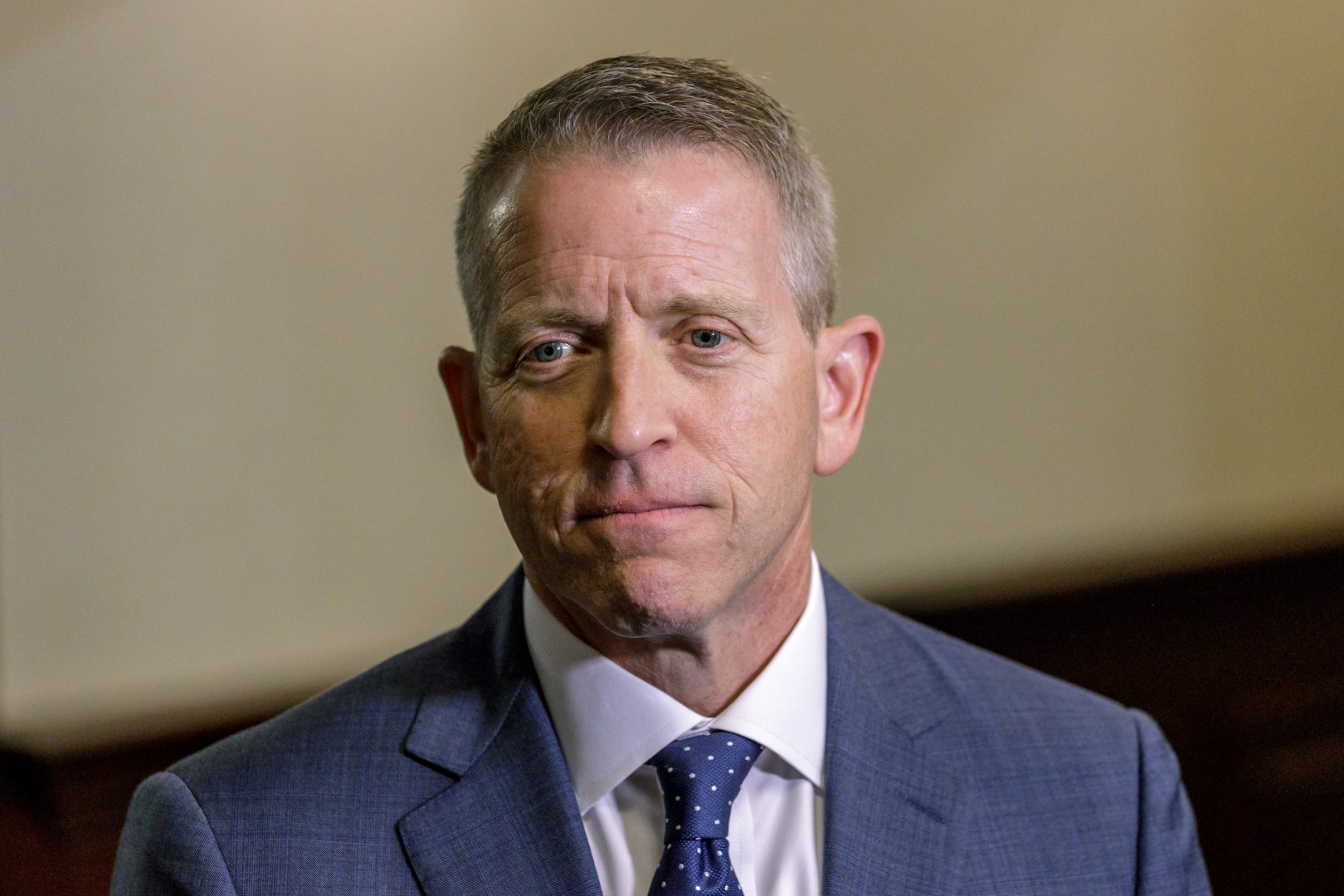
Former House Speaker Paul Renner announced a team made up of veterans and active servicemen who will help him try to win the Governor’s race. 

The Statewide Veterans Coalition will recruit veteran leaders in each county to assist with policy ideas and voter turnout, Renner said in a press release.

“During my tenure as Speaker of the House, we made the Free State of Florida the most veteran-friendly state in the nation,” Renner said in a statement.

“As a Navy veteran who served in two combat theaters, I understand firsthand the sacrifice that our warriors and their families make to keep us safe and free. We must make sure they have access to the healthcare, education, and business opportunities they need to be successful during and after service.”

Leading the coalition will be Rep. Patt Maney of Okaloosa County, who is a combat-wounded Army veteran, Purple Heart recipient and 2018 inductee to the Florida Veterans’ Hall of Fame, according to the press release.

Paul Renner is the trusted leader our state needs as our next Governor. As a fellow veteran, he understands how we can best support service members and their families during and after their time in uniform,” Maney said in a statement.

“When we served together in the Florida House, Paul delivered policies that benefit our veterans and their spouses, such as the expansion of mental health services, job training, mentorship, entrepreneurship opportunities, and eliminating barriers to occupational licensing to ease employability concerns. As Governor, Paul will commit our state to the unwavering support of our military and its veterans.”

Others in the coalition include:

K. Bean, Captain, U.S. Navy, Retired.

Ronald Birchall, Lieutenant Colonel, U.S. Army, Retired.

Richard Bishop, Lieutenant Commander, U.S. Navy, Retired.

Christopher De Ruyter, Lieutenant Colonel, U.S. Army, Retired.

William Dudley, Lieutenant Colonel, U.S. Air Force, Retired.

Dennis Freytes, Colonel, U.S. Army, Retired, 2016 inductee to the FL Veterans’ Hall of Fame.

Bruce Garrott, Captain, U.S. Navy, Retired.

Curt Perkins, Captain, U.S. Navy, Retired.

Lewis Preddy, Commander, U.S. Navy, Retired.

Ralph Dale Rogers, Tech Sergeant, U.S. Air Force.

Samuel Royer, Corporal, U.S. Marine Corps.

Jeremiah Schwarz, Lieutenant, U.S. Navy, Retired.

Carl Schwenker III, Commander, U.S. Navy, Retired.

James Randall Stapleford, Captain, U.S. Navy, Retired.

A new poll out Thursday showed Renner was a distant third to win the GOP nomination behind the leader, U.S. Rep. Byron Donalds, although a larger number of voters were still undecided.

The St. Pete Polls survey said Donalds would win more than 39% of the vote in a Republican Primary against Lt. Gov. Jay Collins, who has less than 4% support, and Renner, who polled at less than 3%. But the poll also found 54% of voters were unsure who to pick.

The survey had a 3-percentage-point margin of error.


Source link

Continue Reading

Politics

Florida could lead AI data centers … just not the way Tallahassee thinks

Published

on


Florida is having a loud debate about AI data centers. Power prices. Water use. Land. Transmission lines. Who pays. Who benefits?

It is a familiar fight. And like many familiar fights, it may already be aimed at the wrong target.

In Tallahassee, the question is where to put AI data centers. In Jacksonville, Tampa, Orlando, and Miami, the question is whether the grid can handle them. Florida Power & Light and Duke Energy are part of the conversation. So are ratepayers.

Those are fair concerns. But they are not the biggest question Florida should be asking.

The bigger question is beyond whether the future of AI data centers needs to be built on Florida soil at all. Perhaps Florida has something better to offer the data center discussion, and it’s beyond our soil. That sounds like science fiction. It is not.

The real limit on AI today is not talent or software. It is physics.

Every AI model runs on chips that turn electricity into computation. Physics tells us something unavoidable. Almost all of that electricity eventually becomes heat. The more powerful the model, the more heat it produces. On Earth, heat is the enemy.

It must be removed continuously; otherwise, systems fail. That means massive cooling equipment, significant water demand, and substantial electricity consumption to remove heat from machines. It also means more power plants, more transmission lines, and more stress on already crowded grids.

In Florida, that stress shows up directly in conversations about FPL and Duke. New generation takes years to build. Grid upgrades are expensive. And those costs ultimately flow back to customers.   There is also another physical reality layered on top of all of this.

Hurricanes.

Every large data center built in Florida must assume power interruptions, grid instability, flooding risk, wind hardening, backup generation, and fuel logistics during storms. Cooling systems depend on electricity that may not be available when hurricanes make landfall. Even short interruptions can damage sensitive equipment.

Storm hardening adds cost. Backup systems add complexity. And every hurricane season reminds us that Florida’s grid, no matter how well run by FPL or Duke, is exposed to forces no zoning decision can eliminate.

So every new data center raises the same worry. Will regular customers subsidize big tech? Will neighborhoods bear the risks? Will the grid hold up during the next major storm?

Florida is not alone in facing these limits.

But Florida has something most states do not.

A launchpad.

In space, the physics change. Solar energy is available almost all the time. More importantly, heat behaves differently. Instead of fighting to move heat through air and water, systems can radiate heat directly into the cold vacuum of space. Cooling becomes simpler, cheaper, and far more efficient.

And there are no hurricanes.

No flooding.

No wind damage.

No storm-related outages.

No long recovery cycles.

Picture what that future looks like.

Small, modular data centers orbit the Earth as satellites. Solar panels collect sunlight while Florida sleeps. AI systems running overhead while communities below board up windows and prepare for storms.

New computing power arrives by rocket, not by bulldozer.

This is why orbital data centers are no longer a fringe idea. As AI demand grows every few years, grid upgrades take a decade, and climate risk increases, physics starts to favor space over land.

Recently, an AI model was trained in orbit using advanced computer chips. The model itself was not the point. The location was. It showed that high-powered computing does not have to live where power politics, weather risk, and local permitting collide.

Once you see that, Florida’s current debate starts to feel incomplete.

We are arguing about where to site AI data centers, assuming they must be placed here in the first place. Florida’s real advantage has never been cheap land or cheap power. If that were the case, Texas or the Midwest would already own this space.

Florida’s advantage is access to orbit.

The Space Coast, from Cape Canaveral to Merritt Island, is the busiest launch corridor in the world. Rockets launch so often that they barely make the news. Space infrastructure already supports daily life, from GPS to communications to weather forecasting.

This infrastructure was not built for AI.

AI is simply discovering it.

In a future where data centers can be launched rather than built, Florida does not compete with other states on land use or electricity prices.

It competes on physics, resilience, and access to space.

That is a very different game.

The most important places in Florida’s AI story may not be office parks in Orlando or industrial sites outside Tampa. There may be communities along the Space Coast that help launch, service, and manage the next generation of digital infrastructure.

Orbital data centers will not replace land-based ones overnight. But they will shape investment decisions this decade. They reduce exposure to grid failures, water shortages, and hurricane risk while easing pressure on utilities like FPL and Duke.

History shows how this works. When systems hit hard limits, technology does not argue. It finds another path. Shipping containers reshaped trade. Satellites changed navigation.

The internet rewrote the media. AI infrastructure is next.

Elon Musk often says, “The future should look like the future.”

Right now, Florida is still arguing about plugging into the past.

The future of AI data centers will not be decided only in zoning meetings, rate hearings, or hurricane preparedness plans.

It will be decided on the Space Coast.

Because the future should look like the future.

And in Florida, that future is launched, not plugged in.

___

Jeff Brandes is a former Florida State Senator known for his leadership in transportation innovation, criminal justice reform, property insurance modernization, and technology-forward public policy. He is the founder and president of the Florida Policy Project and a national voice on autonomous mobility, infrastructure modernization, and the future of transportation in Florida.


Source link

Continue Reading

Politics

Bedrock, we have a problem

Published

on


William Mattox.

A funny thing happened in the Legislature last week. While the House was holding an “AI Week” to talk about all sorts of futuristic possibilities straight out of “The Jetsons,” the Senate Appropriations Committee passed a school choice “glitch bill” that seems better suited for the Stone Age of “The Flintstones.”

To its credit, the Senate wants to address a problem that has arisen in Florida’s highly popular school choice programs — namely, tracking students as they move from one mode of education to another during the school year.

Thankfully, such mid-year movements don’t occur very often. But when they do, they can throw a wrench in things because Florida’s public school computers don’t talk with our state’s scholarship program computers.

Thus, when a mid-year schooling change takes place — due to a family emergency, a bullying situation or some other reason — there’s a chance a student could end up being counted twice (once by each system).

Now, the seemingly obvious solution to this “double counting” problem would be to fix the computers and create a single point of entry for every Florida K-12 student to be registered in the state. Then, as students move from one mode of schooling to another, it would be easy to track them (and to ensure that the dollars for their education follow them wherever they go).

The Senate “glitch bill” sponsor acknowledges this. But instead of getting the techies involved, he wants Florida parents to start filing paperwork — every month! — confirming that their child is still in the scholarship program and wishes to remain there. And get this — if parents slip up and miss a deadline, their child would not receive any education funding for that month.

Bedrock, we have a problem.

Now, maybe someone in the Stone Age would find it reasonable to require parents to submit monthly attestations that they are still doing what they did last month. And maybe in the town of Bedrock it would seem fair to tell taxpayers that they can’t have any of the dollars they’ve paid into the K-12 system unless they jump through monthly hoops and barrels.

But here in the Digital Age, the Senate sponsor’s proposed remedy seems very draconian.

Which is a great shame. Because no one denies that “double counting” is a problem. And no one denies that the Senate sponsor is well meaning.

The only question is whether we need a “solution” that seems straight out of Bedrock. Or a true remedy that shows greater respect for Digital Age parents living in a world with AI.

___

William Mattox is the senior director of the Marshall Center for Education Freedom at The James Madison Institute.


Source link

Continue Reading

Politics

Property tax cuts, elimination would hit Florida’s rural communities hardest

Published

on


A new study by the Florida League of Cities warns that eliminating or slashing property taxes would hit rural communities hardest, as many already operate with little fiscal margin while relying heavily on property taxes to fund essential services.

As lawmakers weigh proposals to eliminate or sharply expand Florida’s homestead exemption, the League’s analysis finds the fiscal fallout would be uneven, placing far greater strain on rural and inland municipalities with limited revenue diversity.

In smaller cities, most of them rural, predictable ad valorem revenue is the backbone of municipal budgets, supporting police and fire protection, infrastructure maintenance, and local economic development.

“Without compensatory measures, reforms risk eroding long-term service capacity and weakening rural revitalization strategies,” the report says.

The pressure is particularly acute in rural regions such as the Panhandle, where some small jurisdictions devote all of their property tax revenue — and more from other sources — to police, fire and emergency medical services.

With narrow tax bases and limited alternatives, those communities must tap other general fund sources simply to keep essential services operating.

Infrastructure costs compound the challenge. A microsimulation conducted for the League found that public works and transportation spending is especially vulnerable in rural and coastal communities with large land areas and infrastructure-intensive responsibilities.

In many of those jurisdictions, the scale and environmental complexity of roads, drainage systems and stormwater management drive costs that are fundamentally mismatched with local taxable value.

“As policymakers consider reforms to the homestead exemption or property tax system,” the report says, “these geographic disparities underscore the need to account for infrastructure-driven fiscal stress, which cannot be easily reduced through efficiency gains or service cuts.”

The study estimates that eliminating homestead property taxes outright would result in a 38% loss of ad valorem revenue and a 14% drop in overall general fund revenue statewide, forcing millage rates to nearly double to avoid service cuts.

Large fixed-dollar exemptions of $250,000 to $500,000 would still produce revenue losses of 25% to 32%, requiring millage increases of 20% to 70% on remaining taxable properties to break even.

Researchers at Wichita State University used a microsimulation model to estimate how various homestead property tax reform proposals would affect municipal revenues across Florida.

After establishing a baseline of each city’s fiscal structure from 2018-2024, they applied reforms — including complete elimination, tiered exemptions and a 32% discount — to parcel-level values under just, assessed and taxable valuation bases.

They then calculated the resulting revenue losses and the millage rate increases needed to keep budgets whole before then breaking the results down by region, population size, housing values and income to show which communities would be most impacted.

The study comes months after DeSantis vetoed a $1 million earmark in Florida’s budget that would have funded a study on the potential impacts of eliminating property taxes. A Florida Policy Institute study released in February found that Florida would need to double its sales tax to 12% to offset the local revenue losses that ending homestead taxes would cause.


Source link

Continue Reading

Trending

Copyright © Miami Select.