Young labels are consolidating their creative standing in Paris, becoming unmissable appointments for the press and buyers alike. The second day of women’s ready-to-wear shows dedicated to Spring-Summer 2026 proved particularly uplifting, with invigorating presentations injecting fresh creative energy. Zomer and Matières Fécales, for instance, shook up the fashion scene on Tuesday.
For its first show in the Paris calendar, Matières Fécales made a major statement with dangerously seductive fashion that oscillated between couture tailoring and a techno-gothic aesthetic. As if emerging from a lost kingdom, members of this mysterious tribe, represented by highly inclusive casting, took the capital by storm in imposing looks. Perched on vertiginous platform stilettos with curved needle heels, the models were made up like porcelain dolls, their gaze glassy, sometimes obscured by a half-mask.
Conformity hardly seemed a priority for the brand’s founders, Canadians Hannah Rose Dalton (29), who opened and closed the show, and Steven Raj Bhaskaran (31), of Guyanese and Sri Lankan heritage. The pair spent years proving themselves before imposing their vision. From Montreal, they stopped off in New York, where they made their mark as DJs, before finding success in Paris, first under the wing of Rick Owens and his wife Michèle Lamy, then with Adrian Joffe, the head of Dover Street Market, all while winning over Lady Gaga and Madonna.
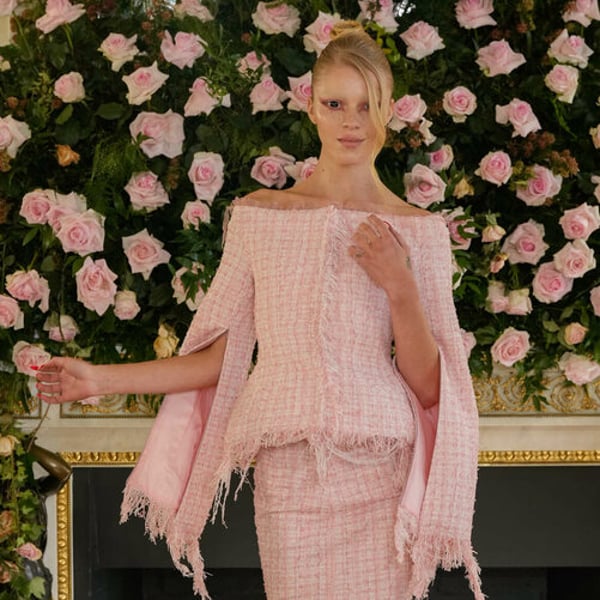
The duo toyed masterfully with couture codes, subverting them without ever lapsing into gratuitous provocation. Case in point: a pale pink, Chanel-esque tweed suit, collarless and off the shoulders, its jacket and skirt edges artfully frayed.
Silhouettes swung from long and lean to sculptural, with pronounced shoulders and rounded hips. Corsetry takes centre stage, accentuating feminine curves, while chic hats and opera gloves add a touch of glamour.
Elegance peaked in impeccably cut pieces: masculine tailoring, satin ensembles, 1940s-style skirt suits, sensual jumpsuits, ruched tulle cocktail dresses, and trench-robe hybrids revealing suspender stockings. Not to mention the crinolines, frothing with tulle and adorned with roses, that closed the show.
A more street-inflected wardrobe rounded out the offer with faded jeans ripped just so, tracksuit tops emblazoned with the slogan “Never conform”, and a hole-riddled black T-shirt printed with a wilted rose and the slogan “La vie en rose”. To spice things up, a BDSM thread ran through the line-up via black leather pieces.
A huge artist’s palette sat centre stage, on which the models rubbed their feet, leaving their colourful footprints on the white catwalk. At Zomer, there is always a playful streak, and it’s often about joy, lightness and witty details.
Exaggerate or pare back? This was the dilemma faced by the brand’s two designers this season, Tatar Danial Aitouganov and Dutch-Caribbean Imruh Asha.
The result was a collection intelligently constructed between neutral-hued basics and more elaborate multicoloured pieces, each lifted by a quirky or clever twist. Ties knotted like bow ties sat perched on shrunken blouson jackets or tiny short-sleeved shirts, while oversized belt buckles fastened the waists of draped dresses.
In this play with proportions, the designers consistently dropped the waist to thigh level, cinched low with a belt. Skirts and Bermuda shorts seemed to have slipped down the legs, leaving the top of an undergarment in a completely different fabric or colour on show. Everything layered into a cheerful mix-and-match. A short denim skirt came inset into a sequinned petticoat, while a crocodile-effect A-line skirt sat flush over a white poplin summer dress.
Variations on the umbrella shape provided the collection’s other original idea. Long dresses and handkerchief-hem skirts unfurled into pointed drapes. Tiers of pointed leather ruffles built volume at the shoulders. Elsewhere, a skirt fell straight to the knees before opening into arched panels below, like an umbrella.
This article is an automatic translation. Click here to read the original article.
Gant has a new CEO as of this month. The Swedish-but-with-American-roots brand has named Fredrik Malm as its chief executive, effective December 1.
Gant CEO Fredrik Malm
It’s an internal appointment with Malm having joined Gant in 2024 as EVP Commercial, Brand & Product. He succeeds Patrik Söderström, who’d led the company for six years.
Before joining the firm, Malm was CEO of SNS, and had been president Europe & International at Coach, as well as president of sales EMEA at Ralph Lauren, and retail director at ECCO.
Gant has been owned by privately-owned Swiss business MF Brands Group (which also owns Lacoste, Tecnifibre and Aigle) since 2008. And MF’s CEO Thierry Guibert said of Gant’s new leader: “Fredrik has brought valuable and extensive leadership experience from global premium fashion and lifestyle brands.
“I have full confidence in his ability to support Gant in its next phase of development, which will notably involve the continued elevation of the collections and an accelerated retailisation across both physical and digital channels.
“I would also like to deeply thank Patrik Söderström for his commitment alongside us over the past 10 years. He has played a pivotal role in transforming and elevating the brand while delivering strong financial performances over the years.”
Gant has been expanding this year, and in late May it reopened its Regent Street, London flagship. It said the refurbishment of the 6,300 sq m space “represents a key milestone in the brand’s global retail investments in the UK and worldwide”. Söderström said at the time that the reopening “kicks off a global initiative to elevate our retail experience”.
The company has also been focusing on its licenses and in June announced the early renewal of its exclusive licensing deal for the design, manufacture, and global distribution of its eyewear with Marcolin.
Lawyers for Chinese online platform Shein return to a Paris court on Friday for a hearing on the French government’s request to suspend the firm’s website for three months, after childlike sex dolls and banned weapons were discovered on its marketplace.
Customers queue to enter the first physical space of Chinese online fast-fashion retailer Shein on the day of its opening inside the Le BHV Marais department store, the Bazar de l’Hotel de Ville, in Paris, France, November 5, 2025 – REUTERS/Sarah Meyssonnier/File Photo
Shein disabled its marketplace- where third-party sellers list their products- in France on November 5, after authorities found the illegal items for sale, but its main site selling Shein-branded clothing remains accessible. The French state wants the website suspended for a minimum of three months in the country, which it argues is needed for Shein to prove that its contents comply with the law.
It has invoked Article 6.3 of France’s digital economy law, which gives a judge powers to prescribe measures with the aim of preventing or halting harm caused by online content. France has also summoned major internet service providers Bouygues Telecom, Free, Orange, and SFR to the hearing, requesting they block Shein’s website. The court will have to decide whether a suspension is warranted, and whether it is in line with European Union law.
In a statement last week, the Paris prosecutor’s office said a three-month suspension could be deemed “disproportionate” under the case law of the European Court of Human Rights if Shein could prove it has stopped all sales of illegal goods. However, the prosecutor said it “fully backed” the government’s demand that Shein provide evidence of measures taken to end those sales.
France’s move comes amid broader scrutiny of Chinese giants such as Shein and Temu under the EU’s Digital Services Act, reflecting concerns about consumer safety, illegal product sales and unfair competition. Meanwhile in the US, Texas Attorney General Ken Paxton said on Monday he is investigating Shein to determine whether the fast fashion retailer violated state law related to unethical labour practices and the sale of unsafe consumer products.
China’s HongShan Capital Group (HSG) has sent a 2.5 billion euro ($2.91 billion) offer to private equity Permira to buy Italian luxury sneaker maker Golden Goose, with the aim of signing the deal by Christmas, daily la Repubblica reported on Friday.
Golden Goose is known for its luxury sneakers – goldengoose.com
Details still need to be defined but the offer gives the luxury group an enterprise value of 10 times the core profit expected by the end of the year, debt included, the newspaper said. Golden Goose’s revenues totalled 655 million euros in 2024, with an adjusted core profit of 227 million euros.
HSG has asked veteran fashion industry executive Marco Bizzarri to become Golden Goose’s future chairman, la Repubblica said, adding that the Chinese private equity aims to expand Golden Goose’s directly-managed stores, particularly in Asia, and plans to list the group in the medium-term.
Last year the Venice-based company, which sells sneakers for more than 500 euros a pair, shelved plans for an initial public offering on the Milan Bourse, citing market volatility caused by political uncertainty in Europe.