
Fashion
Oslo Runway: A decade of putting Norwegian fashion on the global stage
Translated by
Nazia BIBI KEENOO
Published
September 1, 2025
You don’t have to be a big corporation to be relevant in the fashion industry. That is the mantra that seems to guide Oslo Runway since its birth a decade ago. The catwalk — with the Norwegian capital and its rich heritage, culture, and nature as a backdrop — celebrated its first 10 years of existence from August 25 to 30. During these days, and through a comprehensive and carefully planned program, the city showcased the talent and creativity of its brands, both established and emerging, utilising a hybrid format that combined fashion shows, presentations, pop-ups, and talks.
“Oslo Runway started 10 years ago with a bold vision: to showcase Norwegian fashion on a professional level and do something we would be proud of on an international level. And that’s pretty bold,” said Elin O. Carlsen, CEO of Oslo Runway, at the opening ceremony. “Now that we have travelled to different fashion cities, we see that people want to come, join our culture, and see our designers. This platform promotes creativity, craftsmanship, and collaboration.”
She also pointed to the creative ecosystem now surrounding the event, with stylists, photographers, consultants, and creators reinforcing the industry.
“In terms of growth, the numbers speak for themselves. From 2015 to date, the total turnover of our top fashion and lifestyle brands has increased by 1,100%. This proves the vision, resilience, and entrepreneurial drive behind this industry,” added Elin Kathrine Saunes, president and CEO of Norwegian Fashion Hub. “The government’s recent export initiative confirms that Norwegian fashion is a value-generating industry.”
Oslo boasts fashion, nature and cultural heritage
Under a bright sun that seemed to conspire with the organisation to seduce both national and international attendees — in its tenth edition, the runway show invited international press, buyers, and distributors from key markets for Norwegian fashion, such as Japan — Oslo Runway kicked off its anniversary on Monday, August 25, with an opening ceremony aboard a Brim Explorer ship and in collaboration with the jewelry firm Josephine Studio. Sailing through the Oslo Fjord, the runway made a statement of intent: “This is who we are, and this is what we can offer to the fashion world.”

The second highlight of the first day was a fashion show on Monday afternoon at the Munch Museum in Oslo. The imposing building, inaugurated in 2021 and designed by Spanish architect Juan Herreros, began construction in 2015. It houses more than 26,000 works by the Norwegian expressionist painter Edvard Munch, author of “The Scream” and “The Sun.”
The latter was precisely the inspiration for the “Solen” collection by Pearl Octopuss, which includes jewellery, accessories, handbags, and statement garments such as blazers. “The Sun,” and the aptly named Monumental Room that hosts it, served as the backdrop for the collection’s spring-summer 2026 debut, accompanied by live electronic music performed by Gundelach.
Hoops, oversized pearls, orange-toned pieces, and accents that echoed a sunset — including fringe detailing on bags, buttons, and belts — created a fusion of visuals and sound, resonating with the massive artworks in the room and the musical ambience.
Later that evening, Pearl Octopuss.y was awarded the Oslo Runway Tribute Award at the catwalk’s anniversary dinner. This prize recognises exceptional contributions to Norwegian fashion and has previously gone to Livid (2021), Tom Wood (2022), Envelope1973 (2023), and Norwegian Rain (2024).
Long live Nordic minimalism
If the first day of Oslo Runway focused on Norway’s breathtaking nature and the legacy of one of its most famous artists, the second day brought a more intimate mood.

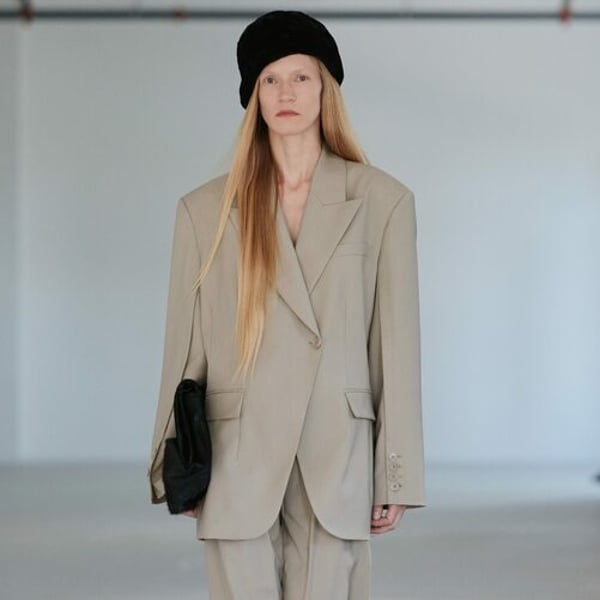
Envelope1976 showcased its designs in a stark minimalist space, where stools were practically the only décor — aside from the morning sun illuminating the clean tailoring. The brand’s sharp, earth-toned silhouettes spoke for themselves.
“We are minimalists with a distinctive touch. With this collection, we aimed to return to our roots and revive some of our signature pieces. Tailoring is essential to our brand, and we added new colours to designs that have been with us for several seasons,” explained Celine Aagaard, co-founder of Envelope1976 with Pia Nordskaug.
Satin, leather, and shearling featured heavily in the lineup, alongside reversible designs and layered looks. “For all the suits, we use Italian wool. We produce in Istanbul with the same supplier we’ve worked with since the beginning. Some fabrics are made there, while others are made in Italy. The shearling comes from China, the leather from India, and our swimsuits — though not shown today — are made in Portugal,” Aagaard said.
At its headquarters, with the hum of sewing machines setting the tone, ESP presented its fifteenth collection, combining spring-summer 2026 garments made from deadstock with a capsule of locally recycled wool.

“Through NF&TA’s ‘Innovating Norwegian Wool’ project, and in collaboration with Norsk Tekstilgjenvinning, Selbu Spinneri, and Gudbrandsdalen Uldvarefabrikk, ESP developed the first Norwegian recycled wool textile with a fully local value chain. Partnering with Manufacture Oslo, these textiles are turned into garments that combine innovation and tradition,” read the show notes. The result was a gender-inclusive selection of jackets, coats, and outerwear featuring deep lapels and waist ties, all in navy, grey, and brown — styled with football boots, including cleats.
In the inner courtyard of its offices, surrounded by red-brick buildings with an industrial past, Camila Pihl debuted her spring collection. Suede jackets, denim staples, and cotton shirts anchored the lineup. Founded in 2018 by its namesake entrepreneur, the brand now operates four stores in Oslo, Bergen, and Trondheim, and is sold in 125 multi-brand outlets, 25 of which are located abroad. It expects to surpass NOK 100 million (€8.5 million) in sales by 2025.
Christian Aks — guided by the concept of “sculpted simplicity for the modern closet” — presented “Tide,” inspired by the stillness and strength of the sea. Soft and structured pieces in silk organza, cotton, and textured sheepskin captured that duality.

In a more urban key, F5 Collections (also featuring a live musical performance) added a more urban feel, showcasing printed pieces — including Vichy and Klein blue — that broke from the prevailing minimalist aesthetic. A live musical performance rounded out the show.
Cohmé Atelier and Wilhelmina, selected for the Oslo Runway NEXT program, took to the catwalk with glittering designs. Cohmé embraced 1930s cabaret glam with sequins and vintage silhouettes. Pia Tjelta closed the evening with a performance at the Nationaltheatret, revealing a collection of romantic satin gowns, embroidered lace dresses, and velvet pinstripe suits, all set against the grandeur of the ceiling paintings.
From timeless basics to knitwear as national pride
On day three, the official fashion shows wrapped with a celebration of refined wardrobe staples. Julie Josephine presented her famously crisp basics in a gallery, accompanied by shirts and tees worn by clients for over nine years — still in perfect condition.

In Ekebergparken — a hilltop park filled with sculptures — Kari Traa brought bold colour to a grey morning. The sportswear brand founded by the Olympic skier incorporated shades of pink into its performance layers, leggings, down jackets, and heavy wool sweaters. Wool and knitwear are national icons in Norway, and Traa offered a modern, functional twist.
Ella & Il returned to clean lines and natural textures for its first show at Oslo Runway. The spring-summer 2026 presentation included resortwear, fringe details, sage knits, and linen pieces.
Woodling also focused on knitwear, showcasing alpaca wool and 3D knits in butter-yellow — a shade still trending for spring — across long dresses, mini skirts, and sheer tops.

Wilhelmina’s deconstructed pieces and Hartlino’s 2026 eveningwear followed. Mads Søreide, now design lead at Hartlino and founder of Cohmé, created polished silhouettes: sequined gowns, strapless styles, and men’s velvet blazers paired with satin shirts.
The official presentations closed with a dinner hosted by O.A.D. outside the Astrup Fearnley Museum of Modern Art. The knitwear brand, rooted in Devold of Norway (est. 1853), honours its textile legacy with Norwegian wool, yak, cashmere, and mohair. While production is centred in Italy, the brand is expanding its made-in-Norway range, including hats and mittens.
“We’ve focused on consolidating in Norway. We distribute through 25 stores nationally and sell online across Europe. Now, we’re expanding abroad — entering stores in Denmark and Switzerland. With 45% growth this year, we’re building a future-proof company,” said CEO Marianne Strand.

A decade that has also transformed the city
The 10 years since Oslo Runway launched have also seen the city undergo significant evolution. In addition to architectural landmarks like the Munch Museum, Oslo’s Promenaden district has emerged as a retail hub — stretching from Akersgata to Karl Johans Gate.
“Over the past decade, we’ve focused on building not just a district, but a fashion community in Oslo,” said Anette Lund, CEO and portfolio director of Promenaden Oslo. “At first, international brands asked where Oslo even was. That’s no longer the case.”
She continued, “Bringing luxury brands here took years of planning, dialogue, and persistence. It’s changed how Oslo is perceived globally. Today, it’s one of the most visible new fashion cities — and that visibility fuels growth and recognition for Norwegian fashion.”
This article is an automatic translation.
Click here to read the original article.
Copyright © 2025 FashionNetwork.com All rights reserved.