On Tuesday, OpenAI launched its own web browser, ‘ChatGPT Atlas”, built around its artificial intelligence (AI) model- the most widely used in the world- in a bid to supplant Google Chrome as the number one gateway to the web.
“AI represents a rare, once-in-a-decade opportunity to rethink the very nature of a browser and how we use it,” said OpenAI’s CEO, Sam Altman, during an online demonstration.
OpenAI aims to challenge Google – SAMUEL BOIVIN / NURPHOTO / AFP
“Tabs were great, but we haven’t seen much innovation since,” he argued, asserting that browsing via the search bar and URLs could now give way to a conversational, chat-like experience within a web browser.
The new browser, currently available only on Mac, integrates ChatGPT in a sidebar, allowing the generative AI to scan the page being viewed and provide contextual assistance, without the need to copy and paste between tabs.
For paying subscribers, ChatGPT Atlas also lets an AI agent take over navigation, control the cursor, and book a flight, fill in a form, or edit a document.
Most of these features are similar to those gradually being rolled out in rival browsers, such as Microsoft Edge, enhanced with the Copilot AI agent, or Comet from AI start-up Perplexity.
But the launch of ChatGPT Atlas was particularly eagerly awaited, as it is built around the world’s most popular model, with 800 million weekly users, according to OpenAI, roughly 10% of the global population.
Google rebounds
With AI models delivering broadly comparable performance for most consumer use cases, the battle to attract the largest number of users now centres on building the most popular and user-friendly interface.
“This marks another step in the race among tech companies to make their AI interface the number one portal for internet users,” said Jacob Bourne, an eMarketer analyst.
ChatGPT Atlas is available from Tuesday exclusively on Apple‘s macOS, with plans to extend to Windows and mobile (iOS and Android), said Sam Altman, without specifying a timescale.
In a sign of what is at stake, the release of a video by OpenAI, showing browser tabs two hours before the announcement, immediately triggered a drop of nearly 5% in the share price of Alphabet, Google’s parent company. But the shares rebounded shortly after OpenAI’s demonstration ended, down just 1.87% by 18:50 GMT.
In September, Alphabet won a major victory in this competition when the US courts ruled it would not be forced to sell Chrome, contrary to the US government’s position, which had sought divestment on antitrust grounds.
In August, Perplexity AI offered to buy Google’s Chrome browser for $34.5 billion, before the courts allowed Alphabet to keep its flagship product and the advertising windfall that comes with it.
In another sign of the ongoing evolution of web browsing interfaces, several major news organisations, such as CNN and The Washington Post, or Le Figaro and Le Monde, have recently entered into paid partnerships with Perplexity to make their articles available to Comet’s paying subscribers.
Having thrown itself headlong into the AI race, OpenAI, whose estimated valuation has reached $500 billion, has in recent weeks placed orders for chips worth hundreds of billions of dollars- sums out of step with its current revenues and a source of concern for some investors.
This article is an automatic translation. Click here to read the original article.
Britain’s financial regulator on Monday unveiled a package of reforms aimed at encouraging retail investors to buy more shares and bonds, setting out one of its clearest statements yet on the UK’s post-Brexit direction for investment regulation.
Signage is seen for the FCA (Financial Conduct Authority), the UK’s financial regulatory body, at their head offices in London, Britain March 10, 2022 – REUTERS/Toby Melville
The Financial Conduct Authority (FCA) published three papers outlining changes to investment disclosure requirements, updating the categorisation of professional investors and a broader rethink of risk in the investment landscape. The measures are designed to make investing in stocks and shares more attractive and accessible to individuals, while reinforcing protections where needed, the regulator said.
Expect Christmas shoppers to be “cautious but positive” this year when it comes to spending. But there’s also one big difference: AI’s getting more and more involved in the decision-making process, a new report shows.
Shutterstock
It appears British consumers are approaching this Christmas with “quiet confidence but clear spending limits” as 56% plan to spend roughly the same as last year, 18% expect to spend more, and the same number expect to spend less, according to Accenture data.
It all adds up to a “slowly stabilising retail environment… after several years of inflation-driven adjustment, households have found a new spending equilibrium when considering planning for Christmas this year”.
Accenture says consumers “are not slashing budgets but managing them more deliberately”. The most common strategies include reducing spend on presents (77%), buying from budget supermarkets (43%), saving earlier (34%), and skipping premium delivery (26%).
And the AI element? Around one in three (31%) consumers have used or would consider using AI tools such as ChatGPT or Gemini to plan Christmas shopping this year.
Their top uses are practical: gift ideas (25%), price comparison (24%) and budget management (18%).
But the research also indicates that while uptake isn’t widespread, “people could be open to using AI to help them in the future”. This means 46% would try an AI gift assistant integrated into retailer websites; 31% said they would be open to using an AI agent to do the full shopping experience, from sourcing a product to making the purchase.
But this uptake of AI is tempered by concern: 62% are unlikely to use AI this year, citing privacy (48%) and loss of personal touch (47%) as key reasons – suggesting we’re still at a nascent phase of adoption of the new technology.
Matt Jeffers, retail strategy lead, Accenture UK & Ireland: “After several years of managing a high cost of living, our data suggests that this year we’re seeing some signs of cautious consumer confidence returning, but people are still hovering above the brakes, and fine-tuning their spending to make Christmas work on their terms. For retailers, it means the opportunity is less about chasing volume, and more about demonstrating genuine value and empathy in how they engage and serve customers.”
On the AI front, Jeffers added: “This year shoppers are still in a test-and-learn phase, but our data shows that many shoppers are beginning to embrace AI to support their Christmas planning. This comes as platforms are beginning to embed third-party shopping tools into their chats, helping consumers make purchasing decisions directly from an AI chat.
“Retailers therefore need to ensure their business is built on modern and agile tech and data stacks, in order to capitalise on this trend as it grows for Christmas next year and beyond. This means being ready to seamlessly connect with LLMs as they prepare to become another way people shop. Trust and personalisation will still be king, and robust data protections should be baked into every layer.”
“We need moments like these to get to know our female customers,” says Marionnaud. With this in mind, the perfume and fragrance business is taking up residence in two Good News cafés in Paris until December 10.
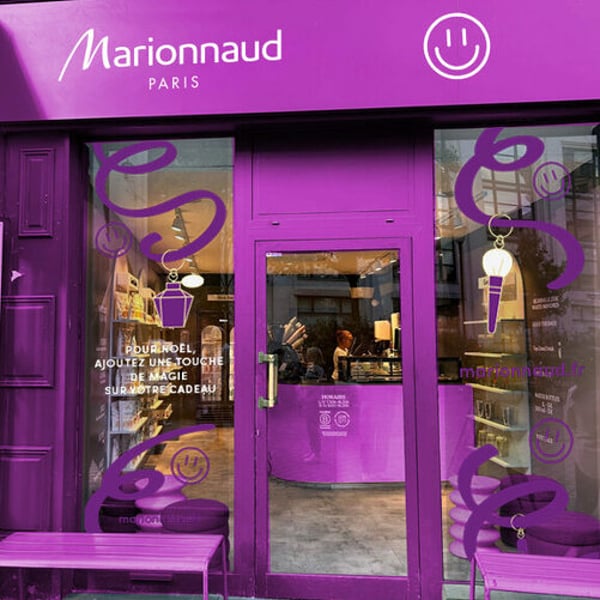
Rue Montmartre shopfront – AI-generated photo by Marionnaud – DR
Marionnaud is unveiling two pop-ups “conceived as convivial interludes, designed to strengthen its physical presence, drive footfall, and partner with a French player sharing the same values of proximity and optimism,” notes the French beauty specialist. The temporary spaces will be located at 94 Rue Montmartre, in the second arrondissement, and at 7 Boulevard de la Madeleine, in the first arrondissement.
Founded in 1984, Marionnaud now operates 385 stores in France. Under the leadership of Kulvinder Birring, the retailer is pursuing a strategy focused on modernising its network and strengthening customer relations. The brand’s turnover amounted to €573 million in 2023, the latest figure available, although the company does not officially disclose its financial performance. These pop-ups are part of this momentum, sitting somewhere between commercial experimentation and on-the-ground engagement.
According to Clémence Courquin, head of marketing, this collaboration is part of a 360° campaign combining social media activations with a physical rollout. “Today, we’re seeing the power of beauty-and-coffee alliances,” she emphasises. The two brands, both French, are bringing their worlds together and cross-pollinating their audiences to reach a broader customer base while nurturing their brand DNA.
In practical terms, Marionnaud and Good News are pooling their databases to increase the number of touchpoints, attract new customers, and raise their visibility. The initiative also includes the distribution of oversized gifts, designed to create surprise and spark engagement.
In short, it is a partnership conceived as a lever for commercial momentum, with each brand putting its expertise at the service of the other to maximise impact throughout the duration of the initiative.
This article is an automatic translation. Click here to read the original article.






 Politics8 years ago