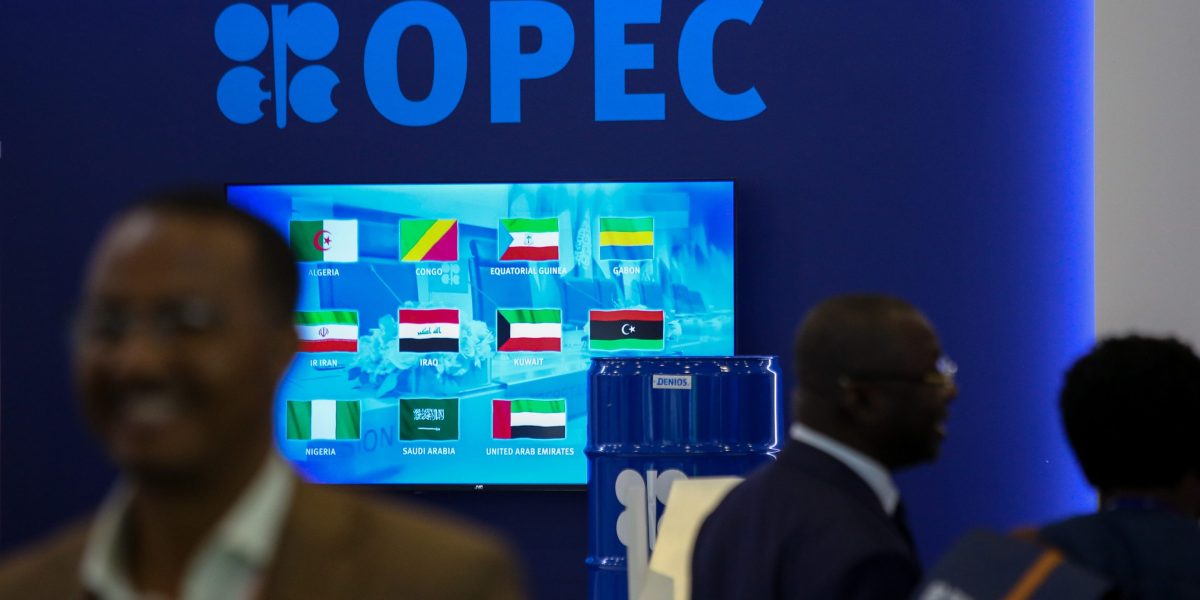
OPEC+ stuck with plans to pause supply increases in the first quarter, as global markets face a surplus and the group awaits clarity on whether the shock US capture of Venezuela leader Nicolas Maduro will impact supplies.
Key members led by Saudi Arabia and Russia agreed on Sunday to keep production levels steady through the end of March, once again ratifying a decision first made in November to suspend last year’s sequence of swift increases. Delegates said they didn’t discuss Venezuela during the 10-minute video conference, and that it’s premature to gauge how to respond to the unfolding situation.
The Organization of the Petroleum Exporting Countries and its partners confront an array of challenges, with crude prices near the lowest in four years and widespread forecasts that plentiful supplies and subdued demand could unleash a record glut. This weekend’s seismic upheaval in member nation Venezuela is the latest in a series of geopolitical pressure points spanning from Russia to Yemen that are also clouding the outlook.
“In an environment this fragile, OPEC+ is choosing caution, preserving flexibility rather than introducing new uncertainty into an already volatile market,” said Jorge Leon, an analyst at consultant Rystad Energy AS. “The political transition in Venezuela adds another major layer of uncertainty.”
While President Donald Trump said that US oil companies will spend billions of dollars to rebuild Venezuela’s crumbling energy infrastructure following the operation to seize Maduro, energy analysts aren’t expecting an immediate, significant change to the country’s exports. Trump said that sanctions on Venezuelan crude will remain in place.
READ: Oil Market May Absorb Maduro Shock as Global Supplies Swell (1)
Caracas may hold the world’s biggest oil reserves, but years of under—investment, mismanagement and international isolation have diminished the country to a fraction of its former standing.
Venezuela currently pumps about 800,000 barrels of oil a day, roughly a third of what it produced a decade ago and under 1% of global supplies. Washington’s recent seizure and pursuit of tankers while it pressured Maduro’s regime helped curb output in the country’s critical Orinoco Belt by 25%.
Production could rise by about 150,000 barrels a day within a few months if sanctions are lifted, but getting back to 2 million barrels a day or higher would require “massive reforms” and large investments from international oil companies, according to consultants at Kpler.
Other geopolitical threats afflicting OPEC+ nations continue to simmer.
Tensions between Saudi Arabia and the United Arab Emirates, two of the coalition’s core Middle East heavyweights, have flared over their support for opposing factions in the conflict in Yemen. Last week a Saudi-led coalition carried out airstrikes against a rival group supported by the UAE.
Washington has sanctioned top producers in Russia following the invasion of Ukraine, a conflict that’s also taking a toll on flows from fellow OPEC+ producer, Kazakhstan. On Friday, Trump pledged to “rescue” protesters in Iran, which has been rocked by a wave of demonstrations after the local currency collapsed to a record low.
Nonetheless, world markets remain comfortably supplied for now. The International Energy Agency in Paris forecasts a record oil surplus in 2026 as supplies swell from both OPEC+ and its competitors while demand growth slows. Trading giant Trafigura Group says the market may confront a “super glut.”
READ: The World Is Awash in Oil and Prices Are Poised to Keep Falling
Brent futures settled just under $61 a barrel on Friday, having slumped 18% last year in their biggest annual drop since the 2020 pandemic. Production in the US, Guyana, Brazil and Canada continues to climb while demand in top consumers like China has slowed.
In April, Riyadh and its partners stunned crude traders by rapidly restarting production idled since 2023 despite signs that world markets were comfortably supplied. Several delegates said the move was intended to claw back market share ceded in recent years to rivals like American shale drillers.
Before the latest pause, OPEC+ had formally agreed to restore about two-thirds of 3.85 million barrels a day of output halted since 2023, leaving about 1.2 million barrels-a-day of these tranches left to restart. However, the actual volumes added have been smaller than advertised as some countries physically struggle to increase, and others atone for earlier overproduction.
The eight OPEC+ members involved in bringing this production back will hold another monthly video conference on Feb. 1.