On Thursday, Zalando held its “Partners Day” in Paris, bringing together 280 executives and representatives of the platform’s French brands and partners. The event offered an opportunity to take stock of French online apparel sales, as well as current trends in fashion, from luxury to budget.
Laura Toledano, Zalando’s Managing Director for Western Europe, addressing the 280 invited professionals – MG/FNW
Under the colourful glass roof and gilding of the Hôtel d’Évreux, a large cross-section of the French apparel and beauty industry convened, alongside a number of online sales specialists and trade federation representatives. While the morning featured several experience-sharing sessions from brands such as Salomon, Soeur and Kendo Paris, the various market analyses lent the event the stature of an industry summit. Zalando was there to demonstrate its commitment to the industry.
“In terms of our infrastructure, there are still many synergies to develop. The priority is to continue investing in the customer experience,” explained co-founder David Schneider, who travelled from Berlin for the occasion.
“We believe a new era is dawning for fashion retail. The customer experience will be very different in a few years’ time. Our ambition is to help shape this wave, because many innovations are emerging and there are many frontiers to push.”
Online fashion sales in France have risen by 6% in volume this year, according to figures presented for the event by Guillaume Coudry, NielsenIQ’s e-commerce manager for Western Europe. Growth was also reported in sport (+10%), beauty (+5%) and designer apparel (+6%). He also notes that while the average basket value has fallen to €48, this decline is offset by an increase in purchase frequency, now at 8.2 per year.
“Marketplaces continue to gain market share in online fashion sales, while direct-to-consumer is losing ground. The challenge for brands is to reposition themselves strategically within this ecosystem,” emphasises Guillaume Coudry, who flagged a new player to watch closely: TikTok Shop.
“It remains very limited in France, but it’s a real breakthrough for commerce, with inspiration and purchase converging. It’s a massive phenomenon that is gaining momentum,” said the expert, who points out that Puma is currently the only clothing brand to make it into the Top 30 best-selling brands on the Chinese social network.
Luxury and the challenge of desirability
Xavier Romatet, managing director of the Institut Français de la Mode, identifies two major challenges affecting the luxury sector: on the one hand, the slowdown in the two markets that have long been the main drivers, China and the United States; and on the other, an issue linked to price trends, with price rises accounting for 80% of post-Covid sales growth.
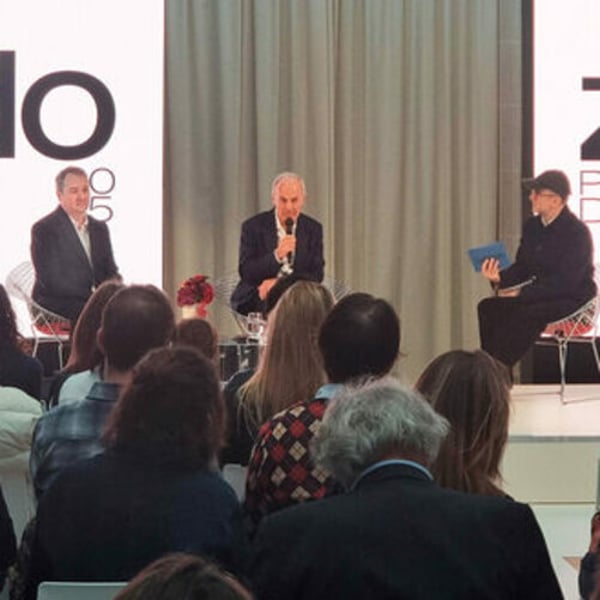
Pierre-François Le Louet (Nelly Rodi), Xavier Romatet (IFM) and journalist Loïc Prigent – MG/FNW
“Behind this phenomenon lies the question of desirability: why would a customer agree to pay €3,500 for a product that previously cost €3,000?” analysed the specialist. For him, the two levers of desirability are creativity, stimulated by the recent reshuffle of creative directors, and quality: the consumer expects an expensive piece to last over time.
The head of IFM also identified a number of decisive social issues for the sector’s future, chief among them the social and environmental responsibility of products, as well as the impact of technology — and artificial intelligence in particular — on the value chain. The specialist also pointed to a new relationship with ownership and possession, which will make the brand experience all the more central. “The problems are well identified; it is the answers that have yet to be devised,” stressed Romatet.
Polarisation and ultra-fast fashion
This analysis of the luxury sector chimed with the NellyRodi agency’s observation that the market is becoming increasingly polarised. Its director, Pierre-François Le Louët, pointed to a widening gap between entry-level and top-end products, driven in particular by the Chinese player Shein, which is pushing entry-level prices down. And while the future of the fast-fashion bill, criticised by the European Commission, remains uncertain, the man who also co-chairs the UFIMH (Union française des industries de la mode et de l’habillement) notes that the finance bill presented on October 15 provides for a €2 tax on small non-European parcels, currently exempt from tax.
“Brands that believe that Shein has no impact on them are completely mistaken,” said the specialist.
“Shein is imposing a new way of behaving and shopping online, and setting new benchmarks in terms of technology, pace, communication, pricing and consumers’ mindset. But there is also a modest revival among certain retailers: polarisation will, paradoxically, give a little breathing space to the various price tiers that invest in understanding the customer and the brand experience.”
In passing, the manager refers to the imminent arrival of Shein at BHV, “which now resembles an extremely empty department store under Brezhnev”.
This comes just a few weeks after the signing of an agreement between European federations against ultra-fast fashion.
“Our small French initiative has triggered a wave of European initiatives,” said Le Louët with satisfaction, citing measures taken by Italy, Sweden and Portugal, while the European Commission is gradually taking up the issue.
This article is an automatic translation. Click here to read the original article.
Kim Kardashian logged onto TikTok earlier this month and did something new: tried to sell pajamas, slippers, and matching sweat sets like the host of an old-fashioned TV infomercial.
Kim Kardashian held a live shopping event for Skims on TikTok – Skims
“This is what we’re here for: the deals, the bundles, the sales,” said Kardashian, dressed in a white outfit with furry trim. The livestream- Kardashian’s first live shopping event on TikTok for her $5 billion loungewear empire, Skims- felt like a crossover between an infomercial and a daytime talk show. Set in a winter wonderland, it featured surprise celebrity guests and a ‘hot Santa’ urging viewers to keep buying. Roughly 30,000 people tuned in at its peak, and alerts flashed on the screen as orders rolled in.
Livestream shopping- where customers can buy products on the spot from online video broadcasts- has for years been a wildly successful, defining feature of e-commerce in China. While the medium feels similar to traditional TV infomercials, it has largely failed to take off in the US despite efforts by the world’s largest American tech companies, including Amazon.com Inc., Alphabet Inc.’s YouTube and Meta Platforms Inc.’s Facebook and Instagram. That’s partly because many US consumers simply aren’t accustomed to shopping that way, and sellers haven’t tried the format.
TikTok, owned by Beijing-based ByteDance Ltd., is starting to change that. The popular video app is working to replicate the shopping experience that ByteDance has championed on Douyin, its Chinese version of TikTok, for a US audience. Small businesses are increasingly making TikTok Live core to their sales strategy for everything from pastries to home goods. Some have started hiring full-time livestream hosts, and are turning to Chinese agencies that have mastered the form in Asia for advice. Sellers are even hiring production companies to turn their live feeds into high-quality spectacles in an effort to stand out in the burgeoning American market.
TikTok declined to share live shopping figures, but the company expects to generate $77 billion globally from TikTok Live by 2027, Bloomberg previously reported. In November, the company said brands and sellers hosting TikTok livestreams during Black Friday and Cyber Monday saw an 84% jump in sales compared with last year. Appearances like those from Kardashian, one of the world’s most-followed celebrities, are further validating the format in the US.
The strategy may be risky; shopping live on a whim is a departure from some of the biggest benefits of online commerce, like reading reviews and hunting for deals. And there’s no guarantee the trend will grow into a habit for US consumers. Live shows cater more to shoppers buying what they want- from novelty items to rare fashion finds- than what they need. To capture the sales, creators or actors need to entertain, making the broadcasts as much about grabbing attention as they are about encouraging spending.
Haley Walsh, vice president of talent at Digital Brand Architects, an influencer management firm owned by Hollywood heavyweight United Talent Agency, believes we’re “only really at the forefront” of what live shopping can be. Walsh’s roster includes creator Mikayla Nogueira, a top beauty influencer who live-sells makeup to her audience of 17.5 million followers on TikTok. “It’s a central part of the content strategy” for those with their own brand or products, Walsh added. The ability to offer tutorials and answer audience questions in real-time makes top social media stars more accessible. “Live shopping allows for a different level of connectivity,” Walsh said.
TikTok, now used by half the country, has long been a dominant entertainment platform in the US, with a lucrative advertising business. Success in shopping means a separate powerful revenue stream. TikTok Shop launched in the US in 2023, and the company kept pushing it despite the potential for a nationwide ban of the app over national security concerns. In 2024, the company halted TikTok Shop’s expansion in other parts of the world to double down on growth in the valuable US market, eventually relocating top brass from ByteDance offices in China to the Seattle area to take the reins of its US e-commerce group in hopes of growing even faster.
On Douyin and other Chinese apps, live shopping is already an overwhelmingly popular product. Livestream social commerce in China drove almost $540 billion in sales in 2025, according to research firm Emarketer, up more than $200 billion since 2023. Emarketer expects that number to jump to almost $700 billion by 2027.
Creator economy experts like Walsh believe the US has similar potential. But TikTok’s app could still be banned, and the product is not without competition. Amazon and Ebay Inc. also offer live shopping products, and livestream shopping startup Whatnot Inc. is gaining traction, particularly with vendors of high-value luxury goods. Earlier this year, the TikTok Shop rival raised funds at a $5 billion valuation.
TikTok live shopping doesn’t require a brand name like Kardashian. Taylor Chip Cookie, a Pennsylvania-based cookie shop, started live-selling on TikTok just a few months ago, but the streams already account for about 80% of its revenue from the app, according to chief executive officer Doug Taylor. The company’s TikTok streams average just 200 viewers, but generate anywhere from $200 to $2,000 per hour, he added. Even on a slow day, Taylor Chip can make as much in a few hours livestreaming on TikTok as it does during a full day at one of its seven brick-and-mortar stores. Taylor called TikTok Live “the ‘on’ button for sales.”
That success as an early adopter has spurred Taylor to invest more. Like TikTok Shop sellers in other categories, Taylor Chip has hired a full-time livestream host and plans to hire others- ideally with acting backgrounds- with the goal of expanding from its current four-hour daily streams to as much as 20 hours by early next year. It’s even building a new facility in Pennsylvania with two live video studios. “The smart people are going to see the opportunity and be the first ones to get that beachfront property,” Taylor said.
New York-based 17th Street, a pre-owned luxury boutique that sells on TikTok, also hired a dedicated livestream host to promote handbags to prospective customers for five straight hours daily. The company sold an Hermès Birkin bag through TikTok Live for $20,000 earlier this year, and has occasionally brought in over $30,000 in a single day of livestreams, said Olivia Sperduto, 17th Street’s head of social media.
Megan Reep, the founder of Texas-based Mavwicks Fragrances, said that TikTok Shop “took our small business to the moon” in part because of shoppable livestreams. The company, which sells scented soaps, sprays, and detergents, expanded from $400,000 in annual sales to $32 million after just one year selling on TikTok, Reep said. She credits the platform for much of that growth, and the company featured Reep during an event at its New York office in November.
“We try really hard to not just make our lives all about selling; we try to make it a show,” Reep said. Mavwicks featured a dunk tank on a recent broadcast and is planning to showcase a small zoo in another. “We’ll have monkeys and lemurs and things like that on Live with us to keep people engaged,” Reep added.
This year, QVC– which pioneered the infomercial in the US in the 1980s and 1990s- also started hosting around-the-clock live shopping streams on TikTok daily.
As live shopping has gained steam in the US, a cottage industry of talent agencies and content studios focused on the craft have cropped up across the country. Some are staffed by social e-commerce experts from China offering to teach sellers the tips and tricks that have worked overseas.
Among them is Greenwood Agency, which has offices across China and one in Los Angeles focused squarely on social shopping and livestreaming. Since starting in 2023, the agency has built a roster of more than a thousand clients it helps with livestream management, market analysis and brand strategy for TikTok Shop, said Kaiyue An, the firm’s LA-based chief marketing officer. Greenwood’s services include recruiting and training high-energy, sales-savvy hosts for livestreams. Being in Hollywood has been an asset, because they often tap aspiring actors looking for jobs.
In live commerce, An said, “it’s not just turning on the camera.”
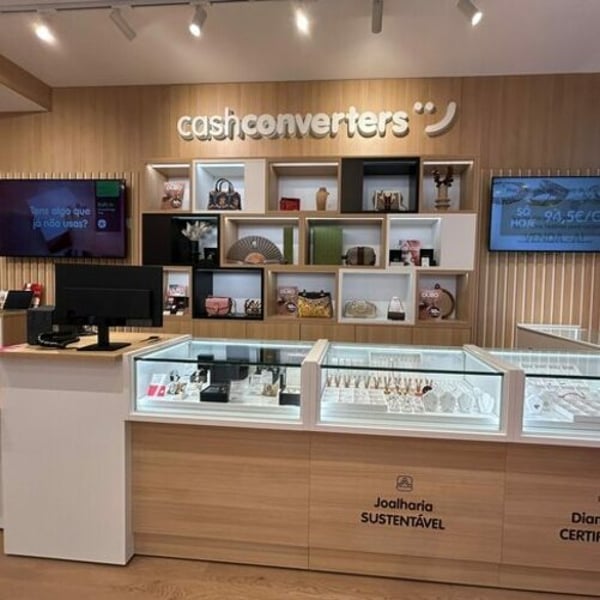
Australian multinational Cash Converters, a leading brand in the purchase and sale of second-hand items, founded in Perth, Australia, in 1984 by Brian Cumins and present in Portugal since 2003, has just opened a new store at the UBBO shopping centre in Amadora, the company said in a statement, adding that this new unit covers 72 square metres and features “an updated and distinctive concept,” broadening categories and focusing on “unique pieces, collectors’ items and discontinued products given a new lease of life”. This is the sixth opening in the Portuguese market.
Cash Converters
The main highlights are second-hand luxury items, “such as watches, bags, and jewellery from leading brands, as well as a space dedicated to the exclusive ‘Jewellery with a Soul’ collection, created by Cash Converters from 100% recycled gold and designed for those who value pieces with history and identity. Customers will also find IT, TV and audio equipment, consoles and video games, photography and video, sports, DIY and small domestic appliances,” the statement notes.
According to Francisco Parra, CEO of Cash Converters in Spain and Portugal: “The Portuguese market has shown a clear commitment to buying and selling second-hand products, and the results bear this out. In 2025, the average monthly number of items purchased in our stores in Portugal grew by 9% on the previous year, while the average ticket increased by 12%. These indicators reinforce our expansion strategy in the country for the coming years, with the aim of bringing more and more people closer to the circular economy through quality products.”
Cash Converters
The arrival at UBBO of the Australian chain specialising in the purchase and sale of second-hand items, which operates brick-and-mortar stores in Lisbon and Porto as well as through its official online store, “marks another step towards the democratisation of sustainable consumption in Portugal and the valuing of objects that deserve to continue to be used and appreciated,” the note stresses, adding that Cash Converters “now has 83 stores across the Iberian Peninsula, reinforcing its expansion strategy based on proximity and convenience.”
In Portugal, the brand currently has physical stores in Lisbon and Porto, located at Rua Pinheiro Chagas, 101B (near Lisbon’s El Corte Inglés), Rua José Rodrigues Migueis, 1, and Rua António Pereira Carrilho, 5 (central Lisbon); Rua Quinta do Paizinho, 2, Alfragide/Carnaxide, and at the UBBO Shopping Centre, Pontinha (Greater Lisbon); and Rua de Fernandes Tomás, 432 (downtown Porto).
Cash Converters
This article is an automatic translation. Click here to read the original article.
The sale of the fashion collection belonging to Paris socialite, filmmaker, and former runway star Farida Khelfa has raised €330,000 at auction, half of it for charity, confirming how buoyant the vintage market remains.
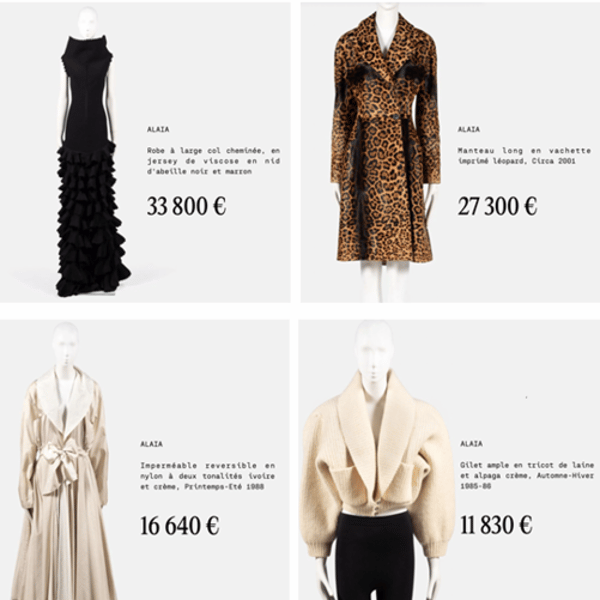
Pieces by Azzedine Alaïa and the prices they fetched at the auction – Maurice Auction
Organised by Maurice Auction, a Paris firm focusing on art and luxury, the sale, entitled Garde-Robe Iconique de Farida Khelfa, raked in €332,343.
A notably elegant figure, Khelfa ran away from her family in Lyons at 15 to begin a career in modelling in Paris, where she walked in shows by such legends as Azzedine Alaïa and Jean-Paul Gaultier. In later life she was named brand ambassador for Schiaparelli. Designs by all three fashion houses made up the majority of the auction which also included creations by Saint Laurent, Jean Charles de Castelbajac, Prada, Pierre Cardin, and Christian Louboutin.
Sold online, these personal archives of Farida came to approximately 200 pieces, comprising outfits, shoes, and accessories worn by the model in her storied career. During this, Khelfa was also the witness at the 2008 wedding of Carla Bruni to then French president Nicolas Sarkozy.
“I thank the buyers: their gesture shows as much elegance as generosity. These resonate particularly well with RIACE, and I am sincerely grateful to them,” said Farida after the auction, half of whose profits will be donated to the RIACE Fund, engaged in solidarity actions.
The Alaïa lots sparked intense competition, achieving a world record for an Alaïa piece from a private collection. A 1996 ensemble of a flared skirt and gilet by Alaïa reached €50,700, while an epic calfskin Alaïa trench printed in leopard went for €27,300.
The sale attracted international collectors, another confirmation of Farida Khelfa’s status and the market’s interest in these archives.