Energy markets are starting to react to the U.S.-Israel bombing campaign against Iran, which is stepping up retaliation in the region.
Brent crude prices jumped 10% to about $80 a barrel over the counter on Sunday, oil traders told Reuters. That’s after the global benchmark had been surging in the days leading up to the first airstrikes early Saturday as tensions mounted, closing at a seven-month high of $73 a barrel on Friday.
Iran pumped 4.7 million barrels per day last year, accounting for 4.4% of global oil supplies. Much of its heavily sanctioned shipments go to China via a so-called shadow fleet.
But the bigger risk centers on the potential for Iran to close off the Strait of Hormuz, where a fifth of all the world’s oil passes through on the way to export markets. Analysts have estimated that any Iranian moves to close off the strait could send prices to $100 per barrel.
While Iran has yet to take steps to close off the strait, such as placing underwater mines, ships are still staying away.
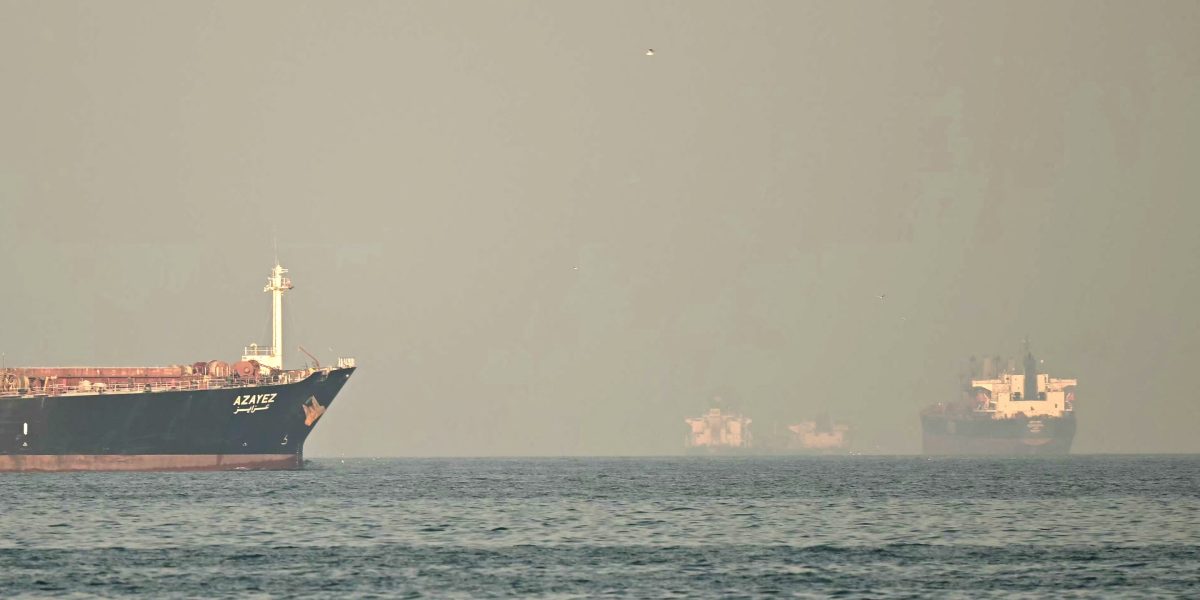
Hundreds of tankers carrying oil and liquid natural gas have dropped anchor or remain stationary near the Strait of Hormuz, according to shipping data compiled by Reuters.
That’s after tanker owners, oil majors and trading houses suspended shipments via the strait on Saturday as a precautionary move.
“Our ships will stay put for several days,” a top executive at a major trading desk told Reuters.
In addition, Greece’s shipping ministry has advised vessels to avoid the Persian Gulf, the Gulf of Oman and the Strait of Hormuz. And shipping giant Maersk said it is suspending all vessel crossings through the strait until further notice.
The Islamic Revolutionary Guards Corps has reportedly warned ships that passage is not allowed in the strait, and at least two ships have already been struck near the waterway though the source of the attacks wasn’t clear.
Iran’s foreign minister said Sunday the country has “no intention of closing the Strait of Hormuz at present, nor has any plans to do anything that would disrupt navigation in it at this stage.”
Meanwhile, OPEC+ agreed to boost oil production, with plans to increase output by 206,000 barrels a day in April from its 137,000-barrel monthly increments.
But there is limited spare capacity among most of the cartel’s members to pump more oil with most residing in Saudi Arabia.
William Jackson, chief emerging markets economist at Capital Economics, said in a note Saturday that a rule of thumb say a 5% annual rise in oil prices usually adds about 0.1 percentage point average inflation in major economies. That means if Brent crude spiked to $100 a barrel, global inflation would rise by 0.6-0.7 percentage points.
“This might slow the pace of monetary easing by major central banks, particularly in emerging markets, where policymakers tend to be more sensitive to swings in commodity prices,” he added.