The 1970s are making a comeback, but not in a good way, as surging oil prices, a weak job market, and slowing growth revive memories of stagflation.
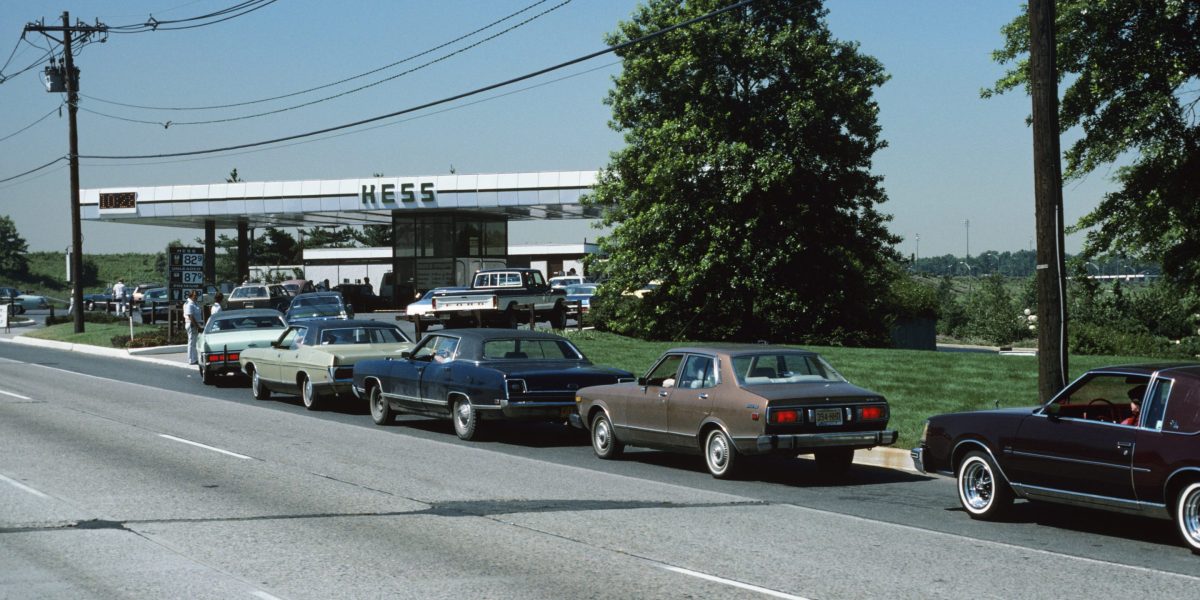
And like the ’70s, Iran is at the center of it again. The earlier shock began with the Arab oil embargo in 1973 and received another jolt from Iran’s Islamic revolution, forcing motorists to wait in long lines for gas as supplies were rationed.
Today, the U.S.-Israel war on Iran has sent crude oil above $100 a barrel as the the regime’s Islamic Revolutionary Guard Corps attacks tankers in the Strait of Hormuz, through which 20% of the world’s crude passes, imposing a de facto blockade.
At the same time, the latest monthly jobs report showed a surprise decline and confirmed a year-long trend of virtually no net gains. Meanwhile, growth forecasts are being revised lower with first-quarter GDP on track for a 2.1% increase, down from an earlier estimate of an 3.2% jump.
While oil prices have eased a bit from weekend highs as Western powers plan to release crude reserves and escort tankers, the threat remains.
“However, as long as the IRGC can fly drones, the Strait will remain straitjacketed,” veteran market strategist Ed Yardeni wrote in a note. “President Donald Trump has authorized the US Navy to escort ships through the Strait, but that operation may take a while to implement and may not completely succeed at thwarting Iranian drone attacks.”
Given the persistent threat, the president of Yardeni Research hiked the probability of a stock market meltdown that includes 1970s-style stagflation to 35% this year from 20%.
His base-case forecast is still for the “Roaring 2020s” to continue and maintained 60% odds of that, but he downgraded a “meltup” to just 5% odds from 20%.
And over the rest of this decade, his outlook has narrowed to just two scenarios, putting the Roaring 2020s at 85% and 1970s-like stagflation at 15%.
“The US economy and stock market are stuck between Iran and a hard place currently,” Yardeni added. “So is the Fed. If the oil shock persists, the Fed’s dual mandate would be stuck between the increasing risk of higher inflation and rising unemployment.”
Oil spikes have often coincided with recessions, he pointed out, though the U.S. avoided one after crude surged in the wake of Russia’s invasion of Ukraine in 2022.
That’s because the economy has been resilient and is less exposed to oil than in the past. Indeed, the U.S. is an energy powerhouse and is now the world’s top oil producer, relying less on imports.
It’s also why his base case is still relatively optimistic, and improved productivity should help offset price pressure. As a result, he’s more inclined to expect a 10%-15% correction in the stock market than a bear market that entails selloff of 20% or more, though he can’t rule it out.
Once ships can pass through the Strait of Hormuz without being attacked by Iran, the bull market in stocks should resume, he predicted.
But the Iran war carries inflationary risks beyond energy prices. Gulf states are also top exporters of fertilizer, and Yardeni warned that if ship traffic through the Strait of Hormuz doesn’t resume by early April, then farmers will have to switch to a different fertilizer or use less of it.
“Lower fertilizer application typically leads to lower yields, which could trigger a secondary ‘food price shock’ in late 2026,” he wrote.