
Business
Ocean technology startup that sold 200,000 carbon credits faces scientists’ doubts
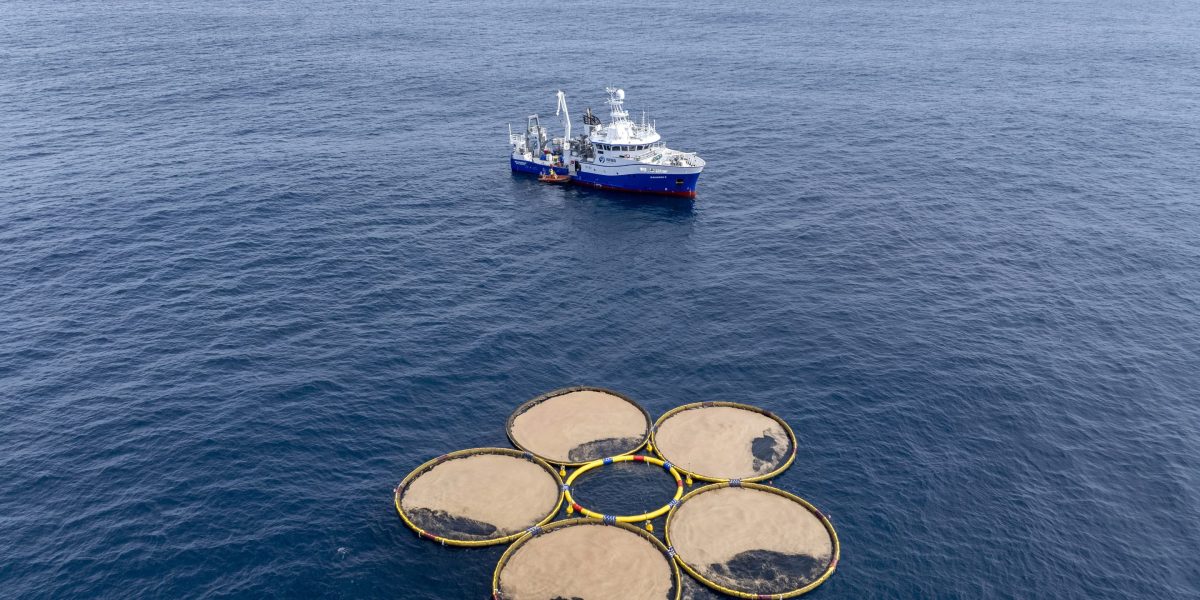
The startup Gigablue announced with fanfare this year that it reached a historic milestone: selling 200,000 carbon credits to fund what it describes as a groundbreaking technology in the fight against climate change.
Formed three years ago by a group of entrepreneurs in Israel, the company says it has designed particles that when released in the ocean will trap carbon at the bottom of the sea. By “harnessing the power of nature,” Gigablue says, its work will do nothing less than save the planet.
But outside scientists frustrated by the lack of information released by the company say serious questions remain about whether Gigablue’s technology works as the company describes. Their questions showcase tensions in an industry built on little regulation and big promises — and a tantalizing chance to profit.
Jimmy Pallas, an event organizer based in Italy, struck a deal with Gigablue last year. He said he trusts the company does what it has promised him — ensuring the transportation, meals, and electricity of a recent 1,000-person event will be offset by particles in the ocean.
Gigablue’s service is like “an extra trash can” where Pallas can discard his unwanted emissions, he said.
“Same way I use my trash can — I don’t follow where the truck that comes and picks up my trash brings it to,” he said. “I’ll take their word for it.”
‘Hundreds of thousands of carbon credits’
Gigablue has a grand vision for the future of carbon removal. It was originally named “Gigaton” after the one billion metric tons of carbon dioxide most scientists say will be necessary to remove from the atmosphere each year to slow global warming.
The company began trials in the South Pacific Ocean last year, and says it will work with country authorities to create a “sequestration field” — a dedicated part of the ocean where “pulses” of particles will be released on a seasonal basis.
Gigablue says its solution is affordable, too — priced to attract investors.
“Every time we go to the ocean, we generate hundreds of thousands of carbon credits, and this is what we’re going to do continuously over the upcoming years and towards the future, in greater and greater quantities,” co-founder Ori Shaashua said.
Carbon credits, which have grown in popularity over the last decade, are tokens that symbolize the removal of one metric ton of carbon dioxide from the atmosphere. On paper, companies that buy credits achieve a smaller carbon footprint without needing to reduce their own emissions — for instance, by paying another vendor to plant trees or capture carbon dioxide from the air.
Only a few countries have required local industries to purchase carbon credits. Most companies that buy them, including Microsoft and Google, do so voluntarily.
The credits have helped fund a band of startups like Gigablue that are eager to tackle the climate crisis, but they are also unevenly regulated, scientifically complex, and have in some cases been linked to fraud.
Gigablue’s 200,000 credits are pledged to SkiesFifty, a newly formed company investing in greener practices for the aviation industry. It’s the largest sale to date for a climate startup operating in the ocean, according to the tracking site CDR.fyi, making up more than half of all ocean-based carbon credits sold last year.
And it could beckon a rapid acceleration of the company’s work. Gigablue hopes to reach a goal this year of capturing 10 metric tons of carbon dioxide for each ton of particles it deploys, Shaashua said. At that rate, Gigablue would disperse at least 20,000 tons of particles in the ocean.
Gigablue wouldn’t reveal what it earned in the sale, and SkiesFifty’s team declined to be interviewed for this story. Most credits are sold for a few hundred dollars each — but a chart on Gigablue’s website suggests its prices are lower than almost any other form of carbon capture on the market.
A mission to save the world
The startup is the brainchild of four entrepreneurs hailing from the tech industry. According to their LinkedIn profiles, Gigablue’s CEO previously worked for an online grocery startup, while its COO was vice president of SeeTree, a company that raised $60 million to provide farmers with information on their trees.
Shaashua, who often serves as the face of Gigablue, said he specializes in using artificial intelligence to pursue positive outcomes in the world. He co-founded a data mining company that tracked exposure risks during the COVID-19 pandemic, and led an auto startup that brokered data on car mileage and traffic patterns.
“Three years ago, I decided to take the same formula, so to say, to climate,” Shaashua said.
Under his guidance, he said, Gigablue created an AI-driven “digital twin” of the ocean based on dozens of metrics to determine where to release the particles.
Chief technology officer Sapir Markus-Alford earned a bachelor’s degree in earth and environmental sciences from Israel’s Ben-Gurion University in 2021, shortly before founding Gigablue.
Markus-Alford said she began her studies and eventual path to Gigablue after seeing bleached coral reefs and other impacts of warming waters on a series of diving trips around the world.
“I understood that the best thing we could do for the ocean is to be able to remove CO2,” Markus-Alford said.
A spokesperson for Gigablue did not answer whether the other co-founders have graduate degrees in oceanography or environmental science, but said the company’s broader team holds a total of 46 Ph.D.s with expertise in biology, chemistry, oceanography, and environmental science. Markus-Alford said that figure includes outside experts and academics and “everyone that supports us.”
The company’s staffing has expanded from Israel to hubs in New York and New Zealand, Shaashua said.
In social media posts advertising open jobs, Gigablue employees encouraged applicants to “Join Our Mission to Save the World!”
Trapping carbon at the bottom of the ocean
The particles Gigablue has patented are meant to capture carbon in the ocean by floating for a number of days and growing algae, before sinking rapidly to the ocean floor.
“We are an elevator for carbon,” Shaashua said. “We are exporting the carbon from the top to the bottom.”
Algae — sometimes referred to as phytoplankton — has long been attractive to climate scientists because it absorbs carbon dioxide from the surrounding water as it grows. If the algae sinks to the deep sea or ocean floor, Gigablue expects the carbon to be trapped there for hundreds to thousands of years.
The ultimate goal is to lower carbon dioxide levels so drastically that the ocean rebalances with the atmosphere by soaking up more CO2 from the air. It’s a feat that would help slow climate change, but one that is still under active study by climate scientists.
Gigablue’s founders have said the company’s work is inspired by nature and “very, very environmentally safe.” The company’s particles and sinking methods simply recreate what nature has been doing “since forever,” Shaashua said.
Gigablue ran its first trial sinking particles in the Mediterranean in March last year.
Later, on two voyages to the South Pacific, the company released 60 cubic meters — about two shipping containers — of particles off the coast of New Zealand.
Materials kept a mystery
While Gigablue has made several commercial deals, it has not yet revealed what its particles are made of. Partly this is because the company says it will build different particles tailored to different seasons and areas of the ocean.
“It’s proprietary,” Markus-Alford said.
Documents provide a window into the possible ingredients. According to information on the permit, Gigablue’s first New Zealand trial last year involved releasing particles of pure vermiculite, a porous clay often used in potting soil.
In the second New Zealand trial, the company released particles made of vermiculite, ground rock, a plant-based wax, as well as manganese and iron.
A patent published last year hints the particles could also be made of scores of other materials, including cotton, rice husks or jute, as well as synthetic ingredients like polyester fibers or lint. The particles contain a range of possible binding agents, and up to 18 different chemicals and metals, from iron to nickel to vanadium.
Without specifying future designs, Markus-Alford said Gigablue’s particles meet certain requirements: “All the materials we use are materials that are natural, nontoxic, nonhazardous, and can be found in the ocean,” she said. She wouldn’t comment on the possible use of cotton or rice, but said the particles won’t include any kind of plastic.
When asked about vermiculite, which is typically mined on land and heated to expand, Markus-Alford said rivers and erosion transport most materials including vermiculite to the ocean. “Almost everything, basically, that exists on land can be found in the ocean,” she said.
The company said it had commissioned an environmental institute to verify that the particles are safe for thousands of organisms, including mussels and oysters. Any materials in future particles, Gigablue said, will be approved by local authorities.
Shaashua has said the particles are so benign that they have zero impact on the ocean.
“We are not changing the water chemistry or the water biology,” Shaashua said.
Ken Buesseler, a senior scientist with the Woods Hole Oceanographic Institution who has spent decades studying the biological carbon cycle of the ocean, says that while he’s intrigued by Gigablue’s proposal, the idea that the particles don’t alter the ocean is “almost inconceivable.”
“There has to be a relationship between what they’re putting in the ocean and the carbon dioxide that’s dissolved in seawater for this to, quote, work,” Buesseler said.
Buesseler co-leads a nonprofit group of scientists hoping to tap the power of algae in the ocean to capture carbon. The group organizes regular forums on the subject, and Gigablue presented in April.
“I left with more questions than answers,” Buesseler said.
Scientists raise questions
Several scientists not affiliated with Gigablue interviewed by The Associated Press said they were interested in how a company with so little public information about its technology could secure a deal for 200,000 carbon credits.
The success of the company’s method, they said, will depend on how much algae grows on the particles, and the amount that sinks to the deep ocean. So far, Gigablue has not released any studies demonstrating those rates.
Thomas Kiørboe, a professor of ocean ecology at the Technical University of Denmark, and Philip Boyd, an oceanographer at the University of Tasmania who studies the role of algae in the Earth’s carbon cycle, said they were doubtful algae would get enough sunlight to grow inside the particles.
It’s more likely the particles would attract hungry bacteria, Kiørboe said.
“Typical phytoplankton do not grow on surfaces, and they do not colonize particles,” Kiørboe said. “To most phytoplankton ecologists, this would just be, I think, absurd.”
The rates at which Gigablue says its particles sink — up to a hundred meters (yards) per hour — might shear off algae from the particles in the quick descent, Boyd said.
It’s likely that some particles would also be eaten by fish — limiting the carbon capture, and raising the question of how the particles could impact marine life.
Boyd is eager to see field results showing algae growth, and wants to see proof that Gigablue’s particles cause the ocean to absorb more CO2 from the air.
“These are incredibly challenging issues that I don’t think, certainly for the biological part, I don’t think anyone on the planet has got solutions for them,” he said.
James Kerry, a senior marine and climate scientist for the conservation group OceanCare and senior research fellow at Australia’s James Cook University, has closely followed Gigablue’s work.
“What we’ve got is a situation of a company, a startup, upfront selling large quantities of credits for a technology that is unproven,” he said.
In a statement, Gigablue said that bacteria does consume the particles but the effect is minimal, and its measurements will account for any loss of algae or particles as they sink.
The company noted that a major science institute in New Zealand has given Gigablue its stamp of approval. Gigablue hired the National Institute of Water and Atmospheric Research, a government-owned company, to review several drafts of its methodology.
In a recent letter posted to Gigablue’s website, the institute’s chief ocean scientist said his staff had confidence the company’s work is “scientifically sound” and the proposed measurements for carbon sequestration were robust.
Whether Gigablue’s methods are deemed successful, for now, will be determined not by regulators — but by another private company.
A new market
Puro.earth is one of several companies known as registries that serve the carbon credit market.
Amid the lack of regulation and the potential for climate startups to overstate their impact, registries aim to verify how much carbon was really removed.
The Finnish Puro.earth has verified more than a million carbon credits since its founding seven years ago. But most of those credits originated in land-based climate projects. Only recently has it aimed to set standards for the ocean.
In part, that’s because marine carbon credits are some of the newest to be traded. Dozens of ocean startups have entered the industry, with credit sales catapulting from 2,000 in 2021 to more than 340,000, including Gigablue’s deal, last year.
But the ocean remains a hostile and expensive place in which to operate a business or monitor research. Some ocean startups have sold credits only to fold before they could complete their work. Running Tide, a Maine-based startup aimed at removing carbon from the atmosphere by sinking wood chips and seaweed, abruptly shuttered last year despite the backing of $50 million from investors, leaving sales of about 7,000 carbon credits unfulfilled.
In June, Puro.earth published a draft methodology that will be used to verify Gigablue’s work, which it designed in consultation with Gigablue. Once finalized, Gigablue will pay the registry for each metric ton of carbon dioxide that it claims to remove.
Marianne Tikkanen, head of standards at Puro.earth, said that although this methodology was designed with Gigablue, her team expects other startups to adopt the same approach.
“We hope that there will be many who can do it and that it stimulates the market,” she said.
The road ahead
It remains to be seen whether New Zealand officials will grant permission for the expanded “sequestration field” that Gigablue has proposed creating, or if the company will look to other countries.
New Zealand’s environmental authority has so far treated Gigablue’s work as research — a designation that requires no formal review process or consultations with the public. The agency said in a statement that it could not comment on how it would handle a future commercial application from Gigablue.
But like many climate startups, Gigablue was involved in selling carbon credits during its research expeditions — not only inking a major deal, but smaller agreements, too.
Pallas, the Italian businessman, said he ordered 22 carbon credits from Gigablue last year to offset the emissions associated with his event in November. He said Gigablue gave them to him for free — but says he will pay for more in the future.
Pallas sought out carbon credits because he sees the signs of climate change all around him, he says, and expects more requirements in Italy for businesses to decarbonize in coming years. He chose Gigablue because they are one of the largest suppliers: “They’ve got quantity,” he said.
How authorities view Gigablue’s growing commercial activity could matter in the context of an international treaty that has banned certain climate operations in the ocean.
More than a decade ago, dozens of countries including New Zealand agreed they should not allow any commercial climate endeavor that involves releasing iron in the ocean, a technique known as “iron fertilization.” Only research, they said, with no prospect of economic gain should be allowed.
Iron is considered a key ingredient for spurring algae growth and was embedded in the particles that Gigablue dispersed in October in the Pacific Ocean. Several scientific papers have raised concerns that spurring iron-fueled algae blooms on a large scale would deplete important nutrients in the ocean and harm fisheries.
The startup denies any link to iron dumping on the basis that its particles don’t release iron directly into the water and don’t create an uncontrolled algae bloom.
“We are not fertilizing the ocean,” Markus-Alford said.
“In fact, we looked at iron fertilization as an inspiration of something to avoid,” Shaashua said.
But the draft methodology that Puro.earth will use to verify Gigablue’s work notes many of the same concerns that have been raised about iron fertilization, including disruptions to the marine food web.
Other scientists who spoke with AP see a clear link between Gigablue’s work and the controversial practice. “If they’re using iron to stimulate phytoplankton growth,” said Kerry, the OceanCare scientist, “then it is iron fertilization.”
For now, scientific concerns don’t seem to have troubled Gigablue’s buyers. The company has already planned its next research expedition in New Zealand and hopes to release more particles this fall.
“They mean well, and so do I,” said Pallas, of his support for Gigablue. “Sooner or later, I’ll catch a plane, go to New Zealand, and grab a boat to see what they’ve done.”