“We are democratizing AI across the entire company,” says Thumu. “Every employee, every team, and every workflow.”
Some examples of how this plays out include the creation of Expedia’s “AI playground,” which gives employees access to more than 60 different large language models—including from OpenAI, Google’s Gemini, Meta’s Llama, and Anthropic’s Claude—to build their own AI agents. Since January 2025, employees have built more than 1,500 different AI agents and around 6,000 monthly sessions occur within the secure AI agent builder environment on a monthly basis.
Around two-thirds of Thumu’s software developer workforce have embraced AI coding assistant tools including Copilot, Claude Code, and Cursor, often resulting in an estimated 20% productivity lift. Thumu says he wants to bring more “joy” to coding by giving them a broad set of AI tools to infuse in their workflows. He vows that more efficiency won’t necessarily mean fewer jobs. “That’s not how I see it,” Thumu adds. “It’s an improvement which means you can get more work done, much faster, and higher quality work.”
And last year, Expedia began to embed AI “squads,” teams of around four to six AI engineers that work with various business divisions ranging from legal, procurement, human resources, and marketing, collaboratively working alongside AI “champions” for each of those segments to figure out where AI can possibly be implemented to handle some manual tasks.
Every one of these AI investments are being measured, ranging from velocity and cycle time for the AI coding assistant tools, and within customer service, tracking how AI is speeding up the time it takes to resolve a customer query. For the broader employee population, Expedia is measuring usage and the impact on workflows. If the company doesn’t see the right adoption or outcomes for these tools, Thumu says Expedia is quick to reassess and adjust its approach.
“We are absolutely testing a lot of experiences and placing a lot of bets to make sure which ones stick and where we scale, and when the test is not wildly successful, fail fast and take those learnings to do something different,” says Thumu.
He joined Expedia, which ranks No. 312 on the Fortune 500, in late 2024 after a decade in technology leadership roles at sports-merchandising company Fanatics. As Expedia’s CTO, Thumu says his core AI priorities include testing and deploying internal productivity use cases, customer-facing external applications that will lean more heavily on multi-step agentic AI, and a focus on data as well as partner support from large language model providers.
“The same transformation that is happening inside the company is going to show up to hundreds of millions of travelers,” says Thumu.
External applications of AI include Expedia Trip Matching, which debuted in June and allows travelers to share any publicly available travel reel that caught their attention on Instagram and then share that reel directly with Expedia. The travel company will then use AI to produce a customized itinerary and travel tips that are based on the content that was originally created by an influencer.
In October, Expedia also served as a pilot partner—along with Booking.com, Zillow, and Spotify—for what’s known as “Apps in ChatGPT,” a feature that aims to further integrate the chatbot with external brands. As an example, a ChatGPT user can type in: “Expedia, find me a hotel in Paris for under $600 per night in March” and it will pull up a list with prices and links that go to Expedia’s site.
The company also developed an AI customer service agent that’s built on Amazon Web Services, which can help travelers with simple tasks including cancelling a hotel booking, getting a refund status, or changing their books so they don’t need to call a human agent. Expedia says this AI agent handles 143 million conversations a year and resolves over 50% of traveler queries.
As Expedia moves forward with embracing more agentic AI capabilities, Thumu stresses that the company will prioritize stitching together the technology in a manner so one AI companion can help customers effortlessly through all touchpoints. He doesn’t want to build one AI companion that helps book hotels, another to handle discovery for excursions, and yet another to address customer service questions.
“We are trying to bring those together,” says Thumu. “To make sure that from a customer standpoint, it’s one agentic experience. There is a lot of work to be done, but we are in the initial stages.”
John Kell
Send thoughts or suggestions to CIO Intelligence here.
NEWS PACKETS
AI’s health care embrace continues to accelerate. Anthropic debuted a new offering within its Claude chatbot that can access medical information, an offering that’s intended for both large organizations and consumers. As Fortune reports, health-related questions are a leading consumer for AI chatbots and while Anthropic has historically been more focused on serving enterprises, this latest offering is an indication that Anthropic would like to make real inroads with consumers. Separately, OpenAI launched ChatGPT Health, which allows users to connect their medical records and wellness apps to the chatbot. But AI companies pushing into heath care need to be careful to closely guard consumer data and avoid inaccurate outputs. An investigation by the Guardian uncovered that some of Google’s AI Overviews provided false or inaccurate information when asked about blood tests.
Apple taps Google’s Gemini for AI-enabled Siri. The iPhone maker has inked a multiyear pact with Google to lean on the latter company’s Gemini to power its AI features, including a big upgrade for Siri that’s expected later in 2026. While the companies didn’t share details about the financials behind the deal, Bloomberg has previously reported that Apple was planning to pay about $1 billion a year to utilize Google AI. The deal is the latest sign that Google is continuing to make serious gains in the AI race against top rival OpenAI.
Nvidia to invest $1 billion in a new AI lab with Eli Lilly. The AI chip maker and pharmaceutical giant behind blockbuster drugs including Type 2 diabetes treatment Mounjaro and antidepressant Prozac are joining forces to build a facility in Silicon Valley that will aim to speed up the use of AI in drug discovery, a costly and time-intensive process. On top of that, the companies say that they see opportunities to apply AI across clinical development, manufacturing, and commercial operations, leveraging multimodal models, agentic AI, robotics, and digital twins.
Moody’s says data centers will need $3 trillion through 2030. The credit ratings company forecasts that at least $3 trillion of data-center investments will be needed to support building facilities, computer equipment, and new capacity to support the rising demand in AI and cloud computing. A big chunk of that spending will come directly from some of the world’s most valuable companies, as Moody’s says six players—Microsoft, Amazon, Alphabet, Oracle, Meta Platforms, and CoreWeave—are forecasted to spend $500 billion on data center investments in 2026, Bloomberg reports.
Walmart expands drone delivery program. Walmart and drone operator Wing, a unit of Google parent Alphabet, have announced that they plan to make package deliveries by sky available to tens of millions of shoppers by expanding the service to more than 270 Walmart locations by the end of 2027. The Wall Street Journal reports that Wing estimates that more than 40 million Walmart shoppers would have access to the service, up sharply from roughly 2 million mostly limited to the Dallas-Fort Worth and Atlanta regions today. Drone deliveries have been an enticing technology application intended to make it even easier to deliver online orders, but most actual applications have been restricted to just a few markets.
ADOPTION CURVE
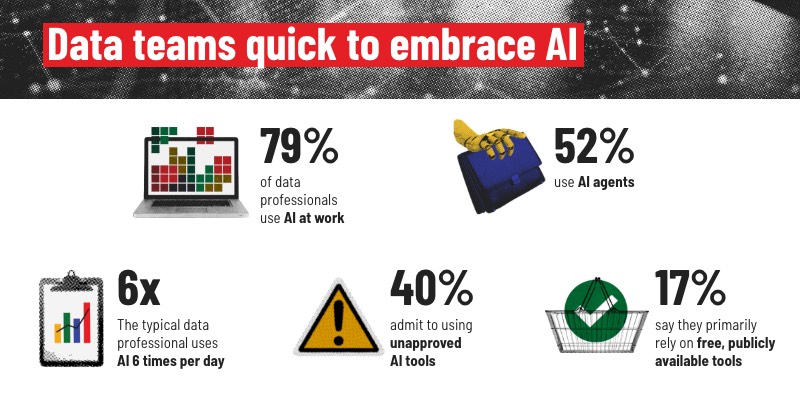
Data professionals are using unauthorized AI tools way more than they should be. Four out of every ten data professionals admitted that they use unauthorized AI at work, and 17% say they are primarily relying on free, publicly available AI tools, according to a recent survey conducted by tech training provider General Assembly. Devanshu Mehrotra, lead instructor of data science and data analytics at General Assembly, tells Fortune that these figures represent an expectation gap between employers and their workforce.
“Employees are expected to be more productive,” says Mehrotra. But, “they are not being given enough instructions and training to understand how to do it properly, or they are not given the tools that are required, and so they end up going the shadow AI route.”
He added that enterprises should more clearly communicate when and where AI should be used and also delineate the difference between a high risk use case that could expose sensitive data externally and lower-risk activities, like asking a chatbot general queries. AI policies, Mehrotra adds, “needs to be more focused on how you can use AI, what education you need to use or have before you can use AI, and what are approved versus unapproved use cases of AI.”
Courtesy of General Assembly
JOBS RADAR
Hiring:
– Fortrea is seeking a chief data officer, based in Durham, North Carolina. Posted salary range: $200K-$250K/year.
– Redesign Health is seeking a VP of technology, AI ventures, based in New York City. Posted salary: $198K/year.
– Armada is seeking a head of engineering for the federal program, based in Seattle. Posted salary range: $187.4K-$235K/year.
– AppFolio is seeking a SVP of engineering, based in San Diego. Posted salary range: $324K-$405K/year.
Hired:
– Airbnb has appointed Ahmad Al-Dahle to the role of CTO, joining the home-sharing technology company from Meta, where he led the Facebook parent company’s generative AI efforts and the team behind the Llama family of open source models. Prior to Meta, Al-Dahle spent over 16 years at Apple, where he was one of the technologists behind the iPhone’s display and multitouch systems and also worked on the first Apple Watch.
– Nationwide has promoted Misty Kuamoo to serve as CTO and SVP of Nationwide Financial, following the appointment of Michael Carrel, who was appointed CTO for the overall enterprise in December 2025. Kuamoo will be responsible for all technology solutions that support the insurer’s financial services businesses. She has served as a technology leader within Nationwide for more than five years.
– The Timken Company promoted John Szarka to the new position of CTO after he most recently served as a vice president for the manufacturer of engineered bearings and industrial motion products. Szarka has worked at Timken for more than two decades, beginning as a sales engineer and earning steady promotions throughout his career, becoming a division president beginning in 2017.
– GitLab has appointed Siva Padisetty as CTO to lead software engineering, operations, and the customer support teams for the software development platform. Padisetty succeeds Sabrina Farmer, who stepped down from her role and will remain in an advisory capacity through January 31. Previously, Padisetty served as CTO at web tracking software company New Relic.
– 1Password appointed Nancy Wang as CTO, where she will lead the global engineering team and steer the AI strategy for the password-management service provider. Wang previously served as general manager and director of engineering and product for AWS’ data protection business. She was also previously a founding product manager at data security company Rubrik.
– Curated For You appointed Brad Klingenberg as CTO, where he will lead the engineering and data science teams for the e-commerce technology company. Klingenberg previously served as a c-founder for three years at the software startup Naro and worked as chief algorithms officer for smoothie company Daily Harvest and online personal styling service Stitch Fix.
– Amerisure has expanded Amjed Al-Zoubi’s role to now serve as chief information and data officer, broadening his scope to lead the commercial property and casualty insurance company’s analytics and AI efforts. Al-Zoubi initially joined Amerisure in 2018 as a VP of applications systems and had served as CIO since 2020. He also previously served as an IT director for USAA and CUNA Mutual Group.
– Validity promoted Matt Gore to serve as CTO from SVP of engineering for the software provider. Gore joined Validity through the company’s acquisition of email marketing software company Litmus last year, where he served as chief product and technology officer.
– Benchmark Electronics announced the appointment of Josh Hollin as SVP and CTO, succeeding Jan Janick, who will retire on January 16. Most recently, Hollin served as VP of engineering and technical program management at camera company GoPro. Prior to GoPro, Hollin held senior leadership roles at recycling infrastructure startup AMP Robotics and electronics manufacturer Flex.
– Darktrace has appointed Terry Doyle as CIO and is also joining the cybersecurity company’s executive committee. As CIO, Doyle will establish and steer a newly consolidated enterprise IT and data team. Most recently, he served as group CIO at internet solutions provider Team Internet Group. He also previously held senior CIO roles at RWS, a provider of translation services.








 Politics8 years ago