Connect with us

Business

‘Now it’s like, ‘OK, you’re in office. I’m still getting done dirty at the grocery store”: Hispanic voters’ inflation fatigue weighs on Trump polling

Published

on


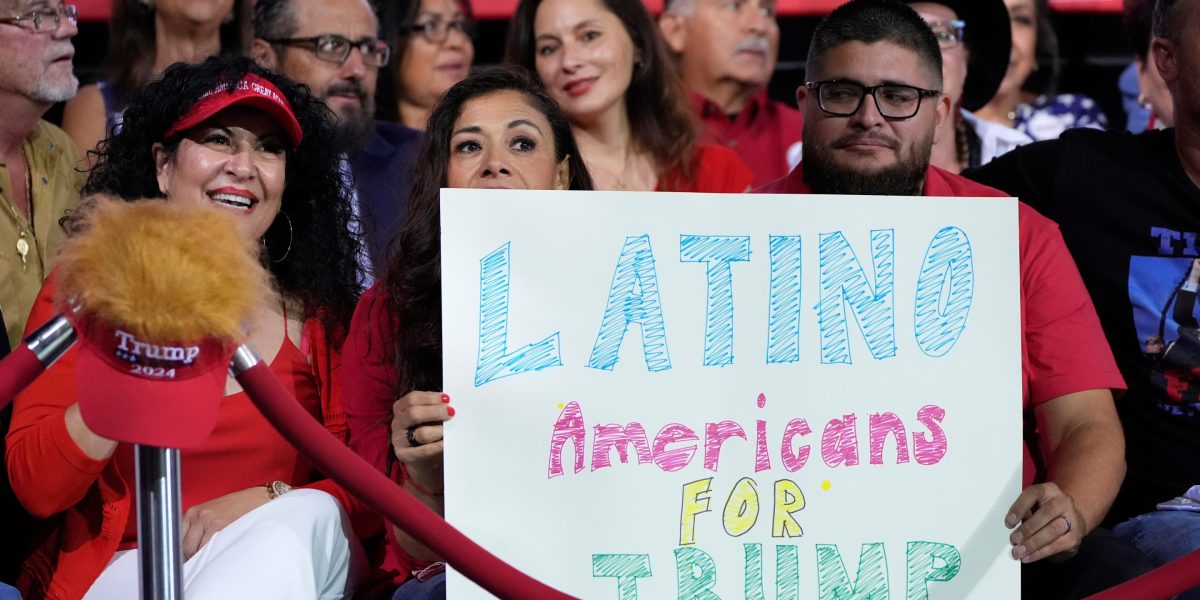
The October survey from The Associated Press-NORC Center for Public Affairs Research finds that 25% of Hispanic adults have a “somewhat” or “very” favorable view of Trump, down from 44% in an AP-NORC poll conducted just before the Republican took office for the second time. The percentage of Hispanic adults who say the country is going in the wrong direction has also increased slightly over the past few months, from 63% in March to 73% now.

The shift could spell trouble for Republicans looking to cement support with this group in future elections. Many Hispanic voters were motivated by economic concerns in last year’s election, and the new poll shows that despite Trump’s promises of economic revitalization, Hispanic adults continue to feel higher financial stress than Americans overall. Hispanic voters made up 10% of the electorate in 2024, according to AP VoteCast, a survey of interviews with registered voters, and the number of eligible Hispanic voters has been growing rapidly in recent decades.

Alejandro Ochoa, 30, is a warehouse worker in Adelanto, California. He identifies as a Republican and voted for Trump last year, but he’s now unhappy with the president. He criticized some of Trump’s budget cuts, adding that the cost of groceries is too high and buying a home is still unattainable for him.

“He was kind of relying on essentially the nostalgia of, ‘Hey, remember, before COVID? Things weren’t as expensive,’” Ochoa said. “But now it’s like, OK, you’re in office. I’m still getting done dirty at the grocery store. I’m still spending an insane amount of money. I’m trying to cut corners where I can, but that bill is still insanely expensive.”

Declining approval on economy and immigration

Hispanic voters shifted toward Trump in the last election, though a majority still backed Democrat Kamala Harris: 43% of Hispanic voters nationally voted for Trump, according to AP VoteCast, up from 35% in the 2020 presidential election, which he lost to Democrat Joe Biden.

But the poll now finds that Hispanic adults are slightly less likely to approve of Trump’s handling of the economy and immigration — two issues that were major strengths for him in last year’s presidential campaign — and their views of his overall presidential performance have slipped a little as well.

In March, 41% of Hispanic adults approved of the way Trump was handling his job as president, but now that has fallen to 27%.

Over the past few months, Hispanic communities have also been a target of the president’s hard-line immigration tactics. The poll found that Hispanic adults’ approval of his handling of immigration has declined slightly since March.

Some see the two issues as linked. Trump’s attacks on immigration have affected low-wage and high-skilled workers alike, at a moment when the economy is already uncertain because of his erratic trade policies.

Fel Echandi, of Winter Haven, Florida, is a behavioral specialist who identifies as a Democrat but sometimes votes for Republican candidates. He said he appreciates Trump’s views on transgender issues, including restroom access for transgender women.

But he’s concerned that Trump’s immigration policies leave many people living in fear, with negative effects on the economy.

“A lot of people rely on immigrants to do labor in certain areas,” Echandi said. “When that gets affected, all prices go up. Our food costs more because of the costs to get people to do that work.”

The poll found particularly high levels of financial stress among Hispanic adults, compared with the rest of the country. More Hispanics say the cost of groceries, housing and health care and the amount of money they get paid are “major” sources of stress, compared with U.S. adults overall.

Favorability among Hispanic Republicans drops slightly

Views of Trump have even soured a little among Hispanic Republicans.

In the latest poll, 66% of Hispanic Republicans said they have a “very” or “somewhat” favorable view of Trump. That’s a slight shift compared with where Trump stood in an AP-NORC poll from September 2024, when 83% of Hispanic Republicans viewed him at least “somewhat” favorably. About 8 in 10 white Republicans had a favorable view of Trump in the new poll, which was unchanged from the year before.

In another potentially worrying sign for the president, younger Hispanics and Hispanic men — two groups that swung particularly dramatically toward him in last year’s election — also see him a bit more negatively.

About two-thirds of Hispanic adults under age 45 and Hispanic men now view Trump unfavorably, according to the new poll. That’s a slight uptick from September 2024, when about half in both groups had a negative opinion of him.

Other concerns about Trump’s chaotic second term emerged in interviews.

Teresa Covarrubias, a 65-year-old retired schoolteacher from Los Angeles, feels things are going in the wrong direction and said she was troubled by how some of Trump’s actions have defied norms and may impact social safety net programs.

“My major concern is the disregard for the Constitution and the law, and then also the level of cronyism,” said Covarrubias, who is an independent voter. “The people at the top are just grifting and taking, and then there’s the rest of us.”

Hispanic adults are more likely to prioritize immigration

There are signs in the poll that Trump’s tough immigration approach may be alienating some Hispanic adults. Over the past few months, the president has doubled down on his pledge of mass deportations, with escalating crackdowns in Latino neighborhoods in cities including Chicago.

The poll found that, in general, Hispanic adults are more likely to say immigration is an important issue to them personally. About two-thirds of Hispanic adults prioritize immigration, compared with about 6 in 10 white adults and about half of Black adults.

And although their views on immigration enforcement aren’t uniform, Hispanic adults are much less likely than U.S. adults overall to favor deporting all immigrants living in the U.S. illegally. About one-quarter of Hispanic adults support this policy, the new poll found, while roughly half of them are opposed and the rest don’t have an opinion. Among U.S. adults overall, about 4 in 10 favor deporting all immigrants in the U.S. illegally, while 34% are opposed and about 2 in 10 don’t have an opinion.

Rick Alvarado, 63, a Republican who lives in San Diego, says he still supports Trump and praised his actions to cut public spending. Alvarado, a property manager, is behind Trump’s immigration crackdown in cities including Los Angeles and Chicago, saying he believes some immigrants are involved in organized crime.

But he added that he would like to see a solution for those without criminal records to obtain legal residency status.

“The people who are productive should have a pathway to stay here somehow,” Alvarado said.

Correction: An earlier version of this post misidentified one of the authors.

___

The AP-NORC poll of 1,289 adults was conducted Oct. 9-13, using a sample drawn from NORC’s probability-based AmeriSpeak Panel, which is designed to be representative of the U.S. population. The margin of sampling error for adults overall is plus or minus 3.8 percentage points. The margin of sampling error for Hispanic adults overall is plus or minus 6.9 percentage points.



Source link

Continue Reading

Business

Mass texts and EZ-Pass phishing: $17 billion stolen in crypto scams, largely by the Chinese

Published

on


EZ-Pass final reminder: you have an outstanding toll. Such texts have become all too familiar to many Americans, and it is a Chinese-backed criminal network that is largely behind them. These scammers are using crypto to steal a record $17 billion from regular people, according to Chainalysis’s recent report

The severity of this fraud has reached the attention of the U.S. government. On Wednesday, Jacqueline Burns Koven, the head of cyber threat intelligence at Chainalysis, spoke in front of the Senate about the increase of this criminal activity, and how the U.S. can combat it. Her testimony was titled, ‘Made in China, Paid by Seniors: Stopping the Surge of International Scams.’

“Scams that leverage cryptocurrency are having a record year in terms of proceeds,” Burns Koven said, in an interview with Fortune. “The Chinese scam conglomerates are the market leaders in criminal fintech. They’ve been doing this for a long time.” 

The estimated $17 billion received in crypto scams is up from about 30% from last year, according to the report. These operations have become increasingly sophisticated and include the use of AI-generated deepfakes. Crypto is an essential part of the operation because the criminals frequently use digital currencies to finance their scamming operations, such as purchasing tools like SMS phishing kits. 

Nefarious actors have leaned heavily on impersonation techniques, where they pose as legitimate organizations to coerce victims into paying digitally. The most well-known example of this is the EZ-Pass phishing campaign, which targeted millions of Americans. The operation was traced back to a Chinese-speaking criminal group called “Darcula”, which also has a history of impersonating the USPS. 

While 2025 also saw a record number of crypto seizures by law enforcement, Burns Koven says that government and industry responses are still fragmented and reactive. Just as criminals are using advanced technology for scams, both the public and private sector could use AI to block these messages from appearing on people’s phones. Also, with criminals using crypto to facilitate these scams and because these transactions are public on the blockchain, this makes it easier to identify criminal networks and disrupt activity.  

“Scammers are taking advantage of the disjointed and reactive responses from both the public and private sector,” she said. “We need to use advanced technologies like AI enabled fraud prevention, to prevent a human being from ever being in contact with that scam in the first place.”

Fraud usually never sleeps, but these Chinese criminal networks actually do take breaks. Chainalysis and other researchers found a dip in criminal activity during the Chinese New Year and other of the country’s public holidays. 


Source link

Continue Reading

Business

Fortune Article | Fortune

Published

on


The European Union’s top official on Tuesday described U.S. President Donald Trump’s planned new tariffs over Greenland as “a mistake especially between long-standing allies” and called into question Trump’s trustworthiness, while French President Emmanuel Macron said the bloc shouldn’t hesitate to use a powerful tool in retaliation.

European Commission President Ursula von der Leyen was responding to Trump’s announcement that starting February, a 10% import tax will be imposed on goods from eight European nations that have rallied around Denmark in the wake of his escalating calls for the United States to take over the semi-autonomous Danish territory of Greenland.

“The European Union and the United States have agreed to a trade deal last July,” Von der Leyen said at the World Economic Forum in Davos, Switzerland. “And in politics as in business – a deal is a deal. And when friends shake hands, it must mean something.”

“We consider the people of the United States not just our allies, but our friends. And plunging us into a downward spiral would only aid the very adversaries we are both so committed to keeping out of the strategic landscape,” she added.

She vowed that the EU’s response “will be unflinching, united and proportional.”

Trump has insisted the U.S. needs the territory for security reasons against possible threats from China and Russia.

Earlier Tuesday, U.S. Treasury Secretary Scott Bessent said America’s relations with Europe remain strong and urged trading partners to “take a deep breath” and let tensions driven the new tariff threats over Greenland “play out.”

“I think our relations have never been closer,” he said.

But Danish Prime Minister Mette Fredriksen, speaking in the Danish parliament, said that “the worst may still be ahead of us.” She said that “we have never sought conflict. We have consistently sought cooperation.”

Trump’s threats spark diplomatic flurry across Europe

The American leader’s threats have sparked outrage and a flurry of diplomatic activity across Europe, as leaders consider possible countermeasures, including retaliatory tariffs and the first-ever use of the European Union’s anti-coercion instrument.

The EU has three major economic tools it could use to pressure Washington: new tariffs, suspension of the U.S.-EU trade deal, and the “trade bazooka” — the unofficial term for the bloc’s Anti-Coercion Instrument, which could sanction individuals or institutions found to be putting undue pressure on the EU.

Macron said in Davos that “the anti-coercion mechanism is a powerful instrument and we should not hesitate to deploy it in today’s tough environment.” He pushed back against aggressive U.S. trade pressures and “an endless accumulation of new tariffs.”

Earlier Tuesday, Trump posted on social media that he had spoken with NATO Secretary General Mark Rutte. He said “I agreed to a meeting of the various parties in Davos, Switzerland.”

France’s Macron suggests G-7 meeting in Paris this week

Trump also posted a text message from Emmanuel Macron in which the French president suggested a meeting of members of the Group of Seven industrialized democracies in Paris after the Davos gathering. An official close to Macron, who spoke anonymously in line with the French presidency’s customary practices, confirmed the message shared by Trump is genuine.

Later, Trump posted some provocatively doctored images. One showed him planting the U.S. flag next to a sign reading “Greenland, U.S. Territory, Est. 2026.” The other showed Trump in the Oval Office next to a map that showed Greenland and Canada covered with the U.S. Stars and Stripes.

In a sign of how tensions have increased in recent days, thousands of Greenlanders marched over the weekend in protest of any effort to take over their island.

In his latest threat of tariffs, Trump indicated that the import taxes would be retaliation for last week’s deployment of symbolic numbers of troops from the European countries to Greenland — though he also suggested that he was using the tariffs as leverage to negotiate with Denmark.

Calls for a stronger Europe against Trump’s threats

Denmark’s minister for European affairs called Trump’s tariff threats “deeply unfair.” He said that Europe needs to become even stronger and more independent, while stressing there is “no interest in escalating a trade war.”

“You just have to note that we are on the edge of a new world order, where having power has unfortunately become crucial, and we see a United States with an enormous condescending rhetoric towards Europe,” Marie Bjerre told Danish public broadcaster DK on Tuesday.

Speaking on the sidelines of Davos, California Gov. Gavin Newsom slammed Europe’s response to Trump’s tariff threats as “pathetic” and “embarrassing,” and urged European leaders to unite and stand up to the United States.

“It is time to get serious, and stop being complicit,” Newsom told reporters. “It’s time to stand tall and firm, have a backbone.”

On Monday night, Greenland’s European backers looked at establishing a more permanent military presence in the High North to help guarantee security in the Arctic region, a key demand of the United States, Swedish Defense Minister Pål Jonson said.

Jonson said after talks with his counterparts from Denmark, Greenland and Norway that European members of NATO are currently “doing what’s called a reconnaissance tour in order to identify what kind of needs there are when it comes to infrastructure and exercises and so forth.”

In Moscow, Russian Foreign Minister Sergey Lavrov strongly denied any intention by Russia and China to threaten Greenland, while also describing Greenland as a “colonial gain” for Denmark. At a news conference, he said that “in principle, Greenland isn’t a natural part of Denmark.”

US-UK tensions over Chagos Islands

In another sign of tension between allies, the British government on Tuesday defended its decision to hand sovereignty of the Chagos Islands to Mauritius after Trump attacked the plan, which his administration previously supported.

Trump said that relinquishing the remote Indian Ocean archipelago, home to a strategically important American naval and bomber base, was an act of stupidity that shows why he needs to take over Greenland.

In a speech to lawmakers at Britain’s Parliament on Tuesday, U.S. House of Representatives Speaker Mike Johnson said he hoped to “calm the waters” as Trump roils the trans-Atlantic relationship with his desire to take over Greenland.

Johnson said the U.S. and the U.K. “have always been able to work through our differences calmly, as friends. We will continue to do that.”

___

AP writers Sylvie Corbet in Paris, Jill Lawless in London, Lorne Cook in Brussels, and Elaine Kurtenbach in Bangkok contributed to this report.


Source link

Continue Reading

Business

IWG CEO warns a 4-day week isn’t coming any time soon, despite what Bill Gates and Elon Musk say

Published

on


Billionaire Microsoft cofounder Bill Gates, JPMorgan CEO Jamie Dimon, Nvidia’s boss Jensen Huang, and Elon Musk have all made the same prediction in recent years: The workweek is about to shrink. Automation will take over routine tasks, they argue, freeing workers’ time and pushing a four-day work week toward becoming standard. Gates has even floated the idea of a two-day workweek.

But Mark Dixon, CEO and founder of International Workplace Group (IWG) CEO isn’t buying it. From his vantage point, running the world’s largest flexible office provider—with more than 8 million users across 122 countries and 85% of the Fortune 500 among its customers—the math doesn’t add up.

“Everyone is focused on productivity, so no time soon,” Dixon says flatly.

“It’s about the cost of labor,” Dixon explains to Fortune. The U.S. and U.K. are experiencing significant cost-of-living crises. At the same time, he says, businesses are experiencing a “cost of operating crisis.” 

“Everyone’s having to control their labor costs because all costs have gone up so much, and you can’t get any more money from customers, so therefore you have to get more out of people.”

Essentially, companies can’t afford to pay the same wages for fewer hours, and they can’t pass the difference on to customers. So any time ‘freed’ by automation is far more likely to be filled with new tasks than handed back to workers. 

Elon Musk says work will be optional in the future—but this CEO says AI may create more work, not less

Silicon Valley’s loudest voices frame AI as a route to more leisure. The world’s richest person and the boss of Space X, Tesla and X, Elon Musk has gone as far as predicting work will be completely “optional” and more like a hobby, in as little as 10 years. 

In reality, Dixon suggests that this scenario would only happen if there’s not enough work to go around, rather than bosses suddenly becoming benevolent. But in his eyes, AI will most likely create more—not less—work. 

Every major technological shift, he argues, has followed a similar arc: fear of displacement, followed by an expansion of opportunity.

“AI will speed up companies’ development, so there’ll be more work, it’ll just be different work,” he says.

In 19th-century Britain, Dixon recalls English textile workers protesting against new automated machinery, fearing it threatened their livelihoods, lowered wages, and de-skilled their craft during the Industrial Revolution. They were called Luddites.

“They went around the country smashing up the looms to stop progress. But look, in the end, you’ve heard of the Industrial Revolution. That’s what came from those looms and factory production.” As mass production made goods more available, retail grew; more managers were needed to oversee the machines; the middle class grew, and so on. 

Likewise, there was a similar palpable fear when computers first burst on the scene in the 1980s. The 1996 book Women and Computers detailed people fearing becoming “a slave” to machines and feeling aggressive towards computers.”

But since the explosion of the PC (and then the internet, the Cloud, social media, and so on), most professions have undergone a digital rebrand—instead of disappearing altogether. 

Copywriters now use laptops instead of typewriters; designers rely on Adobe Photoshop instead of pen and paper; and a plethora of IT roles were created along the way. 

“It’s impossible to stop progress,” Dixon concludes.  

“Companies have to do what companies have to do, and it’s really important for young people coming into the marketplace to work a little bit harder on really selecting the right jobs, the right avenue, getting extra skills in things like AI. Whatever job you’re going to do, you’ve got to be good at tech.”


Source link

Continue Reading

Trending

Copyright © Miami Select.