Connect with us

Business

‘Not the MAHA that we signed up for’: Robert F. Kennedy Jr. learns the perils of power and keeping his grassroots movement together

Published

on


Yet online, a different narrative of his tenure was playing out as a small but vocal group of Kennedy’s supporters and former employees assailed top Trump administration advisers, claiming they were sabotaging him and redirecting MAHA away from its original goals.

“MAHA is not MAHA anymore,” Gray Delany, a former Department of Health and Human Services official ousted in August, said in a podcast interview that day. “I’m not there, but what I’ve heard of what’s happening today is not the MAHA that we signed up for.”

The criticisms, which grew loud enough that the health secretary took to social media to defend his colleagues two days later, exposed the cracks that are beginning to form within his coalition as it amasses power and broadens in scope.

Several of the environmental advocates and vaccine skeptics who helped propel Kennedy into politics have become impatient with what they view as inadequate action on their priorities. They’re also wary that the Health Department appears willing to collaborate with pharmaceutical companies, tech firms and other big corporations whose motives they don’t trust.

The fissures pose a threat to the cohesion of a movement that has given President Donald Trump an important ally and Republicans access to a new group of voters. They come as cracks have developed in Trump’s own Make America Great Again movement over issues like the Epstein files and the White House’s focus on global diplomacy.

In the wider public, MAHA has enjoyed soaring popularity. About two-thirds of Americans said they supported the “Make America Healthy Again” initiative from the federal government, according to an Ipsos poll from June.

“MAHA’s growth is a sign of its success,” said HHS spokesperson Andrew Nixon. “Secretary Kennedy is leading a broad coalition to make Americans healthier, guided by transparency, accountability and measurable results. The movement’s meaning hasn’t changed and it’s stronger than ever.”

Public health researchers say the genius that fuels Kennedy’s movement — the universal appeal of making Americans healthier — can also cause conflicts by inviting competing interests.

“This is a tale as old as time in politics,” said Matt Motta, a professor at Boston University School of Public Health. “The bigger your tent is, the harder it can be to make everyone happy.”

Frustration rises from within

Kennedy, a longtime environmental lawyer and anti-vaccine activist who helped lead the crusade against COVID-19 shots during the pandemic, has taken many steps to curtail vaccines this year. He pulled $500 million for their development, ousted and replaced every member of a federal vaccine advisory committee and pledged to overhaul a federal program for compensating Americans injured by shots. He also has repeatedly spread false and misleading information about vaccines while in office.

As recently as this week, in a move that thrilled Kennedy’s anti-vaccine base, the Centers for Disease Control and Prevention changed its website to contradict the longtime scientific conclusion that vaccines do not cause autism.

But many of Kennedy’s supporters in what they call the “health freedom” movement say it’s not enough. Some want punishments for companies that profited from vaccine and mask requirements during the pandemic. Others want mRNA-based COVID-19 shots pulled from the shelves, despite scientific consensus that they have saved millions of lives.

In their attacks on the administration last week, a few MAHA influencers and two fired HHS employees suggested White House chief of staff Susie Wiles and Kennedy’s close adviser, Stefanie Spear, were conspiring to limit Kennedy’s ability to restrict vaccines and crack down on pharmaceutical companies.

Some Kennedy supporters latched on to the claims and pointed to Wiles’ career history at a lobbying firm that has worked with Pfizer as evidence she’s trying to undermine him. They also shared years-old social media posts from Spear criticizing Trump.

Kennedy defended his colleagues in two posts on X, saying the MAHA movement has “no better friend in Washington” than Wiles and that Spear has become a Trump loyalist.

“Let’s focus on our extraordinary achievements to date and the monumental work that still needs to be done,” Kennedy wrote. “Let’s build our coalition instead of splintering it.”

The meaning of MAHA now depends on whom you ask

Since the “Make America Healthy Again” slogan debuted on the campaign trail last year, Kennedy and Trump have widened the MAHA tent considerably by inviting anyone into the fold who has concerns about Americans’ health, nutrition and chronic disease.

That’s attracted a diverse crowd, including moneyed interests — among them health data startups, artificial intelligence firms, drug manufacturers and even fast-food companies. Steak ’n Shake recently promoted its fries cooked in beef tallow, saying it was “proud to be part of the MAHA movement.”

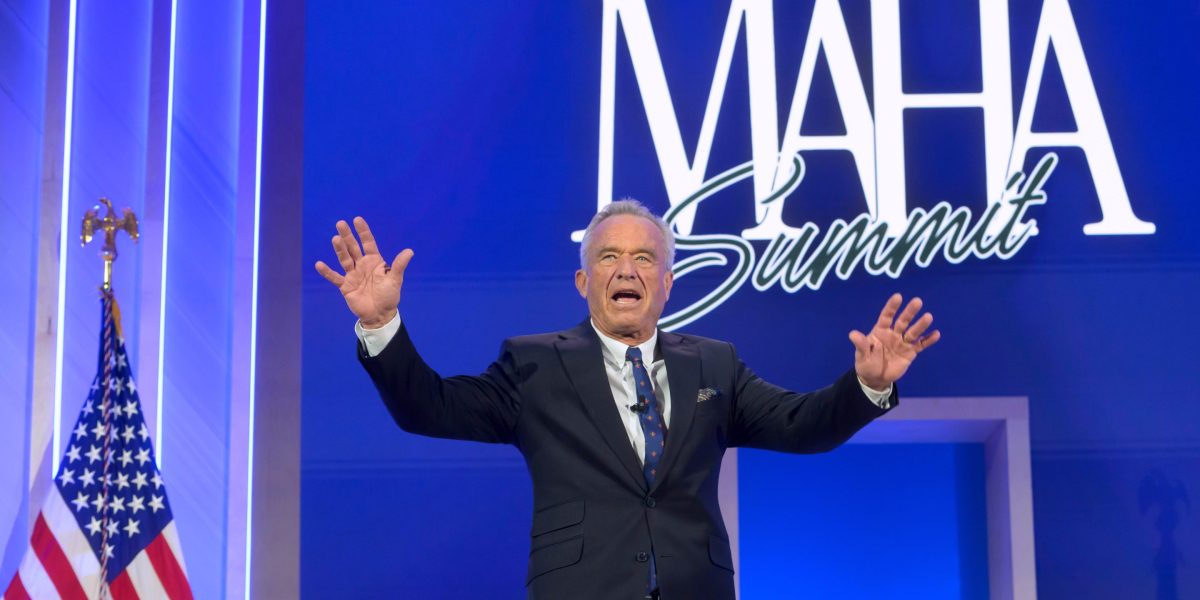
At the recent MAHA event in Washington, hosted by the pro-Kennedy group MAHA Action, Kennedy and other federal health officials appeared on a stage that was occupied throughout the day by biotech companies like CRISPR Therapeutics and Regeneron, the brain-computer interface company Neuralink and various AI companies and health startups. The invitation list raised flags for some longtime Kennedy supporters.

“I was not thrilled about some of the people who were there,” said Leslie Manookian, president and founder of the Health Freedom Defense Fund, a nonprofit that promotes bodily autonomy. “I don’t think that we make America healthy again through pills, creams, injections, pharmaceuticals, chips, monitors, devices.”

Tony Lyons, president of MAHA Action, told The Associated Press that the MAHA movement’s strength “comes from its openness to ideas, from its dedication to including all voices, all perspectives, more dialogue, more fierce debate.”

“We don’t want to exclude anyone,” he said. “We don’t want to censor anyone.”

Ethan Augreen, who led Colorado’s volunteer effort for Kennedy’s presidential campaign last year, said he was concerned both by speakers at the event and by a recent Kennedy social media post about meeting with tech leaders to talk about personal health data.

He said he hoped Kennedy would fight corruption in America’s health care system and remove mRNA COVID-19 vaccines from the market.

“There’s definitely some alarm bells going,” Augreen said. “Grassroots MAHA people definitely don’t trust these corporations, and it’s not really apparent whether the administration is just getting in bed with them or really holding their feet to the fire.”

Kennedy and his team thread a needle on the MAHA message

At a recent Oval Office meeting, Kennedy stood with Trump and other administration leaders as they touted a deal with drugmakers Eli Lilly and Novo Nordisk to expand coverage and reduce the prices of weight-loss drugs.

Kennedy had previously expressed skepticism about GLP-1 weight-loss medications and has said he wants to focus on the root causes of disease instead of medicating the public. But he praised the deal, even as he was careful to add it wasn’t a “silver bullet.”

Dr. Mehmet Oz, the administrator of the Centers for Medicare and Medicaid Services, said during the MAHA event that scrutiny of it from Kennedy’s base was “understandable.” He defended the administration as using Trump’s negotiation playbook instead of going “head-to-head with adversaries.”

Several of Kennedy’s core supporters said they see the government as a deeply entrenched bureaucracy that won’t be easy to reform, even as they hope he’ll be able to remove toxins from food and the environment and further restrict vaccines. Kennedy, at an appearance with western governors Thursday, said he doesn’t intend to take away people’s access to vaccines.

Jeffrey Tucker, founder of the nonprofit Brownstone Institute who has rallied support behind Kennedy, said MAHA activists are idealistic but at times naive about the difficulty of government reform.

“It’s very important to hold on to your ideals,” he said. “But if you’re doing nothing but throwing rocks, then you can become a problem.”

Motta, the professor, said regardless of where MAHA goes next, it’s already bigger than any singular policy position.

“Identities do not go away easily,” he said. “They are deeply held; they are deeply integrated into our sense of self. And I would be shocked if this was a movement that faded.”

___

Associated Press writer Linley Sanders contributed to this report from Washington.


Source link

Continue Reading

Business

Netflix–Warner Bros. deal sets up $72 billion antitrust test

Published

on


Netflix Inc. has won the heated takeover battle for Warner Bros. Discovery Inc. Now it must convince global antitrust regulators that the deal won’t give it an illegal advantage in the streaming market. 

The $72 billion tie-up joins the world’s dominant paid streaming service with one of Hollywood’s most iconic movie studios. It would reshape the market for online video content by combining the No. 1 streaming player with the No. 4 service HBO Max and its blockbuster hits such as Game Of ThronesFriends, and the DC Universe comics characters franchise.  

That could raise red flags for global antitrust regulators over concerns that Netflix would have too much control over the streaming market. The company faces a lengthy Justice Department review and a possible US lawsuit seeking to block the deal if it doesn’t adopt some remedies to get it cleared, analysts said.

“Netflix will have an uphill climb unless it agrees to divest HBO Max as well as additional behavioral commitments — particularly on licensing content,” said Bloomberg Intelligence analyst Jennifer Rie. “The streaming overlap is significant,” she added, saying the argument that “the market should be viewed more broadly is a tough one to win.”

By choosing Netflix, Warner Bros. has jilted another bidder, Paramount Skydance Corp., a move that risks touching off a political battle in Washington. Paramount is backed by the world’s second-richest man, Larry Ellison, and his son, David Ellison, and the company has touted their longstanding close ties to President Donald Trump. Their acquisition of Paramount, which closed in August, has won public praise from Trump. 

Comcast Corp. also made a bid for Warner Bros., looking to merge it with its NBCUniversal division.

The Justice Department’s antitrust division, which would review the transaction in the US, could argue that the deal is illegal on its face because the combined market share would put Netflix well over a 30% threshold.

The White House, the Justice Department and Comcast didn’t immediately respond to requests for comment. 

US lawmakers from both parties, including Republican Representative Darrell Issa and Democratic Senator Elizabeth Warren have already faulted the transaction — which would create a global streaming giant with 450 million users — as harmful to consumers.

“This deal looks like an anti-monopoly nightmare,” Warren said after the Netflix announcement. Utah Senator Mike Lee, a Republican, said in a social media post earlier this week that a Warner Bros.-Netflix tie-up would raise more serious competition questions “than any transaction I’ve seen in about a decade.”

European Union regulators are also likely to subject the Netflix proposal to an intensive review amid pressure from legislators. In the UK, the deal has already drawn scrutiny before the announcement, with House of Lords member Baroness Luciana Berger pressing the government on how the transaction would impact competition and consumer prices.

The combined company could raise prices and broadly impact “culture, film, cinemas and theater releases,”said Andreas Schwab, a leading member of the European Parliament on competition issues, after the announcement.

Paramount has sought to frame the Netflix deal as a non-starter. “The simple truth is that a deal with Netflix as the buyer likely will never close, due to antitrust and regulatory challenges in the United States and in most jurisdictions abroad,” Paramount’s antitrust lawyers wrote to their counterparts at Warner Bros. on Dec. 1.

Appealing directly to Trump could help Netflix avoid intense antitrust scrutiny, New Street Research’s Blair Levin wrote in a note on Friday. Levin said it’s possible that Trump could come to see the benefit of switching from a pro-Paramount position to a pro-Netflix position. “And if he does so, we believe the DOJ will follow suit,” Levin wrote.

Netflix co-Chief Executive Officer Ted Sarandos had dinner with Trump at the president’s Mar-a-Lago resort in Florida last December, a move other CEOs made after the election in order to win over the administration. In a call with investors Friday morning, Sarandos said that he’s “highly confident in the regulatory process,” contending the deal favors consumers, workers and innovation. 

“Our plans here are to work really closely with all the appropriate governments and regulators, but really confident that we’re going to get all the necessary approvals that we need,” he said.

Netflix will likely argue to regulators that other video services such as Google’s YouTube and ByteDance Ltd.’s TikTok should be included in any analysis of the market, which would dramatically shrink the company’s perceived dominance.

The US Federal Communications Commission, which regulates the transfer of broadcast-TV licenses, isn’t expected to play a role in the deal, as neither hold such licenses. Warner Bros. plans to spin off its cable TV division, which includes channels such as CNN, TBS and TNT, before the sale.

Even if antitrust reviews just focus on streaming, Netflix believes it will ultimately prevail, pointing to Amazon.com Inc.’s Prime and Walt Disney Co. as other major competitors, according to people familiar with the company’s thinking. 

Netflix is expected to argue that more than 75% of HBO Max subscribers already subscribe to Netflix, making them complementary offerings rather than competitors, said the people, who asked not to be named discussing confidential deliberations. The company is expected to make the case that reducing its content costs through owning Warner Bros., eliminating redundant back-end technology and bundling Netflix with Max will yield lower prices.


Source link

Continue Reading

Business

The rise of AI reasoning models comes with a big energy tradeoff

Published

on


Nearly all leading artificial intelligence developers are focused on building AI models that mimic the way humans reason, but new research shows these cutting-edge systems can be far more energy intensive, adding to concerns about AI’s strain on power grids.

AI reasoning models used 30 times more power on average to respond to 1,000 written prompts than alternatives without this reasoning capability or which had it disabled, according to a study released Thursday. The work was carried out by the AI Energy Score project, led by Hugging Face research scientist Sasha Luccioni and Salesforce Inc. head of AI sustainability Boris Gamazaychikov.

The researchers evaluated 40 open, freely available AI models, including software from OpenAI, Alphabet Inc.’s Google and Microsoft Corp. Some models were found to have a much wider disparity in energy consumption, including one from Chinese upstart DeepSeek. A slimmed-down version of DeepSeek’s R1 model used just 50 watt hours to respond to the prompts when reasoning was turned off, or about as much power as is needed to run a 50 watt lightbulb for an hour. With the reasoning feature enabled, the same model required 7,626 watt hours to complete the tasks.

The soaring energy needs of AI have increasingly come under scrutiny. As tech companies race to build more and bigger data centers to support AI, industry watchers have raised concerns about straining power grids and raising energy costs for consumers. A Bloomberg investigation in September found that wholesale electricity prices rose as much as 267% over the past five years in areas near data centers. There are also environmental drawbacks, as Microsoft, Google and Amazon.com Inc. have previously acknowledged the data center buildout could complicate their long-term climate objectives

More than a year ago, OpenAI released its first reasoning model, called o1. Where its prior software replied almost instantly to queries, o1 spent more time computing an answer before responding. Many other AI companies have since released similar systems, with the goal of solving more complex multistep problems for fields like science, math and coding.

Though reasoning systems have quickly become the industry norm for carrying out more complicated tasks, there has been little research into their energy demands. Much of the increase in power consumption is due to reasoning models generating much more text when responding, the researchers said. 

The new report aims to better understand how AI energy needs are evolving, Luccioni said. She also hopes it helps people better understand that there are different types of AI models suited to different actions. Not every query requires tapping the most computationally intensive AI reasoning systems.

“We should be smarter about the way that we use AI,” Luccioni said. “Choosing the right model for the right task is important.”

To test the difference in power use, the researchers ran all the models on the same computer hardware. They used the same prompts for each, ranging from simple questions — such as asking which team won the Super Bowl in a particular year — to more complex math problems. They also used a software tool called CodeCarbon to track how much energy was being consumed in real time.

The results varied considerably. The researchers found one of Microsoft’s Phi 4 reasoning models used 9,462 watt hours with reasoning turned on, compared with about 18 watt hours with it off. OpenAI’s largest gpt-oss model, meanwhile, had a less stark difference. It used 8,504 watt hours with reasoning on the most computationally intensive “high” setting and 5,313 watt hours with the setting turned down to “low.” 

OpenAI, Microsoft, Google and DeepSeek did not immediately respond to a request for comment.

Google released internal research in August that estimated the median text prompt for its Gemini AI service used 0.24 watt-hours of energy, roughly equal to watching TV for less than nine seconds. Google said that figure was “substantially lower than many public estimates.” 

Much of the discussion about AI power consumption has focused on large-scale facilities set up to train artificial intelligence systems. Increasingly, however, tech firms are shifting more resources to inference, or the process of running AI systems after they’ve been trained. The push toward reasoning models is a big piece of that as these systems are more reliant on inference.

Recently, some tech leaders have acknowledged that AI’s power draw needs to be reckoned with. Microsoft CEO Satya Nadella said the industry must earn the “social permission to consume energy” for AI data centers in a November interview. To do that, he argued tech must use AI to do good and foster broad economic growth.


Source link

Continue Reading

Business

SpaceX to offer insider shares at record-setting valuation

Published

on


SpaceX is preparing to sell insider shares in a transaction that would value Elon Musk’s rocket and satellite maker at a valuation higher than OpenAI’s record-setting $500 billion, people familiar with the matter said.

One of the people briefed on the deal said that the share price under discussion is higher than $400 apiece, which would value SpaceX at between $750 billion and $800 billion, though the details could change. 

The company’s latest tender offer was discussed by its board of directors on Thursday at SpaceX’s Starbase hub in Texas. If confirmed, it would make SpaceX once again the world’s most valuable closely held company, vaulting past the previous record of $500 billion that ChatGPT owner OpenAI set in October. Play Video

Preliminary scenarios included per-share prices that would have pushed SpaceX’s value at roughly $560 billion or higher, the people said. The details of the deal could change before it closes, a third person said. 

A representative for SpaceX didn’t immediately respond to a request for comment. 

The latest figure would be a substantial increase from the $212 a share set in July, when the company raised money and sold shares at a valuation of $400 billion.

The Wall Street Journal and Financial Times, citing unnamed people familiar with the matter, earlier reported that a deal would value SpaceX at $800 billion.

News of SpaceX’s valuation sent shares of EchoStar Corp., a satellite TV and wireless company, up as much as 18%. Last month, Echostar had agreed to sell spectrum licenses to SpaceX for $2.6 billion, adding to an earlier agreement to sell about $17 billion in wireless spectrum to Musk’s company.

Subscribe Now: The Business of Space newsletter covers NASA, key industry events and trends.

The world’s most prolific rocket launcher, SpaceX dominates the space industry with its Falcon 9 rocket that launches satellites and people to orbit.

SpaceX is also the industry leader in providing internet services from low-Earth orbit through Starlink, a system of more than 9,000 satellites that is far ahead of competitors including Amazon.com Inc.’s Amazon Leo.

SpaceX executives have repeatedly floated the idea of spinning off SpaceX’s Starlink business into a separate, publicly traded company — a concept President Gwynne Shotwell first suggested in 2020. 

However, Musk cast doubt on the prospect publicly over the years and Chief Financial Officer Bret Johnsen said in 2024 that a Starlink IPO would be something that would take place more likely “in the years to come.”

The Information, citing people familiar with the discussions, separately reported on Friday that SpaceX has told investors and financial institution representatives that it is aiming for an initial public offering for the entire company in the second half of next year.

A so-called tender or secondary offering, through which employees and some early shareholders can sell shares, provides investors in closely held companies such as SpaceX a way to generate liquidity.

SpaceX is working to develop its new Starship vehicle, advertised as the most powerful rocket ever developed to loft huge numbers of Starlink satellites as well as carry cargo and people to moon and, eventually, Mars.


Source link

Continue Reading

Trending

Copyright © Miami Select.