Business
No ‘job apocalypse’: Goldman Sachs CEO denies the AI hiring nightmare is real
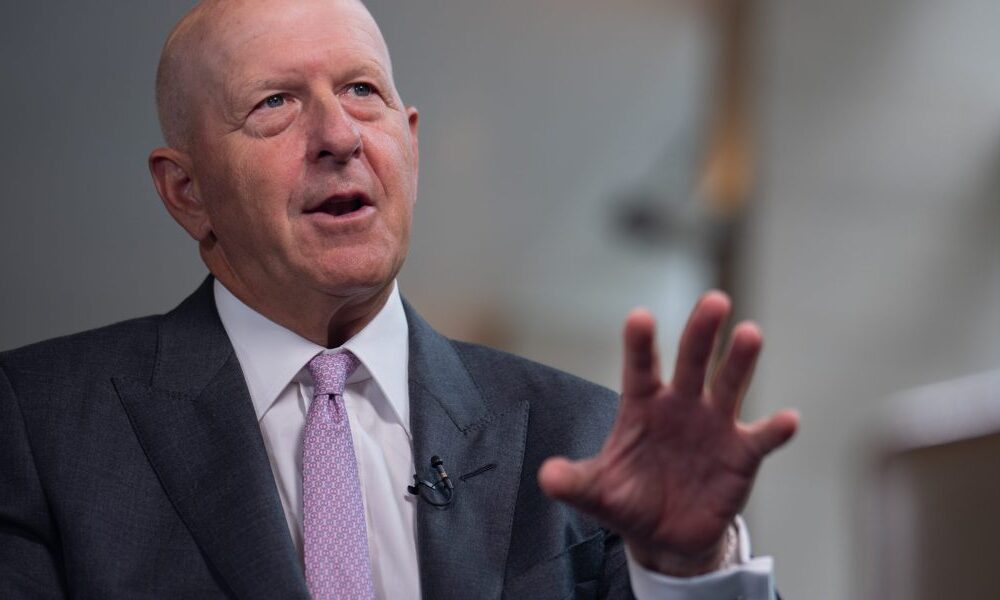
As fears mount that artificial intelligence is ushering in an era of “jobless growth,” Goldman Sachs Chairman and CEO David Solomon is offering a staunch rebuttal to the doomsayers. Speaking in January, amid a massive capital investment boom in AI infrastructure, Solomon insisted the labor market is not facing a catastrophe.
“I’m not in the job apocalypse camp,” Solomon told the Goldman Sachs Exchanges podcast, rejecting the narrative that the current technological wave represents a fundamental threat to human employment.
While acknowledging the labor market has looked fragile relative to recent economic growth, Solomon argued the current disruption is just more of the normal course of creative destruction, rather than structurally unique.
“Technology has been disrupting jobs, changing the way people work, destroying jobs, and forcing us as a vibrant economy to create new jobs for decades,” he said. “It’s no different this time,” he stated.
He cited research from Goldman Sachs Chief Economist Jan Hatzius, noting that while short-term dislocation is inevitable due to the speed of change, there is no evidence of a structurally higher level of long-term unemployment.
Reimagining the firm: one GS 3.0
Solomon applied this philosophy to his own bank, detailing a new initiative dubbed “One GS 3.0.” Far from a layoff strategy, Solomon described the program as an effort to “reimagine” six core processes—such as “onboarding and know your customer”(KYC)—through automation and white-paper redesigns.
“We think [these processes] can really benefit from a fresh kind of white paper look and automation,” he said, “because the technology that exists today allows us to do them a different way.”
According to Solomon, the goal of AI integration at Goldman Sachs is not headcount reduction, but capacity expansion. “If we get this right, I don’t think it significantly lowers the number of people we have,” Solomon said. Instead, the efficiency gains will provide the “capacity to invest in growth” the firm previously lacked due to constraints.
However, the CEO conceded the transition is difficult. While employees are quick to adopt productivity tools that make them “smarter,” completely overhauling legacy workflows like KYC is a heavier lift. “Changing processes in a big enterprise is hard work. And it’s going to take some time,” he warned, noting this friction involves fundamentally changing the “human capital we use around that process.”
Solomon’s comments here aligned with recent research from Wharton professor Peter Cappelli, who told Fortune earlier this month AI adoption is neither cheap, nor easy, nor a surefire route to cutting headcount. In one case, a company called Ricoh adopted AI and was able to reach three times the productivity, but it took a year to break even due to a $200,000 monthly carrying cost and a $500,000 upfront consulting fee.
“It’s not cheap [and] it took a hell of a long time to do,” Cappelli said.
A reality check on speed
Despite his long-term optimism, Solomon offered a tempered forecast for 2026 regarding the pace of AI adoption in the corporate world. While dismissing the idea the AI theme is “losing steam”—calling it “unbelievable technology”—he predicted a potential recalibration of expectations in the coming year.
“It’s going to keep accelerating,” Solomon predicted. “The pace of capital investment is going to continue. Whether the demand, the take-up for the compute will be as quick and people can get it into the enterprises quickly as people are now expecting, I think that’s a place where you could see recalibrations during the year.”
Sometime in 2026, Solomon added, there could be a general realization that deploying AI in the enterprise will be harder than people thought at first. Consequently, implementation might go “slower than people now think” as companies grapple with the complexities of integration.
On the first day of the World Economic Forum annual meeting in Davos, Switzerland, Microsoft CEO Satya Nadella sounded a similar tone. The AI story could well turn into a bubble, Nadella acknowledged for the first time ever, and it would have little or nothing to do with tech companies.
“A telltale sign of if it’s a bubble would be if all we are talking about are the tech firms,” Nadella told WEF interim co-chair Larry Fink. “If all we talk about is what’s happening to the technology side, then it’s just purely supply side.” Adoption will have to be widespread and successful from the demand side, he argued, in a way similar to the computing revolution of the 1980s.
“We invented this entire class of thing called knowledge work, where people started really using computers to amplify what we were trying to achieve using software,” he said. “I think in the context of AI, that same thing is going to happen.”
Solomon’s comments come against a backdrop of a “huge capital investment boom because of AI infrastructure,” which he identifies as a key pillar of the supportive macro setup for 2026. He said he remained bullish on the productivity gains AI will deliver, not just in finance, but across sectors like health care.
“I think the opportunity set’s expanding, not contracting at this point,” Solomon concluded. He pointed to the potential for technology to shift outcomes in disease and cancer treatment as reasons to remain optimistic about the “growth-oriented period” the global economy has entered.
In this regard, Solomon sounded like Nvidia CEO Jensen Huang, whose own interview in Davos with Fink came with a dismissal of AI bubble fears, set against the backdrop of “the largest infrastructure buildout in human history.” Huang argued the the AI industry is a “five-layer cake” requiring total industrial reinvention, with the bottom layer being energy, and the second layer being chips like Nvidia’s GPUs. Next come cloud infrastructure, models, and applications, respectively. The opportunity set is expanding if you believe in this new layer-cake structure, as Solomon and Huang clearly do.