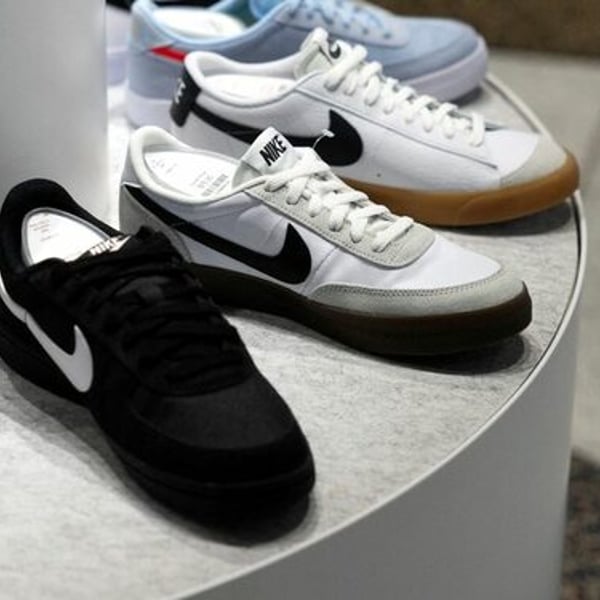
Following its stronger-than-expected Q1 results, Nike’s leadership and analysts discussed the road ahead amid inventory cleanup, challenges in China, and a renewed focus on sports.
Turnaround gains traction at Nike, though challenges persist – Reuters
Nike CEO Elliott Hill vowed to return the company to its sportswear roots when he took the helm last year in a highly anticipated change, and his efforts are bearing fruit — but a sluggish recovery in China and uncertainty over tariffs remain a drag on the company.
The company, which reported a surprise rise in quarterly revenue, has aggressively cleared out aged inventory, as well as some lifestyle product lines, to focus on more innovative shoes centered on sport.
“Nike is in the early innings of its turnaround and momentum is building,” said Jefferies analyst Randal Konik in a note.
The company said on Tuesday that its order book for spring was up year-over-year, driven by its sports category, as launches such as the Vomero, Pegasus, and P-6000 running shoes bring back customers.
Running, training, and basketball categories each reported double-digit growth in the quarter in North America, enabling a return to sales growth in the region after about a year.
“We think retailers — like the combined Foot Locker and Dick’s Sporting Goods — are reacting positively to Nike’s new running shoe lineup,” said Morningstar analyst David Swartz.
Nike’s shares were up about 3% in premarket trading on Wednesday as investors welcomed a 2% reduction in inventory.
“I am very pleased with inventory levels. Units are down more than dollars as inflation starts to come through. They have largely cleared through older franchises,” said Mari Shor, senior equities analyst at Columbia Threadneedle.
The pressure points
Progress will not be linear, Hill warned on a post-earnings call, with tariffs now expected to cost about $1.5 billion — versus the $1 billion Nike estimated previously — and weigh on margins already strained by heavy discounting to clear stock.
China remains a challenging market, with intense competition from lower-priced local brands such as Anta and Li-Ning, which further exacerbates a weaker economic recovery and a struggling wholesale business.
“We can invest to keep the marketplace clean and healthy, but it’s an expensive operating model if sell-throughs don’t improve to the levels that we need to see on a season-in, season-out basis,” said Chief Financial Officer Matthew Friend on a post-earnings call.
Customer engagement also remains weak in the company’s digital business, with revenue falling 12% in the quarter. Hill said the global digital business was still working to find solid ground, with the company paring back promotions on the channel.
Nike’s direct-to-consumer business is not expected to return to growth in fiscal 2026, executives said, as the unit recovers from steep discounts used to clear out inventory of some of its classic labels, such as the Air Force One and Air Jordans.
“I originally thought that Nike would be further along. I was looking at this fall as the real breakout point, but it’s clearly not going to happen until calendar ’26,” said Swartz.
With fashion weeks having kicked off in earnest this month, the world’s top buyers are gathering their thoughts about what they expect affluent shoppers to snap up come AW26 collections arriving in-store and Simon Longland, director of fashion buying at London’s Harrods, is among them.
Just back from the Milan menswear shows, he highlighted the importance of timeless fashion.
“Milan menswear has always lived between two opposing forces: Fashion with a capital ‘F’, and quiet luxury rooted in sartorial tradition and timelessness,” he explained.
“This season, more than ever, the balance of the schedule leaned firmly towards the latter. The result was a Milan season defined by quality, cut, cloth and craft. There was a palpable sense that product integrity and the final customer were front and centre. Less noise, fewer theatrics—but a stronger, more coherent message around what modern luxury menswear looks like today: thoughtful, considered, and built to last.”
He hailed big names including Polo’s Purple Label, Zegna, Prada, Brioni and Dunhill both for the impact of the shows or presentations and the looks they included.
“This season, the strongest ‘shows’ were the ones that felt complete: a clear point of view, real product conviction, and a wardrobe that moves the customer forward,” he said. “Ralph Lauren’s return to Milan brought scale and theatre, but crucially it was backed by wearable, elevated classics that translate beautifully across Polo through Purple Label.
“Zegna delivered that modern luxury sweet spot—quiet confidence, investment dressing, and a proposition built on longevity and wardrobe building rather than novelty.
“And Prada was Prada in the best way: intellectually sharp, slightly disruptive, and refreshingly anti-‘power uniform’—a collection that challenged the idea of what contemporary menswear authority looks like.
Longland thought the best presentation was Brioni “because it understood the moment: craftsmanship, ease, and a sense of journey—luxury that doesn’t shout, it lasts”.
But he also liked Dunhill, calling it “a masterclass in mood and restraint—an incredibly precise take on British elegance, with the kind of tonal sophistication that customers immediately understand”.
As for the season’s top trends so far. In tailoring, he noted “a confident split: either slouchy, relaxed tailoring (softened shoulders, easier proportions), or clean, slim, sharply tailored lines for the customer who wants refinement without volume. Prada and the broader conversation around modern tailoring really underlined this shift”.
He also thought co-ords and tonal dressing were significant with “head-to-toe dressing in shades of one colour now a key styling language—particularly in neutrals and ‘quiet’ hues. It reads modern, premium, and effortless”.
Colour-wise, Longland called out the colours of nature: greens, greys, browns—earthy, mineral, and outdoors-referenced tones “that feel calm, grounded, and timeless”.
And as for materials, leather nd suede were crucial and could be found “everywhere in a more refined register—often softer, more tactile, and less overtly aggressive. It’s about texture, depth and longevity rather than statement”.
On the key item front, Longland’s backing bomber jackets that have “continued to evolve—less ‘street’, more luxury wardrobe essential: cleaner finishes, elevated fabrics, and styling that works over tailoring as easily as with casual trousers”.
And he sees a jacket or coat in “beautifully supple suede, ideally in chocolate brown or charcoal” as a “must-have” for the season. Why? “It perfectly encapsulates the season’s mood—luxurious yet understated, timeless yet modern, and endlessly versatile within a contemporary wardrobe”.
The Who’s Next trade show, held in Hall 7 of the Parc des Expositions (Paris XV) from January 17 to 19, put accessory brands centre stage. Eyewear, jewellery of every kind, bags, mittens, and headwear – buyers were spoilt for choice. Among these brands, a few caught the eye of FashionNetwork.com.
Italian Okkia and its affordable eyewear
Founded in 2016, this Italian brand specializes in affordable eyewear. – Okkia
Founded in 2016, Okkia is an Italian brand offering affordable eyewear, from prescription frames to sunglasses. It is exhibiting at Who’s Next for the first time, with ambitious international plans. Its attractive pricing — €25 for prescription glasses, €27 for sunglasses and €40 for both — helped it sell one million units in 2025. Already widely distributed across Europe, the brand is also present in the United States, several Latin American countries, Turkey and the Maldives. It now aims to establish itself in countries such as Australia, where it is not yet present, and to strengthen its global footprint. This year will see the launch of two new lines for Okkia, as well as a collaboration with Italian designer Seletti.
Lumielle Aurora 1896 holds umbrella licences for a number of brands, including Agnès b. – Lumielle Aurora 1896
Japanese premium umbrella brand Lumielle Aurora 1896 marked its second appearance at the show, having made its debut last September. The brand is seeking a foothold in European stores — a strategy only recently set in motion — but is, for now, hampered by its pricing. Made in Japan from textiles produced in-house in the Niigata region, these umbrellas, with wooden or bamboo handles, have so far found limited traction in Europe. Lumielle Aurora 1896 has, therefore, developed a more affordable line, presented at the show alongside parasols for hot weather. Aurora has also owned Tokyo Hat since 2007, a brand of caps and other headwear featured across several stands. With a more contemporary offer, Tokyo Hat hopes to win over retailers with a younger clientele and a taste for creative fashion.
The timeless Le Béret Français and Le Bonnet Français
Le Béret Français regularly benefits from French lifestyle trends – Le Béret Français
Le Béret Français and its recently acquired subsidiary, Le Bonnet Français, were also in attendance this January. Le Béret Français, which holds the Entreprise du Patrimoine Vivant (EPV) label, aims to maintain its positive growth trajectory, particularly buoyed in recent years by the Rugby World Cup in France and the Paris 2024 Olympic and Paralympic Games. With €1 million in annual sales, the company nevertheless faces strong competition from other brands, whose product quality is not always on a par with its own, made in Bayonne from French wool. Even so, Le Béret Français can boast sales to a wide range of partners, including department stores, milliners and even museums, whose end consumers are very diverse.
Who’s Next also boasted a broad line-up of exhibitors, including Naked Wolfe and its colourful shoes, Zen Collective and its Buddhist bracelets, and Hinterveld and its thick mohair scarves.
A year-and-a-half after his fellow co-founder, Max Svärdh, stepped back, Albin Johansson is now doing the same at Axel Arigato, the label they founded together in 2014. In June 2024, the Swedish brand, renowned for its sneakers and chic streetwear, announced the appointment of Jens Werner as creative director, a role previously overseen by Max Svärdh.
Axel Arigato boutique – Axel Arigato
At that time, Johansson remained CEO of the brand, in which the investment firm Eurazeo took a majority stake in 2020. However, in early 2026, the company—which reportedly exceeded SEK 1 billion in turnover in 2024 (over €90 million)—appointed Frédéric Serrant to the role. He brings more than 16 years’ experience in international leadership roles across Asia and Latin America, gained at Adidas, the sports and lifestyle giant.
This expertise is expected to help Axel Arigato enter a new phase after years of expansion. The brand operates more than 15 standalone stores in major Scandinavian cities, as well as in key cities such as London, Paris, New York, Dubai and Berlin. It is also present in numerous department stores worldwide. However, this expansion has also eroded its margins, and the company has had to refine its strategy to limit operating losses.
“I am sincerely impressed by the remarkable work done so far to make Axel Arigato such a strong, distinctive and inspiring brand. It truly reflects the talent, passion and commitment of the teams, and I’m convinced that the brand’s potential is enormous. I look forward to joining the team, learning alongside them and writing the next chapters of the Axel Arigato story together,” commented Serrant, in a LinkedIn post.
Johansson will remain chairman of the board of directors.
This article is an automatic translation. Click here to read the original article.