For decades, Nike Inc. told its customers to Just Do It. Now its designers, engineers and scientists have their own mantra: “Create epic s–t.”
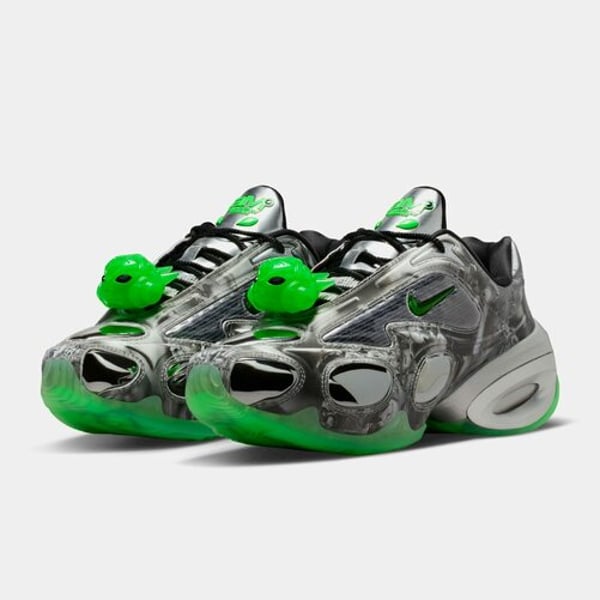
Experimental Nike sneakers – Nike x Windowsen
That mandate comes straight from their new boss, who has used the phrase in internal presentations and documents. Phil McCartney, who’s worked at Nike for nearly three decades, was named chief innovation, design and product officer in May, tasked with fixing one of the world’s largest sportswear company’s biggest problems: its stalled development engine.
“By nature, I’m pretty impatient,” McCartney says during a recent interview at Nike’s headquarters in Beaverton, Oregon. “It’s OK to push some edges and try some crazy things.”
So far that means placing a primary focus on speed: Releasing items as early as 12 months ahead of schedule, launching new shoes that the company claims will stimulate the brain and developing a product for which the prototypes look like robot legs.
McCartney, 51, is hoping new products will get shoppers excited about Nike again. In recent years, the brand lost customers by leaning too hard on selling retro lifestyle sneakers, while neglecting gear that appeals to athletes. Last year, the company shed $5 billion in revenue and replaced its chief executive. Revenue has declined six quarters in a row on a currency-neutral basis and shares are down 8.7% this year.
Now McCartney is working to reinvigorate departments that had long ago come up with breakthroughs, like the Air cushioning system, Flyknit digital engineering and ZoomX lightweight foam.
“I see it as appropriate acceleration rather than rushing,” he says.
On this afternoon in October, McCartney is walking around an indoor track at the Nike Sports Research Lab inside the new LeBron James Innovation Center, one of the many testing facilities on Nike’s vast campus. The track is embedded with force plates that measure a runner’s foot strikes; the basketball court and turf field have motion-capture cameras to better understand athletes’ movements. Nearby climate chambers are used to study the science of sweat in different thermal conditions.
He’s eager to show off four of the newest creations- at varying stages of viability- that teams from his staff of more than 4,000 are working on. Prices and release dates haven’t yet been announced.
There’s Nike Mind, a shoe that claims to calm athletes by targeting pressure points to stimulate certain parts of the brain. The Air Milano jacket is set to debut at next year’s Winter Olympics in Italy- its all-new construction method allows the wearer to inflate and deflate the garment to adjust temperature levels. And lightweight AeroFit fabric, which uses mesh structures also to help regulate body heat, is nearing its launch day.
The most ambitious is called Project Amplify. It’s an attempt at a powered footwear system- the device springs the user forward with each step, helping them walk or run farther distances. Prototypes look like retrofitted robo-legs, but each iteration is getting sleeker. It’s still far from commercial viability and the company doesn’t expect it to reach the market until 2028.
“Innovation and product development is everything- they need products to resonate to get shoppers interested,” says Poonam Goyal, an analyst at Bloomberg Intelligence. “Should they fail, the turnaround fails.”
Nike’s innovation staff are encouraged to spend 20% of their efforts trying to develop moonshot concepts that probably won’t ever make it to store shelves. It’s a policy usually found at a Silicon Valley startup, not a shoemaker.
“I’d expect a much lower hit rate” from such projects, McCartney says.
His ascendance is part of a larger restructuring spearheaded by chief executive officer Elliott Hill, who came out of retirement to take the job last year. In August, Nike completed months of ousters, promotions and hirings in its C-suite, with Hill swapping out most of his direct reports across divisions.
He also shifted 8,000 employees to new roles centered around specific sports, such as basketball and running, while laying off less than 1% of his corporate workforce.
“I want us to go faster,” Hill says. “Make stuff people want, need, and when we’re at our best, make stuff that people don’t even know is imaginable.”
An elite runner from Newcastle, England, McCartney took a job with Nike after college, where he studied sports science. He’s worked with Hill in various roles over the years, most recently as general manager of the company’s footwear division, along with Mark Parker, Nike’s executive chairman and former CEO who still gets involved in projects.
To prepare for the 2026 World Cup, set to be held in the US, Canada and Mexico next year, he’s overseeing staff as they work on improvements across Nike’s global football footwear, apparel and equipment, including products like its Tiempo cleats.
McCartney recently flew to Converse headquarters in Boston as management hopes it can benefit from deeper involvement with Nike’s R&D capabilities. With revenue down 28% last quarter, executives at Converse, Nike’s smallest label, have started to reset the brand’s Chuck Taylor sneaker line.
He’s also reworking Nike’s running category, which has struggled to fend off rising competition from brands like On and Hoka.
In one recent experiment from his team, runner Faith Kipyegon attempted a four-minute mile in Paris in custom Nike track spikes developed by McCartney’s teams.
She fell short, but broke her own world record with an unofficial time of 4:06:42.
“Make athletes better,” McCartney says of Nike’s innovation philosophy. “If it’s not, we shouldn’t do it.”
Boss is further deepening its role as a patron of the international art scene and as a partner of Art Basel. At the inaugural Art Basel Awards Night in Miami Beach last week, the fashion house presented the Boss Award for Outstanding Achievement for the first time. The 2025 award goes to the artist Meriem Bennani, whose multimedia practice is renowned for its innovative, humorous, and critically engaged storytelling.
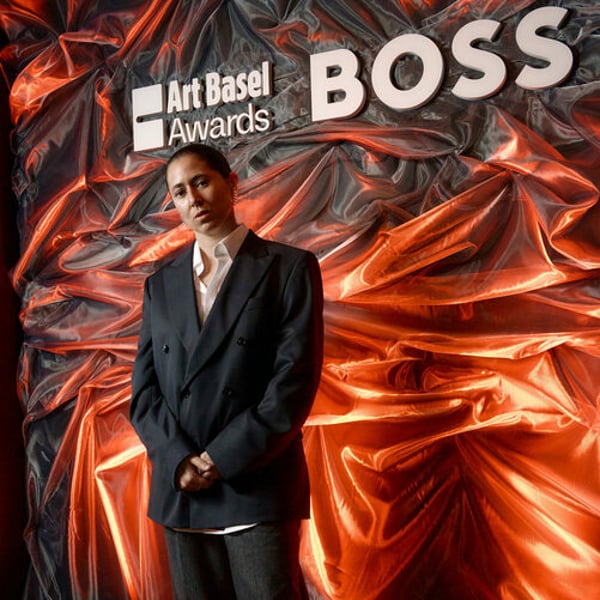
Meriem Bennani is known for weaving humour, pop-cultural aesthetics, and digital language into her storytelling. – BOSS
The Moroccan-born New Yorker works across a variety of artistic media, including video, sound, animation, sculpture, and large-scale installations. She is known for combining humour, pop-cultural aesthetics, and digital language in her narratives to create immersive, playful yet incisive works that resonate with audiences.
The prize was presented by CEO Daniel Grieder and creative director Marco Falcioni. The award will continue to recognise artistic practices that open up new perspectives and spark relevant social dialogue.
“I am deeply honoured to have my work recognised by such an iconic brand that has long championed innovative art that speaks to a wider public. This award inspires me to continue creating works that challenge perspectives and celebrate the beauty of collective experiences,” said Meriem Bennani at the award ceremony.
The highlight of the ceremony was the installation of an immersive catwalk entitled “1995–2025: 30 Years of Arts Sponsorship,” which spotlighted the brand’s arts patronage over the past three decades. Milestones included the “Paper Suit” by artist James Rosenquist from 1998, which marries the timeless craftsmanship of tailoring with the ephemerality of paper. Also featured were the Hugo Boss Prize, awarded for many years in collaboration with the Solomon R. Guggenheim Foundation and Museum, and a retrospective of the Hugo Boss Asia Art Award, launched jointly with the Rockbund Art Museum in Shanghai.
“Art has been an integral part of our DNA for over 30 years, and our partnership with Art Basel takes our commitment to a new level. We are proud to present the inaugural Boss Award for Outstanding Achievement to its first recipient, Meriem Bennani. This award marks the beginning of an exciting journey, and we look forward to shaping the future of art together,” said CEO Daniel Grieder.
The Art Basel Awards, launched in February, honoured 36 medallists from the contemporary art sector in nine categories. Bottom right, Meriem Bennani holds the Boss Award. – HUGO BOSS
“Fashion is an integral part of our everyday lives and serves as a bridge between the individual and society, often blurring the line between functionality and art. From our beginnings to our latest fashion show, Hugo Boss has been committed to the dialogue between fashion and contemporary art, as it continues to inspire innovation, creativity, and forward-thinking ideas,” added creative director Marco Falcioni.
The Boss Award is endowed with $100,000 and supports both future projects and a charitable initiative of the laureate’s choice. The award is open to living artists working across all media, with a particular focus on emerging talents who are shaping discussions within and beyond the art world.
This article is an automatic translation. Click here to read the original article.
The Comité Colbert has unanimously elected Hélène Poulit-Duquesne to be the new chair of the leading French luxury federation. Poulit-Duquesne, the CEO of Maison Boucheron, succeeds Laurent Boillot. She will take up her new responsibilities in June 2026, working alongside Bénédicte Épinay, general delegate of the Comité Colbert.
Hélène Poulit-Duquesne – Boucheron
Poulit-Duquesne has been a long-term active member of the Comité Colbert. As CEO of Maison Boucheron, she has served on the association’s board of directors since 2018 and became its vice president in May 2022.
“I am proud and happy for the trust placed in me today. My roadmap is to continue supporting the Comité Colbert’s major challenges: promoting our expertise and supporting our industries, collectively promoting our values and our Houses internationally, and placing sustainable development, a future challenge for the planet and our professions, at the heart of our strategies,” said the Boucheron CEO in a release.
The Comité Colbert’s membership includes a wide variety of French luxury labels such as fashion houses like Louis Vuitton, Balenciaga, Dior, Givenchy, Jean Paul Gaultier, and Balmain; fine wines like Château Lafitte Rothschild and Perrier Jouët champagne; perfume brands- Frédéric Malle, Guerlain, and Francis Kurkdjian; jewellers such as Van Cleef & Arpels and Messika; and master chefs and restaurants including Yannick Alléno, Taillevent, and Guy Savoy.
“Each Maison of the Comité Colbert, beyond its individual performance and regardless of its market share and size, has a greater role to play: that of defending values that are universal and cement the foundation of our collective: the values of art, culture, and craftsmanship, the hand of man. Because they have meaning, they give meaning. They enrich the lives of millions of people and inspire them to dream,” insisted Poulit-Duquesne.
A notably experienced executive, Poulit-Duquesne has held senior positions in three of the largest luxury groups in the world- LVMH, Richemont, and Kering.
Hélène Poulit-Duquesne is a graduate of ESSEC Business School in the Paris suburbs, who began her career at LVMH before joining Cartier International, the key brand in the Richemont Group, in 1998. In 2010, she joined its Executive Committee as director of international marketing, before joining the Kering Group at the end of 2015 as CEO of Maison Boucheron.
“I am delighted at the prospect of working with Hélène Poulit-Duquesne to serve, together with our collective, the influence of an industry whose excellence and creativity are one of the major jewels in the crown of the French economy. We are committed to supporting its development, honouring its expertise, and amplifying its international influence,” added Épinay.
Created in 1954 on the initiative of famed perfumer Jean-Jacques Guerlain, the Comité Colbert is a non-profit association recognised as being of public interest, bringing together 98 French luxury houses and 17 cultural institutions. The Comité Colbert’s goal is to work together to promote the French art of living internationally, as well as to preserve and pass on French expertise and creativity.
British photographer Martin Parr, renowned for his colour-saturated pictures and the ironic gaze with which he observed his compatriots’ daily life, passed away on Saturday aged 73. The announcement was made by the Martin Parr Foundation in a press release.
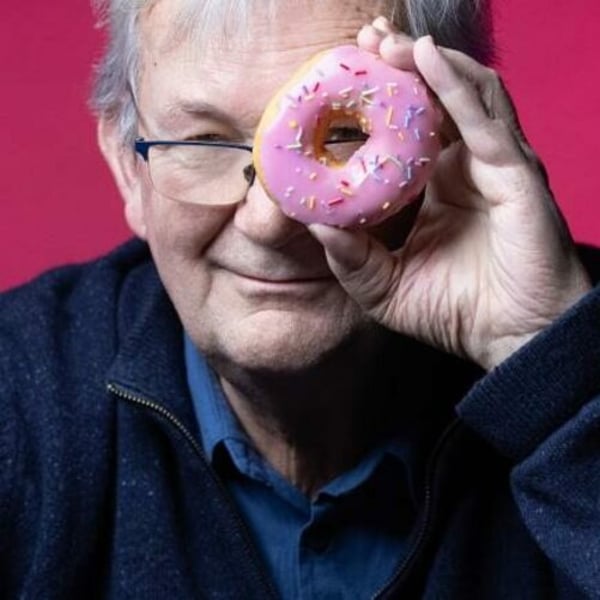
Martin Parr – Afp
“It is with great sadness that we announce that Martin Parr (1952-2025) died on December 6, 2025, at home in Bristol,” stated the foundation. Magnum Photos, the agency for which Parr had worked for a very long time, gave the sad news at the same time.
Parr became famous thanks to his highly recognisable aesthetic featuring close-up shots and a saturated palette, and the amused, sympathetic eye with which he observed his favourite themes, like mass tourism and consumerism, and his subjects, from sunbathers with crimson-baked skin to village fête participants.
Over the last 30 years, Parr’s style won over many fashion labels, and he collaborated with some of the top luxury houses. Last year, the Fashion Faux Parr book traced his links with the fashion world, featuring some 25 images taken over the course of several decades.
Parr’s influence extended beyond the domain of photography aficionados, even if his documentary-style work, sometimes described as kitsch, earned him as many admirers as detractors.
Parr was born in Surrey on May 23, 1952. He was introduced to photography by his grandfather, an enthusiast himself, and began taking pictures in black and white, like the great masters of the 1970s.
He rose to prominence in the mid-1980s, with The Last Resort, a study of working-class people on holiday in New Brighton in Merseyside. It was a foretaste of his future work, notable for the use of flash photography for exteriors shots too.
After a career fraught with challenges, Parr became a full member of Magnum Photos in 1994, despite Henri Cartier-Bresson’s initial opposition. He went on to lead the agency from 2013 to 2017.