The Committee for a Responsible Federal Budget (CRFB) has a ticker on its website: The Retirement Trust Fund Countdown. At the time of writing, it stands at six years, seven months, five days, seven hours, 28 minutes, and eleven seconds.
This, the CRFB says, is when the Social Security program’s funds will be exhausted, and cuts to services would ensue. Medicare has a similar insolvency clock, due to wind down a little over a month before Social Security.
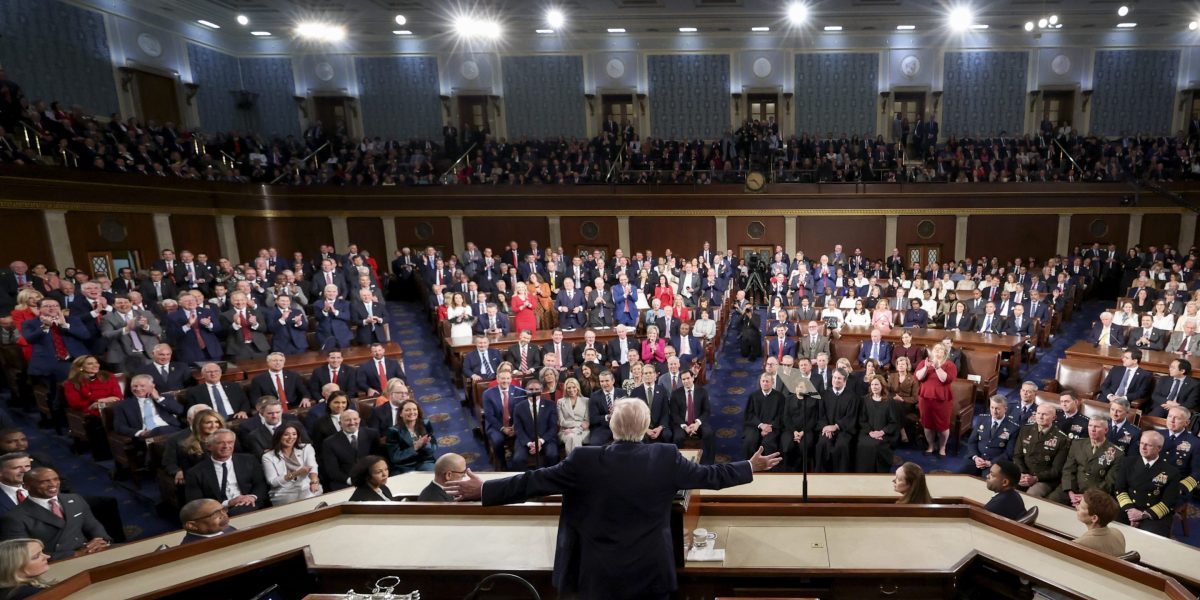
Their continued service, or their replacements, will hold the seats for the next six years: Meaning the deadline to fix the funding for mandatory budget spends like Social Security and Medicare will fall squarely into their laps.
The wider problem they will need to wrangle with is the question of the federal government’s ongoing spending deficit, and the $39 trillion national debt burden it has created.
The total debt itself isn’t necessarily of concern, though the interest payments to service that debt are now eye-watering: A budget update from the Congressional Budget Office (CBO) released this week said the government—according to preliminary estimates—paid out nearly $530 billion in interest between October 2025, when the fiscal year starts, and March 2026. That’s more than $88 billion in interest per month, or more than $22 billion a week.
In that context, many economists are of the opinion that it is no longer a case of if, but when, the mandatory public funds reach insolvency—unless Congress does something about it.
Caleb Quakenbush is the Bipartisan Policy Center’s (BPC) director of fiscal policy, and in an exclusive interview with Fortune in Washington, D.C., highlighted that Congress is already facing some “fiscal deadlines.”
“The next class of senators is going to have to address Social Security, one way or another,” Quackenbush said. Some of that gap might be closed by further borrowing, which would shift the cost onto future generations, but “we may achieve some meaningful reform. There is an opportunity to spread some of the costs over a broader span of generations.”
Michael Peterson, CEO and chairman of the Peterson G Peterson foundation—an organization which advocates and lobbies for fiscal sustainability—is similarly eyeing the looming deadline as an intial test of political willpower.
“The fact that the U.S. senators getting elected now are going to have it on their to-do list during their term, my hope would be that come January the campaign is over and [they] lay down some of the weapons and pick up some of the calculators and pencils, and try and come up with a solution,” Peterson tells Fortune in an exclusive interview.
The elephant in the room
The current debt levels may have increased at a faster pace over recent decades, but they haven’t accumulated overnight—nor under one party as opposed to the other. Indeed, despite efforts such as the Simpson-Bowles Commission under President Obama, and President Trump’s revenue-raising tariff reforms, neither party has enacted specific policy around federal deficits.
But the BPC sees evidence of Peterson’s wish—that lawmakers on both sides will begin working together to come up with solutions—and is more optimistic that an all-out fiscal crisis isn’t on the cards.
“The common knowledge or conventional knowledge is that Congress waits until the last minute to act, and that’s historically been true,” Quakenbush said. “I am personally a little bit skeptical of the total crisis, collapse scenario.”
“I think higher living costs [and] slower income growth, is probably the likelier scenario just given our position in the world economy, our position as the world’s reserve currency, to the extent that we continue to find markets for our debt that are willing to buy it … that puts us in a relatively strong position for the foreseeable future in terms of the economic risk, but that doesn’t mean that there’s zero risk.”
From his conversations with members of Congress, Quakenbush added spending is an issue individuals understand they need to address, but know they need to do so with bipartisan support and appeal in order for the policies to stick: “That signals to me at least that they’re not writing this off as something they’re going to put off forever.”