Florida’s twice-updated Live Local Act is delivering affordable units and faster approvals, but not for a major category of renters it promised to help.
A new report from Florida TaxWatch says the 2-year-old law is falling short for “missing middle” renters — households that earn too much to qualify for affordable housing subsidies, but not enough to comfortably pay market rents in their area.
The nonprofit, nonpartisan watchdog group says a major problem with the legislation is that its main incentive to help “missing middle” renters — a 75% property tax exemption for 80% to 120% AMI rentals — can be opted out of by eligible local governments.
Thirty-four of 49 counties eligible to opt out of the exemption this year have done so, citing the risk of revenue loss.
The legislation also doesn’t provide for pass-through to tenants, meaning landlords receiving tax breaks don’t have to lower rents. And many lenders ignore the exemption at underwriting, Florida TaxWatch found, because it kicks in only after a development’s completion, reducing the project’s feasibility.
Florida TaxWatch found that 35% of Sunshine State households were cost-burdened in 2022, meaning they spent more than 30% of their income on housing and related costs. By 2024, the state was short more than 323,000 affordable units for households at up to 30% AMI, and in 16 counties, at least a third of households are cost-burdened.
“As the 2026 Legislative Session approaches, Florida TaxWatch urges legislators to continue to work with stakeholders to pursue measures to address the provision of affordable housing, especially for the missing middle,” Florida TaxWatch Vice President and General Counsel Jeff Kottkamp said in a statement.
“These are our teachers, firefighters, police, and other professionals who cannot afford to live near where they work.”
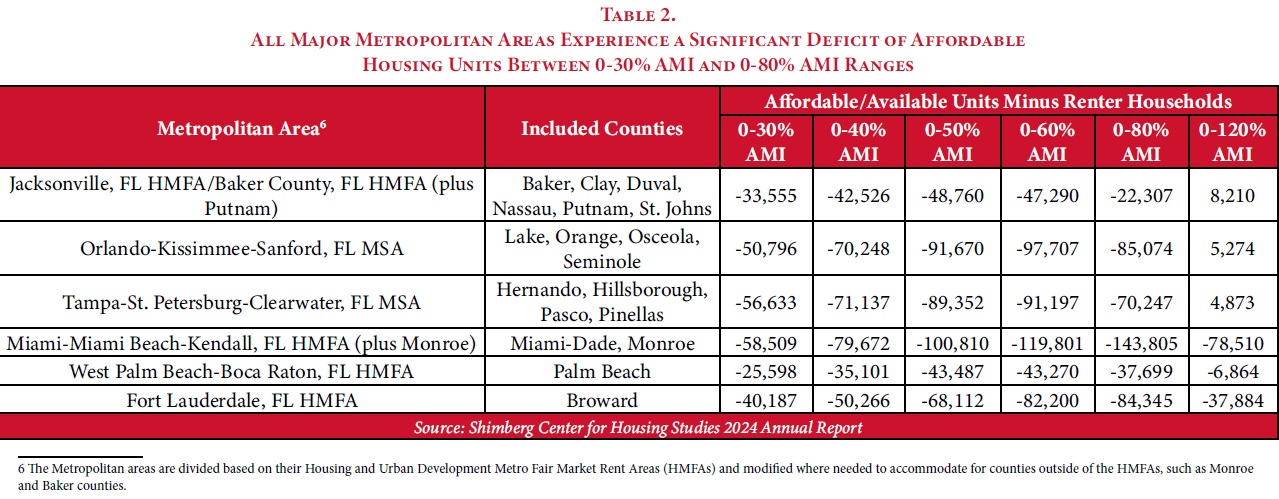
Image via Florida TaxWatch.
Sponsored by Sen. Alexis Calatayud and Reps. Demi Busatta and Vicki Lopez, all Miami-Dade County Republicans, the Live Local Act passed in 2023 and was updated in 2024 and 2025 to address Florida’s growing demand for affordable housing.

Among other things, it provides developers with financial and regulatory incentives to build more housing units, requires local governments to prioritize affordable housing development, streamlines the approval process and mandates that a substantial portion of new housing units whose development benefited from Live Local be available to a wide range of income levels.
The measure also prohibits local governments from imposing rent controls, permits housing development on land owned by religious institutions and requires local governments to reduce parking requirements for transit-adjacent projects.
Since the law went into effect, 3,171 affordable units across 23 Florida properties have been added. Massive mixed-use projects served by transit are leading the way forward.
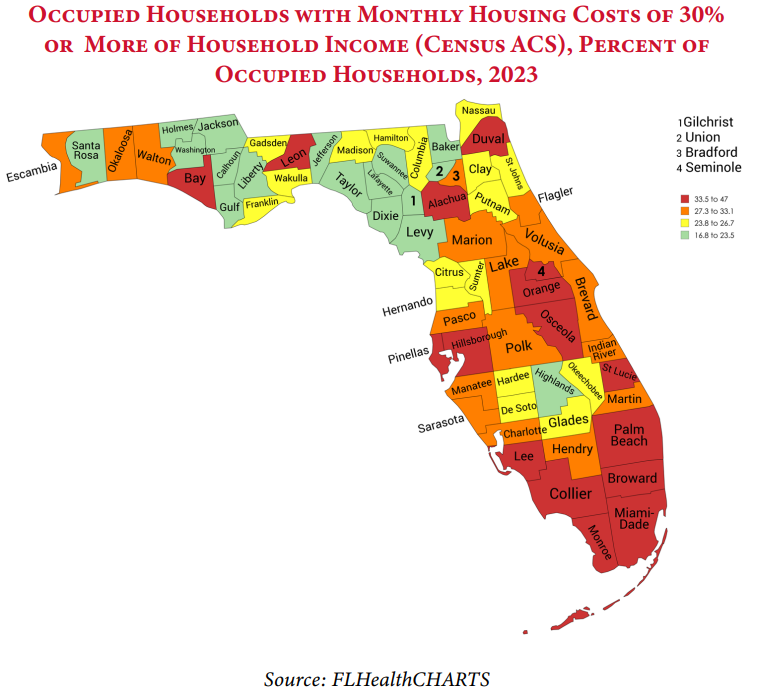
Image via Florida TaxWatch.
In Orange County, Catchlight Crossings by Wendover Housing Partners is bringing 1,000 units of which 600 will be set aside for 30% to 60% AMI households and 400 will serve the “missing middle.”
In Miami-Dade, the recently approved HueHub will deliver 4,032 units — the largest Live Local project to date — in the unincorporated West Little River area with substantial workforce set-asides. Another project in Midtown Miami proposes 598 apartments, with 40% reserved for households at 120% AMI or lower.
So Live Local is indeed “moving units,” Florida TaxWatch says, but still not at a fast enough pace to adequately serve “missing middle” households.
To do so, the group’s report calls for additional state incentives and more consistent local implementation, including:
— Creating a state corporate income tax credit for homebuilders that produce attainable single-family homes.
— A state low-income housing tax credit for rental properties to augment the federal credit.
— Providing tax credits to projects that adapt existing structures, including historic properties (a recommendation sure to rankle preservationists who fought similar provisions in Live Local’s 2025 update).
— Encouraging uniform administrative approvals and discouraging retroactive local code changes that derail qualifying projects.
— Maintaining and enforcing expedited litigation timelines and public reporting.
Live Local has drawn ample criticism over the past two years. In a June column, the TC Palm editorial board lambasted the measure as “the mother of all unfunded mandates” because it erodes home rule and forces local governments to handle growth impacts without new revenue while developers get state-backed zoning advantages.
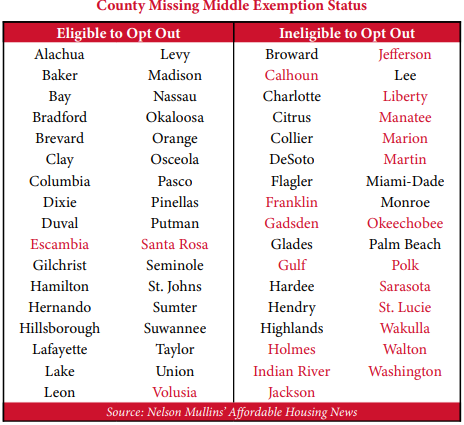
Image via Florida TaxWatch.
A lengthy report the Palm Beach Post published the same month highlights how loopholes in the law and local preemption let developers build pricier “workforce” units without ensuring true affordability, which is what prompts many jurisdictions to opt out of the 75% “missing middle” tax break.
Others — including industry voices like the Florida Housing Coalition, Live Local’s sponsors and former Senate President Kathleen Passidomo, who oversaw its initial passage — argue the updated framework is essential to cutting red tape, channeling capital and making a dent in Florida’s short affordable housing supply.
“It’s working in many, many places,” Passidomo told the Post, adding that county and city officials must step up to maximize the legislation’s efficiency and efficacy. “It’s all about leadership on a local level.”
Early voting is now underway in Miami for a Dec. 9 runoff that will decide whether political newcomer Rolando Escalona can block former Commissioner Frank Carollo from reclaiming the District 3 seat long held by the Carollo family.
The contest has already been marked by unusual turbulence: both candidates faced eligibility challenges that threatened — but ultimately failed — to knock them off the ballot.
Escalona survived a dramatic residency challenge in October after a rival candidate accused him of faking his address. A Miami-Dade Judge rejected the claim following a detailed, three-hour trial that examined everything from his lease records to his Amazon orders.
After the Nov. 4 General Election — when Carollo took about 38% of the vote and Escalona took 17% to outpace six other candidates — Carollo cleared his own legal hurdle when another Judge ruled he could remain in the race despite the city’s new lifetime term limits that, according to three residents who sued, should have barred him from running again.
Those rulings leave voters with a stark choice in District 3, which spans Little Havana, East Shenandoah, West Brickell and parts of Silver Bluff and the Roads.
The runoff pits a self-described political outsider against a veteran official with deep institutional experience and marks a last chance to extend the Carollo dynasty to a twentieth straight year on the dais or block that potentiality.
Escalona, 34, insists voters are ready to move on from the chaos and litigation that have surrounded outgoing Commissioner Joe Carollo, whose tenure included a $63.5 million judgment against him for violating the First Amendment rights of local business owners and the cringe-inducing firing of a Miami Police Chief, among other controversies.
A former busboy who rose through the hospitality industry to manage high-profile Brickell restaurant Sexy Fish while also holding a real estate broker’s license, Escalona is running on a promise to bring transparency, better basic services, lower taxes for seniors and improved permitting systems to the city.
He wants to improve public safety, support economic development, enhance communities, provide more affordable housing, lower taxes and advocate for better fiscal responsibility in government.
He told the Miami Herald that if elected, he’d fight to restore public trust by addressing public corruption while re-engaging residents who feel unheard by current officials.
Carollo, 55, a CPA who served two terms on the dais from 2009 to 2017, has argued that the district needs an experienced leader. He’s pointed to his record balancing budgets and pledges a residents-first agenda focused on safer streets, cleaner neighborhoods and responsive government.
Carollo was the top fundraiser in the District 3 race this cycle, amassing about $501,000 between his campaign account and political committee, Residents First, and spending about $389,500 by the last reporting dates.
Escalona, meanwhile, reported raising close to $109,000 through his campaign account and spending all but 6,000 by Dec. 4.
For the first time in a decade, hunters armed with rifles and crossbows are fanning out across Florida’s swamps and flatwoods to legally hunt the Florida black bear, over the vocal opposition of critics.
The state-sanctioned hunt began Saturday, after drawing more than 160,000 applications for a far more limited number of hunting permits, including from opponents who are trying to reduce the number of bears killed in this year’s hunt, the state’s first since 2015.
The Florida Fish and Wildlife Conservation Commission awarded 172 bear hunt permits by random lottery for this year’s season, allowing hunters to kill one bear each in areas where the population is deemed large enough. At least 43 of the permits went to opponents of the hunt who never intend to use them, according to the Florida chapter of the Sierra Club, which encouraged critics to apply in the hopes of saving bears.
The Florida black bear population is considered one of the state’s conservation success stories, having grown from just several hundred bears in the 1970s to an estimated more than 4,000 today.
The 172 people who were awarded a permit through a random lottery will be able to kill one bear each during the 2025 season, which runs from Dec. 6 to Dec. 28. The permits are specific to one of the state’s four designated bear hunting zones, each of which have a hunting quota set by state officials based on the bear population in each region.
In order to participate, hunters must hold a valid hunting license and a bear harvest permit, which costs $100 for residents and $300 for nonresidents, plus fees. Applications for the permits cost $5 each.
The regulated hunt will help incentivize maintaining healthy bear populations, and help fund the work that is needed, according to Mark Barton of the Florida chapter of Backcountry Hunters and Anglers, an advocacy group that supported the hunt.
Having an annual hunt will help guarantee funding to “keep moving conservation for bears forward,” Barton said.
According to state wildlife officials, the bear population has grown enough to support a regulated hunt and warrant population management. The state agency sees hunting as an effective tool that is used to manage wildlife populations around the world, and allows the state to monetize conservation efforts through permit and application fees.
“While we have enough suitable bear habitat to support our current bear population levels, if the four largest subpopulations continue to grow at current rates, we will not have enough habitat at some point in the future,” reads a bear hunting guide published by the state wildlife commission.
___
Republished with permission of the Associated Press.