Connect with us

Politics

New watchdog report says updated law still overlooks Florida’s ‘missing middle’

Published

on


Florida’s twice-updated Live Local Act is delivering affordable units and faster approvals, but not for a major category of renters it promised to help.

A new report from Florida TaxWatch says the 2-year-old law is falling short for “missing middle” renters — households that earn too much to qualify for affordable housing subsidies, but not enough to comfortably pay market rents in their area.

In Florida, that generally means households earning roughly 80% to 120% of the area median income (AMI).

The nonprofit, nonpartisan watchdog group says a major problem with the legislation is that its main incentive to help “missing middle” renters — a 75% property tax exemption for 80% to 120% AMI rentals — can be opted out of by eligible local governments.

Thirty-four of 49 counties eligible to opt out of the exemption this year have done so, citing the risk of revenue loss.

The legislation also doesn’t provide for pass-through to tenants, meaning landlords receiving tax breaks don’t have to lower rents. And many lenders ignore the exemption at underwriting, Florida TaxWatch found, because it kicks in only after a development’s completion, reducing the project’s feasibility.

Florida TaxWatch found that 35% of Sunshine State households were cost-burdened in 2022, meaning they spent more than 30% of their income on housing and related costs. By 2024, the state was short more than 323,000 affordable units for households at up to 30% AMI, and in 16 counties, at least a third of households are cost-burdened.

“As the 2026 Legislative Session approaches, Florida TaxWatch urges legislators to continue to work with stakeholders to pursue measures to address the provision of affordable housing, especially for the missing middle,” Florida TaxWatch Vice President and General Counsel Jeff Kottkamp said in a statement.

“These are our teachers, firefighters, police, and other professionals who cannot afford to live near where they work.”
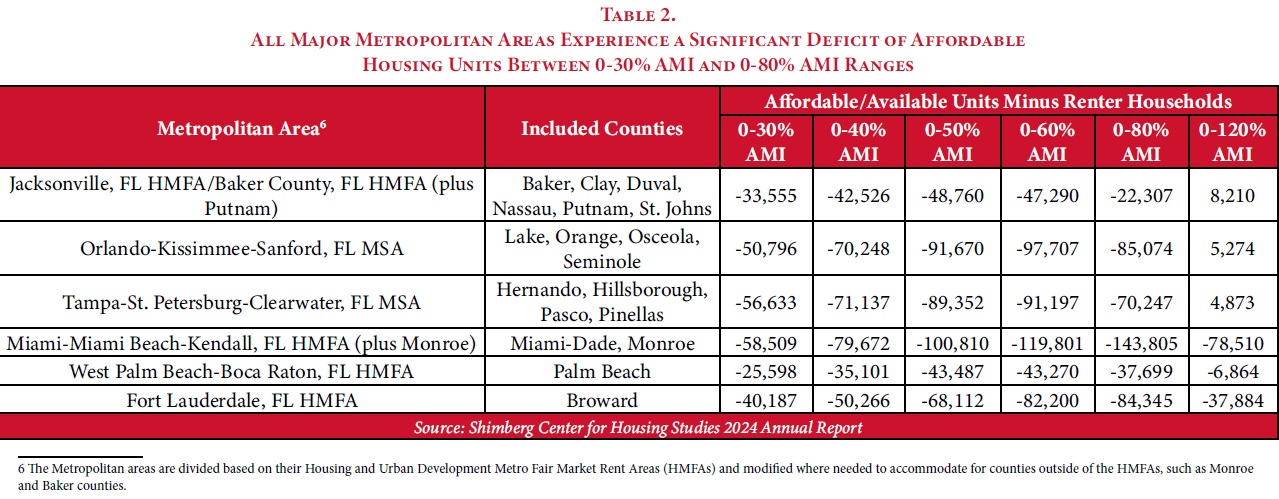
Image via Florida TaxWatch.

Sponsored by Sen. Alexis Calatayud and Reps. Demi Busatta and Vicki Lopez, all Miami-Dade County Republicans, the Live Local Act passed in 2023 and was updated in 2024 and 2025 to address Florida’s growing demand for affordable housing.

Among other things, it provides developers with financial and regulatory incentives to build more housing units, requires local governments to prioritize affordable housing development, streamlines the approval process and mandates that a substantial portion of new housing units whose development benefited from Live Local be available to a wide range of income levels.

The measure also prohibits local governments from imposing rent controls, permits housing development on land owned by religious institutions and requires local governments to reduce parking requirements for transit-adjacent projects.

Since the law went into effect, 3,171 affordable units across 23 Florida properties have been added. Massive mixed-use projects served by transit are leading the way forward.
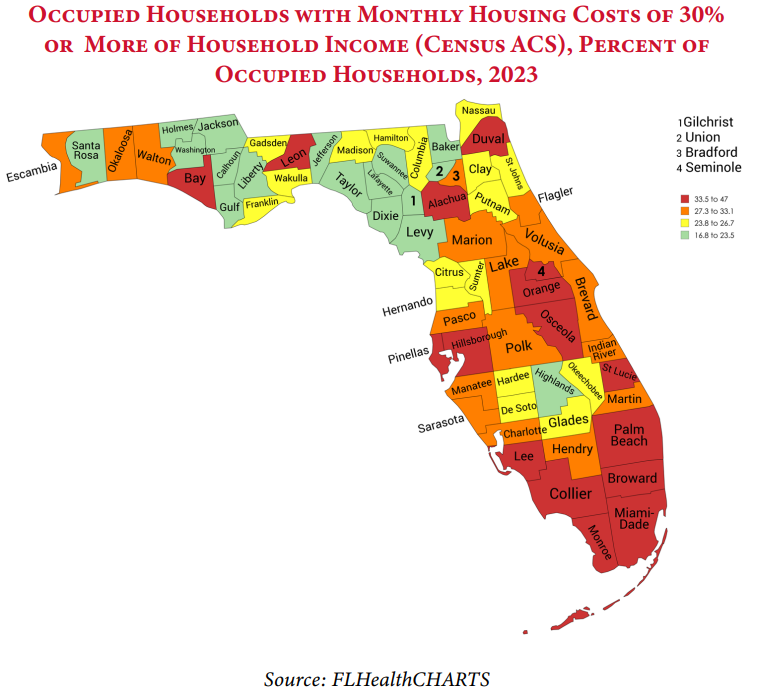
Image via Florida TaxWatch.

In Orange County, Catchlight Crossings by Wendover Housing Partners is bringing 1,000 units of which 600 will be set aside for 30% to 60% AMI households and 400 will serve the “missing middle.”

In Miami-Dade, the recently approved HueHub will deliver 4,032 units — the largest Live Local project to date — in the unincorporated West Little River area with substantial workforce set-asides. Another project in Midtown Miami proposes 598 apartments, with 40% reserved for households at 120% AMI or lower.

So Live Local is indeed “moving units,” Florida TaxWatch says, but still not at a fast enough pace to adequately serve “missing middle” households.

To do so, the group’s report calls for additional state incentives and more consistent local implementation, including:

— Creating a state corporate income tax credit for homebuilders that produce attainable single-family homes.

— A state low-income housing tax credit for rental properties to augment the federal credit.

— Providing tax credits to projects that adapt existing structures, including historic properties (a recommendation sure to rankle preservationists who fought similar provisions in Live Local’s 2025 update).

— Encouraging uniform administrative approvals and discouraging retroactive local code changes that derail qualifying projects.

— Maintaining and enforcing expedited litigation timelines and public reporting.

Live Local has drawn ample criticism over the past two years. In a June column, the TC Palm editorial board lambasted the measure as “the mother of all unfunded mandates” because it erodes home rule and forces local governments to handle growth impacts without new revenue while developers get state-backed zoning advantages.
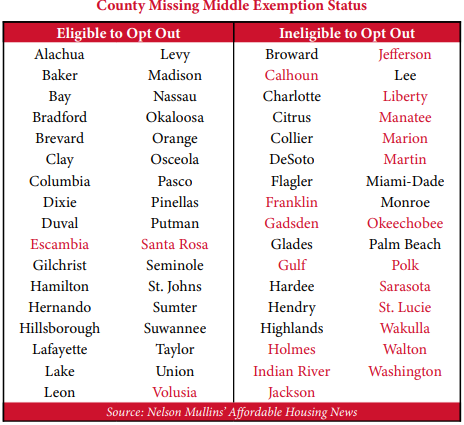
Image via Florida TaxWatch.

A lengthy report the Palm Beach Post published the same month highlights how loopholes in the law and local preemption let developers build pricier “workforce” units without ensuring true affordability, which is what prompts many jurisdictions to opt out of the 75% “missing middle” tax break.

Others — including industry voices like the Florida Housing Coalition, Live Local’s sponsors and former Senate President Kathleen Passidomo, who oversaw its initial passage — argue the updated framework is essential to cutting red tape, channeling capital and making a dent in Florida’s short affordable housing supply.

“It’s working in many, many places,” Passidomo told the Post, adding that county and city officials must step up to maximize the legislation’s efficiency and efficacy. “It’s all about leadership on a local level.”


Post Views: 0


Source link

Continue Reading

Politics

Eileen Higgins brings out starpower as special election campaign nears close

Published

on


Prominent Democrats will be on hand at a number of stops.

Former Miami-Dade Commissioner Eileen Higgins is enlisting more big names as support at early vote stops ahead of Tuesday’s special election for Mayor, including a Senate candidate, a former Senate candidate, and a current candidate for Governor.

During her canvass kickoff at 10 a.m at Elizabeth Virrick Park, Higgins will appear with U.S. Senate Candidate Hector Mujica.

Early vote stops follow, with Higgins solo at the 11 a.m. show-up at Miami City Hall and the 11:30 at the Shenandoah Library.

From there, big names from Orlando will be with the candidate.

Orange County Mayor and candidate for Florida Governor Jerry Demings and former Congresswoman Val Demings will appear with Higgins at the Liberty Square Family & Friends Picnic (2 p.m.), Charles Hadley Park (3 p.m.), and the Carrie P. Meek Senior and Cultural Center (3:30 p.m.)

Higgins, who served on the County Commission from 2018 to 2025, is competing in a runoff for the city’s mayoralty against former City Manager Emilio González. The pair topped 11 other candidates in Miami’s Nov. 4 General Election, with Higgins, a Democrat, taking 36% of the vote and González, a Republican, capturing 19.5%.

To win outright, a candidate had to receive more than half the vote. Miami’s elections are technically nonpartisan, though party politics frequently still play into races.


Source link

Continue Reading

Politics

Hope Florida fallout drives another Rick Scott rebuke of Ron DeSantis

Published

on


The cold war between Florida’s Governor and his predecessor is nearly seven years old and tensions show no signs of thawing.

On Friday, Sen. Rick Scott weighed in on Florida Politics’ reporting on the Agency for Health Care Administration’s apparent repayment of $10 million of Medicaid money from a settlement last year, which allegedly had been diverted to the Hope Florida Foundation, summarily filtered through non-profits through political committees, and spent on political purposes.

“I appreciate the efforts by the Florida legislature to hold Hope Florida accountable. Millions in tax dollars for poor kids have no business funding political ads. If any money was misspent, then it should be paid back by the entities responsible, not the taxpayers,” Scott posted to X.

While AHCA Deputy Chief of Staff Mallory McManus says that is an “incorrect” interpretation, she did not respond to a follow-up question asking for further detail this week.

The $10 million under scrutiny was part of a $67 million settlement from state Medicaid contractor Centene, which DeSantis said was “a cherry on top” in the settlement, arguing it wasn’t truly from Medicaid money.

But in terms of the Scott-DeSantis contretemps, it’s the latest example of tensions that seemed to start even before DeSantis was sworn in when Scott left the inauguration of his successor, and which continue in the race to succeed DeSantis, with Scott enthusiastic about current front runner Byron Donalds.

Earlier this year, Scott criticized DeSantis’ call to repeal so-called vaccine mandates for school kids, saying parents could already opt out according to state law.

While running for re-election to the Senate in 2024, Scott critiqued the Heartbeat Protection Act, a law signed by DeSantis that banned abortion after the sixth week of pregnancy with some exceptions, saying the 15 week ban was “where the state’s at.”

In 2023 after Scott endorsed Donald Trump for President while DeSantis was still a candidate, DeSantis said it was an attempt to “short circuit” the voters.

That same year amid DeSantis’ conflict over parental rights legislation with The Walt Disney Co.Scott said it was important for Governors to “work with” major companies in their states.

The critiques went both ways.

When running for office, DeSantis distanced himself from Scott amid controversy about the Senator’s blind trust for his assets as Governor.

“I basically made decisions to serve in uniform, as a prosecutor, and in Congress to my financial detriment,” DeSantis said in October 2018. “I’m not entering (office) with a big trust fund or anything like that, so I’m not going to be entering office with those issues.”

In 2020, when the state’s creaky unemployment website couldn’t handle the surge of applicants for reemployment assistance as the pandemic shut down businesses, DeSantis likened it to a “jalopy in the Daytona 500” and Scott urged him to “quit blaming others” for the website his administration inherited.

The chill between the former and current Governors didn’t abate in time for 2022’s hurricane season, when Scott said DeSantis didn’t talk to him after the fearsome Hurricane Ian ravaged the state.


Source link

Continue Reading

Politics

Amnesty International alleges human rights violations at Alligator Alcatraz

Published

on


Enforcing what Gov. Ron DeSantis calls the “rule of law” violates international law and norms, according to a global group weighing in this week.

Amnesty International is the latest group to condemn the treatment of immigrants with disputed documentation at two South Florida lockups, the Krome North Service Processing Center (Krome) and the Everglades Detention Facility (Alligator Alcatraz).

The latter has been a priority of state government since President Donald Trump was inaugurated.

The organization claims treatment of the detained falls “far below international human rights standards.”

Amnesty released a report Friday covering what it calls a “a research trip to southern Florida in September 2025, to document the human rights impacts of federal and state migration and asylum policies on mass detention and deportation, access to due process, and detention conditions since President Trump took office on 20 January 2025.”

“The routine and prolonged use of shackles on individuals detained for immigration purposes, both at detention facilities and during transfer between facilities, constitutes cruel, inhuman and degrading treatment, and may amount to torture or other ill-treatment,” the report concludes.

Gov. DeSantis’ administration spent much of 2025 prioritizing Alligator Alcatraz.

While the state did not comment on the report, Amnesty alleges the state’s “decision to cut resources from essential social and emergency management programs while continuing to allocate resources for immigration detention represents a grave misallocation of state resources. This practice undermines the fulfillment of economic and social rights for Florida residents and reinforces a system of detention that facilitates human rights violations.”

Amnesty urges a series of policy changes that won’t happen, including the repeal of immigration legislation in Senate Bill 4-C, which proscribes penalties for illegal entry and illegal re-entry, mandates imprisonment for being in Florida without being a legal immigrant, and capital punishment for any such undocumented immigrant who commits capital crimes.

The group also recommends ending 287(g) agreements allowing locals to help with immigration enforcement, stopping practices like shackling and solitary confinement, and closing Alligator Alcatraz itself.


Source link

Continue Reading

Trending

Copyright © Miami Select.