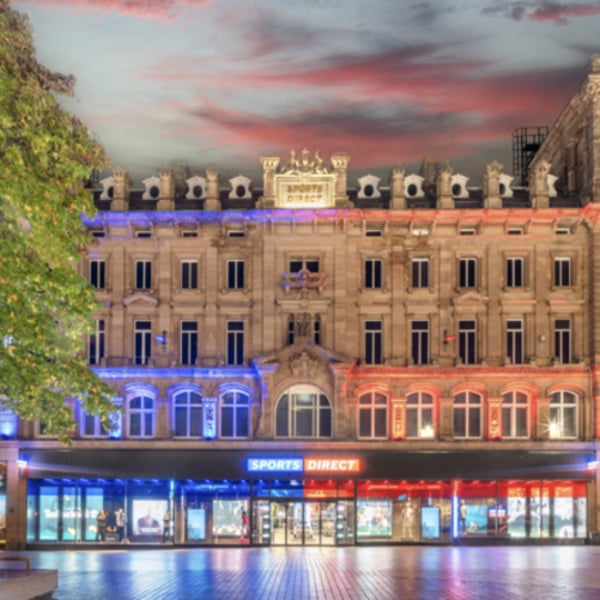
There’s big and then there’s Sports Direct big. Owner Frasers Group has opened its 90,00 sq ft three-storey flagship store on Liverpool‘s Church Street for its key sports retail brand that comes with a dedicated Everlast Gym+.
The Liverpool store’s opening “forms a key milestone in the next phase of the brand’s vision”, namely “redefining the future of the British high street, with stores where people both shop and workout”, Frasers said.
And group CEO Michael Murray called it “arguably the most ambitious retail investment in Liverpool by any UK business”.
The parent company also noted that these newly elevated Sports Direct stores “are purpose-built to serve how today’s consumer shops, trains and lives – a destination where sport, performance, wellness and style are part of the same experience”.
To date, over 50% of Sports Direct’s stores have now been “elevated” as part of the wider Elevation Strategy, with the Liverpool store marking the next phase of the plan, with multipurpose stores that “offer everything from shopping to training, and immersive sports experiences under one roof”.
Each floor is zoned by sport and training type – from running, football and swimming to outdoor adventure and racket sports.
With fitness competition brand Hyrox “continuing to soar in popularity across the globe”, the store’s in-built Everlast Gym+, which occupies the full third floor, features the UK’s first Hyrox Performance Centre, “making the flagship one of the best Hyrox training locations in the world”.
The gym also features a Reformer Pilates Studio and a dedicated Recovery Zone. This offers access to an exclusive recovery suite featuring Brass Monkey ice baths, herbal and dry salt saunas and a modern, elevated space for post-training reset.
Other key store features include: Sports Direct’s Running Concept to help consumers find the right product for their running journey; Outdoor Concept, incorporating advanced technology and information sharing to educate consumers about products and outdoor activities; Women’s Training Concept, “a key innovation at this new flagship” with a curated retail space and brand-led experience; Under Armour Agility Test, an immersive, high-energy activation that brings the brand’s training ethos to life; Adidas Football Skill Zone; and Evans Cycles’ space, with a selection of bikes, parts, accessories, and clothing.
Murray added: “Liverpool is a case study of how our Elevation Strategy is winning. It’s where ambition meets execution: a destination that showcases our strategy’s momentum. With every new opening, we’re not just adding stores, we’re transforming the retail landscape, creating spaces that energise communities and redefine the high street experience.”
He also said over 220 new retail roles have been created through the flagship openings of Flannels, Sports Direct and Everlast Gyms+ in Liverpool city centre between 2022 and 2025, “which represents a 213% uplift in staffing”.
“No other retailer has matched this scale of investment or long-term commitment to the city – a strategy that’s not only creating jobs but actively contributing to the wider economic and cultural revival of Liverpool’s high street.”
We’ve seen a dash by businesses to set up e-marketplaces in recent periods and that’s no surprise given that a new study shows that “online marketplaces dominate almost every stage of UK shoppers’ purchase journey”.
Photo: Akeneo
That’s according to product experience specialist and product information management solutions provider Akeneo. It said its data shows marketplaces are key from “discovery and comparison through to purchase, reviews and even returns”.
For “high-value purchases” (over £90) UK shoppers “lean more heavily on marketplaces than any other digital or physical touchpoint”.
For instance, 24% most regularly use marketplaces for search and discovery; 26% for price and promotions comparisons; and 28% to compare or validate products.
Also, 26% use them most often to leave reviews while 21% get advice from other users via marketplaces (interestingly, they seek that advice via marketplaces more than they do social media).
And of course’s marketplaces are key for the actual purchase process. Some 30% of consumers most regularly use marketplaces to buy the product – ahead of stores and retailer sites — while 21% use marketplaces to initiate returns, second only to other routes (22%).
It’s particularly interesting that across the whole journey, “30% of UK consumers say they most often buy from online marketplaces, while just 6% most often buy from a brand’s own website”.
Amazon is perhaps the ‘ultimate’ marketplace with its business model having been founded on that concept. But other retailers have also cottoned on to their importance with big names such as Next, M&S and John Lewis having dived deep into marketplaces recently.
Boohoo/Debenhams Group is also embracing marketplaces for its basket of brands and the impressive recovery of the Debenhams business since Boohoo acquired it has been driven by a marketplace makeover.
“This peak season has confirmed what our research already shows; for UK shoppers, marketplaces are the default shop window, comparison engine, review hub and checkout,” said Romain Fouache, CEO at Akeneo. “If your product information and brand story do not show up clearly and consistently on marketplaces, you are invisible for a big share of high-value purchases. And in a world where AI agents and LLMs will increasingly replace search in guiding shoppers to the right products, being invisible on marketplaces means you may not exist at all for these new discovery engines.”
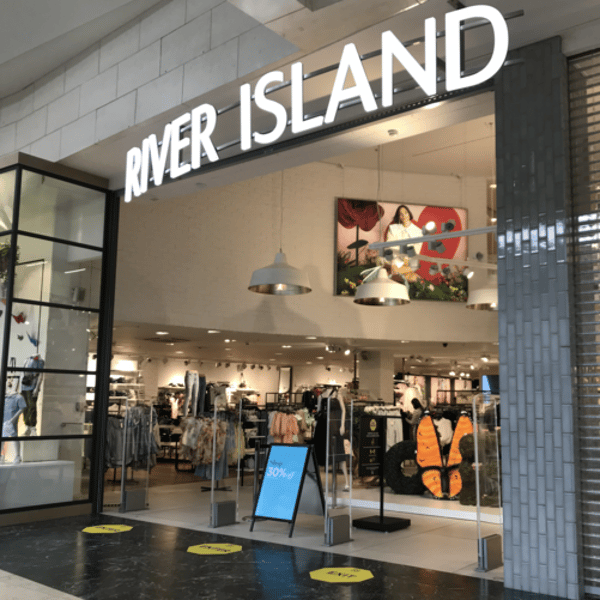
River Island’s store closure programme will move into high gear within weeks as 33 stores will close by the end of January under the chain’s court-approved restructuring plan.
Photo: Sandra Halliday
The plan should also see it starting to pay reduced rents for 71 of its current 200+ chain. That could include up to three years of rent cuts or even no rents being paid for some River Island stores.
Its restructuring plan was approved earlier this year amid dire warnings that the business might collapse if the restructuring process didn’t go through.
Only this month the fashion retailer’s newly-filed accounts showed that River Island Holdings Limited made a loss before tax of £124.3 million in 2024, much wider than the £32.2 million loss of the year before. That came as turnover fell to £690.1 million from £701.5 million.
At the hearing for its restructuring plan in August, its legal team told the court that external pressures meant it hadn’t been able to reverse the downward trend.
The stores that will close within weeks are: Aylesbury, Bangor Bloomfield, Barnstaple, Beckton, Brighton, Burton-Upon-Trent, Cumbernauld, Didcot, Edinburgh, Falkirk, Gloucester, Great Yarmouth, Grimsby, Hanley, Hartlepool, Hereford, Kilmarnock, Kirkcaldy, Leeds Birstall Park, Lisburn, Northwich, Norwich, Oxford, Perth, Poole, Rochdale, St Helens, Surrey Quays, Sutton Coldfield, Taunton, Workington, and Wrexham.
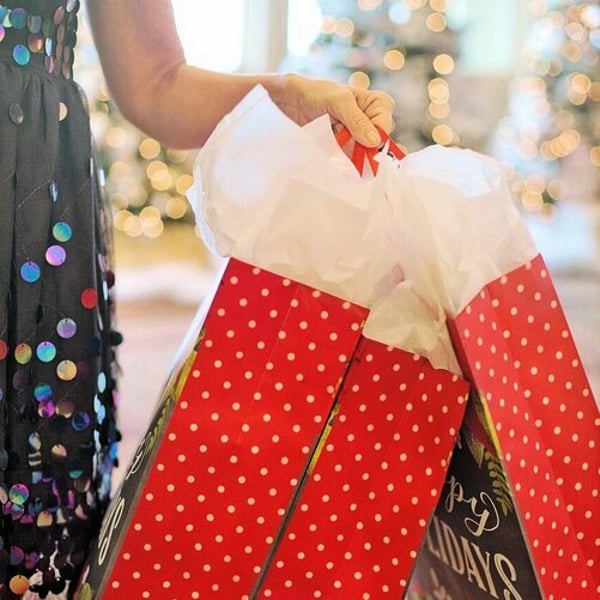
UK spend will increase this festive season but won’t beat inflation according to the latest PwC forecast that predicts seasonal spend of £24.6 billion.
Photo: Pixabay
That would be a 3.5% year on year rise, which is close to the current inflation rate (3.6%) but still slightly behind. So in real terms, spending will be static.
Shoppers are expected to spend £461 per head (up from £449 in 2024), with the top priorities being food & drink, Christmas dinner, and health & beauty.
And importantly, plenty of 18 to 24-year-olds plan to spend more than last year.
The latest Festive Predictions Survey showed 15% of shoppers planning to increase their spending compared with last Christmas, but with an almost equal number (14%) saying they’ll spend less. This is a slightly more pessimistic outlook than this time last year, when 20% of consumers said they’d spend more on festivities and 16% spend less.
As mentioned, younger shoppers should be key as they’re set to spend more on the festive period this year than other age groups, with 32% of 18 to 24-year-olds set to spend more. And as in previous years, they’re forecast to be the biggest spenders per head with an estimated £541.
The 25 to 34 age group will be next with a spend of £476 each and just over one in five (21%) saying they’ll increase their festive spend.
When it comes to more cautious consumers, they’re mainly found in older age groups with 18% of the 35 to 44 age group and 14% of those aged 45 to 54 keeping a close eye on their spending, The 45 to 54-year-olds are also the group forecast to spend the least per head, at £436.
Among the consumers planning to spend less there’s a mix of reasons ranging from those who actually have less cash available to those who just feel less confident about their finances.
PwC also said that in a reversal of what happened around Black Friday, women are forecast to spend more than men, with a £471 outlay per head forecast. Men are projected to spend £452 per head.
Fashion and beauty spend to rise
It added that “there are winners and losers amongst the categories shoppers say they will be buying”.
Health & beauty is among the winners with 18% saying they’ll spend more on such products, making it the third-most-prioritised category, overtaking both adult and children’s clothing and electricals & technology. Health & beauty has become particularly important for younger shoppers.
That said, fashion is the fourth-highest priority for consumer spend this Christmas, with 17% planning to spend more on adult clothing this year.
As for when and where consumers have shopped or will be shopping, 46% say they finished their shopping before the beginning of December, partly to be organised but also to take advantage of pre-Christmas discounts.
Young shoppers are most likely to be in this group with 25% of 18 to 24-year-olds and 23% of 25 to 34-year-olds saying they did their shopping earlier than usual. More than half of 25 to 44-year-olds finished most of their shopping by the start of December.
But many consumers are still shopping in December with 47% doing it in the early or middle days of the month. Only 8% are leaving it until the week before Christmas.
Women continue to be more organised than men, with the majority of women (54%) having bought most of their gifts by the start of December, and only 4% leaving it until the week before Christmas. Some 12% of men plan to do most of their shopping the week before Christmas.
Most consumers plan to do their spending for the festive season online with 55% of purchases happening online for home delivery. Together with click & collect (9%), that leaves only a little over a third of shopping taking place in physical stores (36%).
The combined 64% of Christmas presents bought online is an increase on the last two years, and the highest proportion spent online since the end of the pandemic.






 Politics8 years ago