Connect with us

Business

New luxury airline seeks top first class and will only fly to a handful of cities
Published

on


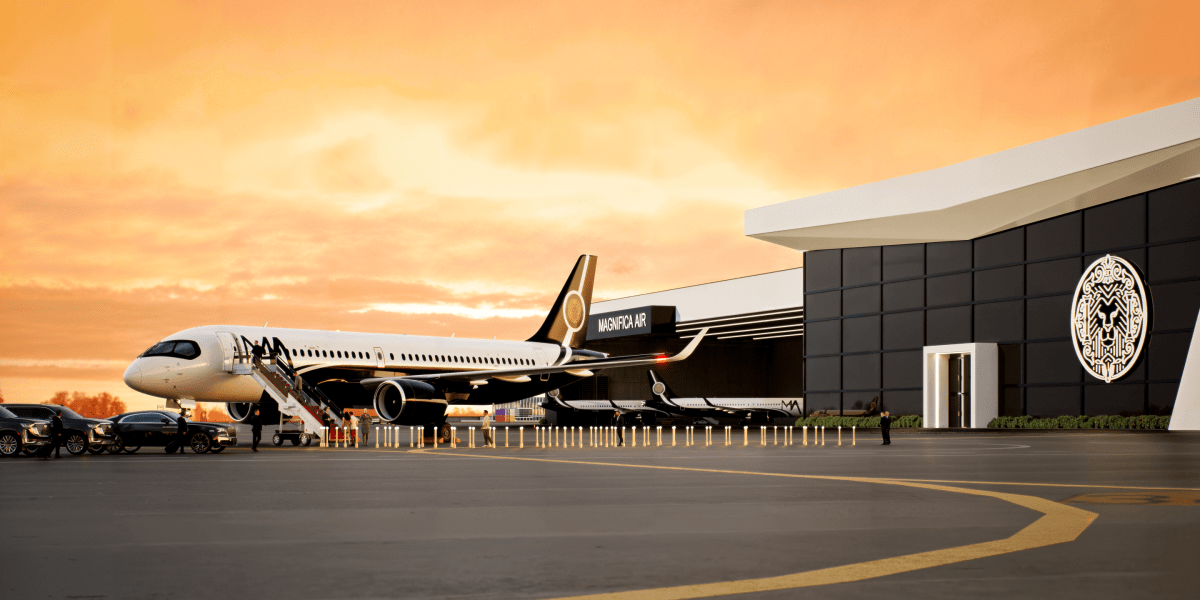
As premium travel becomes an increasingly important part of the airline industry, a new carrier is launching that looks to offer an experience beyond first class but without the enormous cost of chartering a private jet.

Florida-based Magnifica Air expects to begin service in 2027, with plans for six to seven daily departures, connecting to Miami, New York, Los Angeles, the San Francisco Bay Area, Dallas, and Houston. The airline will also offer seasonal service to Napa Valley and the Caribbean.

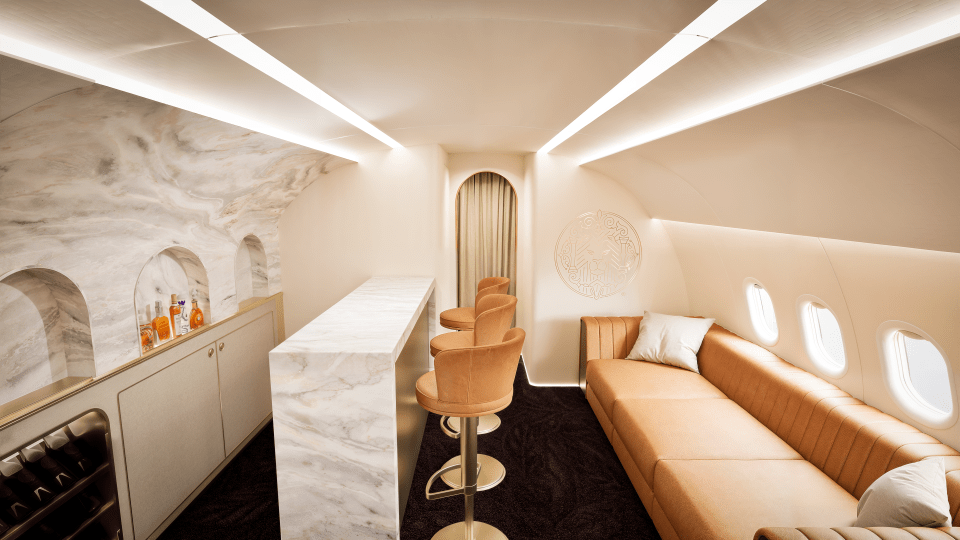
Magnifica has long-term lease agreements with Air Lease for six new Airbus aircraft, including four A220-300s and two A321-200neos. The A321neo will fly on longer-haul routes and include four private suites, while the A220-300 will serve mid-haul routes and have two suites.

Each plane will carry only 45–54 passengers—less than half what they carry for typical airlines—and there will be no overhead bins, increasing cabin space even more.

Magnifica Air

Service begins with a driver who picks up passengers and takes them to a private terminal, where they will not have to wait in a TSA line, while a concierge handles their luggage.

Travelers can arrive just 30 minutes before departure. Prior to takeoff, they can partake in fine dining and wellness offerings. While onboard, there’s curated entertainment and tailored dining in the privacy of suites and recliners. After landing, baggage arrives in 10–15 minutes, while chauffeurs wait curbside.

“Right now, if you want a truly luxurious experience, you’ve got two options: Pay 10 times the cost of a first-class ticket for a private jet, or deal with the frustrations of commercial first-class travel, where you’re still treated like just another number. Magnifica Air is stepping into that space between,” the airline said. “We’re offering a fully private, seamless experience for a fraction of what you’d pay to charter a jet.”

Magnifica hasn’t disclosed any details on ticket prices yet, but a spokesperson said they will vary by route and dynamic demand. Meanwhile, renting a private jet can cost several thousand dollars per hour.

The airline has announced prices for its “The Seven Club” membership, which will offer priority access and tailored service, as well as invitations to major events like Art Basel and the Super Bowl. Family memberships will start from $14,950 and corporate membership from $29,950.
Magnifica Air

Magnifica comes as the main airlines have become more reliant on first-class and business-class passengers.

In October, Delta Air Lines said for the first time ever it expects sales of premium seats will overtake those of its traditional main cabin offerings by 2026, a full year earlier than previously expected.

“Premium products used to be loss leaders, and now they’re the highest-margin products,” Delta President Glen Hauenstein told analysts on an earnings call.

He added Delta is seeing “many, many more opportunities in premium in the coming years” and cited investments in Los Angeles, Boston, New York, and Seattle “where a considerable amount of premium lives. Delta historically wasn’t as big in those markets as we are now.”

At the same time, Delta has introduced an extra-high-end tier of lounges as its Delta Sky Club lounges grow more overcrowded.

It’s indicative of the K-shaped economy, in which the top 10% of households accounted for nearly 50% of all consumer spending in the second quarter of 2025, according to Moody’s Analytics

Even low-cost carriers like Frontier Airlines are reducing capacity in economy class to add first-class seats.

“We’ve listened to customers, and they want more—more premium options, like first class seating, attainable seat upgrades, more free travel for their companions, and the ability to use miles on more than just airfare,” Frontier CEO Barry Biffle said last year.


Source link

Continue Reading

Business

CEO of Boeing and Lockheed rocket joint venture ULA resigns

Published

on


Tory Bruno, the chief executive officer of Boeing Co. and Lockheed Martin Corp.’s rocket joint venture United Launch Alliance, has resigned after serving in the position for nearly 12 years.

Chief Operating Officer John Elbon will serve as interim CEO, ULA’s board of directors announced on Monday.

One of SpaceX’s biggest rivals, ULA is one of an elite group of companies that is authorized to launch the most sensitive satellites for the US military. During his tenure leading ULA, Bruno oversaw the retirement and phasing out of the company’s older Delta and Atlas rockets, while spearheading the development of a new rocket called Vulcan.

“We are grateful for Tory’s service to ULA and the country, and we thank him for his leadership,” the ULA board said in a statement. Bruno is leaving to pursue another opportunity, the statement said.

Join us at the Fortune Workplace Innovation Summit May 19–20, 2026, in Atlanta. The next era of workplace innovation is here—and the old playbook is being rewritten. At this exclusive, high-energy event, the world’s most innovative leaders will convene to explore how AI, humanity, and strategy converge to redefine, again, the future of work. Register now.


Source link

Continue Reading

Business

Jim Beam halts production at key US distillery amid bourbon glut

Published

on


Bourbon maker Jim Beam plans to pause production at its main US distillery for all of 2026 after slumping demand caused an oversupply of whiskey. 

The brand, owned by Japanese alcohol giant Suntory Holdings Ltd., said it’s halting whiskey distillation at the James B. Beam campus in Clermont, Kentucky after an assessment of its production levels against consumer demand, according to a statement on Monday. 

The company plans to use the downtime to invest in site enhancements. Production will still continue at the smaller Fred B. Noe craft distillery in Clermont and the Booker Noe site in Boston, it added. 

Sales of bourbon have slowed as consumers rein in spending and drinking, and as uncertainty over the impact of US President Donald Trump’s tariffs and taxes on aging barrels weigh on the sector, the Kentucky Distillers’ Association said in October. There are about 16.1 million barrels — a record — of bourbon aging in warehouses in Kentucky as of January, though most won’t be ready to bottle until after 2030, the association said.

Jim Beam, which employs about 6,000 people worldwide, did not announce layoffs. Bottling and warehousing operations will continue at the brand’s James B. Beam campus, while its visitor center and restaurant remain open, it said.

Suntory, which also owns soft drinks such as Orangina, is grappling with the fallout of Takeshi Niinami’s resignation as chief executive officer in September after Japanese police raided his home as part of an investigation into suspected illegal cannabis-based supplements. Niinami was one of the country’s best-known and most outspoken business leaders.

Join us at the Fortune Workplace Innovation Summit May 19–20, 2026, in Atlanta. The next era of workplace innovation is here—and the old playbook is being rewritten. At this exclusive, high-energy event, the world’s most innovative leaders will convene to explore how AI, humanity, and strategy converge to redefine, again, the future of work. Register now.


Source link

Continue Reading

Business

iRobot cofounder Colin Angle: Roomba-maker’s biggest reason for failure was Chinese competitors

Published

on


After Roomba-maker iRobot filed for Chapter 11 bankruptcy last week, founder and former CEO Colin Angle did not shy away from sharing what went wrong. 

Angle, who co-founded iRobot in 1990 alongside other members of MIT’s Artificial Intelligence Lab, said in a recent episode of The New York Times “Hard Fork” podcast that one of the core problems with remaining competitive in its market was growing Chinese competition. 

“It’s certainly the advent of this new type of competitor, the Chinese fast follower who had access to the Chinese marketplace, which I Robot effectively did not,” Angle said. “I also think that the marketplace was not a level playing field.”

Roomba became a household name—and appliance—in numerous American homes after the vacuuming robot hit the market in 2002, a pioneer in the household robotics sector. The 2018 self-emptying Roomba i7+ vacuum was even able to tidy dust and detritus from specific rooms using mapping technology. The company reached its peak revenue in 2021 at nearly $1.6 billion. Now, following its bankruptcy filing, iRobot will be acquired by the China-based Picea Robotics, its primary manufacturer and lender.

Despite the Roomba’s initial success, it began losing market share to its Chinese rivals, a death knell for the company, according to Angle. 

“For a small period of time, iRobot was the meeting manufacturer of vacuuming robots in China,” he said. “Then it stopped, because China decided that this was a market of interest, and they were going to ensure that Chinese companies were advantaged to succeed there.”

Angle noted that China, “for various pragmatic and political reasons, gave a protected market to cut your teeth on for the competition,” such as the China-based Roborock, which put iRobot at a disadvantage in the massive Chinese market. (Roborock has since become the world’s largest robot vacuum brand.) 

China has implemented a series of incentives for consumers to buy domestic products, including an up-to 20% discount on certain tech appliances, in an effort to boost spending following a prolonged pandemic-era lull. The Central Committee of the Chinese People’s Congress announced in October a renewed focus on bolstering domestic consumption, calling for support of Chinese businesses.

Picea Robotics, for its part, has dominated the robotic vacuums space, and it reports partnerships with Shark and Anker, in addition to iRobot.

“It’s a cage match, and it certainly got hard, and it got increasingly competitive,” Angle said. 

iRobot did not immediately respond to Fortune’s request for comment.

Obstacles in iRobot’s path

Increased competition from China may be why iRobot lost key international market share, but Angle said Amazon’s failed bid to acquire the company only hurt it.

In 2022, Amazon announced a deal to buy iRobot for $1.7 billion, what would have been its fourth-largest acquisition ever at the time. However, regulators thwarted the deal, with the European Union and U.S. Federal Trade Commission arguing Amazon could engage in anticompetitive practices by delisting competitors on its platform, or increasing advertising costs that would stymie innovation in the sector. Amazon and iRobot decided in January 2024 to abandon the deal.

To Angle, the failed acquisition hurt more than just iRobot, but rather the consumer and entire industry of household robotics.

“The tragedy of the blocking of the transaction is we did it to ourselves,” he said. “And the net result, which I have argued, was done with eyes wide open, was putting the consumer robot industry in a box, gift wrapping it and handing it to someone else.”

iRobot had other failures, such as a wet-mopping feature that lagged behind competitors and never really materialized, according to Angle, but regulator scrutiny of the proposed Amazon acquisition inhibited the American robotics sectors from being nurtured, he argued.

Amazon did not respond to Fortune’s request for comment.

“If nothing else, the tragedy of the events of the Amazon attempted acquisition of iRobot to serve as a lesson as we think about an industry which honestly could be 1,000 times larger than robot vacuuming,” Angle said.


Source link

Continue Reading

Trending

Copyright © Miami Select.