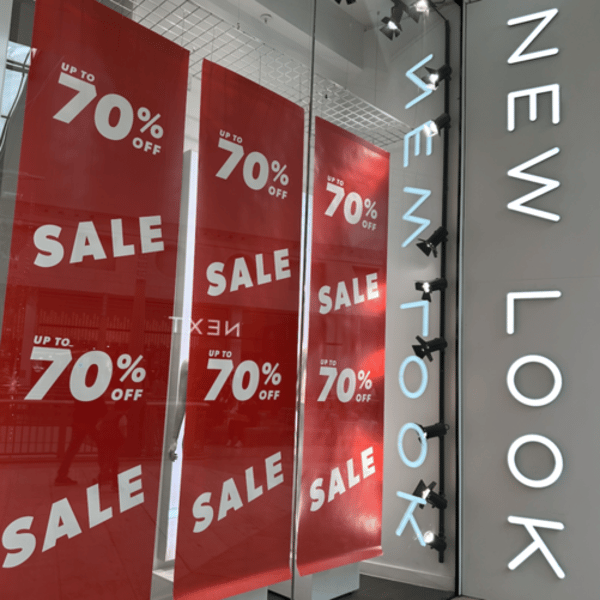
New Look has filed its accounts for the year to the end of March and they show both challenges and progress. The company — or New Look Retailers Limited to give it its official name — is reportedly up for sale. So what condition would any buyer find it in?
Photo: Sandra Halliday
Bearing in mind that the latest year was the 52 weeks to late March 2025, rather than 53 weeks in the prior year, it saw a revenue fall that was about more than just the loss of an extra trading week.
The company said that total revenue dropped to £687.7 million from £735.4 million due to “store closures and tough trading conditions”.
The gross margin fell to 48.1% from 48.7% due to higher levels of discounting, the overall challenging market and unseasonal weather.
Meanwhile the company’s adjusted EBITDA fell to £18.47 million from £46.65 million due to that reduction in sales and the increased promotional activity.
The operating loss was £47.6 million after a profit of £17.4 million on the same basis is the year before. The statutory loss before tax widen to £77.2 million from a £3.6 million loss the previous year, partly due to those lower sales but also increased admin expenses. They included the cost of liquidation of the Irish business (which added up to more than £40 million) and increased staff costs. Finance expense was also higher for the business.
The net loss for the period was also £77.2 million after a £3.7 million loss in the prior year.
But the company got a £30 million cash injection from its shareholders to accelerate its digital transformation during the period.
Other upbeat news during the year was that the company remains a key part of the UK womenswear retail scene (it was number three overall for womenswear in the 18 to 44 age range both online and offline). It also maintained its number one market share position in women’s dresses, jeans and footwear.
And its total known customers grew by 15% to 10 million with its CRM customer base growing 32% to 4.5 million.
It ended the year with 337 stores compared to 356 in the previous period.
It has been putting a number of growth initiatives in place since the financial year ended and only last month named a new retail director responsible for the store estate and for implementing its omnichannel strategy across stores “to drive sales and enhance the customer experience”.
It also recently launched its first-ever loyalty programme, Club New Look; added all its major suppliers to the TrusTrace global platform to standardise its supply chain traceability and compliance data management; and got that big cash injection. The £30 million will be spent on its data, AI and e-commerce platforms “to enhance [the] seamless, personalised shopping experience for its 10 million customers”. It wants to double digital orders from £500 million to £1 billion by 2030 and grab a 10% online market share by FY28.
Italian luxury brand Brunello Cucinelli, known for its $3,000 cashmere sweaters, bet big on department stores, a strategy now in the spotlight as iconic US High Street retailer Saks struggles to pay back debts.
A look by Brunello Cucinelli – Brunello Cucinelli
Saks Global, created after Saks Fifth Avenue parent Hudson’s Bay Company bought rival Neiman Marcus, saw its CEO depart this month, amid reports it was preparing for bankruptcy after missing an over $100 million interest payment. That’s put a harsh spotlight on the strategy of firms like Cucinelli that have bet heavily on high-end department stores, whose future is more uncertain in a weak global luxury market where many brands have shifted towards their own outlets.
The firm, however, is doubling down. Brunello Cucinelli, founder and chairman of his namesake firm, told Reuters that the company was sticking with its strategy, which gives a strong emphasis to the wholesale channel.
He said that so far it had only faced a one-month delay in payments from Saks Global, and at the operational level had not had any issues with the retailer. “We don’t foresee any economic risks, except for extremely limited ones,” Cucinelli told Reuters by phone. “And bear in mind, they would be the first (losses) in 45 years of business. Every year, we lose 0.1% from our multi-brands, which is practically nothing.”
Cucinelli is, however, more exposed than most. Co-CEO Luca Lisandroni in December lauded the cashmere king’s ties with Saks and heralded some of its “best results ever” in its stores around the US, “demonstrating the great centrality of this client in the global luxury landscape.” The Italian firm makes some 36% of its revenues from the wholesale channel and around 64% from its own retail outlets, relying more heavily on multi-brand distribution than some key luxury peers, according to data compiled by Reuters.
Over the past decade, luxury groups have shifted toward their own retail networks, giving them more control over pricing, inventory, and margins. Retail now accounts for some 90% of sales by Prada, 81% at Moncler, 87% at Zegna, and 75% at Gucci-owner Kering.
Cucinelli, which targets some of the highest-end wealthy customers, has proved to be among the most resilient brands in the industry hit by lower demand. Sales in both the wholesale and retail channel grew in the first nine months of 2025 and the brand raised its full-year revenue growth forecast to 11–12% in December.
Morningstar analyst Svetlana Menshchikova said that a possible Saks bankruptcy or restructuring could lead to “delayed payments, limited bad-debt exposure and maybe some lost sales if the department stores would fail to replenish their stock.”
“The company has consistently highlighted the US wholesalers as key clients and an integral part of its brand image and business model,” she said. “Although we do not expect a severe impact on the company given Cucinelli’s global footprint and strong balance sheet.”
Saks Global’s financial troubles reflect wider challenges in the $417 billion global luxury market, which is battling to emerge from years of stalling sales. The US luxury retailer, which operates Saks Fifth Avenue, Neiman Marcus, and Bergdorf Goodman, missed an interest payment due at the end of December and it is preparing to file for bankruptcy, the Wall Street Journal reported last month. Founder Cucinelli credited department stores in part for that and said he had faith in Saks and the 400 multi-brand stores he said the brand worked with worldwide.
“We do 40% of our business with multi-brands and I’m absolutely delighted,” he said, calling department stores the “true custodians of the brand.”
“To make it even clearer how much we believe in multi-brand (stores), hypothetically speaking, I would buy Saks Global tomorrow if I were an interested investor.”
Recycling Europe Textiles (RET), the European association representing the textiles reuse and recycling sector, has urged the EU Commission to introduce ecodesign rules mandating the presence of at least 10% of recycled fibre content in textile products from 2028.
RET believes that the forthcoming European regulation on ecodesign for textile products is a decisive opportunity to accelerate the industry’s transition to a truly circular model. In a position statement published on January 7, the organisation underlined that introducing mandatory recycled-content requirements is essential to strengthen the recycling industry and respond to the growing pressure on textile-waste collection and treatment systems in Europe.
According to RET, the sector currently faces a critical juncture, characterised by an excess of low-quality textile waste, weak demand for recycled fibres, and funding constraints. The situation is likely to worsen as the separate collection of used textiles became mandatory in Europe in January 2025, and given the growing consumption of apparel products driven by the ultra-fast-fashion phenomenon. Without clear market signals, RET warned, increasing volumes of used textiles risk being incinerated or sent to landfill, rather than reutilised to make new products.
To reverse this cycle, RET is advocating a strict, targeted definition of ‘recycled content’ that prioritises post-consumer textile waste generated in Europe, excludes open-loop sources such as PET bottles, and discourages the generation of industrial textile waste. The aim is to promote genuine fibre-to-fibre circularity and ensure that recycling efforts focus on the main textile-waste stream in the European market.
Targets-wise, RET is proposing the progressive introduction of mandatory recycled-content requirements for textile products, starting with a company-portfolio-level approach and moving to product-level targets from 2030. The proposals stipulate a minimum of 10% of recycled fibres by 2028, 15% by 2030, and 30% by 2035, with a growing share sourced from European post-consumer waste. These targets, according to RET, would send clear predictive signals to the market, creating steady demand for recycled fibres and unlocking investment in new sorting and recycling technologies.
Another mainstay of RET’s position is the need for robust and credible verification systems. The association supports a hybrid model combining chain-of-custody systems, mass-balance methodologies and greater traceability, especially at the collection and sorting stages. In this context, the EU’s Digital Product Passport is regarded as a key tool for strengthening transparency, as it requires clear information on the amount, type and origin of the recycled content incorporated into textile products.
“Mandatory recycled-content targets are among the most effective policy instruments for transforming the European textile industry. By promoting genuine fibre-to-fibre circularity, the European Union can reduce resource extraction, boost innovation and recycling capacity, and support a resilient and competitive European textile recycling sector,” concluded RET.
This article is an automatic translation. Click here to read the original article.
Swiss watches and travel gear maker Wenger has launched its first e-commerce-enabled brand website in India as the House of Victorinox brand increases its focus on the country through direct-to-customer retail.
Wenger has increased its focus on the Indian market – Wenger
“Wenger has long been celebrated globally for its Swiss craftsmanship, superior quality, and functional yet stylish design ethos,” said Victorinox India’s managing director for sales and marketing Debraj Sengupta in a press release. “By launching our own e-commerce platform in India, we are enabling consumers to experience authentic Wenger products directly from the brand. This marks a significant step in strengthening our footprint in a market that values trust, durability, and premium lifestyle experiences at an affordable price.”
The online store retails Wenger’s complete product portfolio, including its Swiss-made watches and travel gear for men and women. Highlighting India as a key market for premium lifestyle and travel accessories, Wenger’s online offering also features curated bundles, seasonal offers, and brand stories designed to celebrate its heritage, which dates back to 1893.
“With the launch of Wenger’s dedicated e-commerce platform, we are deepening direct consumer engagement and making authentic Swiss craftsmanship more accessible,” said Siddharth Mudaliar, national manager for e-business at Victorinox India. “This initiative is central to our long-term digital and retail strategy for India.”