
Business
Neuralink’s first study participant says his whole life has changed
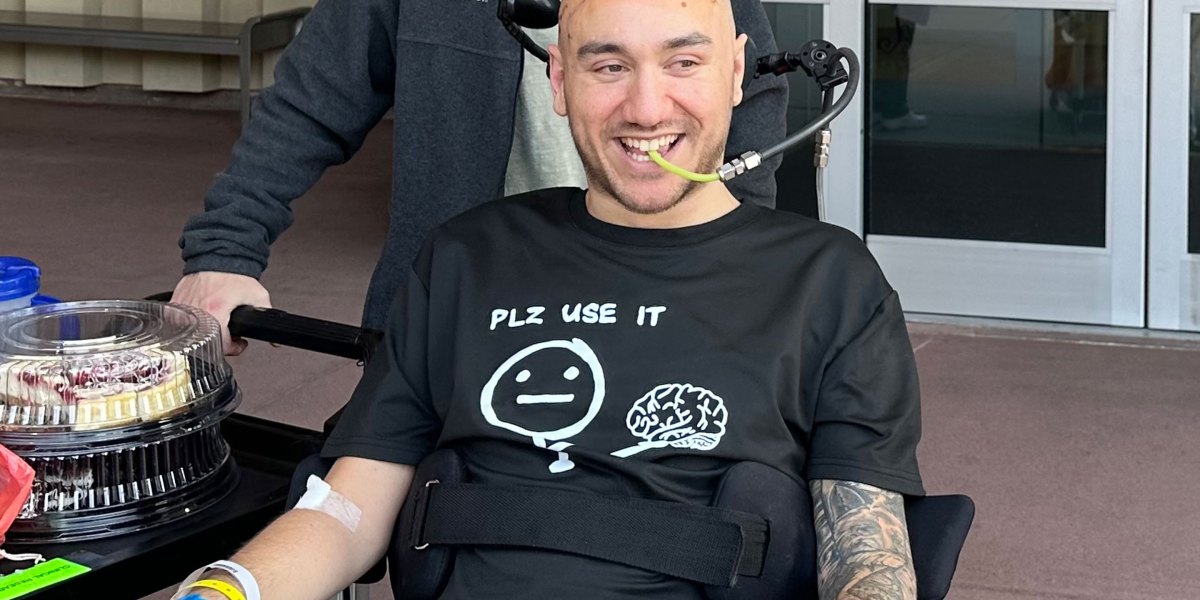
It was February 2024 when Noland Arbaugh, the first person to get Elon Musk’s experimental brain chip, rolled across the stage in a wheelchair during a Neuralink “all hands” meeting, revealing his identity for the first time.
The room, filled with Neuralink employees, erupted in applause as Arbaugh—who dislocated two of his vertebrae in a swimming accident in 2016 and has since lost sensation and movement below his shoulders—smiled ear-to-ear in his chair, a red Texas A&M hat planted on his head. He grinned as he began to speak: “Hello, humans.”
About a month before that town hall, Arbaugh had undergone surgery at the Barrow Neurological Institute in Phoenix, about 2.5 hours from his home in Yuma, to get an experimental chip embedded into his brain which Neuralink had been working on and testing on animals for the past nine years. Arbaugh was anesthetized and, in a surgery that lasted just under two hours, a Neuralink-made robotic surgery device implanted the chip and connected tiny threads with more than 1,000 electrodes to the neurons in his brain. Now the device can measure electrical activity, process signals, then translate those signals into commands to a digital device. In layman’s speak, the BCI , or brain-computer interface, allows Arbaugh to control a computer with his mind. As a result, Arbaugh can do things like play Mario Kart, control his television, and turn his Dyson air purifier on and off without physically moving his fingers or any other part of his body.
The first day that Arbaugh used his device, he beat the 2017 world record for speed and precision in BCI cursor control. “It was very, very easy to learn how to use,” he tells me in an interview.
When Arbaugh became Participant 1—or “P1” as he is often referred to by Neuralink employees and subsequent study participants—he joined a list of about 80 people to ever receive such a device. Brain chip interfaces have been a focus of neurological study for more than 50 years, and there’s a dozen companies in the U.S. and China that have been conducting limited human trials since 1998.
But becoming the first patient to get a Neuralink implant, in particular, is its own right of passage. For one, Neuralink’s device has threads with more than 1,000 electrodes, giving the device a much higher connectivity rate than most of the BCIs currently being studied in humans in the market. But Neuralink also places its electrodes in the motor cortex, the part of the brain that controls movement—a more invasive approach than competitors like Synchron or Precision Neuroscience, which also have ongoing studies of multiple patients. Neuralink’s device is also wireless, versus competitors like Blackrock Neurotech that require a wired connection from the implant through the skull to an external receiver for signal capture and decoding (BlackRock Neurotech sells a wireless processor that has been used for research). That means Neuralink participants can go cordless—but the device is battery powered because of it and does need to be charged: around every five hours or so, Arbaugh says. Neuralink heat treats the charger, a coil, into some of Arbaugh’s hats, so that he can recharge it while wearing a hat. In the beginning, Arbaugh couldn’t use the device while it charged, though that’s since been updated.
Of course, there is also the fact that Neuralink is Elon Musk’s brain chip company, which draws an entirely different level of scrutiny and attention to any study participant. Since Arbaugh revealed himself as “P1,” he has become a public figure, frequently invited on podcasts and having journalists show up at his home. His X account has been hacked, and he told me that a SWAT team showed up with AR15s after someone gave a false tip to the local sheriff’s office that Arbaugh was in danger.
When I first reached out to Arbaugh in early June to see how the BCI had changed his day-to-day 1.5 years in, it took a couple months for us to finally pin down a time. When we finally did hop on the phone, he laughed. “I’m just so busy all the time,” he says. “That is so different than what life was like before… I feel like I’m playing catch-up for eight years of not doing anything—kind of lying around, staring at walls.”
Since Arbaugh became the first Neuralink patient in January 2024, there have been eight more individuals, including one woman, to enroll in the company’s ongoing clinical trials, which are now open in the U.S., Canada, Great Britain, and the United Arab Emirates. So far, all of the surgeries have taken place at hospitals in the U.S., with two of the participants receiving the implant on the same day at the end of July. All of the study participants suffer from either paralysis or ALS, a nervous system disease that causes loss of muscle control. “Our goal is to really build a whole brain interface,” Neuralink cofounder and president DJ Seo, said during Neuralink’s summer update meeting.
For Arbaugh, the Neuralink device has been entirely transformative, he says. He uses it about 10 hours a day to control his computer so he can study, read, and game—and to handle things like scheduling an interview with me. Arbaugh enrolled in classes at his community college in Arizona, where he has started taking prerequisites he needs for a degree in neuroscience, and, as he tells Fortune, he’s working on starting his own business—paid professional speaking engagements and live talks.
As he talks about all of it with me, his excitement—and a newfound sense of purpose—is palpable. Before his surgery, “I would stay up all night and sleep all day, and I didn’t really [want to] bother anyone or ruin any plans or get in the way of anything,” he says. “I just had no purpose… I was just kind of going through the motions, waiting for something to happen.”
Arbaugh never lost the ability to think or speak due to his accident. But in the last year and a half, he has regained more of the autonomy he lost with his disability, and is able to do more things for himself. “I feel like I have potential again. I guess I always have had potential, but now I’m finding a way to fulfill that potential in meaningful ways. It’s a lot different.”
‘Never doubted for a second’
When you talk to Arbaugh, he makes all of it seem rather simple. He had never heard of a “BCI,” or Neuralink for that matter—until his friend from military school, an Elon Musk buff, learned of the first Neuralink clinical trial while researching SpaceX at the end of 2023, Arbaugh recalls. The friend, Greg Bain, reached out to Arbaugh, who signed up to join the very same day (though Bain spelled his name wrong on the application).
Apu Gomes/Getty Images
“I never doubted for a second that it would work,” Arbaugh, who personally didn’t have strong opinions of Elon Musk one way or another, says.
Arbaugh says he received an email from the Barrow Neurological Institute the day after he applied, and started going through the process. There was a screening call and an interview, and then about a month later, he was going into the nearby hospital for a full day of scans and testing. About three months after he applied, Arbaugh found out that he was going to be the first participant, and his surgery was scheduled a few weeks later. While Arbaugh is not paid, Neuralink covers the cost of the surgery and the implant, and the company reimburses him for travel to and from his check-ups or for expenses directly related to the study. (Arbaugh says that, with FDA approval, Neuralink did pay him for two talks he gave at Neuralink, including the February 2024 talk where he revealed his identity for the first time)
Despite the risks of being the first participant of an experimental clinical trial, Arbaugh says it was an easy decision for him. “I decided that, even if it didn’t work—even if something went terribly wrong—I knew that it would help someone down the road,” Arbaugh says. “And I knew that good or bad, they would learn something and push this technology forward.”
Technically I am a cyborg because I have been enhanced by a ‘machine’, but I still see myself as a regular guy
Noland Arbaugh, Neuralink’s first study participant
As you may imagine, it was a little harder for his parents. Arbaugh says he remembers sending his mother the consent forms he had to sign for her to read over, which contained a laundry list of potential risks associated with the surgery—and every imaginable thing that could go wrong with the experimental device. He said she read one or two items and then put them away, unable to read any further. But ultimately, both his parents supported his decision, he says, and never showed that the decision was hard on them. “I hadn’t really been excited about many things before that point, so they were just happy to help in any way they could,” he says.
Arbaugh was also extremely decisive in his choice to go public with his identity. He says he wanted to show people that he believed this device was safe, and what could be possible for those who used it.
“I wanted to share it with people, because I thought it was huge, and I still do,” Arbaugh says. “I think it’s one of the biggest leaps in technology that we’ve had in a really long time, and I think that it’s going to keep growing.”
Arbaugh insists that Neuralink has never tried to dictate what he can or can’t say publicly, and he says he has never been asked to sign any kind of non-disclosure agreement. It’s been the opposite, he says: Neuralink staffers have encouraged him to disclose whatever he’d like to. But he has voluntarily chosen not to talk about some things on occasion. For example, shortly after his surgery, some of the threads retracted, causing him to lose much of the control he had over the device. The incident was later published in the Wall Street Journal, and Neuralink published a blog post about it. It was a big deal, Arbaugh says, but he decided to wait for the team to figure out what had happened and how to repair it, which they did.
Revealing something like that at the time would have been “extremely rash of me, and it would have absolutely made people lose faith in the product,” he says. “That’s not what I want. I love this thing. I love what Neuralink is doing. I love all of it, and I’m really proud of it.”
Next up at Neuralink
In the summer update meeting Neuralink published publicly, Seo laid out what the company is focused on next. Neuralink is starting a trial in the United Arab Emirates, called “Blindsight,” that would help restore sight to the blind. Neuralink is already developing robotic arms for participants, and, during the presentation, Musk said that the company wants to give them sensory control to where they could essentially “inhabit an Optimus robot” and control it with their minds, or attach an Optimus arm or leg to a person to give them full control again of that part of their body.
“The future is going to be weird, but pretty cool,” he said.

Stanislav Kogiku/SOPA Images/LightRocket via Getty Images
As of right now, Neuralink is still adding patients to its various trials. At the end of July, Neuralink announced it had received approval to introduce a trial in Great Britain via University College London Hospitals and Newcastle Hospitals.
Neuralink still has plenty of critics for its more-invasive BCI approach and—true to form for all of Elon Musk’s companies—the high employee expectations and long work hours have led to high turnover as a result. Neuralink has also been accused of poor treatment of the monkeys it’s used to test its Link devices. (Regarding treatment of its animals, Neuralink says it works with animals in “the most humane and ethical way possible.” Several of the Neuralink study participants that I spoke also contested the claim of animal mistreatment).
While some of Musk’s other companies, including SpaceX and the Boring Company, have been accused of being lax when it comes to safety precautions, Musk is adamant that Neuralink is moving slowly and carefully as Neuralink tests its brain chips.
“We’re very cautious with the Neuralinks in humans,” Musk said during the summer update. “That’s the reason we’re not moving faster than we are is because we are taking great care with each individual to make sure we never miss.”
As more Neuralink patients become vocal about the Neuralink BCI and the company, Neuralink is garnering more global recognition, and investors are pouring in hundreds of millions of capital.
Indeed, there is something uniquely compelling about the vision at Neuralink and its mission to help those with disabilities. And there’s something uniquely compelling about Arbaugh, too. Perhaps it’s his sense of humor, his earnestness, or his humility—but it’s hard not to like him at once.
He speaks about his three conversations with Musk—once via FaceTime the day of his surgery, in person post-surgery, then later at the Austin Gigafactory—nonchalantly, saying Musk is a “cool dude” who “has done a lot of his life and is super impressive, but at the end of the day is just another guy.”
After our interview, I asked Arbaugh if he considers himself a “cyborg”—the scifi term coined in the ’60s to describe a human being who has been enhanced by a technological body part or device. “Technically I am a cyborg because I have been enhanced by a ‘machine,’” he says. “But I still see myself as a regular guy… But it’s fun to play around with.”
A year-and-a-half after his surgery, Arbaugh still has so much to say about all of it: about neuroscience, about his faith, and about what technology is making possible for paralysis. This whole ordeal has given him a new appreciation for what’s possible, he says: “I always thought that [paralysis was] going to be fixed through drugs, or some sort of new surgery, or something they discovered in science—stem cells or something of that nature.”
But now that he has been thrust into the tech world, Arbaugh says he’s thinking about it differently. “I see how the advancements in tech at this point are going to solve so many things. They are, I think, the future of medicine. I think a lot of disabilities, cures, and answers that we’ve been searching for a long time will come through tech—and that kind of surprised me.”
In the meantime, there is a lot for him to soak up in this new way of life—where he can play Mario Kart with his dad, go back to college, and build a business: “I definitely didn’t expect for this to ever happen,” he says.