Connect with us

Business

Nearly 70% of the miles of the 10 longest interstates is now within 10 miles of a fast EV charger

Published

on


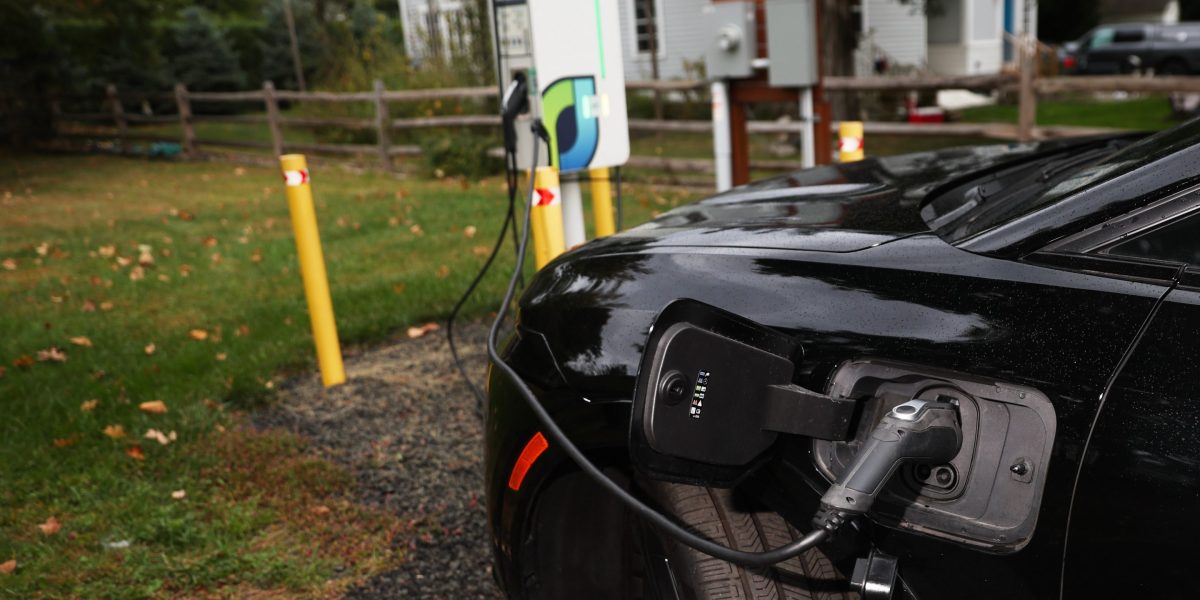
For most Americans, there’s less reason than ever to worry about finding chargers to fuel up an electric vehicle. But charging worries remain a top hesitation for potential buyers, second only to sticker shock.

Those concerns linger even as fast chargers multiply. More than 12,000 have been added within a mile of U.S. highways and interstates just this year, an Associated Press analysis of data from the National Renewable Energy Laboratory shows. That’s about a fifth of quick-charging ports now in operation.

Yet a new poll from The Associated Press-NORC Center for Public Affairs Research and the Energy Policy Institute at the University of Chicago finds about 4 in 10 of U.S. adults still point to range and charging time as “major” reasons they wouldn’t buy an EV. That’s significant considering only about 2 in 10 Americans say they would be “extremely” or “very” likely to make a new or used electric vehicle their next car purchase.

That’s a perception Daphne Dixon, leader of a nonprofit that advocates for clean transportation, has been trying to fight. She has taken a coast-to-coast road trip in an EV each year since 2022. Always sporting hot pink and waving a bubblegum checkered race flag to match, Dixon posts snapshots of the charging experience along her 3,000-mile (4,828-kilometer) route, hoping to “bust” Americans’ anxiety about range and charging.

Dixon said she has repeatedly found that “range anxiety is stuck in people’s heads,” even though the gap in price between gas and electric cars is closing and more chargers are being installed.

“A lot of people still fear that there’s not enough chargers, but what they’re not seeing is that chargers are being put in every single day,” she said.

Fast chargers expand, but worries remain

Traveling on Interstate 80, the longest American interstate, a driver will encounter few stretches that are more than 10 miles (16 kilometers) away from a fast charger, all the way from New York City to Des Moines. Out West, coverage is spottier. But the miles on I-80 covered by fast chargers has increased by 44% since 2021, the AP analysis found.

Drivers would have a similar experience on other major roads. Nearly 70% of the combined length of the 10 longest interstates is within 10 miles of a fast charger — up from about half just five years ago.

Installing fast chargers is considered critical to supporting EV adoption because they can refill a fully electric vehicle in 20 minutes to an hour. Compare that to home chargers, which often take four to 10 hours.

In Dixon’s home state of Connecticut, drivers still fret about charging. In the fall, Dixon takes a shorter trip along Route 7, a scenic drive full of river bends and antiques barns. Fast chargers are scarce along the route, as they still are in many rural parts of the U.S.

The only plug in Kent, a town about 50 miles (80 kilometers) north of Norwalk, is an aging machine at town hall that’s long been defunct, said Lynn Mellis Worthington, chair of the town’s sustainability team.

Connecticut’s state government plans to use $1.3 million in federal funds to install eight fast-charging plugs at two stations in New Milford, about 15 miles (24 kilometers) down Route 7 from Kent. The Trump administration sought to cancel those federal funds earlier this year, before reinstating them in August after multiple states sued over the halt of the $5 billion program. Congress had approved the funds in 2021under the Bipartisan Infrastructure Law.

Mellis Worthington and her husband considered an EV when they replaced their 15-year-old Pontiac Vibe this year. She said prices for cars with enough range to make her husband feel comfortable with his commute were still too high. So despite her high hopes of going full electric, they went with a hybrid instead.

“Our next car will definitely be an EV,” she said.

Vehicle price still top barrier for buyers

While many are concerned about charging, price is still the reason U.S. adults most commonly gave when asked why they would not buy one, the AP-NORC/EPIC poll shows. Only about 2 in 10 U.S. adults said the high cost is “not a reason” for holding off on an EV purchase.

Electric vehicles held about 8% of the U.S. market share in 2024, up from 1.9% five years prior, according to data from Atlas Public Policy.

In the long run, owning an EV may be cheaper due to lower maintenance costs and the lower price of electricity compared to fuel in many places, said Daniel Wilkins, a policy analyst at Atlas Public Policy.

Still, “everyday Americans are focused more on the sticker price upfront,” he said.

And with federal incentives expiring at the end of September, the final bill for many prospective buyers has effectively increased by $7,500 for a new EV.

Electric vehicle advocates are quick to point out the average U.S. resident drives no more than 30 miles (48 kilometers) per day, according to AAA, well within the range modern EVs offer. Most electric vehicle owners, like Bloomfield resident Jim Warner and his wife, do the majority of their charging at home.

Warner has one EV and one plug-in hybrid vehicle. He’s taken the EV, a Chevy Bolt with a roughly 250-mile (402 kilometer) range per charge, on a 400-mile (643-kilometer) trip to Maine twice since he bought it in 2022.

“The first trip, I turned the heat off. I made sure I drove 65,” Warner said. “The second time I just drove normally and had no problem.”


Source link

Continue Reading

Business

Netflix cofounder started his career selling vacuums door-to-door before college—now, his $440 billion streaming giant is buying Warner Bros. and HBO

Published

on


Reed Hastings may soon pull off one of the biggest deals in entertainment history. On Thursday, Netflix announced plans to acquire Warner Bros.—home to franchises like Dune, Harry Potter, and DC Universe, along with streamer HBO Max—in a total enterprise value deal of $83 billion. The move is set to cement Netflix as a media juggernaut that now rivals the legacy Hollywood giants it once disrupted.

It’s a remarkable trajectory for Netflix’s cofounder, Hastings—a self-made billionaire who found a love for business starting as a teenage door-to-door salesperson.

“I took a year off between high school and college and sold Rainbow vacuum cleaners door to door,” Hastings recalled to The New York Timesin 2006. “I started it as a summer job and found I liked it. As a sales pitch, I cleaned the carpet with the vacuum the customer had and then cleaned it with the Rainbow.”

That scrappy sales job was the first exposure to how to properly read customers—an instinct that would later shape Netflix’s user-obsessed culture. After graduating from Bowdoin College in 1983, Hastings considered joining the Marine Corps but ultimately joined the Peace Corps, teaching math in Eswatini for two years. When he returned to the U.S., he obtained a master’s in computer science from Stanford and began his career in tech.

The idea for Netflix reportedly came a few years later in the late 1990s. After misplacing a VHS copy of Apollo 13 and getting hit with a $40 late fee at Blockbuster, Hastings began exploring a mail-order rental service. While it’s an origin story that has since been debated, it marked the start of a company that would reshape global entertainment.

Hastings stepped back as CEO in 2023 and now serves as Netflix’s chairman of the board. He has amassed a net worth of about $5.6 billion. He’d be even richer if he didn’t keep offloading his shares in the company and making record-breaking charitable donations.

Netflix’s secret for success: finding the right people

Hastings has long said that one of the biggest drivers of Netflix’s success is its focus on hiring and keeping exceptional talent.

“If you’re going to win the championship, you got to have incredible talent in every position. And that’s how we think about it,” he told CNBC in 2020. “We encourage people to focus on who of your employees would you fight hard to keep if they were going to another company? And those are the ones we want to hold onto.”

To secure top performers, Hastings said he was more than willing to pay for above-market rates. 

“With a fixed amount of money for salaries and a project I needed to complete, I had a choice: Hire 10 to 25 average engineers, or hire one ‘rock-star’ and pay significantly more than what I’d pay the others, if necessary,” Hastings wrote. “Over the years, I’ve come to see that the best programmer doesn’t add 10 times the value. He or she adds more like a 100 times.”

That mindset also guided Netflix’s leadership transition. When Hastings stepped back from the C-suite, the company didn’t pick a single successor—it picked two. Greg Peters joined Ted Sarandos as co-CEO in 2023.

“It’s a high-performance technique,” Hastings said, speaking about the co-CEO model. “It’s not for most situations and most companies. But if you’ve got two people that work really well together and complement and extend and trust each other, then it’s worth doing.”

Netflix’s stock has soared more than 80,000% since its IPO in 2002, adjusting for stock splits.

Netflix brought unlimited PTO into the mainstream

Netflix’s flexible workplace culture has also played a key role in its success, with Hastings often known for prioritizing time off to recharge. 

“I take a lot of vacation, and I’m hoping that certainly sets an example,” the former CEO said in 2015. “It is helpful. You often do your best thinking when you’re off hiking in some mountain or something. You get a different perspective on things.”

The company was one of the first to introduce unlimited PTO, a policy that many firms have since adopted. About 57% of retail investors have said it could improve overall company performance, according to a survey by Bloomberg. Critics have argued that such policies can backfire when employees feel guilty taking time off, but Hastings has maintained that freedom is core to Netflix’s identity. 

“We are fundamentally dedicated to employee freedom because that makes us more flexible, and we’ve had to adapt so much back from DVD by mail to leading streaming today,” Hastings said. “If you give employees freedom you’ve got a better chance at that success.”

Netflix’s other cofounder, Marc Randolph, embraced a similar philosophy of valuing work-life balance.

“For over thirty years, I had a hard cut-off on Tuesdays. Rain or shine, I left at exactly 5 p.m. and spent the evening with my best friend. We would go to a movie, have dinner, or just go window-shopping downtown together,” Randolph wrote in a LinkedIn post.

“Those Tuesday nights kept me sane. And they put the rest of my work in perspective.”


Source link

Continue Reading

Business

‘This species is recovering’: Jaguar spotted in Arizona, far from Central and South American core

Published

on


The spots gave it away. Just like a human fingerprint, the rosette pattern on each jaguar is unique so researchers knew they had a new animal on their hands after reviewing images captured by a remote camera in southern Arizona.

The University of Arizona Wild Cat Research and Conservation Center says it’s the fifth big cat over the last 15 years to be spotted in the area after crossing the U.S.-Mexico border. The animal was captured by the camera as it visited a watering hole in November, its distinctive spots setting it apart from previous sightings.

“We’re very excited. It signifies this edge population of jaguars continues to come here because they’re finding what they need,” Susan Malusa, director of the center’s jaguar and ocelot project, said during an interview Thursday.

The team is now working to collect scat samples to conduct genetic analysis and determine the sex and other details about the new jaguar, including what it likes to eat. The menu can include everything from skunks and javelina to small deer.

As an indicator species, Malusa said the continued presence of big cats in the region suggests a healthy landscape but that climate change and border barriers can threaten migratory corridors. She explained that warming temperatures and significant drought increase the urgency to ensure connectivity for jaguars with their historic range in Arizona.

More than 99% of the jaguar’s range is found in Central and South America, and the few male jaguars that have been spotted in the U.S. are believed to have dispersed from core populations in Mexico, according to the U.S. Fish and Wildlife Service. Officials have said that jaguar breeding in the U.S. has not been documented in more than 100 years.

Federal biologists have listed primary threats to the endangered species as habitat loss and fragmentation along with the animals being targeted for trophies and illegal trade.

The Fish and Wildlife Service issued a final rule in 2024, revising the habitat set aside for jaguars in response to a legal challenge. The area was reduced to about 1,000 square miles (2,590 square kilometers) in Arizona’s Pima, Santa Cruz and Cochise counties.

Recent detection data supports findings that a jaguar appears every few years, Malusa said, with movement often tied to the availability of water. When food and water are plentiful, there’s less movement.

In the case of Jaguar #5, she said it was remarkable that the cat kept returning to the area over a 10-day period. Otherwise, she described the animals as quite elusive.

“That’s the message — that this species is recovering,” Malusa said. “We want people to know that and that we still do have a chance to get it right and keep these corridors open.”


Source link

Continue Reading

Business

MacKenzie Scott tries to close the higher ed DEI gap, giving away $155 million this week alone

Published

on


MacKenzie Scott has arguably been the biggest name in philanthropy this year—and has nonstop been making major gifts to organizations focused on education, DEI, disaster recovery, and many other causes.

This week alone, several higher education institutions announced major gifts from the billionaire philanthropist and ex-wife of Amazon founder Jeff Bezos—donations totaling well over $100 million. In true Scott fashion, many of these donations are the largest single donations these schools have ever received.

The donations announced this week include: 

  • $50 million to California State University-East Bay
  • $50 million to Lehman College (part of the City University of New York system)
  • $38 million to Texas A&M University-Kingsville
  • $17 million to Seminole State College

All four institutions are public, access-oriented colleges that enroll large shares of low‑income, first‑generation, and racially diverse students and function as minority‑serving institutions or similar engines of social mobility. They fit MacKenzie Scott’s broader pattern of directing large, unrestricted gifts to colleges that serve “chronically underserved” communities rather than already wealthy, highly selective universities.

Scott, who is worth about $40 billion and has donated over $20 billion in the past five years, has doubled down this year on causes that the Trump administration has cut deeply, such as education, DEI, and disaster recovery.

“As higher education, in general, works to find its way in an uncertain environment, this gift is a major source of encouragement that we are on the right path,” Lehman College President Fernando Delgado said in a statement. 

Scott also made one of the largest donations in HBCU Howard University’s 158-year history with an $80 million gift earlier this fall, and a $60 million donation to the Center for Disaster Philanthropy after Trump administration’s cuts to the Federal Emergency Management Agency (FEMA)—an organization Americans rely on for help during and after hurricanes, wildfires, tornadoes, and floods.

“All sectors of society—public, private, and social—share responsibility for helping communities thrive after a disaster,” CDP president and CEO Patricia McIlreavy previously told Fortune. “Philanthropy plays a critical role in providing communities with resources to rebuild stronger, but it cannot—and should not—replace government and its essential responsibilities.”

Trust-based philanthropy

Scott accumulated the vast majority of her wealth from her 2019 divorce from Bezos, but is dedicated to giving away most of her fortune. She’s considered a unique philanthropist in today’s environment because her gifts are typically unrestricted, meaning the organizations can use the funding however they choose. 

“She practices trust-based philanthropy,” Anne Marie Dougherty, CEO of the Bob Woodruff Foundation previously told Fortune. Scott has donated $15 million to the veteran-focused nonprofit organization in 2022, and made a subsequent $20 million donation this fall.

Scott is also considered one of the most generous philanthropists, and credits acts of kindness for inspiring her to give back.

“It was the local dentist who offered me free dental work when he saw me securing a broken tooth with denture glue in college,” Scott wrote of her inspiration for philanthropy in an Oct. 15 essay published to her Yield Giving site. “It was the college roommate who found me crying, and acted on her urge to loan me a thousand dollars to keep me from having to drop out in my sophomore year.”


Source link

Continue Reading

Trending

Copyright © Miami Select.