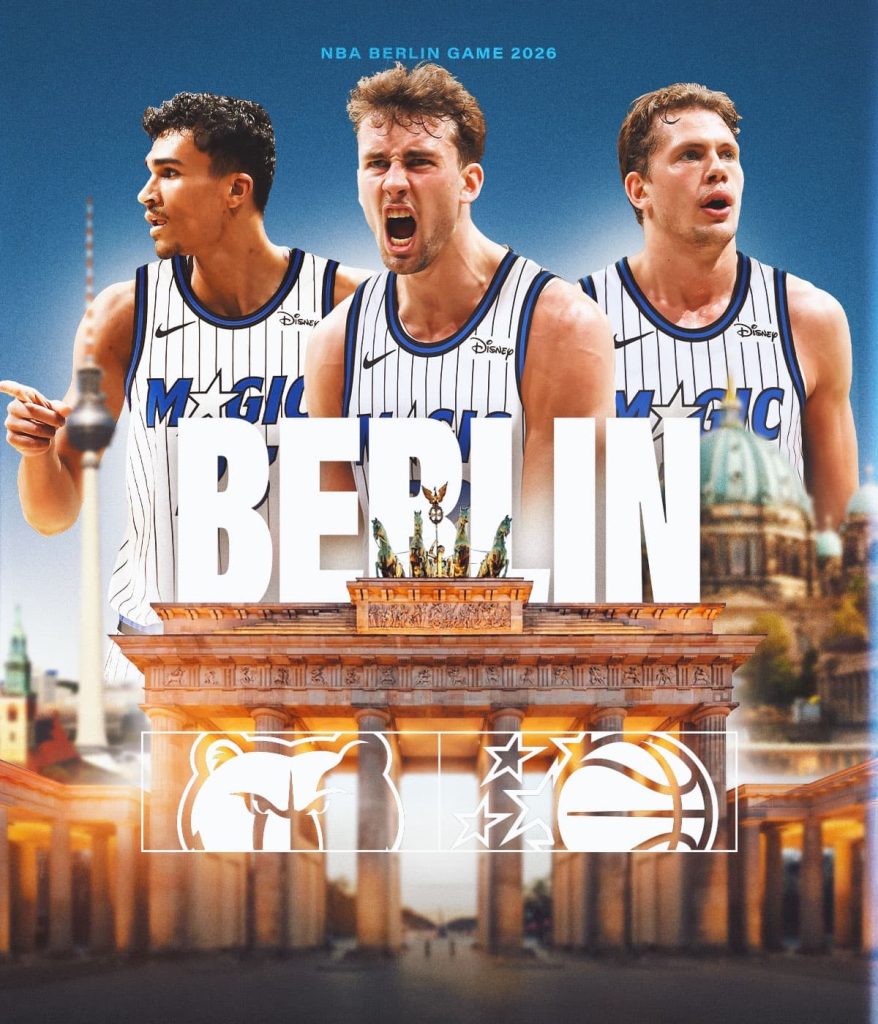
The National Basketball Association will send the Memphis Grizzlies and the Orlando Magic to Europe for a pair of regular-season games in January, continuing the league’s long-standing effort to grow its global footprint. The teams will meet on January 15 in Berlin, Germany, followed by a second game on January 18 in London, England. While international games are not new for the NBA, the locations and timing have drawn attention for reasons that go beyond the games themselves.
The league has played preseason and regular-season contests across Europe for decades, using them to strengthen fan engagement and commercial ties. This trip, however, arrives as the NBA quietly prepares for a much more ambitious project that could reshape professional basketball on the continent.
Eyes on a New NBA-FIBA European League
Behind the scenes, the NBA and FIBA are continuing discussions about launching a new European league as early as 2027. FIBA, the governing body of international basketball, has been working with the NBA on a model that would blend American-style commercial growth with European basketball traditions. The proposed league would feature 16 teams, with the NBA reportedly targeting 12 major cities as potential homes.
Those cities include London and Manchester in England, Paris and Lyon in France, Barcelona and Madrid in Spain, Milan and Rome in Italy, Berlin and Munich in Germany, as well as Athens, Greece and Istanbul, Turkey. The choice of Berlin and London for the Grizzlies–Magic games appears deliberate, as both cities are high on the NBA’s list of priority markets.
The EuroLeague Factor
Any new NBA-backed European competition would face immediate challenges from the existing EuroLeague. Founded in 1958, the EuroLeague has evolved into the continent’s premier club competition and currently features 18 teams. It has deep roots, loyal fan bases, and strong cultural ties in many European basketball hotbeds.
The NBA has stated it wants to respect European basketball traditions, but it is also focused on maximizing commercial potential. That reality sets up a possible conflict. The NBA could attempt to coexist with the EuroLeague, but it could also seek to recruit top EuroLeague clubs into its new venture, potentially weakening the established competition in the process.
Political and Economic Headwinds
There is also an unexpected complication. Ongoing trade tensions and American tariffs have strained relations between the United States and the European Union. The EU’s response to those policies has not been favorable, and public sentiment could play a role in how a new American-backed league is received.
While traditional basketball strongholds like Madrid, Barcelona, and Athens already have entrenched teams, Europe still offers numerous untapped or underdeveloped markets. The NBA may view those cities as opportunities, even if resistance emerges in more established regions.
A Business Decision at Its Core
Ultimately, the NBA’s interest in Europe is driven by growth. If expanding into the European market means challenging or even displacing the EuroLeague, the league may be willing to accept that outcome. The Grizzlies and Magic games may be exhibitions on the surface, but they could also be a preview of a much larger shift in the global basketball landscape.
Manchester United have sacked Ruben Amorim after a turbulent 14-month spell that ended in a breakdown of trust between the head coach and the club’s hierarchy. The decision was confirmed on Monday morning, less than 24 hours after Amorim publicly hinted at internal interference behind the scenes.
Amorim was appointed in November 2024 and guided United to the UEFA Europa League final in Bilbao last May. Despite that European run, domestic form and growing internal tension pushed the club toward a reluctant but decisive change.
Breakdown Behind the Scenes
Sources close to the club say Amorim’s relationship with United’s leadership fractured following a heated meeting with director of football Jason Wilcox at Carrington last Friday. Wilcox called the meeting to address United’s disappointing 1-1 draw against Wolverhampton Wanderers and urged Amorim to show greater tactical flexibility.
Wilcox wanted the Portuguese coach to trust his players more and move away from the back-three system that many inside the club blamed for United’s inconsistent form. Amorim reacted badly. One insider described his response as explosive, leaving no room for constructive dialogue.
Amorim carried that frustration into his pre-match press conference, where his body language and tone hinted at deep frustration with senior figures at the club.
Tactical Stubbornness and Mounting Frustration
United’s hierarchy grew increasingly concerned about Amorim’s unwillingness to adapt. He had briefly switched to a back four during an impressive win over Newcastle United, only to revert to three central defenders against Wolves, a team rooted to the bottom of the table.
Senior figures felt United should not need to “match up” tactically with struggling opponents. That frustration intensified after the club spent more than £250 million on players they believed could operate in multiple systems.
Instead, Amorim continued to rely on the 3-4-2-1 formation that defined his managerial career. The lack of evolution became a decisive factor in his downfall.
Transfer Tensions and Public Comments
Tensions also flared over the January transfer window. Amorim pushed for a new midfielder, but United only sanctioned moves for long-term targets. Several of those players proved unavailable or destined for rival clubs.
Behind the scenes, United felt Amorim had agreed to previous recruitment strategies. His sudden public complaints during press conferences confused and irritated senior figures.
After a 1-1 draw with Leeds United, Amorim insisted he was the manager, not merely the coach, and challenged the club’s sporting department to “do their job.” Those remarks caused alarm inside Old Trafford and accelerated a decision that was already taking shape.
Decision Backed at the Top
The final call came from Wilcox and chief executive Omar Berrada, with full board support. Although Ineos chairman and co-owner Jim Ratcliffe had backed Amorim strongly, that support was not unconditional.
United officials feared the team risked missing out on European qualification. Despite sitting sixth in the Premier League and only three points off fourth, recent draws and defeats raised serious doubts about the season’s direction.
Amorim won 25 and lost 23 of his 63 matches in charge. He becomes the sixth Manchester United manager to lose his job since Sir Alex Ferguson retired in 2013.
Fletcher Steps In, Future Unclear
Darren Fletcher will take charge on an interim basis, starting with Wednesday’s match against Burnley at Turf Moor. Fletcher, a former United midfielder who spent 13 seasons at the club, currently coaches the under-18s.
United plan to appoint an interim manager until the end of the season before making a permanent appointment in the summer.
In a club statement, United said they believed the change would give the team “the best opportunity of the highest possible Premier League finish.”
For Amorim, the exit ends a spell that promised much but ultimately collapsed under pressure, rigidity, and fractured relationships at one of football’s most demanding institutions.
The Tampa Bay Buccaneers’ 50th anniversary season officially ended at 4:12 p.m. on January 4, 2026, when the Atlanta Falcons edged the New Orleans Saints 19–17, creating a dramatic three‑way tie atop the NFC South. Despite Tampa Bay’s gritty win over Carolina the day before, the tiebreakers favored the Panthers, handing them the division crown and ending the Bucs’ streak of six straight postseason appearances and four consecutive NFC South titles. It was a bitter conclusion to a season that began with promise and ended with frustration, missed opportunities, and a division slipping away in the final minutes of Week 18.
A Collapse Defined by Missed Opportunities
The Buccaneers’ failure to repeat as division champions can be traced back to a season that started 6–1 but unraveled quickly. Tampa Bay won just two of its final nine games, including losses to multiple teams with losing records — the Falcons, Panthers, Saints, and Cardinals — all by three points or fewer. Any one of those games, had it gone the other way, would have made Saturday’s win over Carolina the clincher for a fifth straight NFC South title.
Instead, even as the Bucs slogged through a dark, rainy Saturday afternoon and beat the Panthers, they no longer controlled their destiny. Their season, in truth, ended long before the Falcons’ victory over the Saints made it official.
Todd Bowles’ Future and Major Offseason Decisions Loom
Now the focus shifts to head coach Todd Bowles and the future of his entire coaching staff. The Glazer family must determine how much of the collapse was due to coaching and how much stemmed from a roster ravaged by injuries on both sides of the ball — a theme echoed throughout the national and local media.
Then comes the biggest personnel decision: quarterback Baker Mayfield. Playing hurt for the final six weeks, Mayfield still produced enough to remain a fan favorite and respected locker‑room leader. He enters the final year of his contract in 2026, earning $30 million guaranteed, and according to reporting from Sports Illustrated, the team plans to begin extension discussions during the year. Still, Tampa Bay is expected to explore drafting a quarterback or signing a low‑cost veteran backup, with names such as Malik Willis and Tyler Huntley circulating as potential targets.
More Questions Than Answers as the Offseason Begins
As Tampa Bay enters the offseason, the organization faces more uncertainty than at any point in the last half‑decade. From coaching decisions to quarterback planning to rebuilding depth across the roster, the Buccaneers must confront hard truths about how a season that began with championship aspirations ended in disappointment.
The 50th anniversary season is over — and the next era begins now.
In a tough, double overtime game with over 70 free throws combined by both teams, the USF Bulls took a 109-106 loss on their home court to the UAB Blazers.
In the Bulls’ first game of American Conference play, they got some monster contributions from the usual suspects.
Wes Enis put up 36 points with 10 3 pointers, hitting big bucket after big bucket.
Izaiyah Nelson played his usual stifling brand of defense, but also contributed 23 points and 11 boards.
Unfortunately the biggest blow of the game came when guard CJ Brown fouled out after struggling most of the afternoon with his shot, only posting 8 points on 3-12 shooting from the field.
But the Bulls missed his playmaking dearly in the 2nd overtime, as the offense struggled without his 5 assists on the floor.
UAB managed to get a huge outing off the bench from Chance Westry, who had 24 points and 6 assists on 8-12 shooting from the field.
While it’s a bummer of a start for the Bulls in conference play, they played a very hard-fought game and have no reason to hang their heads based on effort.
They out rebounded UAB 61-49 and had 22 assists as a team.
The biggest thorn in the side of USF was unfortunately their inability to take care of the ball.
The Bulls nearly doubled the turnover total of the Blazers, committing 14 to UAB’s 8.
USF heads to Denton, Texas this Wednesday to take on the North Texas Mean Green, who have taken consecutive losses to begin their conference play against Tulsa and Memphis.
The Bulls have every chance to turn this season into a good one despite the disappointing start, and they certainly showed they have the talent to do so; if Brown stays on the floor, who knows how Sunday’s game turns out?
We’ll see how they bounce back from this loss, as they will undoubtedly want to take advantage of the winnable conference games before playing hefty opponents such as Tulane, Memphis, and Tulsa.