Connect with us

Business

Natasha Lyonne says AI has an ethics problem because right now it’s ‘super kosher copacetic to rob freely under the auspices of acceleration’

Published

on


Actor Natasha Lyonne may not come from the tech world, but her production company is emerging as a trailblazer in bringing AI content to the big screen—and she has thoughts about the tech’s increasing influence.

Lyonne, who is most well-known for an on-screen roles in Netflix’s “Russian Doll” and “Orange is the New Black,” is also a writer, director, and the cofounder of Asteria Film Co., an artist-led animation and film studio that aims to provide high-quality and copyright friendly generative AI for marquee content.

Other AI video-generation models like OpenAI’s Sora 2 and Google’s Veo 3 have run into controversy for scraping the web and sometimes clashing with copyright rules. Asteria, which Lyonne co-founded in 2022, is taking a different approach.

Asteria partnered with Moonvalley AI, which makes AI tools for filmmakers, to create Marey, named after cinematographer Étienne-Jules Marey. The tool helps generate AI video that can be used for movies and TV, but only draws on open-license content or material it has explicit permission to use. 

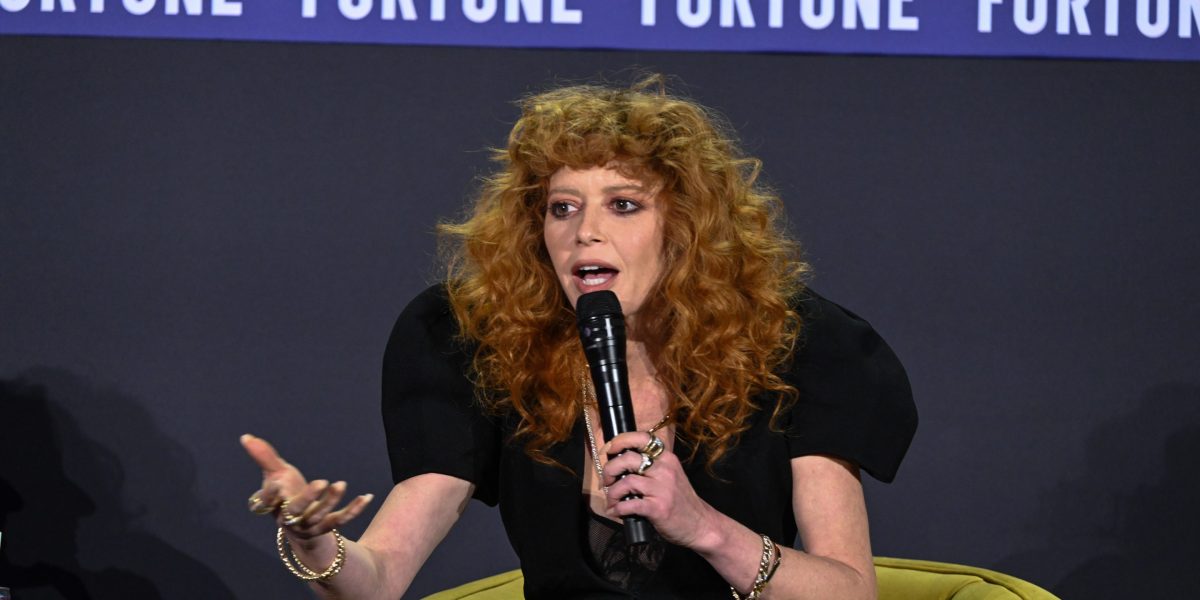
Being careful about the inputs for Asteria’s AI video generation is important, Lyonne said at the Fortune Brainstorm AI conference in San Francisco last week. As AI use increases, both tech and Hollywood need to respect the work of the cast, as well as the crew and the writers behind the scenes. 

“I don’t think it’s super kosher copacetic to just kind of rob freely under the auspices of acceleration or China,” she said. 

While she hasn’t yet used AI to help make a TV show or movie, Lyonne said Asteria has used it in other small ways to develop renderings and other details.

“It’s a pretty revolutionary act that we actually do have that model and that’s you know the basis for everything that we work on,” said Lyonne.

Marey is available to the public for a credits-based subscription starting at $14.99 per month.

While her production company aims to lead the AI charge in Hollywood, Lyonne said it’s important to remember the human aspect of tech. With so many countless possibilities for AI’s uses, she noted it can at least be used to make human lives better, and not purely for “cutting costs.”

“We need human beings in AI so that the tools don’t run us,” she said.


Source link

Continue Reading

Business

Tesla chief designer: Accidentally smashing Cybertruck windows was ‘great marketing moment’

Published

on


Some may call Franz von Holzhausen’s accidental destruction of a Tesla Cybertruck window a blunder; von Holzhausen would prefer to call it a “great meme” instead.

During the 2019 reveal of the Tesla Cybertruck, von Holzhausen, the company’s chief designer, threw steel balls at the vehicle, intending to demonstrate the windows CEO Elon Musk that said were made of “armor glass” were indeed extra tough. The windows, however, unexpectedly shattered, leaving Musk to deliver the rest of his presentation of the new truck while standing in front of the damaged car. Tesla’s stock fell more than 5% the next day.

While the incident seemed like an omen, indicative of the Cybertruck being poised to fail, the botched demonstration actually opened up an opportunity to give the new model a spotlight, von Holzhausen said in an interview with Tesla Club Austria published earlier this year.

“It was just one of those Murphy’s Law kind of things where something bad happens, but it turned out to be a great meme,” von Holzhausen said, referring to the phenomenon of when something can go wrong, it usually will. “And I think in an odd sort of way—we don’t do marketing—but it turned into a great marketing moment.”

He added, “It was not an expected moment, but in that moment, you have to roll with it.”

Following the reveal of the vehicle, Musk posted a video on X of von Holzhausen throwing a steel ball at the model Cybertruck before its launch, with its windows withstanding the force of the throw with no visible damage. The video was viewed more than 6 million times within three days of its posting.

Guess we have some improvements to make before production haha,” Musk wrote.

Days later, Musk touted the success of the Cybertruck launch, saying Tesla had received more than 200,000 orders for the vehicle. While Tesla does not break out Cybertruck numbers when it reports earnings, instead grouping them with the Model S and X, the company recalled nearly all of the Cybertrucks it had on the road earlier this year due to an issue in which an exterior panel could become detached, and that only tallied around 46,000 vehicles.

Bigger problems than broken windows

Despite Musk’s preorder optimism, Cybertruck’s inauspicious launch was a sign of things to come for the vehicle. Though Musk initially bragged the truck would retail at only $39,900 when it was expected to hit the market in late 2021, the Cybertruck faced years of delays, debuting in November 2023 with a price tag of $60,990.

Tesla tried to reclaim the shattered glass mishap with a $45 T-shirt sold on its website, but the brand was developing an otherwise soured reputation on other parts of the internet. In particular, concerns mounted over the security of the Cybertrucks, which saw numerous recalls as a result of a malfunctioning tire pressure monitoring system, among other issues—including the aforementioned recall of all 46,100 Cybertrucks ever delivered back in March.

To pile onto its troubles, multiple deaths have occurred following Cybertruck crashes. One wrongful death lawsuit alleged the truck had defective safety mechanisms after a man in Houston died in a crashed Cybertruck that burst into flames. 

Safety concerns and recalls associated with the Cybertruck have coincided with faltering sales for the truck. The vehicle’s demand remained steady last year, but Cybertrucks were piling up in lots over the summer as dealerships navigate stockpiles of the unwanted vehicles.

Just 16,097 Cybertrucks were delivered in the first three quarters of this year, according to Cox Automotive data, a 38% year-over-year decrease, with the model being eclipsed by the beleaguered Ford F-150 Lightning, which is being discontinued in its all-electric form due to falling demand.

Sales of the Tesla truck have been so dire that the Musk-owned SpaceX has purchased 1,000 Cybertrucks from Tesla and may purchase up to 2,000 vehicles, Elektrek reported last week, citing an anonymous source. Earlier this year, another Musk-founded company, xAI, reportedly purchased unsold Cybertrucks.

Tesla did not respond to Fortune’s request for comment.

A version of this story was published at Fortune.com on Aug. 5, 2025.

More on Tesla:

  • Tesla promotes Optimus as its next big breakthrough, but one robot’s collapse has sparked doubts about their current level of autonomy
  • Elon Musk has started work toward his $1 trillion Tesla pay package. But 2 loopholes foreshadow how it could be a bust for shareholders
  • Elon Musk says Tesla owners will soon be able to text while driving, despite it being illegal in nearly all 50 states
Join us at the Fortune Workplace Innovation Summit May 19–20, 2026, in Atlanta. The next era of workplace innovation is here—and the old playbook is being rewritten. At this exclusive, high-energy event, the world’s most innovative leaders will convene to explore how AI, humanity, and strategy converge to redefine, again, the future of work. Register now.


Source link

Continue Reading

Business

Dartmouth professor says he’s surprised just how scared his Gen Z students are of AI

Published

on


When Scott Anthony (Dartmouth College, class of 1996) left a 20-year career in high-stakes consulting to join the faculty at his alma mater in July 2022, he thought he was leaving the “intense day-to-day combat” of the corporate world for a quieter life of teaching. Instead (as Anthony previously described in a commentary for Fortune), he arrived on campus just months before the release of ChatGPT, landing him squarely in the center of the artificial intelligence (AI) revolution that has left many of his students paralyzed by anxiety.

In a recent interview, the former consultant at McKinsey and Innosight, a boutique firm cofounded by Clayton Christensen and Mark Johnson in 2000 and acquired by Huron in 2017, revealed the prevailing mood among the next generation of business leaders isn’t just excitement—it is fear.

“One of the things that really surprises me consistently is how scared our students are of using it,” Anthony said. He clarified this anxiety isn’t merely about academic integrity or cheating. Plenty of his students are excited to use AI and push into the frontier of this new tech advance, he clarified, but a meaningful portion approach it with “hesitation and fear.” They are “scared full stop.”

“There’s something about AI where people, I think, worry that they’ll lose their humanity if they lean too much into it,” Anthony explained. This is different from many of his long-tenured academic colleagues, who he said are usually eager to dig into the new tools at their disposal. The freshly minted author of Epic Disruptions: 11 Innovations That Shaped our Modern World, Anthony talked to Fortune about teaching a course on disruption while education and work itself is in the middle of being disrupted itself. “History teaches me very clearly that in the middle of a change like this, it’s very messy.”

The fear of losing yourself

Anthony said what he believes about studying disruption, and managing through it as a consultant, is that you look back later on and the pattern becomes clear, but at this particular stage, “there’s just a lot of noise.” He said he understands his students’ concerns about AI and shares it to some extent—offloading too much cognitive work to AI will atrophy the critical thinking skills required to lead.

An eye-catching MIT study published in June would seem to make Anthony’s point. Titled “your brain on ChatGPT,” with a subtitle mentioning “accumulation of cognitive debt.” Widely covered in the media as supporting Anthony’s students’ fear, that AI tools can somehow harm humanity, the study suggested that “cognitive activity scaled down in relation to external tool use.” In other words, it suggests that using AI makes you stupider.

Vitomir Kovanovic and Rebecca Marrone, from the University of South Australia, argued in The Conversation at the time that “brain-only group” repeated the task in question three times, a phenomenon known as the familiarisation effect. The AI control group only got to “use their brains” to perform the task once, they noted, and so achieved only slightly better engagement than the brain-only group’s first try. They argued AI is functioning like a calculator, and tasks haven’t become advanced enough to put students through the ringer, even using AI tools. Anthony, who didn’t comment on that specific MIT study, told Fortune he’s rolled up his sleeves on AI assessments.

“I’ve been teaching a class about how you lead disruptive change,” Anthony said, adding he wants to find someone who needs to learn a particular topic and use AI to tackle that. This doesn’t mean he wants something like, say, an AI-driven song that required one prompt to make. “I want you to actually go and expose the guts of the work that you did so I can then go and see whether you learned anything or not.” Sometimes, he said, elegant outputs are the result from students who didn’t learn anything, but he also gets “rough outputs where when you see what they’re actually doing.”

When asked about the example of someone like Jure Leskovec, the Stanford computer science professor who went fully to blue-book exams several years ago, as Fortune reported in September, Anthony said he respected that, but it wasn’t for him. “I’ve never given a blue-book exam,” he said, noting he’s just a few years removed from his consulting career and he may try it, but he’s not there yet. Some of his colleagues are very strict still: Not only does one colleague still only do blue-book exams, “he does not allow people to go to the bathroom during the exam. You just, you can’t leave the room.”

He agreed with Leskovec some changes are already irreversible: “The writing is all good now. The bad writing has been taken out.” This can be “dangerous,” he added, saying he really pushes his students to resist temptation.

“The thing I’ve just really been pushing, whether it’s students or whether it’s the executives that I’ve been working with, it’s so seductive and easy to say, ‘Let me offload,’” he said. The reason why, he explained, has to do with what he learned about Jerry Seinfeld and Julia Child while researching his book.

What Jerry Seinfeld believes about hard work

To paraphrase Seinfeld, Anthony said he tells his students “the right way is the hard way.” He recalled an interview Seinfeld gave to the Harvard Business Review in 2017 when the famous comedian, with a reputation as a bit of a micromanager, was asked if he ever wanted McKinsey to help with his process. “Who’s McKinsey?” He asked. When told that it was a consulting firm, he countered, “Are they funny?”

Seinfeld was making the point, Alexander told Fortune, that the hard way to be funny is the right way, at least for him. He said he wants students to do the “hard work” to develop the wisdom necessary to manage AI effectively.

“We just have to separate people from technology when we’re assessing learning or else we’re going to get AI regurgitation,” he warned. That can be useful for some things, “but if you’re trying to figure out whether people learn something or not, it’s useless.”

Anthony also drew on a fitness analogy: “You go to the gym, you want to lift any amount of weight, bring a forklift with you. You can lift the weight, but that’s not the point.”

Julia Child‘s long record of failure before success

Anthony said his research, teaching at the Tuck School of Business, and his writing shows people are getting bogged down by AI when they should be focused on the hard work Seinfeld was referencing. Take the example of the famous cooking author Julia Child, which Anthony said was his favorite chapter of the book because it was the most surprising. The lesson he drew from it is that you may not be able to be the next Steve Jobs, but you could be the next Julia Child. “If life bounces the right way, I could imagine that happening to me, you know?”

The professor explained Child’s example shows disruption “isn’t about being a superhero,” but it’s more about ordinary people following certain behaviors and showing curiosity.

“It’s a reminder that there is no straight line to success,” he said. She started working on her masterpiece, Mastering the Art of French Cooking, roughly 10 years—and two publisher changes—before succeeding with it. She also failed her first exam at Paris’ Cordon Bleu, persevering to become the woman who brought French cuisine to mainstream America. “It’s classic hero journey sort of stuff,” he said.

Consider the first French meal that Child cooked for her husband, Anthony said: brain, simmered in red wine. “Everybody agreed it was a disaster.” But again, he said, the hard work was the point.


Source link

Continue Reading

Business

James Talarico says biggest ‘welfare queens’ are corporate giants ‘that don’t pay a penny’ in taxes

Published

on


James Talarico, a 30-year-old former public school teacher and current Texas State Representative, is mounting a 2026 U.S. Senate campaign that challenges conventional wisdom about government spending and corporate responsibility. He represents a growing push to scrutinize corporate tax strategies and reframe the debate around who truly benefits from government support. His arguments about tax avoidance by Fortune 500 companies and wealthy executives are gaining traction among young voters and may influence future tax policy discussions if he gains higher office.

​​During a recent taping of Jubilee Media’s web series Surrounded at the company’s Los Angeles studios, Talarico sat down with roughly 20 undecided Texas voters to debate his policy positions. The episode, which released on Monday, caught fire on social media after Talarico delivered a pointed reframing of conservative rhetoric about welfare spending. In a sharp challenge to long-standing political talking points about “welfare queens”—a term traditionally used to disparage low-income individuals receiving government benefits—Talarico flipped the script, arguing that the nation’s actual dependency on public resources flows upward, not downward.

“The biggest welfare queens in this country are the giant corporations that don’t pay a penny in federal taxes,” he said. He also extended his critique to include wealthy executives, adding “the biggest welfare queens are the CEOs who get a tax deduction for flying on a private jet.”

Corporate tax avoidance as hidden welfare

Talarico’s argument strikes at a real issue: Some of America’s largest corporations have legally structured their tax arrangements to minimize or eliminate federal income tax liability. This practice has drawn scrutiny from policymakers across the political spectrum and sparked ongoing debates about tax code reform.​ So, rather than accepting that welfare is primarily a lower-income issue, he argues the problem is systemic and benefits the wealthy.

Talarico said his background as a middle school language arts teacher at Rhodes Middle School in San Antonio informed many of his policy positions.

“I was a public school teacher, so I saw how when kids showed up hungry, they couldn’t learn,” he told local ABC affiliate KSAT in October. “Even my brightest students, even my hardest working students couldn’t succeed. Couldn’t pull themselves up by their bootstraps when they didn’t have boots.”

To illustrate the point, he invoked a metaphor about teaching someone to fish: “If you’re gonna take your friend out on a boat for the day to teach him how to fish, you wanna make sure he had breakfast that morning. You wanna make sure he’s not sick, because that allows him to learn how to fish again,” he said.

A platform around corporate accountability

Since his election to the Texas House in 2018 at age 28, Talarico has positioned himself as a champion of legislation targeting corporate and pharmaceutical industry practices. He was instrumental in passing legislation capping insulin copays at $25 per month in Texas and enabling the importation of lower-cost medications from Canada.

His Senate campaign messaging appears to hinge on this core idea: that fairness and personal responsibility should apply equally to billionaires and working people.

“We don’t want dependency. We want to reward hard work. And I think that should apply to those billionaires, not just working people,” he said during the recent taping.

​You can watch the entire Surrounded episode featuring James Talarico below:


Source link

Continue Reading

Trending

Copyright © Miami Select.