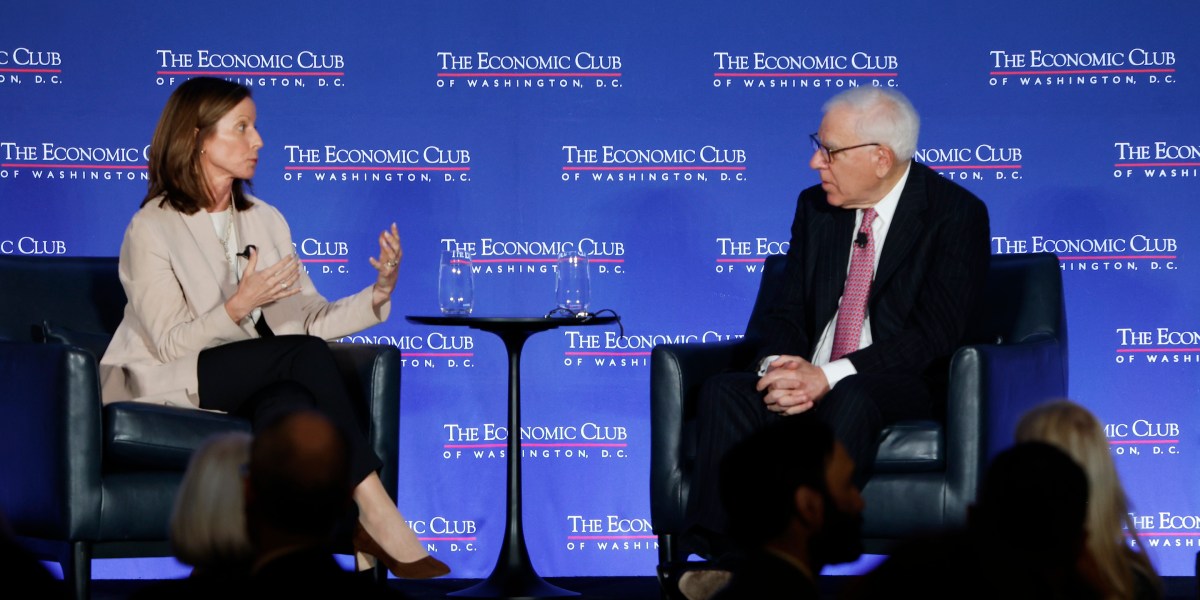
“I don’t think any software business is going to sit still,” Friedman said during a fireside chat with David Rubenstein at an event hosted by the Economic Club of Washington, D.C., on March 11. “Any business that sits still in the world of AI will ultimately fail,” she said.
Friedman views AI as a transformative force redefining how companies operate, including Nasdaq itself. Once known primarily as a stock exchange, Nasdaq has evolved into a large-scale software and technology provider for the financial industry. Nasdaq has 10,000 employees worldwide, and about half are in product and technology, she said.
“We’re leaning in very hard on integrating software at an enterprise level—frankly, an industrial-strength, secure level—to bring that to the industry,” Friedman said. She highlighted how Nasdaq is integrating AI into its systems to make financial operations more efficient and secure. One such tool, Settlement Guard, uses AI to predict settlement failures, helping firms save billions by identifying potential issues before they occur.
“Our financial industry needs precision; they need complete accuracy,” Friedman said. And that includes “battle-tested systems” that are highly secured and able to integrate very complex workflows, she said. AI empowers that, she added, when integrated properly.
Friedman became CEO of Nasdaq in 2017. Her career journey includes the CFO role at Nasdaq, and CFO and managing director at The Carlyle Group, the private equity firm co-founded by Rubenstein. During the fireside chat, Friedman also discussed how her experiences clarified the type of role she preferred. You can read more here.
Sheryl Estrada
sheryl.estrada@fortune.com
Leaderboard
James (Jamie) Coogan was appointed EVP and CFO of Hexcel Corporation (NYSE: HXL), an industrial materials company, effective May 1. Coogan succeeds Mike Lenz, who has been serving as interim CFO. Lenz will remain for a period of time after Coogan joins the company, serving as a senior advisor. Coogan most recently served as EVP and CFO at Axcelis Technologies. Previously, he served as SVP and CFO of Kaman Corporation. During his 15 years at Kaman, he held various management positions, including VP of investor relations and corporate development, assistant VP of external reporting and SEC compliance, and director of external reporting and SEC compliance.
David Ramsay was appointed interim CFO of Halozyme Therapeutics, Inc. (Nasdaq: HALO), a biopharmaceutical company, effective March 23. Ramsay brings more than 30 years of experience. He previously served as Halozyme’s CFO from 2003 to 2009 and again from 2013 to 2015. Ramsay also served as SVP and CFO of Bonti, Inc. until its sale to Allergan plc in October 2018. He will oversee all financial operations while Halozyme continues its search for a permanent CFO.
Big Deal
RevenueCat’s 2026 State of Subscription Apps report provides an analysis of an in-app subscription data set of more than 115,000 apps across all app categories, covering over $16 billion in revenue and more than 1 billion transactions.
One of the key findings is that AI sells, but it’s not sticking. AI-powered apps generate 41% more revenue per payer, but they churn 30% faster. The data shows that while an AI focus can drive initial sales, it’s not yet creating the lasting value needed for long-term retention.
In addition, the majority of apps on the company’s platform are not AI-based. According to the report, AI-powered apps represent just 27.1% of apps across all categories, compared with 72.9% for non-AI apps.
RevenueCat, which offers subscription management tools, also found that hard paywalls beat freemium on conversion. Apps that ask for money upfront convert five times better than freemium (10.7% vs. 2.1%). But the advantage disappears over the long run: After one year, retention for both models is nearly identical.
Going deeper
“An OpenAI cofounder ‘vibe coded’ an analysis of the U.S. labor market’s exposure to AI, and the highest-paying jobs have the worst scores” is a Fortune article by Jason Ma.
Over the weekend, Andrej Karpathy, an OpenAI cofounder and former director of AI at Tesla, posted a graphic showing how susceptible every occupation is to AI and automation, using Bureau of Labor Statistics data.
“Different jobs received scores on a scale of 0 to 10, with 10 being most exposed,” Ma writes. “While the overall weighted exposure was 4.9, Karpathy’s data also showed that professions earning more than $100,000 a year had the worst average score (6.7), while those earning less than $35,000 had the lowest exposure (3.4).” Read more here.
Overheard
“We expect a very bullish update around enterprise AI demand and expect Jensen to come out with a ‘no-holds-barred’ positive outlook on the AI industry and the pipeline opportunity.”
— Wedbush Securities analysts wrote in a Sunday note, referring to anticipated comments from Nvidia CEO Jensen Huang at GTC 2026 in San Jose, March 16–19, the company’s global AI and accelerated computing conference.